



How to sell mirrors when the customer can't see them at home
When someone buys an ordinary mirror, they take a risk: it's unclear how the product will fit into a room, what actual size and style will suit their particular wall.
Photos on the website and even videos don't solve the main problem of choosing a product — the buyer doesn't see themselves next to that mirror in their own apartment.
As a result, selling mirrors online turns into long email threads, doubts, and abandoned carts. The customer postpones the decision, switches to competitors, or orders "blind," then returns the item and demands an exchange. Every such refusal is lost time and margin.
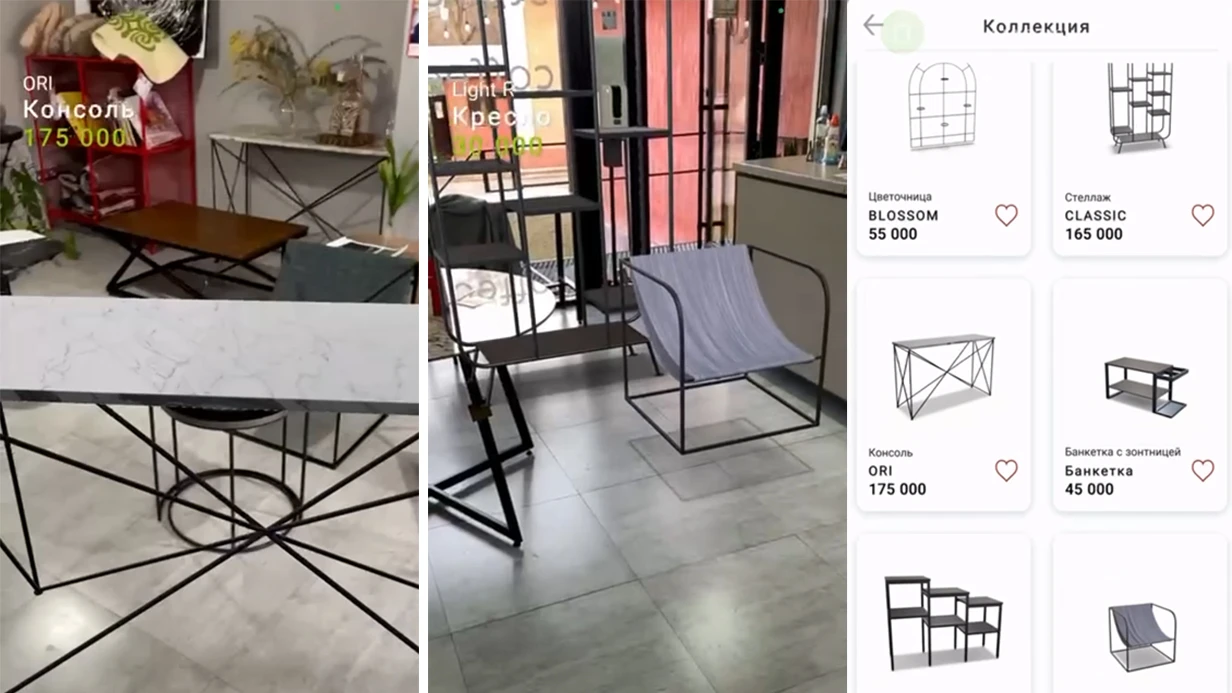
Visualizing mirrors in an interior removes this barrier. The buyer opens the camera, points it at a wall in their room, and sees how a specific mirror will look in that spot — at real scale, with their lighting and furniture. They can move and position the product, compare shapes, and make a decision in a couple of minutes.
For you, this means growth in online mirror sales without discounts or persuasion. The customer stops hesitating, returns items less often, and is more willing to buy several pieces at once. And those who previously didn't buy due to uncertainty turn into paying customers.
We'll teach you how to implement such visualization in your store and help you overcome the main objection — "I can't imagine how this will look in my home."
What you get from AR product visualization
A buyer can't "try on" a mirror against their wall: on the website they see a photo, but they can't assess the scale, the color, or how it will fit into the interior. That's why many postpone the purchase or order blindly and then return the item.
AR visualization removes this tension: the buyer opens their smartphone camera, points it at the wall — and sees the mirror in their room.
For an online store, this isn't a "gimmick" but a tool that works on key metrics:
- Conversion growth. When a buyer sees a product in their own interior, it's easier for them to decide. In the case of major furniture catalogs (like IKEA Place), such scenarios increase the share of purchases made without consultation.
- Fewer returns. The mirror is shown at real scale, so the buyer can't go wrong with either size or style. This reduces the percentage of returns and complaints.
- Higher average order value. An AR scenario allows showing the mirror together with a vanity cabinet, lamp, or adjacent products from your catalog — as a complete solution. The customer adds more items to the cart.
- Greater loyalty. The shopper remembers the store where they could "try on" a product, returns for the next purchase, and recommends you to friends.
We create such scenarios turnkey: from choosing the format to embedding it into your website or app. Your team doesn't need developers — the visualization works through a link in the browser or inside your catalog.
Check which products will benefit most from AR, and we'll prepare a demo in just a few days.
AR mirror visualization formats for business needs
The visualization format should match the point of contact with the customer: a storefront, website, or personal consultation each has a different task.
To avoid overpaying for unnecessary functionality and losing customers halfway through, it's worth deciding in advance which scenario you're covering. Below is a comparison of the three main formats we use in projects for mirror manufacturers and showrooms.
| Format | Who it's for | What it gives the customer |
|---|---|---|
| AR storefront format | Shopping malls, showrooms, exhibitions | Attracts attention, shows the mirror at real scale, increases time at the display and the number of photos shared on social media |
| Interactive catalog | Salon websites, marketplaces, offline catalogs | The buyer changes the model, color, and finish, sees the mirror in their room, and makes a decision faster |
| Personal AR app | Chains of showrooms, brands with a wide product range | Collects preferences, helps the consultant select an option for the interior, and brings the customer back to the brand |
Each format shortens the path from "interesting" to "I want to buy" in its own way.
The storefront creates impulse and works for reach, the interactive catalog removes doubts about compatibility, and the personal app turns a one-time purchase into a dialogue with the brand.
We help you choose a format that fits your task, audience, and sales channel. If you need to quickly show a collection on the sales floor — we set up a storefront. If the main point of contact is your website — we enhance the catalog with an AR feature.
If working with repeat customers matters most — we develop an app. In any case, you get a tool that pays for itself through higher conversion and customer loyalty.
How the project goes: from brief to launch
When you order AR visualization of mirrors in an interior, the main question is how the process will go and when you'll see the result. We've built a transparent workflow: you control every stage, know the deadlines in advance, and get no surprises at the finish.
- Brief and task definition. You tell us which mirrors need to be shown, in which interiors, and for which audience. We ask guiding questions to package your idea into a clear assignment for the team.
- Technical specification and project approval. We lock in usage scenarios, the feature list, visual references, and acceptance criteria. You see the budget and timeline, and the team gets a clear work plan.
- Prototype and style approval. Using one or two mirrors as examples, we show how the visualization will look: the interface, response to user actions, and alignment with your brand.
- AR scene development. We build a complete solution: mirror model selection, material swapping, lighting, and the ability to compare interior variants. You receive a working product, not abstract mockups.
- Testing and refinement. We check performance on different devices so the app runs stably and without lag for your customers. At this stage, we make final adjustments based on your feedback.
- Launch and support. We hand over the finished solution, instructions for your staff, and stay in touch. If questions come up, we help quickly — without lengthy approvals.
This sequence is especially important for mirror projects: incorrectly configured visualization can distort reflections and spoil the customer's impression of the product.
That's why we complete each stage of AR development with an intermediate result — you see progress and fine-tune details in time.
In the end, you get not "raw" development but a proven tool that helps sell mirrors and increase audience loyalty. And more importantly, the process runs smoothly, with clear deadlines and a predictable result.
What's included in the AR app delivery
When you order the development of an AR app for mirror visualization, you receive not just a program but a complete AR delivery package — everything you need for launch and day-to-day operation.
We've put together a solution your employees will start using from day one, and your customers will appreciate live.
The package includes the product itself, documentation, and training — so you won't have to figure anything out on your own or hire contractors after the project is handed over.
The final delivery includes:
- AR app for mirror visualization — works on tablets and smartphones, letting visitors "try on" a mirror in their own interior and immediately see how it fits into the room;
- customization for your catalog: we upload your mirror models, shapes, frames, and materials so customers see exactly the assortment you have on sale;
- app documentation: simple instructions for installation, launch, and updates — no complex technical manuals, everything is written for ordinary employees;
- staff training: we hold a session with your managers and consultants, walk through typical work scenarios, and answer questions — after that, they confidently use the app on their own;
- technical support for the launch period: we help configure equipment, set up the demonstration before your first customers arrive, and promptly resolve any issues;
- source materials and access to updates — you remain the owner of the solution and can develop it as your assortment grows.
Thanks to this package, you launch visualization in days, not months. Staff quickly master the tool, customers see mirrors in their interior before buying — this reduces doubt and speeds up the purchase decision.
All documentation and training are built on real scenarios from your business, so you won't have to figure things out yourself or pay for refinements we've already accounted for in the delivery.
Case study: AR catalog for a mirror showroom
The client — a mirror showroom called Mirror House. Buyers chose from photos on the website but often backed out at the last step: they couldn't understand how a model would fit into an interior.
Each staff member spent 20–30 minutes on messaging and phone calls to explain dimensions, and a portion of carts was still abandoned. Losses from returns and unclaimed orders reached a fifth of revenue.
We proposed an AR catalog: through the smartphone camera, a visitor "places" the selected mirror on their wall, moves it around the room, and checks how it matches the furniture and lighting. No apps to install — everything works right on the showroom's website.
Integration took two weeks: we uploaded the models, populated the catalog, and trained the managers.
Numbers from the first month
Conversion to order grew by 34%, the average order value rose by 18%, and returns dropped by 21%. Buyers stopped being afraid of making a mistake with size and shape because they saw the mirror in a real setting before paying.
Average time on the catalog page grew to three minutes — people aren't flipping through product cards, they're "trying on" products like in a showroom.
A month later, the showroom ordered an extension of the AR catalog to the entire collection and connected visualization for consultations on social media.
The repeat request was the best confirmation: the tool paid for itself and brought in sales that previously got lost at the stage of doubt.
How to choose the AR visualization format for your mirrors?
Choosing an AR visualization format for your mirrors starts not with technology but with the task. What do you want to achieve: show the customer how the mirror will fit into a finished interior? Give them the ability to try different frames and colors? Or amaze visitors in the showroom? The format selection and project budget depend on the answer.
For a small collection or a flagship product, a lightweight AR solution that launches via a link or QR code is enough. That's a quick start with minimal investment — a sense of presence without complex development.
This format is convenient for social media, ad banners, and initial customer acquaintance with the product.
If you have dozens of models and customers need to compare them with each other, an interactive storefront is a better fit: shape, color, frame material, and surroundings change right on the screen.
It works in the browser without installing an app — an important criterion for online sales. The buyer sees the mirror in their room, imagines it in the interior, and makes a decision faster.
For an offline showroom, a separate option is a large AR mirror in front of which the buyer "tries on" frames in real time. It holds attention and creates a wow effect, which directly increases visit time and the number of purchases. Here the selection criteria are floor space and expected visitor traffic.
So, how do you choose the right AR solution for your task? Determine where the visualization will be seen: on the website, on social media, or at a retail location. Assess the number of models and the required level of interactivity.
We'll help you select the visualization format — we'll propose 2–3 scenarios within your budget, test them with real users, and implement the one that measurably increases conversion to order.
Common client doubts before starting
Before an AR project starts, clients ask the same questions: will the deadlines slip, will the solution work on visitors' devices, and how will it fit into current processes. We answer the main concerns — without technical details, only what affects your results.
What guarantees do you provide on the app?
We fix the requirements, scope of work, and deadlines in the contract. After launch, we provide a guarantee on the core functionality, as well as free bug fixes for an agreed period. If something goes wrong — we fix it at our own expense.
Will the app work on our customers' devices?
Yes, we develop the AR solution for the major platforms and test it on different smartphone and tablet models. Your visitors won't need to buy special equipment — a modern device that almost everyone already has is enough.
How long does development take?
Timelines depend on the task: a month for a simple AR mask, two to three for a full-featured catalog with visualization. After the brief, we give realistic dates, break the project into stages with checkpoints, and show intermediate results so you can see progress.
Does the solution integrate with our CRM, website, or catalog?
Of course. We embed the AR module into your existing system — website, mobile app, or accounting system. All analytics on sessions, popular models, and conversion is passed to your internal tools, so the data stays with you.
If your question wasn't covered — ask it before we start. We'll have a short consultation, show examples of similar projects, and honestly tell you what's feasible in your case.Get an AR visualization cost estimate
To order AR visualization for mirrors, you don't need to understand technical details. Just leave a request — we'll get in touch, clarify your tasks, and propose the optimal solution.
We provide the cost estimate for AR visualization quickly — usually within one business day.
This isn't an impersonal commercial proposal but a working-out of your specific situation: the type of mirrors, audience, and platform where the visualization will be used. We'll account for all the nuances so you get a tool that genuinely helps sell and impress customers.
How we arrive at the numbers
- You leave a request on the website — provide your contact details and briefly describe the project.
- A specialist contacts you within one business day to discuss the goals and demo format.
- We prepare a preliminary solution: implementation options, timeline, and scope of work.
- We finalize the agreements and send the cost estimate for AR visualization.
- After approval, we begin development — you receive intermediate results and make adjustments.
- We launch the project, train your team, and stay in touch after the handover.
Bonuses after your inquiry
- Consultation with an AR visualization specialist — we answer your questions in detail and help you decide on the format.
- Preliminary cost estimate — you understand the budget before work even starts.
- A solution tailored to your task: mobile app, web version, or a tablet demo in the showroom.
- Examples of completed mirror and interior visualization projects — see the result before you invest.
- Recommendations on content preparation: which photos and 3D models you'll need so everything goes quickly.
- A ready-made technical specification for your team or contractors if you decide to do it yourself.
Leave a request for an AR cost estimate — it takes a couple of minutes, and the time and budget you save on mistakes will go a long way. We'll explain exactly how AR mirror visualization will fit into your business process and start delivering value from day one.