





Clients leave without buying when they can't try out flooring in context
A flooring buyer rarely makes a decision on the first visit. They look at a sample in the store or a photo in the catalog, but they cannot see how that laminate, parquet, or tile will look in their own room—with their own lighting, in their own space, next to their own furniture.
An inner question arises: “What if it doesn’t work?” As a result, the person puts off the purchase or goes to a competitor where they were shown not an abstract sample but their own floor.
The seller loses not only the specific deal but also reputation: a customer who ordered “by eye” often becomes disappointed and asks for a refund. An interactive catalog with augmented reality solves this problem.
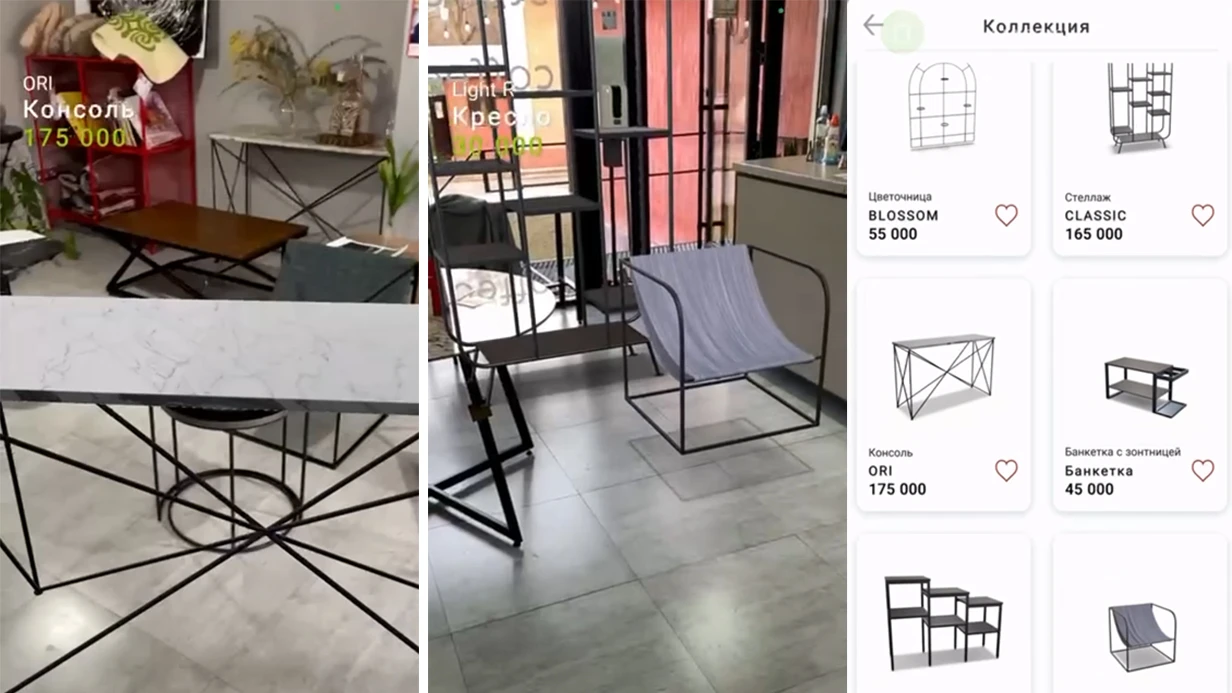
The buyer points their smartphone camera at the floor, and the flooring is applied to the surface in real time, taking perspective and texture into account.
They can examine the joints, estimate how it fits the interior, and choose from dozens of options—the interior visualization takes a couple of minutes, and confidence in the purchase grows many times over.
This is especially important for online sales, where the buyer cannot touch the material with their hands.
Wehave been developing AR tools for sales for more than 10 years and know how to turn product try-on into a revenue driver. Implementing such a solution increases online sales conversion, reduces the number of returns, and makes the catalog truly interactive.
That is why our client gets not just technology but a working sales channel: we support the project from task analysis to launch and help integrate try-on into the store’s or online platform’s current processes.
This is exactly how we solve the pain of the customer who cannot imagine the flooring at home, and the pain of the seller who loses profit because of that.
What AR try-on gives you: higher conversion and customer loyalty
A flooring buyer almost always hesitates: how will the chosen color and texture look in their interior under real lighting? Photos on the website and samples in the showroom do not provide an answer—the person mentally “completes” the picture and often gets it wrong. The result is a postponed decision, a visit to another store, or a return after installation.
AR try-on removes this doubt: the client sees the flooring in their own room, moves the camera, changes the angle and lighting. The doubt disappears—the decision is made here and now.
Practice shows that where such try-on works, conversion grows many times over because the main objection, “I’m not sure how it will look,” disappears.
Loyalty is the second benefit. A buyer who is confident in their choice returns for future purchases and recommends the store to friends. They feel that the business cares about them rather than simply selling.
Augmented reality turns a routine purchase into a positive experience—this works for brand reputation.
Returns deserve special attention. When flooring has been installed and does not match expectations, it is a loss of money, time, and nerves for all sides. AR try-on significantly reduces the share of returns: the buyer sees the result in advance instead of relying on luck.
For business, this is direct savings and margin protection. According to estimates in construction retail, implementing AR reduces returns by up to 30%—and that means dozens of saved orders every month.
Wedevelop AR try-on for flooring using professional equipment and proven tools. The client receives not a “demo version” but a working tool that integrates into a website or application and starts generating leads immediately.
At the same time, the technology stays in the background—your conversion, customer loyalty, and peace of mind for every order come first.
AR flooring try-on formats for business
Every business solves the task of choosing flooring in its own way: one needs quick try-on in the sales hall, another needs a tool for an online catalog, and a third needs a visual demonstration at the client’s site.
That is why we offer several formats of AR flooring try-on—you get the option that matches your sales model rather than a universal “box.”
The main principle is that the client sees the final result before purchasing. This removes the main objection, “how will this look at my place,” and shortens the time needed to make a decision.
The formats are easily adapted to your product range, area, and type of retail outlet—from a compact showroom to a large construction hypermarket.
| Format | Who it is for | What it gives the client |
|---|---|---|
| AR showroom display | Stores with samples and exhibition stands | A visitor sees the flooring in real scale in an interior without taking up a consultant’s time |
| Catalog with try-on | Online stores and brand websites | A buyer uploads a photo of their room and immediately evaluates which color and texture will suit it |
| Mobile application | Construction markets, showrooms, on-site consultations | A specialist shows the result directly at the site, which speeds up the choice and closing the deal |
You can combine formats: for example, an AR showroom display for an offline location and a catalog with try-on for your website. This way you cover both purchase scenarios—the spontaneous choice in the store and the considered decision from home.
As a result, trust in the product grows, and clients return products less often due to mismatched expectations.
How the project goes: from brief to launching AR try-on
We have structured the process so that you understand what happens at each stage and when you will receive the finished AR try-on for flooring. All key approval points are set as separate steps—you control the project, and we are responsible for the result.
- Brief and goals. You tell us about your flooring collections and use cases. We agree on deadlines, budget, and acceptance criteria.
- Preparing materials. We convert samples and catalogs into digital form—color, texture, and pattern match the real flooring.
- Mockup approval. We show you the screens of the future AR try-on: flooring selection, camera launch, and a card with the price. We make corrections before development.
- Creating a prototype. We build a working version: you point the camera at the floor and see the flooring. We test it on various devices.
- Testing. We work through scenarios under different lighting and on different surfaces, and make sure the interface is clear to buyers. We fix any issues.
- Launch. We deploy the application or web version and connect it to your website or social media. We train your team and hand over instructions.
- Support. We monitor stability, add new collections, and update the assortment. You can contact us at any time.
The result: instead of an abstract “we will develop an application,” you get a working sales tool with clear implementation stages and approval points. Usually the project takes 3–4 weeks—we provide the exact timeline after the brief.
What is included in the delivery: a complete package for your sales team
After development is completed, you receive not just an application but a complete package for your sales team: employees start showing collections in augmented reality on the very first day.
No involvement of IT specialists or lengthy setup is required—everything is prepared and tested before handover.
What is included in the delivery:
- A ready AR catalog of flooring — collections are uploaded, marked up, and verified: open a tablet, point at the floor, show the client. No additional preparation is needed.
- Instructions for staff — step-by-step scenarios for managers: how to launch the try-on, select a collection for a request, and save the result for the client so they can return to it later.
- Employee training — we conduct in-person or online sessions with your team and review real situations from the sales floor. Staff confidently works with the tool without technical training.
- Integration with your processes — connection to price lists, estimates, and catalogs: the buyer sees the price and SKU right in the try-on, and the manager does not need to switch between systems.
- Administrator rights — your responsible employee independently adds new collections, changes prices, and updates content without contacting developers.
- Support package — technical support and content improvements after launch: we respond to feedback from your sales team and improve the tool.
The project delivery closes the main risk: “the tool exists, but employees do not use it.” Clear instructions and training lead to results: every manager shows the try-on to the buyer rather than merely talking about it. Everything needed for work is already on the tablet or laptop you use for demonstrations.
Real case: online sales growth after implementing AR try-on
Showing catalog flooring in static photos means losing the client at the most important stage: they see the color but cannot imagine how it will look in their interior.
AR try-on solves this problem: the buyer “places” the laminate or tile they like directly on the floor of their room through the smartphone camera.
We implemented such a tool for one flooring manufacturer, and the result exceeded expectations. Here are the numbers we obtained two months after launch.
Sales growth and buyer behavior
Within 60 days after launching AR try-on, the share of orders from mobile devices grew by 40%, and the average order value increased by 18%. Most importantly, the number of returns decreased: people stopped making mistakes with color and texture because they were choosing “live.”
Alexey, head of e-commerce at the client: “Clients write that they are no longer afraid to order online. Before, they used to go to the showroom to see samples, and now they send us AR screenshots—how the flooring looks in their hallway or living room.”
Client feedback and repeat orders
The tool became a growth point: six months later, the client returned to us with a task to scale the try-on to the entire catalog—another 200 SKUs. For us, this is the main indicator that the solution paid off and is working for the business.
If you want to get the same result, let’s discuss your product and calculate the potential effect of AR try-on.
Frequently asked questions about implementing AR try-on
To understand the value of AR try-on, a client only needs a couple of questions: how much does it cost, how quickly will it work, and how difficult will it be to integrate into the current website. Decisions are most often postponed because of uncertainty—not because of real technical problems.
Below we discuss the most common objections we encounter in meetings with flooring store owners. Briefly, to the point, and without getting into technical details.
How much does AR try-on implementation cost and what does the price depend on?
The cost depends on the size of the catalog, the number of SKUs, and the complexity of the visualization: perspective fitting, work with color and texture, and adaptation for mobile devices.
We do not state a price range on the website without details—during the first brief, we calculate your assortment and provide a precise commercial proposal. Setup, test launch, and support are already included in the price.
How long does implementation take?
A typical project takes 2–3 weeks: during this time we connect the try-on to your catalog, adapt it to your brand, and run tests on real devices.
If the catalog is large, the timeline may increase by a few days. But from the very beginning you see intermediate results rather than receiving a “black box” at the end of the project.
Will the try-on work with our current assortment?
Yes, that is exactly why the setup is created: we upload your photos and descriptions, bring the flooring to a unified visualization standard, and publish it on your website within a couple of days after the initial setup.
It is important that you have high-quality images in high resolution. If you do not, we will help sort and adapt the available materials so that the client sees realistic color and texture on their own walls and floor.
Is it difficult to integrate AR try-on with my website?
Technically, it is a simple task: we prepare a module that connects to your platform without rebuilding the site. You do not need to change the design or move the catalog—everything works on top of your current structure.
We only need access to the admin panel and the product list. After that, we set everything up ourselves, and you receive a ready section and short instructions for managers.
What if the flooring looks different on the screen from real life?
We specifically configure the rendering so that the image matches the real color and texture as closely as possible. If the client still has doubts, we show classic photos and recommendation tips next to the try-on.
For your team, we provide a short checklist with typical buyer questions and answers. This reduces the load on sales staff and speeds up decision-making.
Do not hesitate to ask about any detail—we will reply by email or messenger within one business day. And if you want to see how it works on your own catalog, just write to us: we will make a demo in 2–3 days, and then you can decide for yourself.Let’s discuss your task—launch AR try-on in 2 weeks
In just two weeks, your clients will be able to “try on” flooring directly in their interior by pointing their smartphone camera at the floor.
While competitors are going through long approvals and months of development, you get a ready-made tool that increases conversion and reduces returns caused by mismatched expectations.
We have streamlined the process so that standard tasks take no more than 14 days: brief, solution selection, implementation, integration, and launch.
During a consultation, we will discuss your task, show similar projects, and immediately give you the cost—without hidden extras or complicated estimates. After placing an order, you receive:
- Launch in 14 days — we fix the deadline in the contract and make it in time for an important event or the start of the season.
- Consultation and cost calculation — before the work starts, you know exactly the budget and the result.
- A test version for your team — you check the usability before the official publication.
- Placement on your website or in your application — clients use the try-on without installing new software.
- Training for your managers — they can show the try-on to clients even in the showroom.
- Technical support after launch — we quickly resolve any issues while you focus on sales.
To order AR try-on for flooring, leave a request on the website or call us. We will call you back within one business day, clarify the details, calculate the cost, and offer a launch in just two weeks. Missing the moment means giving your clients to those who decided first. Let’s discuss your project now.
How to choose the AR try-on format for your task?
The AR try-on format is determined not by the “beauty of the picture” but by the specific business task: where the client interacts with the product and what should happen after that interaction.
A flooring showroom, an online store, and an exhibition stand need different solutions, and the selection criterion is always the same—the buyer’s path from interest to decision.
If a buyer comes to the showroom and chooses laminate or tile from a catalog, a stationary AR zone with a large screen is optimal. It projects the flooring onto the floor of a real room in seconds, allowing the guest to “try on” several options without holding samples.
This format speeds up the dialogue with the consultant and shortens the selection time, which means it increases foot traffic and the average order value.
For a website or social media, mobile AR try-on works better: the client points their smartphone camera at their own floor and sees how the flooring looks in their apartment.
This removes the main objection, “I don’t know how it will fit the interior,” and pushes them toward a request or a sample order. The format is especially effective for marketplaces and stores with delivery, where it is not possible to visit a showroom.
The third scenario is an exhibition, a new product presentation, or a showroom opening. An immersive installation works here: the guest sees themselves and the space in different flooring options, takes photos, and shares them on social media. This creates reach and brand awareness that continue to work long after the event.
The key selection criterion is what result you want to achieve: sales at the point of sale, leads from online, or a media effect. For each goal, we choose a format that uses the buyer’s habitual behavior and requires no training.
The main thing is not to chase the “most advanced” solution. If your audience is retail buyers, they need simplicity and speed. If partners and designers are your audience, then detail and the ability to compare options matter more.
A properly chosen format pays off in the first month: fewer returns, higher purchase conversion, more repeat inquiries.
If you are unsure which option suits your business, you can take a short survey on our website—after a brief meeting, we will propose 2–3 formats for your task. One of them can almost always be launched in test mode to measure the return.
This way you get a solution that works for your result, not just technology for the sake of technology.