



How the absence of AR try-on for plumbing fixtures hurts your sales
A plumbing fixture buyer almost always follows the same scenario: they see a faucet, bathtub, or shower enclosure in a catalog, but can't picture how it will look in their own bathroom.
Doubt creeps in — "what if it doesn't fit in size, color, or style?" And this doubt becomes the main reason for a postponed purchase: the person closes the tab, goes away "to think," and usually comes back to competitors who already know how to show products in context.
The absence of AR try-on in a plumbing fixture online store translates into concrete numbers: low conversion, abandoned carts, long sales cycles. Customers are forced to mentally complete the picture, and that works against you.
Even high-quality photos and videos don't solve the problem — they show the product in a perfect studio interior that has nothing to do with the buyer's actual bathroom. Trust in the purchase is never built.
This is especially painful on expensive items — bathtubs, shower enclosures, designer faucets. The higher the price tag, the greater the risk of doubt and hesitation at the point of choice.
A buyer isn't ready to risk a large sum on "a pig in a poke." They need confidence that the product will blend naturally into the interior, match in scale, and not look out of place. Without product visualization, that confidence cannot be provided.
Meanwhile, buyers are already used to modern stores helping them "try on" a product before purchase. Furniture, clothing, eyewear, even cars have used augmented reality for a long time. Plumbing fixtures are no exception — it's just that few offer it yet.
If your plumbing store avoids this tool, you're silently handing the market to those who give the buyer visibility and control.
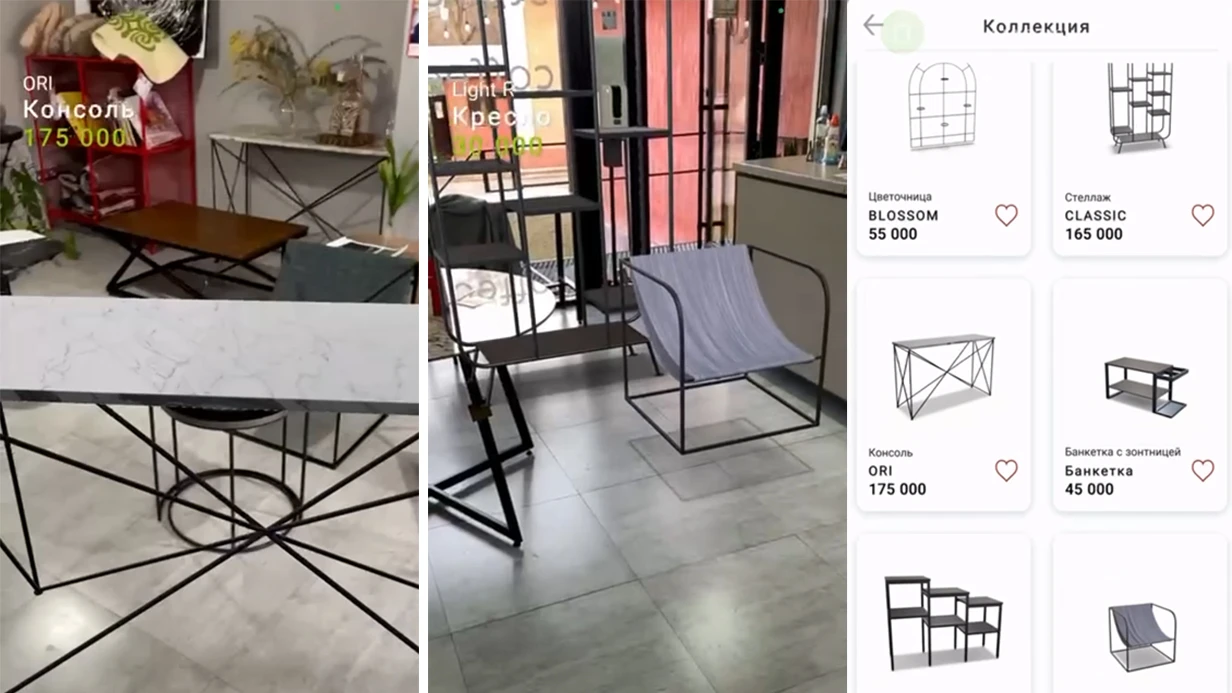
We fill this need: we develop AR try-on for your product range and integrate it into your store. The buyer points their smartphone camera at the floor and sees how the selected bathtub or toilet will fit in their room — with accurate scale and color.
This removes objections, accelerates decisions, and directly increases conversion. Plumbing sales stop depending on the client's imagination — you give them a tangible reason to buy from you.
What you get by implementing AR try-on for plumbing fixtures
Implementing AR try-on for plumbing fixtures isn't a trendy feature — it's a tool that directly impacts key business metrics. Below are five measurable results you get after launch.
- Higher conversion. Buyers see how a faucet or bathtub looks in their actual bathroom before purchasing. No need to mentally imagine sizes and colors — uncertainty disappears, decisions are made faster, and orders are placed more often.
- Fewer returns. One of the main reasons for returning plumbing fixtures is "it didn't match expectations": color, scale, style. AR try-on shows the product at 1:1 scale in the client's interior, so mistakes are ruled out. You spend less on logistics and return handling.
- Higher average order value. When buyers see how many items work together in their interior, they're less likely to limit themselves to a single product. AR try-on encourages ordering a set — faucet, shower panel, accessories. The result: more items in the cart.
- Customer loyalty. A service that saves time and stress is remembered. The buyer doesn't just make a purchase — they gain confidence in their choice. Customers return for new products and recommend the store to friends, which is cheaper than acquiring new customers.
- Brand recognition. An AR try-on feature is a reason to talk about you: customers share photos of "how it looks at my place" on social media, and the brand gets free reach. People talk about this kind of technology, they write about it — and they remember your store in particular.
To illustrate: in a project for Santek, implementing AR try-on increased conversion in the faucet section and cut returns for "wrong size" reasons in half. This isn't a one-time effect, but systematic growth that continues after launch.
Each of the benefits listed is measurable and achieved within the first month of operation. You get not just technology, but a clear business tool with a predictable result.
AR try-on formats: how to choose the right one for your needs
Plumbing fixtures have a specific trait: the customer isn't buying a valve or faucet — they're buying a finished bathroom look. While the product sits on a shelf, it's hard to imagine whether it will fit the interior. AR try-on removes this barrier — and there are three formats for different needs.
We select the format based on your task and budget: online try-on on your website, a mobile app, or an AR mirror in the showroom. Each option solves its own business task — from higher conversion to fewer returns.
| Format | Who it's for | What it gives the customer |
|---|---|---|
| Online try-on on the website | Online stores and plumbing catalogs | The buyer sees the product in their bathroom before ordering — fewer doubts and returns |
| Mobile app | Brands with a wide product range and loyalty program | The client "places" a faucet on a sink anywhere; engagement and repeat orders grow |
| AR mirror in the showroom | Retail showrooms and exhibition halls | The visitor changes the bathroom design on screen, the consultant upsells finishes and lighting, the average check rises |
The choice of format depends on your main point of contact. If customers reach you via phone — you need online try-on; if they visit the showroom — an AR mirror will pay for itself through the average check; if you need an ongoing connection with the customer — a mobile app. Tell us how your customers find you — we'll recommend a format and calculate the effect.
How the project proceeds: from brief to launch
To make plumbing AR try-on actually drive sales rather than being just a trendy feature, you need a clear process. We've broken development into seven stages — at each one, you see the result and understand what's happening. No "black boxes" and no surprises.
-
Brief and objectives. We start by diving into your business: what's in the product range, who the customer is, and where the app will be used — in the showroom, at an exhibition, or on the website. We pin down the goals: more time at the display, higher conversion, fewer returns. As a result, you get a document with objectives and success criteria.
-
Prototype. We build an interactive layout of the future app: how a user chooses a bathtub, toilet, or faucet, how they point the camera and see the object in real space. This is a fast, inexpensive way to test the logic. You approve it before design and development begin.
-
Design. We create a visual style for your brand: clear icons, buttons, product cards, and size visualization. You can immediately see how the app will look in the customer's hands and how it fits the showroom interior.
-
Development. Programmers build the AR functionality using professional equipment and proven tools. We connect your catalog so prices, SKUs, and descriptions are pulled automatically. You don't waste time on manual updates.
-
Testing. We test the app on different smartphones and in different lighting conditions — from a bright showroom to the dim lighting of an exhibition. We fix anything that could get in the customer's way: freezes, misaligned model overlay, unreadable text.
-
Launch. We publish the app, configure access for showroom staff or clients, and provide a short instruction. You get a working tool, not a "raw" build. We help with initial launches if needed.
-
Support. We stay in touch after launch: we update the catalog, add new items, and help with questions. This matters because the product range changes, and the app needs to stay current.
As a result, you get a predictable project with clear timelines and no surprises. Each stage ends with an intermediate result that you can see and approve. This is how AR try-on becomes part of your service, not a "black box."
What's included in the delivery of an AR app for bathroom interiors
You get not a "presentation prototype," but a working tool that your team can develop and populate without constant involvement from developers. We hand over a complete package — from source code to staff training.
That means after launch, you're not dependent on a particular vendor, and you can change content for new collections or promotions.
Here's what's included in the delivery of AR try-on for plumbing fixtures:
- App source code — you become the full owner of the product. The code is placed in your repository and written to industry standards, so any team can work with it.
- Admin panel for content management — an intuitive interface through which your marketer or manager can add new plumbing models, change photos, prices, descriptions, and promotional banners. No need to message a developer to put a new bathtub on the virtual shelf.
- Technical documentation — architecture overview, deployment and update instructions. Your CTO or a future contractor can get up to speed quickly without lengthy onboarding.
- Administrator instructions — a step-by-step guide to the admin panel: how to upload a 3D model, set sizes, and link SKUs to the catalog. The training is designed so even an employee without a technical background can figure it out.
- Training for your team — we hold 2-3 online sessions with those who'll work with the system: we demonstrate real scenarios, answer questions, and provide lesson recordings for new hires.
- Launch-stage support — for the first month after handover, we're on call to help upload content, fix issues, and adapt the app to your internal processes.
This complete package addresses every client's biggest fear: "what if the developer disappears?" — you get the product, documentation, and trained people. Everything you need for independent operation within a month of project delivery.
Case study: how AR try-on increased sales by 30%
A plumbing buyer rarely imagines how a faucet or sink will look in their particular bathroom. They see the product on display but can't "try it on" against their own space — hence the doubts, postponed decisions, and returns after installation.
The managers of the retail chain AquaMarket came to us with exactly this request: they needed to lower the barrier to purchase and increase customer confidence.
We developed in-store AR try-on for them: the buyer points their smartphone camera at a wall or floor and sees the selected fixture at real scale. They can compare models, look at finishes and colors, and understand how everything will look in their interior.
The try-on takes a couple of minutes and works right on the sales floor — no complicated setups or stands.
The numbers speak for themselves
In the first few months, more than five thousand customers used the AR try-on. Conversion in the chain's stores rose by 30%, and returns fell by 20% — people stopped making mistakes with size and design.
The chain also noticed a rise in average order value: in augmented reality, the fixtures looked more convincing, and customers more often chose premium models.
Today AquaMarket is scaling the solution to all locations and preparing an online try-on for the website — so customers can "try on" a product before visiting the store.
It's a clear example of technology working not for show, but toward concrete business metrics: sales, average order value, and returns.
Frequently asked questions about implementing AR try-on
Integrating AR try-on feels intimidating because of the unknown: it seems expensive, complicated, and likely to require restructuring business processes.
In practice, it's simpler: we work with the equipment your customers already have and integrate into your existing website or app without replacing your accounting or management systems.
Here are the questions we're asked most often before a project starts.
Is it difficult to integrate AR try-on into an existing online store?
No. We connect the module to your website or mobile app using ready-made code — this usually takes a few days. You don't need to change your catalog, cart, or checkout processes.
Integration happens at the product display level: a "Try it on" button is added, after which the buyer points their smartphone camera at the installation spot and sees how the faucet, bathtub, or shower enclosure will look.
How much does AR try-on development cost and what does the price depend on?
The cost depends on the number of models, the complexity of the fixtures (angles, curves, materials), and where the tool will be used — on the website, in an app, or in an offline store.
We usually start with a set of 10-15 models to test the hypothesis and measure conversion growth. After the pilot, you decide whether to scale the solution to the full catalog.
Do we need to buy special equipment?
No. All the buyer needs is a smartphone or tablet with a camera — not necessarily the latest generation. The tool works through a browser or a lightweight app, so no additional software installation is required. That means virtually every visitor to your site becomes a potential user.
When will AR try-on pay off for the business?
Payback is directly tied to returns and confidence at the point of choice. When a buyer sees fixtures in their real interior, they make fewer mistakes with size and style — so the share of returns drops and the number of completed orders rises.
On average, with a 5-10% increase in conversion, the project pays for itself within 1-2 sales seasons.
Do you have questions about integration or the scope of work? Tell us how your catalog is organized — we'll advise on the best starting point and how long the first stage will take.Let's discuss your AR try-on project?
Leave a request — and we'll show you on your own products how AR try-on shortens the customer journey from "just looking" to "buying." You'll get not abstract promises, but a concrete plan: an analysis of your plumbing product line, an AR try-on prototype, and a cost calculation tailored to your budget.
We work in stages — so you see results right at the start and understand what you're paying for.
- Request and consultation. You describe the task; we clarify how your plumbing fixtures are currently sold and where you lose customers — in the showroom, catalog, or on the website.
- Cost calculation. Immediately after the brief, we provide a budget range and timeline — no hidden fees or "surprises" mid-project.
- Prototype on your products. We load 2-3 of your models into an interactive try-on and show what it will look like for the buyer — before full development begins.
- Turnkey development. We build a solution that works on showroom tablets, on customers' smartphones, and in the website catalog.
- Launch and support. We implement, train your managers, and stay in touch after handover — refining things if we see room for improvement.
As a result, you get:
- Touchpoint analysis — where exactly the plumbing buyer stumbles and how AR try-on removes that obstacle.
- A working prototype — within days, not months, so you can evaluate the value on your own models.
- An implementation plan — a step-by-step action list, including integration with your website and staff preparation.
- A payback calculation — how many additional orders the try-on will bring and when it will pay for itself.
- A quality guarantee — we fix timelines and outcomes in the contract, so you take on no risk.
Let's start with a short conversation — 15 minutes to understand whether AR try-on is right for you and which first steps will deliver fast results. Just leave a request, and we'll prepare a cost estimate and a proposal tailored to your task.
How to choose the AR try-on format for your needs?
Choosing an AR try-on format depends on the specific business task: attracting new customers, increasing conversion for your plumbing catalog, or reducing returns caused by choosing the wrong model.
The easiest way is to compare formats using three criteria — launch budget, audience reach, and integration complexity with your sales system.
| Format | Budget | Reach | Integration complexity | When to choose |
|---|---|---|---|---|
| Web AR via link | Low | Maximum — any smartphone, no installation | Minimal — link, QR code, website | You need fast reach and a broad start |
| AR in a mobile app | Medium | Limited to your app's user base | Medium — catalog updates within the app | You already have an app and a customer base |
| Interactive kiosk in the showroom | High | Local — visitors to a specific location | High — equipment and scenario setup | Emotion and live service matter most |
Web AR offers maximum reach and the fastest start: the customer doesn't need to download anything, and you get a working link for your site, email campaigns, and advertising.
For a plumbing catalog, that's enough for the customer to picture the product in their interior and make a confident decision.
If you already have a mobile app, we embed the try-on directly into it — this increases catalog engagement and the average order value.
For an offline showroom, an interactive kiosk is a better fit: it holds attention, is memorable, and helps the salesperson consult more visually.
Not sure which format will pay off? We launch a pilot on one product category and show conversion-to-purchase within a couple of weeks. Based on those numbers, you decide whether to scale or adjust — without unnecessary investment or downtime.