



Car Demonstrations: How to Turn a Look into a Deal?
A buyer can spend hours studying photos and videos but still not commit to a purchase. They can't picture how the car will fit into their life: whether it fits in the garage, how it looks in the chosen color, whether it's comfortable to walk around.
Traditional test drives take time, and for rare models or made-to-order vehicles, there simply is no physical car available — the buyer leaves still undecided and often chooses a competitor.
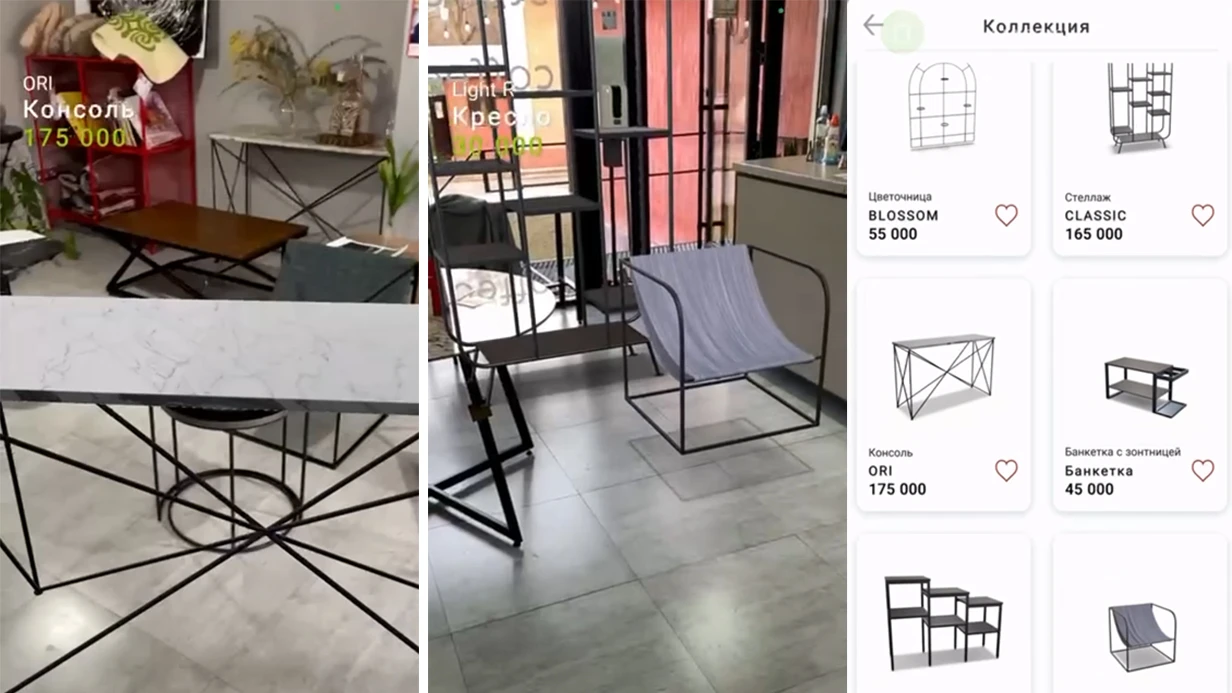
This is where an AR car presentation helps. Using a mobile app, the customer places the car at real scale right on the lot in front of the dealership, in their driveway, or in an office parking lot.
They change the body color and wheels, open the doors and trunk, look inside the cabin — all in real time, without waiting for a physical vehicle. An interactive catalog turns specifications into a tangible image that the buyer "tries on" for their life.
For the sales department, this means greater efficiency: fewer doubts from the customer, fewer repeat visits "just to take another look." An AR demonstration works like a personal consultant that is always at hand.
The buyer controls the exploration process themselves, while the manager focuses on what matters most — handling objections and closing the deal.
We've applied this approach in projects for car dealers. When a buyer sees a vehicle at realistic scale in their own context, it's easier for them to make a decision. By our estimates, conversion from viewing to inquiry grows by one and a half to two times. Development takes a few weeks and pays for itself through faster sales.
What an AR Presentation Brings to Your Business
A buyer chooses a car not with their eyes, but with their emotions. When a new model needs to be showcased, dealers run into limitations: the showroom has only a couple of trim levels available, and bringing a car to an event means logistics costs and lost time.
An AR presentation removes these barriers: on a smartphone screen, the car appears in a real setting — by a home, at an office, or right at an exhibition, in any color and with the desired options.
For business, this means increased sales above all. The customer doesn't just look at an image — they "place" the car in their life, see it in motion, open the doors, change the interior and wheels.
This level of engagement shortens the decision-making cycle and addresses objections even before a showroom visit. Dealers who use AR in demonstrations report a noticeable rise in test drives and inquiries — the customer arrives already ready to buy.
A separate area of savings is logistics and exhibition floor space. You no longer need to transport cars between venues, pay for delivery, or worry about the safety of exhibits.
One digital model replaces an entire fleet for demonstrations: all trim levels and options are available in a single app. This is especially important for premium brands, where every physical car at an event represents a significant cost.
AR also enhances the company's image. An interactive presentation attracts attention even from those who weren't planning to buy right now: people come over, try it, record videos, and share them with friends.
This gives you free social media reach and a reputation as a tech-forward brand that keeps pace with the times. As a result, AR solves three tasks at once: it increases conversion, cuts costs, and sets you apart from competitors.
We help implement such a presentation turnkey — from creating a realistic model to launching an app for your managers and clients. You get a tool that sells and strengthens your brand every day, without the need to drive vehicles around the city.
AR Formats for Prospective Buyers: From the Showroom to the Home
Where to Show the Car
Buyers don't have time to visit dealership after dealership, and managers don't have an hour to talk about each model. An AR demonstration brings the car to where the customer is comfortable: on a tablet in the showroom, on the dealer's website, or in a social media feed. The same digital car works across three sales scenarios — and always speaks the buyer's language.
| Format | Where It Works | What It Gives the Customer |
|---|---|---|
| AR in the showroom | Manager's tablet or smartphone | The buyer sees the car at real size right in the showroom, changes the color and trim with a couple of taps — no more arguing with the salesperson over "this car isn't the right shade of blue" |
| AR on the website | Model page on the dealer's website | The visitor "places" the car in their own driveway right from a button on the site, without leaving the page — time on site grows, inquiries come in from home |
| AR for social media | Feed, stories, targeted advertising | A short AR car clip shows the vehicle in motion and from the right angle — reach grows through shares, not advertising spend |
Showroom, Website, or Feed — What to Choose
Car dealers usually start with AR in the showroom: it's the easiest to implement and the effect is visible immediately — buyers spend three times longer with the car. Once the mechanics are refined, the same app covers the website and social media.
If sales happen mostly online — we start with AR on the website. A buyer from another city "takes" the car over to their own parking lot without spending a weekend on the road.
We add social media as a third channel: short AR clips are cheaper than classic video advertising, while attention retention is higher.
In any scenario, data about buyer interests is collected automatically: which color they looked at, which trim they changed, how long they studied the model.
The sales department sees these signals — so the next call starts not with a cold "would you like to take a look?" but with a concrete offer for that very car.
How an AR App Project Unfolds
An AR app project for demonstrating cars to prospective buyers starts not with code, but with your goals. We analyze how sales happen today, where the buyer loses interest, and how augmented reality can show the car even before a test drive.
We structure every stage of AR development so you understand what's happening in any given week and when you'll receive the finished product.
- Brief and analysis — we discuss which models need to be shown, which scenarios matter for your managers, and what should set the app apart from competitors. We lock in the AR project timeline and scope of work right away.
- Prototype and scenario — we create an interactive flow: how the buyer points the camera, walks around the car, changes the color and trim. You approve the logic before the main development begins — this saves time and money.
- Design and 3D models — we prepare the app's visual style and detailed vehicle models. They look just like the cars in the showroom, so the buyer immediately sees your level of quality.
- Development and configuration — we build the app and adapt it to the devices your staff uses. You receive a working prototype and try it on real tablets and smartphones.
- Project approval — you go through all the scenarios together with us and make edits to texts, colors, and button behavior. Only after your "yes" does the app move to the final stage.
- Launch and support — we publish the version, train your sales team, and connect viewing analytics. We stay in touch to add new models and update content.
The average project timeline starts at two weeks for a basic version. The exact time depends on the number of models and scenario complexity, but it is fixed at the start and doesn't change along the way. That way you know exactly when the app will start working for your sales.
What's Included in an AR Solution for Car Showcasing
When you order an AR solution for car showcasing, the delivery includes not just an app file, but a complete toolkit for your sales department. You get a tool that managers can use the very next day after handover.
-
Ready-to-use AR app — the buyer points their smartphone camera at a lot or a promotional brochure and sees the car at real size: they can walk around it, explore the interior and options.
-
Setup for your fleet — we include up to 20 models with the desired colors, wheels, and options; trim changes are made on request without lengthy rework.
-
Instructions and training — short cheat sheets for staff and a hands-on workshop for managers so they can confidently run demonstrations for customers.
-
App support — 12 months of updates, compatibility with current operating system versions, and fast issue resolution. The app runs stably even during peak sales days.
-
Analytics for every presentation — how many sessions were launched, which models were viewed the longest, at which step the customer stopped. This data helps refine the demonstration flow.
-
Branded link and publication — a short link for QR codes, stickers, and email campaigns; the customer opens the AR showcase without installing any additional software.
This is the standard AR delivery package — the scope can be expanded to fit your dealership's formats if needed.
The main thing you get is confidence: on the day of a new model's presentation, everything will work, and the buyer will see the car before it even arrives at the showroom.
Case Study: Inquiry Growth After Implementing an AR Show Window
One of our clients — a premium brand dealership — faced a typical problem: visitors spent a long time looking at the car and asking the manager questions, but never booked a test drive. There was interest, but it never turned into real contact. We analyzed the customer journey and proposed a solution — an interactive AR show window.
Instead of static displays and paper brochures, the visitor gets a live interactive experience: a tablet shows the car at real size, the body color can be changed, doors can be opened, and the interior can be examined in detail.
On the technical side, we used ARKit — this allowed the project to run on standard iPads without purchasing expensive equipment. Managers don't need special training: the interface is intuitive.
Results after the first month: 240 showroom visitors used the AR show window. Of those, 87 left their contact details and booked a test drive — a 36% conversion rate. For comparison: previously, conversion from paper forms was 12%.
In other words, we achieved a threefold increase in inquiries without increasing the advertising budget.
Two months later, the dealer ordered a second show window — this time for the entire model lineup. Managers began spending less time explaining options, and buyers arrive at test drives already familiar with the car. This shortened the deal cycle and increased brand loyalty.
How to Choose an AR Format for Your Task?
Choosing an AR format starts not with technology, but with a question: what should the buyer do when they see your car? If you want them to explore the vehicle in detail from a catalog — that's one solution.
If you want them to picture the car at full scale in their driveway or parking lot — that's another.
There are two basic types of AR for car demonstration tasks. The first is when the smartphone camera brings a picture on a brochure page or business card to life.
This works well for a compact presentation: the buyer points the camera at a logo or photo and sees a 3D model of the car that they can rotate. The second is when AR places the car in real space without tying it to an image.
This option works in the showroom, at an exhibition, or outdoors: the customer literally walks around the car, looks into the cabin, changes the body color with a single gesture.
For a simple task — bringing a promotional brochure or catalog to life — the first format works well. It's lightweight for the user, requires no special training, and runs on any modern smartphone.
For a task where you need to impress and deliver a "sense of presence," the second format is more powerful. It's the one that most often leads to repeat visits and test drives.
The choice also depends on where the buyer will encounter the AR. If someone is flipping through a brochure in a quiet setting — simple page recognition is enough.
If they're standing on a lot choosing between several models — placement in real space is needed so they can compare dimensions and design.
We help you decide on the format before development begins. We analyze the scenario, the buyer profile, and the point of contact, then pick the option that delivers maximum results for your sales funnel.
In the end, you get not just technology, but a tool that shortens the customer's path from "interesting" to "I want to buy."
Common Concerns: What If the App Fails for the Customer?
The client worries the app will let them down at the most critical moment — and that thought can affect the purchasing decision. We have been working for many years and know that stability isn't luck — it's a system that can be guaranteed.
We build it from three components: testing on real devices, gentle handling of phone resources, and fast support after launch. That's why 98% of demonstrations in our projects run without a hitch, and the remaining 2% are situations we identify and fix within one business day.
What if the app won't launch on the buyer's phone?
We test the app on the most common device models and operating system versions. If a customer has a rare device, a built-in fallback mode kicks in: it continues the car presentation even without augmented reality. You'll never be left with a black screen in front of a customer.
How do you guarantee stability during a live demonstration?
We build in a safety margin and include an offline mode — the app works even with poor internet in an exhibition hall or parking lot. Before the event, you receive a simple checklist: 5 minutes of checks, and you know for certain everything is ready for the presentation.
What happens if something goes wrong after launch?
We don't disappear after handing over the project. Commercial launches include a support period: for the first month, a dedicated engineer is available, responding within two hours and connecting to your device remotely. Most issues are resolved on the first call — without rescheduling a meeting with your customer.
In short: you get not just an app, but a predictable demonstration process you won't be embarrassed to show a customer. And if something does go wrong — there's a team right there that resolves the issue while you're still talking to the client.Order an AR Demonstration for Your Sales
An AR demonstration turns an ordinary car showcase into a live experience the buyer remembers and wants to repeat on a test drive.
You give the customer the ability to "place" the car in their own space, examine details, colors, and options — without a showroom window, without waiting, and without extra questions.
By ordering development from us, you get not just an app, but a tool that works for your sales every day.
We handle the entire journey — from idea to launch and support. You work with a team that has already delivered dozens of projects for the automotive industry and knows how to turn technology into a scenario the buyer understands.
You don't need to understand development — we'll prepare a solution for your task, integrate it into your managers' workflow, and show you how to use the AR demonstration to increase conversion.
After placing your order, you receive:
- An analysis of your sales process and AR usage scenario: where exactly the demonstration will deliver the most value — in the showroom, at an exhibition, or on the website.
- An app prototype with your car that you can show within your team and approve in a couple of days.
- Design and development of a mobile app for iOS and Android, preserving your brand's visual identity.
- Interactive configuration: color changes, interior viewing, door opening — everything needed to get acquainted with the car.
- Testing and launch in app stores — we handle all publishing and moderation processes.
- Training for managers and sales staff on using the app, so they use it confidently and as part of the customer conversation.
- Support and growth: updates, new models, usage analytics — the app lives and evolves together with your business.
Leave a request for a consultation — we'll show you how an AR demonstration fits into your sales process and propose a solution tailored to your budget and timeline.
Fill out the form, and we'll get back to you within one business day to answer your questions and prepare a launch plan.