



Navigation and Product Search in a Shopping Mall: Business Benefits
Shopping mall visitors often get lost: they can't find the store they need on the first try, and wayfinding signs don't help. Visitors waste time, get frustrated, and leave without buying anything — a direct loss of customers and revenue for the landlord.
The larger the complex, the more acute the problem: even regular guests don't always remember where the brand they want is located.
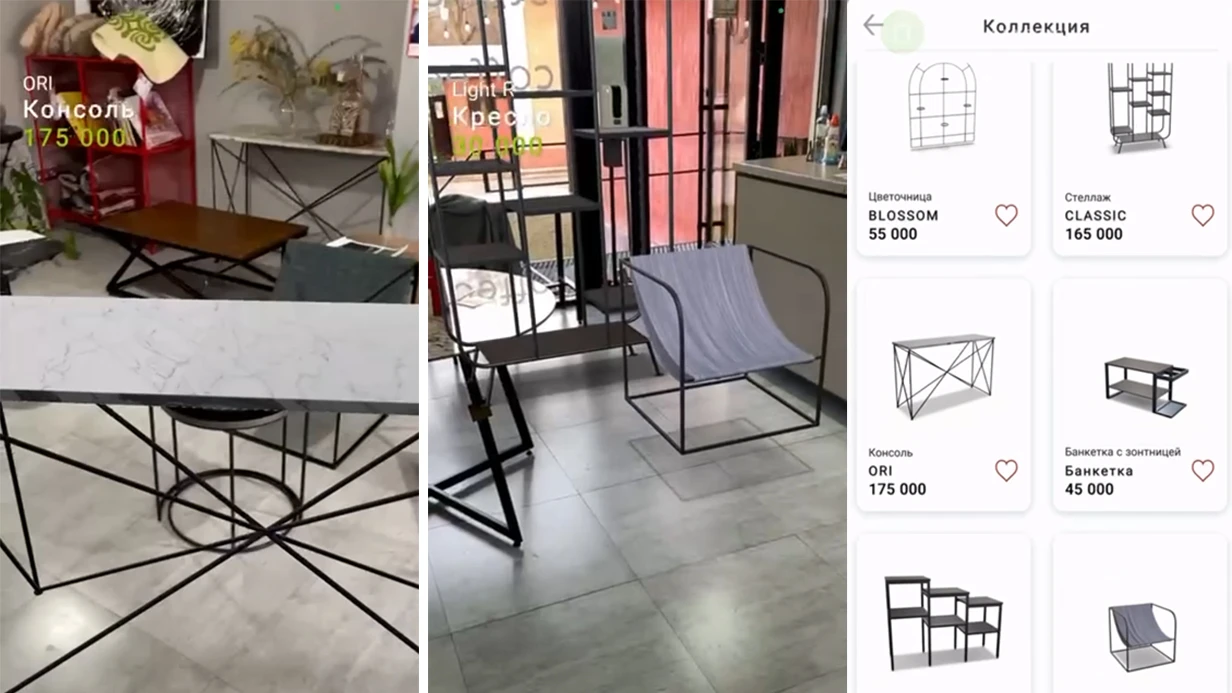
An augmented reality mobile app turns a visitor's smartphone into a personal guide. Just point the camera at the space, and arrows show the way to the desired store or product, while hints about promotions and special offers appear on the screen.
This way, navigation and product search in a shopping mall stop being a "needle in a haystack" task and become a fast, clear experience.
For the owner or management company, this means higher visitor retention: people spend more time in the complex and return more often. Every completed purchase lifts tenant sales and therefore the property's profitability.
Mall mobile apps are not a fashion trend but a working tool for improving loyalty and competitiveness.
We've been creating AR solutions for business for over 10 years and know how to turn technology into measurable results.
We'll help you design and launch an app that solves navigation and product search for your specific mall format — without unnecessary technical complexity and with a clear path to return on investment.
What Results You Get from an AR App
Imagine a trip to the mall turning from a routine "home — store — checkout" route into an engaging journey with bonuses. That's exactly what an AR app delivers: our team develops such solutions with the specific mall's objectives in mind. As a result, you get not just navigation but a tool that works to grow key metrics.
Here are the results our clients expect after launch:
-
Longer time spent in the mall. Shoppers follow a visual route, discover new stores, and stop at promotions. The longer a guest stays in the mall, the higher the chance of impulse purchases — this directly affects tenant revenue.
-
Higher sales and average ticket size. Along the way, the system shows promotions from nearby stores and products often bought together. Shoppers see a special offer on the screen and go somewhere they hadn't planned. AR turns a single-item errand into a full shopping trip with a bigger basket.
-
Greater customer loyalty. The app remembers favorite stores, personal discounts, and visit history. Guests feel the mall cares about them — and come back deliberately, not by chance. This drives repeat visits and a steady audience.
-
Mall brand awareness. AR navigation is itself an innovative, eye-catching experience. Guests capture the interaction, share it on social media, and tell their friends.
The mall gets free advertising and becomes a modern leisure destination in local residents' eyes, not just "a place to buy groceries."
-
Useful analytics for the management company. You see which zones and stores are popular, where shoppers linger, and which routes sit idle. This data helps plan tenants, promotions, and layout changes without expensive surveys or counters.
In addition, the app can be extended with event mechanics — quests, giveaways, holiday augmented reality. This again boosts footfall and gives even those who didn't plan to buy a reason to visit the mall.
We refine every scenario for your audience: from simple routes to game formats. You get a proven working tool, not an "app for the sake of technology." We're ready to discuss your mall's goals.
Implementation Options for Different Scenarios
The choice of format depends on the scenario: whether you need permanent navigation for all mall visitors, a one-time campaign, or a phased launch.
We select the option that fits your task and audience, so you don't overpay for unnecessary development while still reaching enough visitors through a convenient interface.
Three Formats — One Result
| Format | When to choose | What the business gets |
|---|---|---|
| Native AR app | Permanent mall navigation, product search, loyalty program | Guests quickly find the right store, fewer abandoned carts, repeat visits |
| Web AR (via browser) | Promotions, events, one-time navigation without installation | Reach in 1-2 clicks, low entry barrier, good for promo |
| Hybrid solution | Testing scenarios, then deepening into a full app | Collect interest data, convert one-time visitors into regular users |
A native app delivers maximum accuracy and speed: it works with an offline map and doesn't depend on an overloaded mall Wi-Fi network. Web AR is a convenient starting point — a guest scans a QR code at the entrance and immediately sees the route to a product.
The hybrid option combines both approaches: an easy browser entry and advanced scenarios in the mobile app.
We use proven tools and professional SDKs — for example, ARKit for iOS devices — to ensure stable navigation performance on most smartphones. All solutions are tailored to the mall's specific traffic and goals.
Whichever format you choose, we support the project from brief to launch: we configure scenarios, test them on real devices, and provide instructions for staff.
Development Stages for Your Mall App
Developing an AR navigation app for a shopping mall is not a "black box." We've structured the development process so that at every stage you understand what's happening, how long it takes, and what result you'll get. No surprise revisions or missed deadlines: all key decisions are made together upfront.
Below is a typical project cycle. It has been proven across dozens of commercial launches and adapts to your task: from a simple wayfinder to a full mall map with product search.
-
Brief and task audit. We meet or call to discuss goals: which zones to cover, how many visitors, what the anchor attractions are. We lock in success criteria, timelines, and technical constraints of the venue.
-
Concept and scenario. We work through user journeys: how a guest enters the app, searches for a product, and gets a route. We define key screens, navigation logic, and the points where a visitor might get distracted or lost.
-
Prototype and design. We build an interactive mockup of the future app. You see and "feel" the interface before development begins and make changes before the first line of code is written. This saves budget and time.
-
Development. We assemble the interface, visuals, and animations, and connect floor-plan navigation and tenant catalogue search. Analytics is configured at this stage too — you'll see how often the app is used and what queries people enter.
-
Testing. We check scenarios on real devices, measure location speed and route accuracy. We fix bugs before your visitors ever see the app.
-
Launch and support. We publish the app to the App Store, help with QR codes and promo materials. We stay in touch after launch: update floor plans, add new tenants, and refine features based on your requests.
This approach lets you launch on time and with a predictable budget. You always know where the project stands, what's ready, and what result you'll get at the finish line.
What's Included: The Full Package
We handle the entire journey — from idea to a working app that genuinely helps visitors find products and navigate the mall. You don't get "source files sent by email" but a finished product with post-launch support.
Here's the scope of work and what's included in the delivery:
- Analytics — we study visitor behavior, entry points, typical routes, and "bottlenecks" where people get lost. Based on this, we design navigation logic that shortens the path to the right department or display.
- Design concept — we craft an interface and 3D cues that any user understands without instructions. We factor in your brand style so the app looks like part of your space.
- App development — we build AR navigation with search by name, category, or display, showing the route directly over the camera view. Users don't need to read maps — they just follow the arrow.
- Testing on real devices — we verify performance under different lighting conditions, during peak hours, and in different zones of the mall. We achieve stable launch on most popular smartphones.
- App store publication — we prepare accounts, moderation, icon, screenshots, and description. The app appears in the App Store and Google Play under your brand.
- Staff training — we run a short session for administrators and consultants: how to answer visitor questions, where to update the product catalogue, and how to quickly resolve common issues.
- Technical support and updates — we stay in touch after release: fix bugs, update data, add new stores and promotions on request.
The list may look long, but each item solves a specific task. You're ordering a result, not a process: visitors find products faster, staff field fewer "where is this department?" questions, and the mall gains a modern service that sets it apart from competitors.
Case Study: How an AR App Increased Mall Sales by 25%
Shoppers in a large mall spend an average of up to 10 minutes finding the store they need — and often leave without ever finding it. That's a direct loss for landlords: footfall is there, but revenue isn't growing because the visitor never reaches the checkout.
The manager of the Galereya mall came to us with exactly this problem: they needed to keep guests inside the complex and lift tenant sales.
How It Works
We developed AR navigation inside a mobile app: a person points the camera at the space and sees directional arrows overlaid on reality. No flat maps where you have to decode the "you are here" marker — everything is visual and clear even for first-time visitors.
The route to the desired store shrinks dramatically, and the frustration of pointless walking disappears.
Results
In the first months after launch, average store-finding time dropped from 9 to 3 minutes, and the number of visitors leaving without a purchase fell by nearly a third.
Tenants reported higher revenue: the mall's total turnover grew by 25% — because people managed to visit more locations and far less often left empty-handed. These figures come from navigation data and cash register reports, not estimated surveys.
The numbers confirm the key point: the AR app paid for itself within a few months and gave tenants an additional reason to stay in the complex.
After the project wrapped, the owner of Galereya extended the partnership for the next season — we not only maintain the system but also add new scenarios: giveaways, special offers near the right department, and help finding a parking spot. This turns navigation from a support service into a tool for increasing the average ticket.
How to Choose the Right App Format for Your Task?
The app format should be chosen based on the mall's goals, not on how trendy the technology is. If visitors get lost in the corridors and can't quickly find a store or product, you need AR navigation with routes and display search.
If the goal is to keep guests longer, raise the average ticket, and engage them in a loyalty program, then the app should include AR quests, game mechanics, and special offers that come to life on the smartphone screen.
In the first case, the app is built around the building map and catalogue: the visitor picks a category or store name, sees an arrow over the live camera feed, and moves along the optimal route. This format is understandable from the first seconds and quickly builds loyalty to the mall itself.
In the second, scenarios are added for finding virtual clues, completing tasks, and earning bonuses; this requires more careful scenario design but delivers measurable growth in repeat visits.
The budget depends directly on three things: the number of floors and stores, the complexity of game scenarios, and the depth of integration with your infrastructure.
You don't have to launch a large-scale project at once — you can start with a basic version for one food court or one floor, test it with real visitors, and only then expand coverage. This way you see results early and make budget decisions based on facts, not assumptions.
Our experience shows that a phased approach works best for a shopping mall. First, we lock in the core scenario from "entrance to desired product," draw a prototype, and test it with a focus group; then we refine the interface and launch a pilot.
We work with professional equipment and proven tools, so stated timelines and stability are confirmed at the very first launch. We'll advise which format solves your specific task and help you stay within a sensible budget without unnecessary features.
Answers to Questions Before You Order
Before ordering AR navigation, many people have the same questions — about timelines, budget, technical security, and how the solution will fit into the mall's existing operations. Here are answers to the most common ones, so you can decide without guessing.
How long does development and launch take?
A basic version for one mall can be launched in 3–4 weeks, including map content and testing on real devices. If navigation needs to be linked to a bonus program, push notifications, or analytics, the timeline is 2–3 months — the exact plan is locked in at the brief stage.
How much does such an app cost?
The estimate is transparent and depends on the module set: you can start with a map and product search, then add promotions, events, and integration with the mall's app later. This keeps the entry point flexible for your budget.
Payback typically comes through higher tenant sales, savings on information kiosks, and increased visitor dwell time.
Will the app work on visitors' phones?
Yes — we use technologies supported by the majority of modern smartphones. Visitors don't need to download anything: navigation opens via a QR code in the browser or is embedded in the mall's existing app. No additional equipment is required for guests.
How secure is it, and will it work with our systems?
The app doesn't store visitors' personal data without their consent, and analytics is collected in anonymized form. On the server side, we work over secure protocols.
The solution integrates easily with your current mall infrastructure — from Wi-Fi and beacons to CRM and loyalty systems.
What happens after launch?
We provide full instructions for administrators, train staff, and offer a warranty on the app's operation. At every stage — from brief to post-release support — a dedicated manager works with you. If refinements are needed, we make changes according to an agreed procedure.
If you didn't find your question here, just contact us — we'll share details for your specific task and prepare a preliminary plan and budget.Shall We Discuss Your Project? Submit a Request
Submit a request on the page and we'll get back to you within one business day to discuss the project, answer your questions, and prepare a cost estimate for your tasks.
We'll show you how AR navigation and product search solve a specific mall problem: fewer lost visitors, more time inside the retail space, higher repeat visits.
What you'll receive after contacting us:
- Personal consultation with an expert — we'll analyze your case, audience, and project goals, without template pitches.
- Cost and timeline estimate for your scale — from a single mall to a chain, with a transparent quote and no hidden fees.
- Implementation plan — which zones and AR scenarios will deliver the most impact in your space.
- Demo of capabilities on real examples — see how navigation works in similar shopping malls.
- Technical compatibility assessment — which smartphones most of your visitors use and how the app will run without modifications.
- Bonuses when signing the contract — free integration with your store map, a training video for staff, and recommendations for the marketing launch.
We don't start work until you see what you'll get and what it costs. You can ask any questions — about quality, guarantees, post-launch support — and get honest answers before making a decision.
Fill out the form below or send us a message — we'll pick the most convenient way to connect. We'll show you how AR navigation pays off in a shopping mall and prepare a proposal you can discuss with your colleagues.