



Training in equipment assembly and installation: why employees make mistakes
A briefing in a meeting room and actual installation on site are two different skills. An employee confidently recites the sequence of steps, but during their first independent assembly they mix up the order, pull the wrong fastener, or skip a unit check.
The reason is not inattention: paper diagrams and videos do not provide motor skills and do not show how a part behaves in your hands.
The cost of such a mistake is rarely limited to a single damaged unit. The deadline slips, reputation suffers in front of the client, and rework takes the time of an experienced mentor — the very person who is needed on another site.
The more complex the equipment and the more often the product line changes, the faster the instructions become outdated and the more expensive each new batch of employees becomes.
Classic personnel training runs into three limitations: a mentor cannot be next to everyone, a training stand wears out quickly, and production briefings have to be repeated with every rotation.
As a result, the skill is cemented through trial and error — directly on live equipment, where the cost of a trial is at its highest.
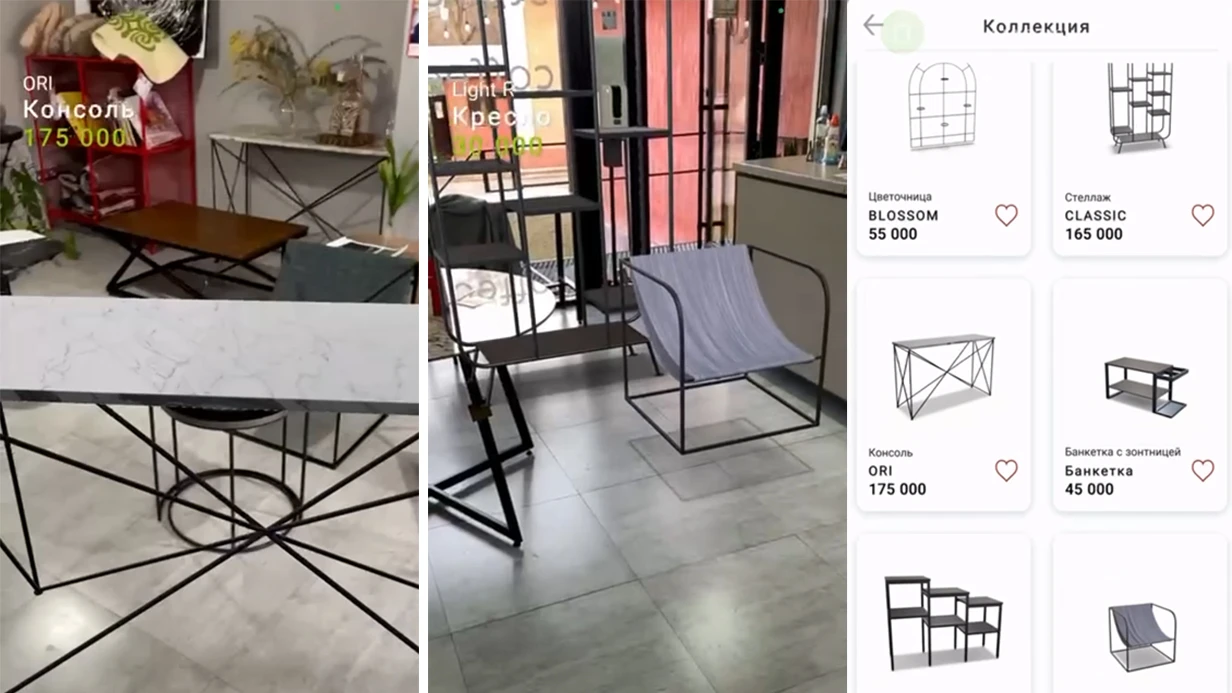
We solve this with a mobile augmented reality application: an employee points the camera at a real unit and sees a prompt right over the parts — what to take, where to place it, how to check it.
Installation errors are caught before a part goes into the wrong place, and training in equipment assembly and installation proceeds at the employee's own pace, without a mentor and without risk to the equipment.
What a business gets from AR training
A newcomer in manufacturing or service starts working independently not when they have read the instructions, but when they have confidently repeated the operation with their own hands.
AR training shortens this path: the employee sees prompts right on the equipment, in the real order of actions, and masters assembly and installation without lengthy mentoring.
The speed of onboarding increases many times over — a person joins a shift or a site visit noticeably earlier, and the mentor stops being a "babysitter" and returns to their own tasks.
Reducing defects is the second direct benefit. Prompts guide the user through the correct sequence and prevent skipping a step, mixing up fasteners, or getting the tightening torque wrong.
Errors that previously surfaced at incoming inspection or at the customer's site are caught at the moment of execution. For the business, this means fewer reworks, fewer returns, and less downtime due to a faulty unit.
A unified quality standard maintains itself: all employees — newcomers and experienced ones — work according to one proven procedure, not "the way they are used to." Updating the regulation instantly propagates to all devices, and no one is left on site with an old version of the instructions in their head.
Safety and savings on site visits come as a bonus. Dangerous or rare operations are practiced without risk to people or expensive equipment, and complex scenarios can be run right in the workshop or office without sending a crew to a site just for training.
There are fewer site visits, and their quality is higher, because the person arrives already prepared.
AR Application Formats for Your Task
The format determines not the "beauty" of the application, but which tasks of equipment assembly and installation training it solves.
One department needs a safe trainer where a mistake costs nothing, another needs a clear hint overlaid on the real installation, and a third needs quick assistance for a field engineer.
Below are four working scenarios that we most often implement; they can be combined in a single application.
What to Choose for Your Task
| Format | For Whom | What It Gives the Client |
|---|---|---|
| AR trainer | New employees, interns, training centers | Practice of assembly and installation without risk to expensive equipment; the mentor sees exactly where the person makes a mistake |
| Interactive instruction | Service engineers, installation crews on site | Step-by-step hints right on the part: fewer support requests and downtime, more consistent work quality across different shifts |
| Remote support | Field specialists, regional teams | An expert connects to the picture from the site and guides without traveling in person; complex cases are closed the same day |
| Emergency simulator | Experienced employees, operations service | Training of rare and dangerous scenarios without stopping real production |
The formats do not replace each other but cover different stages: first a person learns on the trainer, then works according to the interactive instruction, and in a non-standard situation receives a remote hint.
Such a set pays off through a shorter time to onboard into the role and fewer errors during installation.
We select the composition of formats for your industry, equipment fleet, and employee skill level. Describe your task — we will come back with an estimate and a plan for which scenario will deliver results fastest.
How a project works: from brief to launch
We structure the project so that at every stage you understand what is happening and why. Below is the path our clients take: from the first conversation about the task to a working solution in the hands of employees.
- Brief and task analysis. We discuss whom we are training, which unit or line the employee must master, and which mistakes are the most costly. The output is a clear picture: what we teach and by what signs we will know that the training has worked.
- Training plan and scenario. We assemble the sequence of actions, break the assembly down into steps, and think through hints and checkpoints. We coordinate with your engineers and instructional designers so that the scenario matches the real regulations.
- Approval and scope lock-in. You approve what will go into the first version and what we will postpone. This way you do not pay for anything unnecessary and know exactly what you will get as a result.
- Implementation. Our engineers build the application and fill it with your equipment and instructions. We show intermediate versions along the way — we make edits before they become expensive.
- Pilot launch. We give the solution to a small group of employees and watch how they go through the training. We collect feedback, remove unclear points, and check that a newcomer can manage without a mentor's hints.
- Launch and training your team. We deploy the application on work devices and show how to add new employees and update instructions. From there, you manage the process yourselves.
- Solution support. After launch, we stay in touch: we refine scenarios for new equipment, help with updates, and answer your team's questions.
What this gives you as a client
You see the result at every step, not only at the end. The pilot launch reduces risk: if the scenario needs edits, we catch this with a small group before the training goes out to the entire staff.
And support after AR implementation means that the solution lives and evolves together with your equipment, rather than becoming outdated a month later.
What is included in the delivery
The customer receives not a "application file", but a ready-to-use training tool that can be used from day one. Below is what is included in the delivery and why each item is needed by you, not by the developer.
- A ready-made application tailored to your tasks. It works on the smartphones and tablets that employees already have: an employee points the camera at the equipment and sees step-by-step guidance directly on the real unit — without a separate training stand and without traveling to the site.
- Training scenarios for assembly and installation. We build routes according to your regulations: the sequence of operations, typical errors, checkpoints. Scenarios can be expanded and modified for new equipment models.
- A guide for the mentor. A short practical document: how to start a session, how to analyze a trainee's mistakes, how to track progress. The mentor does not need to be a technical specialist.
- Training for your team. We conduct a session with mentors and responsible persons: we show how to lead a group, assign scenarios, and collect reporting. After that, you conduct the training on your own.
- A results monitoring dashboard. You can see who has completed the module, where they got stuck, and how many attempts it took. The department head understands the real level of qualification rather than relying on words.
- Warranty and support. A warranty period for the application's operation, assistance with updates and scenario edits. We answer the team's questions until the tool becomes familiar to them.
Separately, we transfer the rights to use and the source materials so that you do not depend on us in your day-to-day work. If you need to modify a scenario for a new equipment line, that is already a targeted task, not a project from scratch.
Case Study: How Training in Equipment Assembly and Installation Accelerated Newcomers' Ramp-Up
A manufacturer of industrial equipment comes to us with a typical pain point: a newcomer at a site assembles a unit "from memory," makes mistakes, and the mentor spends hours sorting out someone else's errors instead of doing their own work.
We proposed moving training in equipment assembly and installation into a mobile AR application: an employee points their phone camera at a real unit and sees step-by-step hints right on top of the parts.
What Changed After Implementation
Before launch, a newcomer's adaptation period to independent work took weeks, and the error rate on first assembly remained at a high level.
After training in equipment assembly and installation was moved to an AR format, newcomers reached independent work noticeably faster, and the number of installation errors dropped severalfold. Mentors got relief: instead of constant prompting, they step in only at complex stages.
A separate effect is predictability. Previously, quality depended on who exactly trained the shift. Now everyone goes through the same scenario, and the manager sees at which step newcomers stumble most often and can reinforce the instruction in a targeted way.
Why the Client Came Back
The project was done for a manufacturer of industrial equipment.
The first scenario covered one unit, but after the team saw the results of implementation on newcomer adaptation, we expanded the application to the entire product line and added a self-check mode for experienced employees.
A repeat order is the best indicator that AR training solves the task rather than just looking good in a presentation.
We work with professional equipment and well-tuned tools — the client gets a stable result on real sites, not a demo reel.
How to choose the right format for the task?
You should start not with choosing a technology, but with answering the question: what skill should the employee master, and how will you know they have mastered it.
If we are talking about training in equipment assembly and installation, the format is almost always determined by the nature of the operations.
Linear, repeatable actions — tightening fasteners, installing modules, connecting connectors — fit well into a step-by-step scenario with hints overlaid on real equipment. Complex cases, where sequence and diagnostics matter, require scenarios with branching and error analysis.
Specific requirements are not a reason to postpone. If you have non-standard equipment, rare regulations, or restricted production areas, we start with a short pilot on one unit or one operation.
The pilot shows how employees respond to hints, where they make mistakes, and what needs to be rewritten in the scenario. This is cheaper and faster than immediately building a full course for the entire equipment fleet.
Define three things before we take on the assessment: who will be learning (new hires, current employees, service engineers), on what equipment and in what conditions (workshop, field, training classroom), and by what criterion you will consider the training successful.
Both the scenario and whether object recognition on a real device is needed or an interactive model is sufficient depend on these answers.
If the budget is limited, a reasonable path is to start with one critical operation and expand the scenario as its value is confirmed. That way you get a working tool, not a long project with an unclear result. Describe the task — we will come back with an assessment and a plan, including a pilot option.
Common doubts before ordering
Doubts before ordering are usually the same: "what if the app stops working," "do we need to buy equipment," "what happens when a new version of the phone comes out." These are normal questions — they determine whether employee training pays off. Below are honest answers, without promises that "everything will be perfect."
What if the app breaks or freezes right during training?
We build in stability from day one: the assembly and installation scenario does not depend on the internet, and critical steps are duplicated with hints if the camera fails to recognize a part.
After launch, you get support — we handle requests, release fixes, and make sure training does not stall. If something breaks on the employee's device side, we help localize the cause rather than leaving you alone with the problem.
Do we need our own equipment and special devices?
No. Training runs on ordinary smartphones and tablets that employees already have — there is no need to buy separate headsets or stations. We tailor the scenario to what is actually in your device fleet, so you do not have to purchase additional hardware for the app. If later you want to extend training to other models, we will adapt the scenario.
What will happen to the app when new versions of phones and the system are released?
We support the project after launch: we track platform updates and release compatible versions on time so the app does not "fall off" on new devices.
Scenario updates — new units, a changed assembly order, different regulations — are also part of the work: you send edits, we add them to the app. This way training stays current instead of becoming outdated six months later.
How difficult is it to train employees to use the app?
The interface is designed for people without technical background: an employee points the camera at the equipment and sees step-by-step hints. Usually a short briefing is enough, and after that people learn on their own as they go.
We also provide clear materials for internal training so you can onboard new employees without our involvement.
If there are doubts that are not covered here, describe the task, and we will come back with an estimate and a plan: what is really needed and what can be left out.
Let's discuss your task and come back with a plan
Tell us who needs to be trained and in what: which units and operations employees are mastering, where they work — in manufacturing, service, or in the field — and how training currently happens.
That's enough for us to come back with a project estimate and a work plan, rather than generalities.
Training in equipment assembly and installation is a task where the cost of error is high, so we build verification against your team's real scenarios into the plan from the start.
From there we work like this: first we break down the task and define what result we consider achieved, then we prepare a plan and assemble a team for your project.
After that we launch a pilot with a limited group of employees — you see how people absorb the material, and only then do we decide on full rollout. This approach removes the main risk: investing in training that doesn't stick in day-to-day work.
What you get after submitting a request:
- A project estimate — timelines, scope of work, and team composition for your task.
- A work plan with stages: from process analysis to launch and handover.
- A pilot with a real group of employees with clear success criteria.
- A team that has already run training and immersive solution projects.
- Post-launch support: scenario updates and help when equipment changes.
- Transparent reporting: you see what stage the project is at and what's already been done.
Describe your task in the request — we'll come back with an estimate, a plan, and a pilot proposal.