





How Residential Renovation Planning Brings Clients Back
Clients starting a renovation are afraid of the unknown. They do not see what the result will look like, they doubt the timeline and budget, and they constantly change their minds.
Without visual renovation planning, every question turns into an argument, and every doubt becomes a reason to postpone the project or leave for a competitor who could show a picture.
When a company owner has no tool to “show and approve,” more than a single order is lost. The cost of a design project, materials, and approvals seems risky to the client. They compare offers and choose the one who speaks the language of images.
Those who work with static drawings and spreadsheets become hostages of endless revisions and lose the most solvent customers.
This is where AR for renovation helps. An app on a tablet or smartphone overlays the layout and finishing options onto the real room — before materials are purchased. The client sees their future apartment, walks through it, and selects colors and finishes in one click.
Visual clarity removes the main objections: “what will it look like,” “won’t we make mistakes in our calculations,” and “will we make the deadline.”
For the company, this is not just a nice demonstration but a working sales tool. The designer shows several scenarios — the client immediately sees the difference and makes a decision.
Fewer disputes, fewer refunds, and a higher average order value through add-ons: lighting, furniture, decor.
A repeat flow also appears: a person who saw the result before the renovation is happy to return for consultation, recommends you to friends, and comes back when deciding to do a second apartment or office.
We have been developing such solutions for more than 10 years for companies that want to bring clients back through service.
We gather requirements, design an interface for an inexperienced user, and implement the app so that salespeople and designers use it without training. The result: planning renovation work in residential spaces stops being a headache and becomes a company advantage.
What You Get from an AR App for Renovation
A meeting with a client often comes down to the same question: what will the result look like? Ordinary sketches and 3D images leave room for doubt, and doubt delays the decision.
The AR app shows the future apartment right on the smartphone screen — with furniture arrangement, wall colors, and material textures. The client sees their renovation before it begins, so they agree to the estimate and contract faster.
The benefit shows up at the approval stage. When the client understands in advance what they will get, the need for endless project revisions and conflict resolution disappears. Fewer reworks mean less wasted time and materials, and it becomes easier to start work on schedule.
You direct the freed-up hours to new projects rather than to repeated discussions of the same thing.
Trust is a separate result of this approach. When a client sees that you are willing to show the outcome before payment and before work begins, they perceive you as a partner rather than a contractor.
Such clients leave positive reviews, return for new projects, and bring acquaintances. Loyalty turns into a steady stream of orders without additional advertising spend.
Ultimately, the AR app works for the business at every stage: it attracts clients with visual clarity, saves time on approvals, and strengthens the company’s reputation.
You get a tool that increases the number of orders today and builds a base of clients ready to recommend you tomorrow.
AR App Formats for Your Task
Choosing an AR app format is not a question of technology but a question of exactly how you will make money. With augmented reality, you can show a client what their apartment will look like after renovation, even before work starts.
But a small design studio and a large developer need different solutions: different scale, different complexity, different tasks.
We compared the key AR app formats for renovation planning — from simple mobile apps to comprehensive VR/AR presentations. The table will help you orient yourself and choose the option for your business format. We will handle the technical implementation and support.
| Format | For whom | What it gives the client |
|---|---|---|
| Mobile AR app for showing the future renovation | Private designers, small renovation teams, interior studios | Fast project approval, fewer reworks, trust from the first meeting |
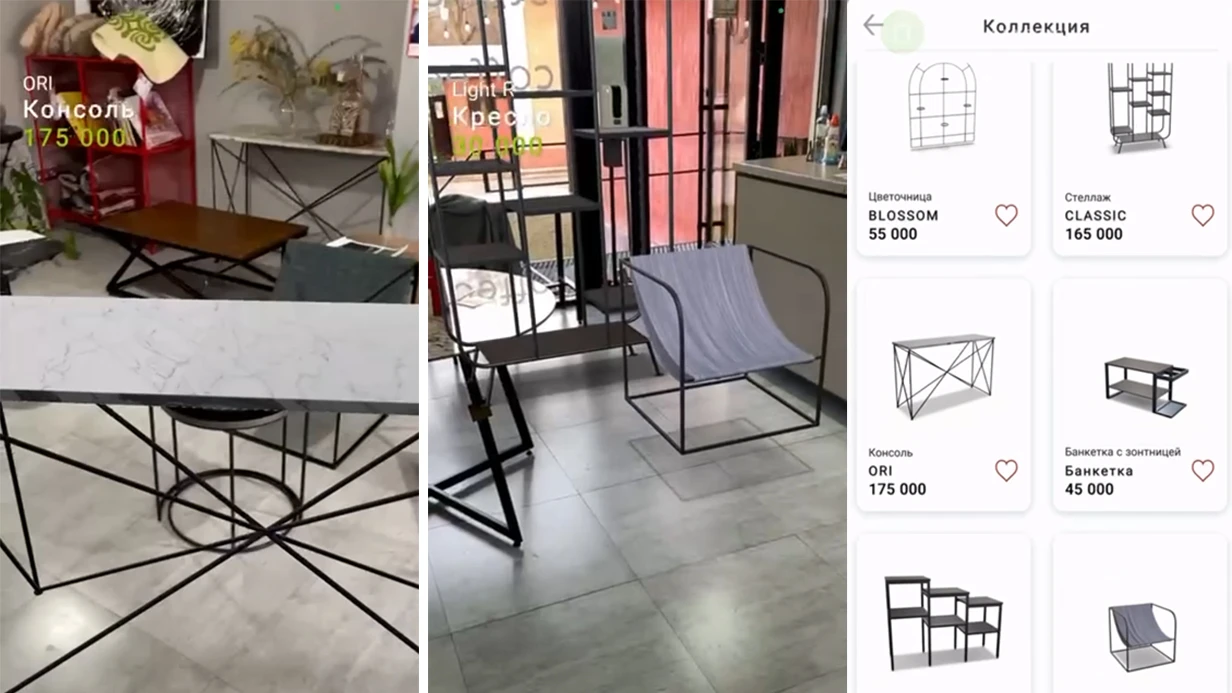
| AR catalog of materials, furniture, and finishes | Building material stores, furniture showrooms | The client chooses from your assortment right on site — average order value and repeat visits grow |
| Cross-platform AR solution | Companies with a large flow of clients and multiple branches | A single standard for all managers and locations, coverage of any client devices |
| Professional VR/AR presentation of a property | Developers, architectural bureaus, construction companies | Savings on physical models, visual presentation of the project to investors and buyers |
We adapt each format to your task: define the usage scenario, refine the interface and logic, and test it in real situations.
Thanks to professional equipment and proven development tools, you get a stable application without failures at the most important moment — a client presentation or an exhibition.
If you are not sure which format will pay off faster, start with a consultation. Tell us about your business and goals — we will choose a solution and show you how to turn AR into real order growth.
How an AR App Is Developed
We structure the work so that you can always see where the project stands and what happens next. No “black box”: each stage ends with a concrete result that you see and approve. Below is the path your AR app takes from the first brief to launch.
-
Brief and goals. We meet and discuss how the app will help your specific clients: show the future renovation before purchase, discuss the layout, and choose materials and furniture. We record goals and success criteria.
-
Plan and estimate. We determine the scope of work, deadlines, and team composition. You receive a transparent plan with dates and approval points before the start — without hidden stages or unexpected extra charges.
-
Prototype. We build a working mockup of scenarios: how the user points the camera, sees the layout change, and changes wall colors and textures. At this step, it is easy to adjust a feature while it is still “on paper” rather than in finished code.
-
Design concept. We develop a visual style for your brand: clear buttons, icons, and hints. You approve the look, which is then carried into the finished app — no surprises at the final stage.
-
Development. Programmers build the app according to the approved mockups. You receive intermediate builds and see progress live: test it at your site or in the office, and make edits along the way.
-
Testing and approval. We test the app on different smartphones and in different lighting conditions, and fix any defects. You confirm that everything works stably the way you need.
-
Launch and support. We publish the app, train your team, and hand over instructions for users. We remain available for updates and refinements after launch.
The entire process usually takes 6 to 12 weeks, depending on complexity. Payment is made in stages: you pay for the accepted result, not “for the whole project blindly.” This reduces risks and speeds up approval — you always understand what you are paying for and what you get.
What Is Included in an AR Solution Delivery
To ensure the AR solution brings real value rather than staying a pretty demonstration, we deliver the project turnkey. You get not just a program but a working tool that your employees will start using in the first days after implementation.
The full delivery scope includes:
- Ready-made application for smartphones and tablets — the surveyor goes out to the site immediately after installation, without complex setup.
- Source code and all rights to it — the product belongs to you, and you are not dependent on the developer as the project evolves.
- Clear documentation — instructions for the surveyor, foreman, and project manager, written without technical jargon.
- Employee training — we walk through a real scenario: “arrived, measured, showed the client the renovation plan,” and answer the team’s questions.
- Post-launch support — we support the implementation, fix issues, and refine features to fit your processes.
- Integration guide — a step-by-step plan for embedding AR into your current workflow, from request to client approval.
Every item has been proven on real projects for apartment and commercial space renovations, so the training is based not on theory but on the typical tasks of your specialists.
With this package, you quickly get the first result: fewer unnecessary site visits, clear plans for clients, and minimal disputes over the scope of work.
Support and documentation also address the client’s main fear — “what if a key employee leaves or we want to refine the solution.” Everything remains with you and works for your business.
Frequently Asked Questions About AR App Development
Renovation is always deadlines, budget, and dozens of decisions made “by eye.” When a client sees the future kitchen or plumbing layout before work begins, there are fewer disputes and more trust.
But before launching such a project, clients have the same questions: how long to wait, what it will cost, and what happens if something goes wrong.
We have gathered answers to the main concerns — without technical details, only what affects your process and result.
How long does it take to develop an AR app for layout planning?
On average, 4–8 weeks from brief to a ready-to-use prototype. The exact time depends on the number of rooms and scenarios: simply showing furniture arrangement is faster than calculating the area for painting or checking walkways.
At the start, we fix the timeline in the contract and show the stages so you understand what you will receive and when.
What does the cost depend on, and can I stay within budget?
The price is based on three things: the number of layouts, the complexity of the logic, and the amount of integration with your estimating system. We don’t sell “hot air”: we send an estimate with a stage-by-stage breakdown before work starts.
If the budget is limited, we suggest starting with a basic feature set and adding the rest after testing on real sites.
What guarantees are there that the app will work on different devices?
We test the project on current iPhone and Android smartphone models used by your clients. The contract includes a guarantee of stable operation for three months after launch — during that time, we fix any compatibility-related errors free of charge. After the guarantee period, you can choose a support package or continue working without one.
Can the app be connected to your order accounting system?
Yes. We integrate with your CRM or estimate calculation system — then parameters from the app are automatically transferred to the order. This speeds up client approval: the client changes the layout, and you immediately see the new cost and the list of materials.
If you don’t have your own system, we’ll offer a simple way to export data to Excel or Google Sheets.
We understand that the decision to develop is made once and affects all future projects. That is why on the first call we show examples of similar tasks and outline a test scenario on your real layouts. This way you will understand how it works, and we can give an accurate assessment of timelines and budget.Let’s Discuss Renovation Planning for Your Business
Renovation planning is a chaos of estimates, drawings, and verbal agreements. Any inaccuracy at this stage leads to rework, missed deadlines, and unhappy clients.
A mobile AR app lets you see the future renovation right in the room — choose materials, arrange furniture, and check lighting before work begins.
To understand which solution fits your business, leave a request. We will provide a consultation, evaluate your tasks, and propose a clear action plan. After the first conversation, you will receive:
- Consultation on AR use scenarios for renovation planning in your niche — from client demonstrations to contractor oversight.
- Preliminary development cost estimate tailored to your tasks and scope — without hidden conditions or “ranges.”
- Prototype of the future app — you will see how it works on a real example before the full development cycle starts.
- Clear estimate and roadmap with stages, deadlines, and responsibility for each block.
- Risk assessment and ways to mitigate risks — integrations with your current systems, employee training, and post-launch support.
- A plan for engaging your clients in the renovation planning process — how it will increase their loyalty and raise the average order value.
Leave a request for a consultation — and within the next few days you will receive a specific scenario, figures, and the first prototype. All that will be left is to make a decision.
How to Choose the Right AR Format for Your Task?
Choosing an AR format starts not with technology but with the task. If a client is renovating an apartment and wants to see in advance what the walls, floor, and furniture will look like, it is enough to point the smartphone camera at the room.
For residential renovation planning, this approach gives the clearest result: a person changes colors, materials, and furniture layout right on the screen, without an expensive 3D project.
Full immersion in a virtual environment makes sense when you need to show a finished interior as a whole — with furnishings, lighting, and atmosphere.
But for an ordinary task like “choose wallpaper or move a sofa,” virtual reality is overkill: it requires special equipment and time to learn, and the final goal is still a real room.
That is why mobile augmented reality is more often chosen for renovations: it is faster, easier to understand, and works on the client’s phone.
The third criterion is ease of access. A browser version is suitable for a one-time promotion or a catalog: nothing needs to be downloaded, the user opens a link and immediately sees the preview.
But when a renovation lasts several months, saved measurements, a history of options, and a list of materials become important. In a mobile app, this data is always at hand; it works without a stable internet connection and lets you return to the project at any time.
Also, pay attention to implementation speed: a ready-made solution based on modern AR algorithms launches in weeks, not months. We help you choose the format for your scenario — from quick try-on to comprehensive planning of renovation work in residential spaces.
As a result, your clients get a tool that saves time, reduces errors when ordering materials, and increases trust in the company.