




Virtual Real Estate Tours: How to Show a Property Without an In-Person Visit
A client who wants to buy or rent an apartment often lives in a different district, city, or even country. Organizing an in-person showing for every such person means time, travel expenses, and constant schedule coordination.
As a result, some interested buyers simply drop off before ever reaching the property, and the listing sits vacant longer than the owner would like.
Virtual tours for real estate solve this problem: a property can be shown online without waiting for a face-to-face meeting.
The buyer or renter walks through the apartment at their own convenience, evaluates the layout, lighting, views from the windows, and room sizes — right down to being able to "step into" each room as if they were physically standing on the threshold. This is not a set of photos but a full remote viewing experience.
For a real estate agent, this format works as a proactive approach. Instead of a dozen repetitive meetings with people who aren't ready to decide yet, you show the apartment selectively — to the most interested audience.
Meanwhile, an online showing can be used as a preliminary stage: first the person views the tour, then they arrive at the property already with a concrete desire to close the deal. This approach speeds up the sale and noticeably increases the percentage of successful meetings.
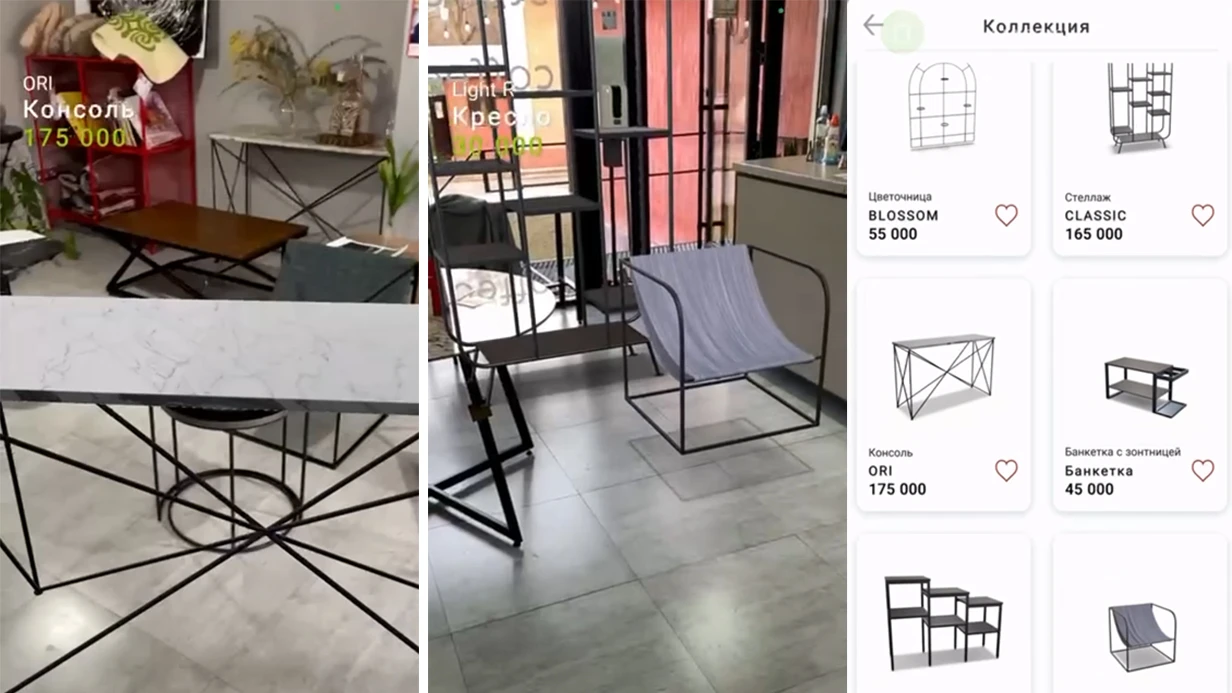
Additionally, we amplify the effect with AR for real estate agents — augmented reality allows you to "place" furniture, show remodeling options, or embed virtual markers describing the apartment's key advantages.
This helps attract clients to the property even when the building is still under construction or the renovation isn't finished.
These virtual tours work on any modern smartphone and don't require the client to install complex software. You send a link or QR code — and the person is immediately inside the property.
Online apartment showings are no longer a novelty; they become your competitive advantage, saving time and increasing revenue.
What Augmented Reality in Sales Will Give You
When a buyer can't visit the property in person, and choosing an apartment is an emotional decision, augmented reality for sales becomes a key tool. Instead of flat photos, you show the space at real scale, with finishes and lighting — the way the future resident will see it.
This removes the main objection, "I need to see it with my own eyes," and brings the deal closer.
Here's what you get from implementing an AR solution:
- Live guest reactions. At an exhibition or in the office, an AR tour attracts attention: people approach, examine the layout from different angles, and share their impressions with those nearby. Time spent at the booth multiplies — that's a direct indicator of interest.
- Increased reach without an advertising budget. A virtual tour can be sent via messenger, posted on your website and social media. Every recipient sees the property "as if in person," even from another city — the geography of your sales expands.
- Higher lead conversion. When a person sees an apartment in augmented reality, they form a complete understanding of the layout and square footage. Doubts diminish — clients move faster to booking and closing the deal.
- A modern company image. The interactive format shows that you're a step ahead of competitors. This builds trust and memorability — people talk about your project and come back to you.
- Lead generation after viewing. After an AR tour, guests naturally want to learn more: leave a contact, get a consultation, or schedule an in-person showing. You get a warm base of interested buyers.
We develop such AR solutions turnkey — from concept to launch and support. You get a ready-made tool that immediately integrates into your sales funnel.
Augmented Reality Formats on ARKit for Property Demonstration
Buyers don't choose an apartment from photos — they need to picture themselves in the space. Augmented reality on ARKit brings the property into the smartphone screen: you can "walk through" the apartment, change the layout, examine the facade from different angles.
Each real estate task has its own format — the important thing is to choose the one that accelerates sales and reduces the workload for managers.
We specialize in ARKit development and offer several scenarios — from a simple catalog to a full virtual tour. The format is selected according to the funnel stage: some work at exhibitions, others on websites or in messengers.
| Format | Who It's For | What It Gives the Client |
|---|---|---|
| Interactive catalog | Developers, sales departments | Quick viewing of all layouts and floors without traveling to the property |
| ARKit-based virtual tour | Buyers, agents | A sense of presence from a smartphone, "entering" any room and assessing sizes |
| Marker-based AR demonstration | Marketing campaigns | Comes to life on printed materials: brochures, banners, business cards |
In the marker format, the camera reads an image and overlays a 3D model on top of the physical medium. This is convenient for distribution at exhibitions and in mailings: the prospective client keeps a physical piece of material that launches the digital presentation.
Whatever you choose, the result is a single mobile application for real estate that runs on modern iPhone and iPad devices without special glasses or headsets.
We handle the concept, development, and quality control so that you get measurable results: more views, higher conversion to inquiries, and less time spent on "live" tours.
How We Work on Your Project
We work on virtual real estate tour projects in stages — so you always know where the project stands and what you'll get in the end. Below are the main AR development stages we go through together with the client.
- Brief and requirement discovery. We discuss which properties need tours, who your audience is, and where the application will be used: on the website, in the showroom, or at an exhibition. We lock in goals and timelines.
- Project agreement. We propose the tour scenario, list of rooms, navigation methods, and visual style. You approve the plan before work begins — edits at this stage are the least costly.
- Prototype and design mockup. We show the interface layout and navigation logic so you can see in advance how clients will use the tour.
- Application development. We build the tour itself: process the rooms, configure navigation and interface. We work with professional equipment and refined tools, so the result is stable.
- Testing and approval. You check the application on your own devices and make edits before launch. It's important that the tour is equally convenient to view on both a phone and a tablet.
- Application launch. We publish it in app stores or set up closed access for your clients. We prepare simple instructions and help with the first launches.
- Post-launch support. We answer questions, update the application, and add new properties and features as your business grows.
As a result, you get a tool that works for your revenue: virtual tours hold buyers' attention and accelerate the decision to view an apartment or house. We stay in touch after project delivery.
What's Included in the Sales Application Package
Many clients worry that after payment they'll receive "raw" code and be left with questions. That's why we put together a delivery package as a finished business product: with documentation, training, and support.
The full package includes:
- A ready-to-use application — a compiled version for iOS/Android that can be immediately published to the app stores and handed to your staff.
- Source code — the complete, commented project code so you can continue developing the product with us or another team without losing any accumulated work.
- Operating instructions — a clear guide for managers: how to launch the tour, how to update properties, how to integrate the application into your current sales process.
- Staff training — an online session where your managers review usage scenarios and answers to common client questions.
- Admin panel — if the tour involves changing properties, you can add new apartments and houses yourself without involving developers.
- Warranty support — after launch we stay in touch: we fix bugs, assist with updates, and advise on feature development.
This isn't just handing over code; it's a complete kit for launch and ongoing sales. You get a product that works in your sales department from day one, plus a team that continues to support it.
This approach protects your budget and eliminates unexpected expenses for "finishing touches."
Case Study: How We Increased Views 2.5 Times
A developer, Vostok-ZhilStroy, came to us with a typical pain point: buyers struggled to imagine an apartment from photos and floor plans. Managers spent a lot of time on in-person showings, but clients still hesitated, compared options, and postponed decisions. The main questions concerned views from the windows, room sizes, and how the interior would look.
We proposed an AR tour for mobile phones.
Instead of 3D models on a computer, the buyer gets a simple scenario: open a link or point the camera at a QR code — and they're already "standing" in the apartment, turning the camera, looking at the view from the window, and changing the layout. Nothing needs to be installed — everything works directly from the phone.
How We Measured the Results
The tour was implemented in two active show offices, and the link was included in a mailing to new clients. Two months after launch, the number of page views for apartment listings grew 2.5 times, and average time on page doubled.
The share of requests for free showings increased by a third — buyers started arriving with a clear understanding of which apartment they wanted to see.
Why the Client Ordered Again
The results held even after the advertising campaign ended — the tour worked as an independent sales channel. So the company included AR tours in the standard launch package for its new building.
For us, this is the main indicator of a successful project: when a client sees measurable growth in views and interest, they come back without hesitation.
How to Choose the Right Augmented Reality Format?
Choosing an augmented reality format starts not with the technology but with a question: what business problem are you solving?
For one project, a simple AR marker that brings a product catalog to life is enough; for another, a full virtual tour of a real estate property with the ability to change the layout is required.
Different scenarios require different levels of immersion, budget, and timelines — and our job is to find a solution that delivers maximum results without overpaying for excessive functionality.
When choosing, it's important to consider three priorities: who your audience is, what device they use, and in what environment the application will be used. If clients view an apartment on a mobile device inside a banking app, you need a lightweight and fast AR mode.
If you're giving presentations on a tablet in a showroom, you can build a more detailed model with interactive layers. We help capture these requirements at the briefing stage and translate them into a clear work plan.
Clients often ask whether they can do "everything at once": a virtual tour, a try-on experience, and AR advertising all in one project.
Technically it's possible, but we honestly recommend starting with a single scenario that delivers measurable value — for example, increasing time spent viewing a property or reducing "show me again" requests. One well-working format is easier to launch, evaluate, and scale.
That's why we conduct a consultation before starting: we analyze your task, target audience, and constraints, then propose two or three suitable formats with cost and timeline projections.
You get not an abstract presentation but a concrete choice tailored to your budget and expectations. This helps you make a balanced decision without wasting resources.
Frequently Asked Questions About AR Application Development
Developing an AR application for virtual real estate tours raises the same questions from clients: how long will the project take, what will it cost, what happens after launch, and on which devices will everything work.
We've compiled the key answers into an accordion so you can see the full picture before even talking to us.
How long does it take to develop an application for virtual tours?
Timelines depend on the project scope: the number of properties, the list of features, the level of design. A minimal tour module can be prepared in a few weeks, while a full application with a catalog and integrations will take two to three months. The exact timeline is fixed in the contract after the brief and technical specification approval.
How is the budget for a real estate AR application determined?
The cost is built from specific tasks: creating 3D models, interface, navigation, integration with your property database and personal account.
During the consultation, we calculate an estimate for your specific case and offer stage-by-stage payment — so you control spending at every step.
What guarantees and support are provided after launch?
We work under a contract that specifies timelines, stages, and the responsibilities of both parties. After project delivery, we provide a warranty on the application's stable operation, promptly fix bugs, and support you during the first months. You're never left alone with the product.
On which devices will the application work?
Our primary focus is on iPhone and iPad, using Apple's ARKit — this provides precise overlay of virtual objects onto video and stable performance on popular models. If you need an Android version, we discuss that separately and find a suitable solution.
Order an AR Application and Gain a Competitive Advantage
People buy apartments and commercial spaces with their eyes: the faster a person can picture themselves at the property, the higher the chance of closing the deal.
An AR application for virtual real estate tours lets clients "walk through" an apartment from their smartphone before ever visiting.
This removes the "go see it in person" barrier, shortens the decision-making cycle, and sets you apart from ordinary photos and floor plans.
Ordering an AR application means getting a ready-made property demonstration channel that strengthens your sales department. We handle the entire journey: from concept to publication in app stores.
The first step is to submit a consultation request: we'll discuss your task, propose implementation options, and prepare a cost calculation. No obligations — just a conversation about your project and goals.
After ordering, you receive:
- a personalized virtual tour scheme tailored to your property type;
- a prototype of key scenes before development begins;
- a clear work plan with stages and timelines;
- a finished application that works on your clients' smartphones;
- training for your team on adding new properties;
- post-launch support and regular updates;
- a guarantee on results and support at every stage.
You can find out the cost and timelines at the very first consultation. Leave a request — we'll call you back within one business day, clarify your requirements, and show how an AR tour will strengthen your sales. Take the first step toward a competitive advantage in real estate.