




AR try-ons increase conversion — how to implement them before your competitors
A buyer loses attention in a matter of seconds: they scroll through the catalog, compare three stores, and go where they got an answer to the main question — "how will this look on me?" Regular photos and videos no longer remove doubts, so online store conversion hits a wall of mistrust. Especially when it comes to products that are hard to assess from a picture.
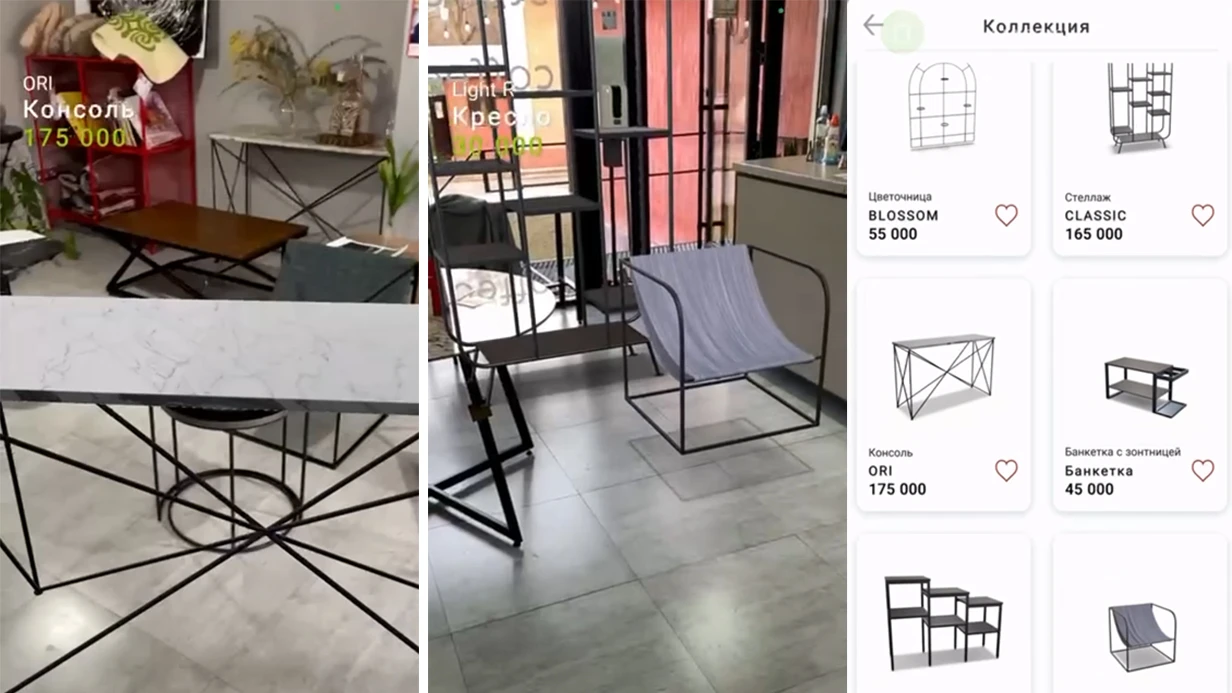
Augmented reality changes buyer behavior: instead of an imaginary try-on, they see the product in their own space. For example, IKEA gave people the ability to place furniture in a room — and the number of returns dropped noticeably, while orders stopped being postponed.
The buyer no longer wants to guess: will the jacket fit, will the sofa match the wallpaper. AR try-on removes this barrier — people make decisions faster and return products less often.
AR try-ons are not an experiment for the sake of technology but a working tool for increasing revenue. Those who implement them first take the audience that is already ready to pay for confidence.
We help launch AR implementation without a long market research: we analyze your products, choose the scenario, and integrate the try-on so that the buyer reaches the cart.
The key point is that we select the scenario for your assortment — from furniture and clothing to cosmetics and accessories — and you get not a one-off promotion but a working sales tool.
We work remotely and on professional equipment, so the project doesn't require a technical team from your side. At the same time, you get a measurable result: higher conversion, fewer returns, and more orders — before competitors have time to adapt.
What will change in sales after the technology is launched
A buyer in an online store cannot touch the product, try it on, or imagine it in their own conditions. This is the main reason for doubts, abandoned carts, and returns.
AR try-on removes this barrier: the customer sees the product "on themselves" or in their own space before paying — and makes a decision faster and more confidently.
Time on site is one of the direct indicators of interest. With AR try-on, a visitor doesn't just read the description but interacts: changes colors, scale, angles.
This engagement keeps them on the page 2–3 times longer, and the longer the contact, the higher the chance of an order and a repeat visit.
Returns are the pain of any e-commerce. When a buyer understands at the selection stage how a product fits, looks, or blends into the interior, the number of unsuitable items drops noticeably.
In categories with a high share of returns — clothing, footwear, furniture, optics — the effect is especially noticeable: according to our data, returns drop by 20–40%.
The average order value also grows. When a try-on is easy and visual, the customer is more willing to add extra items to the main product: accessories, a second color, a set.
Confidence in the right choice removes the fear of overpaying for something extra — and the final order amount increases.
Technically, we achieve this with professional equipment and refined algorithms, as in IKEA projects — without complex setup for the user. A smartphone or tablet camera is enough, and we've already ensured precise model overlay.
The server architecture handles the load even during peak sales, so the try-on doesn't freeze or lose quality.
As a result, the business gets measurable changes: higher conversion, a lower share of returns, and a larger average order value. And the customer gets a new level of service that makes them come back again.
This is not "technology for technology's sake" but a tool that quickly pays off and strengthens your advantage over competitors.
Three formats for implementing augmented reality into your catalog
A product catalog stops being a flat picture. Augmented reality shows the product "live" — on a person, in a room, in hands. The client sees how an item fits the figure or blends into the interior before paying. This removes the main fear of online shopping: "what if it doesn't fit".
We've identified three AR implementation formats that address different business tasks. Choose yours — or combine them if the product is sold both in a showroom and in a catalog.
Three formats of augmented reality for a catalog
| AR format | Who it suits | What task it solves |
|---|---|---|
| Virtual try-on | Clothing, eyewear, cosmetics, and furniture stores | Lets customers "try on" a product on themselves or in their own interior — fewer returns, higher conversion |
| Virtual showcase | Retail, showrooms, exhibition stands | Pointing the camera at a product or display brings it to life: specs, promotions, video review — sales without a consultant |
| AR product card in the catalog | Online stores, distributors, marketplaces | Instead of a static photo — a 3D model. It can be rotated, examined in detail, and the mechanism operation can be seen |
We implement each augmented reality format to meet business goals — from quick integration into an existing catalog to building a dedicated AR application. We'll help you calculate which option will deliver the greatest reach and pay off fastest in your niche.
Project implementation stages: from audit to training video
Implementing an AR try-on is not buying a ready-made solution but a sequential project. So that you understand what happens at each step and what result you get, we've broken the work into seven transparent stages — from the initial brief to a training video for your team.
-
Brief and immersion in the task. First, we discuss your goals: where the try-on will be used — on the website, in an app, or at an offline location — and which product needs to be shown. The output is a clear technical specification with deadlines and the expected business result.
-
Audit of the project and current infrastructure. We analyze your website, catalog, mobile app, and loads. We look at how the AR try-on will fit into existing processes, what needs refinement, and what's already ready. You get a clear integration plan without surprises at the launch stage.
-
Prototype and usage scenario. We create a working try-on prototype: how the user opens the camera, selects the product, "puts it on", and interacts with it.
We agree on the scenario before development starts — so you can immediately see how it will look for your customers.
-
Development and design. Using professional equipment and refined tools, we build a full-fledged AR solution. Importantly, the result works consistently across different devices — from new flagships to mass-market models — so every customer gets the same high-quality image.
-
Integration with your systems. We connect the try-on to your website, online store, or CRM. We set up data transfer for orders, carts, and user preferences. This allows not only showing the product but also collecting analytics and improving conversion.
-
Testing and launch. We test scenarios on real devices, fix the nuances, and only then launch. You get a working AR try-on that doesn't "hang" the site or scare clients away with complexity.
-
Staff training and support. We record a short training video for your employees — how to update the catalog, change products, and monitor statistics. After launch, we stay in touch: we answer questions, help with refinements, and develop functionality.
What the AR try-on delivery includes: ready-made materials and training
You get not just technology but a ready-made working tool — a package your team can use from day one. The delivery is designed so employees quickly get the hang of it and customers immediately see how AR try-on simplifies shopping. Packaging and setup take minimal time: everything is already thought through and ready to launch.
Along with the project, you receive:
- Configured AR try-on scenes — virtual product samples are already grouped and adapted to your tasks; the client sees a realistic result without lengthy setup.
- Training videos — short instructions for staff and customers that show how to use the try-on in a couple of minutes.
- Marketing banners and templates — ready-made materials for the website, social media, and offline screens so you can immediately tell customers about the new feature.
- Clear instructions for the team — step-by-step guides for consultants, managers, and cashiers: how to enable the try-on, help the customer, and answer questions.
- Access to a training course — your employees learn how to use the AR try-on every day in a convenient format, without sacrificing their main duties.
- Launch checklist — a checklist of actions for your manager to quickly verify that everything works and all employees are trained.
- Support during implementation — a short session with our expert who helps the team get comfortable and answers questions after launch.
Employees don't need to understand technology — everything is simple and intuitive. Your marketer gets ready-made materials for promotion, managers get a clear procedure, and customers get a new reason to stay in the store and come back again. The AR try-on delivery covers all team questions before the first visitor opens the application.
Case study: how a brand doubled conversion with a single showcase
For the furniture and interior brand «Dom i Uyut», the try-on in the showroom was a bottleneck: customers took a long time choosing a sofa but often left without buying. The reason — uncertainty: how the piece would fit into the room and whether it would match the size.
We proposed setting up an AR try-on on a single showcase. A visitor points a tablet at an empty corner of the showroom and sees the product at real scale, changes the upholstery and color. This way, we reduce selection time and remove objections before the conversation with the manager.
Implementation results
Over two months of testing, showcase conversion doubled: every second guest who used the try-on left a request. Average selection time dropped from 25 to 10 minutes — buyers moved faster to a specific request.
This AR case also generated repeat visits: about a third of guests returned to the showroom with a ready decision, and some placed orders online after "trying on" the sofa at home through the mobile catalog.
The brand scaled the solution to other showcases and began using the try-on for staff training: salespeople now demonstrate the product in the desired configuration faster. For the business, this is conversion growth without expanding floor space and reduced load on consultants.
We selected the format to match the client's task: there was no need to rework showcases or train employees in complex technology — a tablet and a well-tuned scenario were enough.
Implementation took less than a month and paid off through the growth of requests from the same point of sale.
How to choose an augmented reality format for your niche?
Choosing an augmented reality format starts not with technology but with three parameters of your business: assortment, traffic, and goal. There is no one-size-fits-all solution — what works perfectly in a furniture showroom will be unnecessary for a cosmetics store. So let's first look at how the customer makes a purchase decision in your specific niche.
If the assortment is narrow and the product is large — sofas, cars, household appliances — the buyer needs detailed visualization in an interior or real space.
Here, "try-on yourself" formats don't work, but placing a 3D model in the environment removes the main objection: "it's unclear how this will look at my place".
If the assortment is wide and the product is small — clothing, eyewear, jewelry, cosmetics — quick virtual trial adds value: the client assesses in a minute how the item fits or looks and moves to purchase without a fitting room.
The second factor is traffic and visit scenario. In a shopping mall or on a marketplace, a visitor is not ready to wait, so lightweight solutions are needed that launch with a single touch and don't require app installation.
In a showroom or exhibition pavilion with low traffic, you can afford a richer experience — it becomes a reason to linger at the display and engage with the brand.
A mistake at this stage costs reach: even an impressive technology that loads slowly loses up to half of those willing to try it.
Finally, the goal. If the task is to close a sale, the format must lead to the cart or a request in a couple of touches. If the task is awareness and viral reach, the priority is visual appeal and the ability to instantly share the result on social media.
By answering these questions before starting, you get a solution that pays off — not "technology for technology's sake".
We've spent ten years selecting augmented reality formats for niche specifics and testing them on real scenarios — from eyewear try-ons in an online store to virtual exhibition halls.
Come with your task; during the consultation, we'll show which format will deliver results for your specific assortment and customer flow.
Common doubts before launch: answering directly
Before launching an AR try-on, every manager has the same doubts: will the equipment break, will the format suit customers, will implementation drag on. This is normal: any new tool carries risks. We implement AR try-ons in retail and at events, so we answer directly.
What if the equipment fails?
We use professional equipment proven in hundreds of projects. Spare units are always included — the promotion won't stop even if the main unit fails.
What if AR doesn't suit our customers?
Before launch, we conduct an express audit: audience, assortment, touchpoints. If we see that AR won't deliver results, we honestly say so. In most cases, scenario adaptation solves the problem: try-ons work for both clothing and furniture.
How long will implementation take?
Usually two to three weeks from brief to launch. The main time goes to content preparation. Integration with the website or showcase takes a couple of days, and the launch doesn't stop your current processes.
We prepare failure scenarios, adaptation, and timelines in advance. So you handle the business, not the technology. Still have doubts? Ask us directly — we'll answer honestly, even if the answer is "you don't need this".Leave a request for an audit — get an implementation plan within a week
Leave a request for an audit — and within a week you'll have a ready-made AR try-on implementation plan adapted to your business. This is not a general presentation but concrete steps: what to prepare, which scenarios to launch first, and how to measure the result.
A preliminary consultation is needed so you don't invest blindly. We'll assess your current showcase, customer flow, and goals — and propose the format that will pay off fastest.
Within a week, you'll receive a document you can already use to make decisions and assign tasks to your team.
What the implementation plan includes:
- Readiness checklist: what data and materials will be needed from your side so the start doesn't drag on.
- Timeline estimates for each stage — from tests and pilot to full launch.
- Recommendations for AR try-on scenarios: product try-ons, virtual fitting, 3D showcase — tailored to your niche.
- Team composition and areas of responsibility: who handles design, development, and staff training.
- Measurable success criteria: conversion growth, average product selection time, repeat inquiries.
- Integration points with your catalog, cart, or customer base.
Leave a request for a consultation — we'll contact you within a day, clarify the details, and confirm what you need to start. Within a week, you'll receive an implementation plan that removes uncertainty and lets you move forward precisely, without wasting time or budget.