



Why Engineering and Commissioning Work Requires VR Solutions
Engineering and commissioning work always carries a high cost of error. Incorrect equipment settings, an untested startup scenario, or insufficiently trained personnel result in line downtime, missed deadlines, and lost contracts.
At the same time, the traditional approach requires specialists to be present on site, access to operating equipment, and time for trial starts — and that is always a risk for production and budget.
Commissioning in real conditions often means training personnel right on a live line. A trainee's mistake stops the process, damages expensive components, and sometimes creates a safety hazard.
Companies are forced either to delay the facility's commissioning or to absorb costs due to unprepared employees. Moreover, every change to a scheme or procedure has to be verified by trial and error — consuming materials, electricity, and working time.
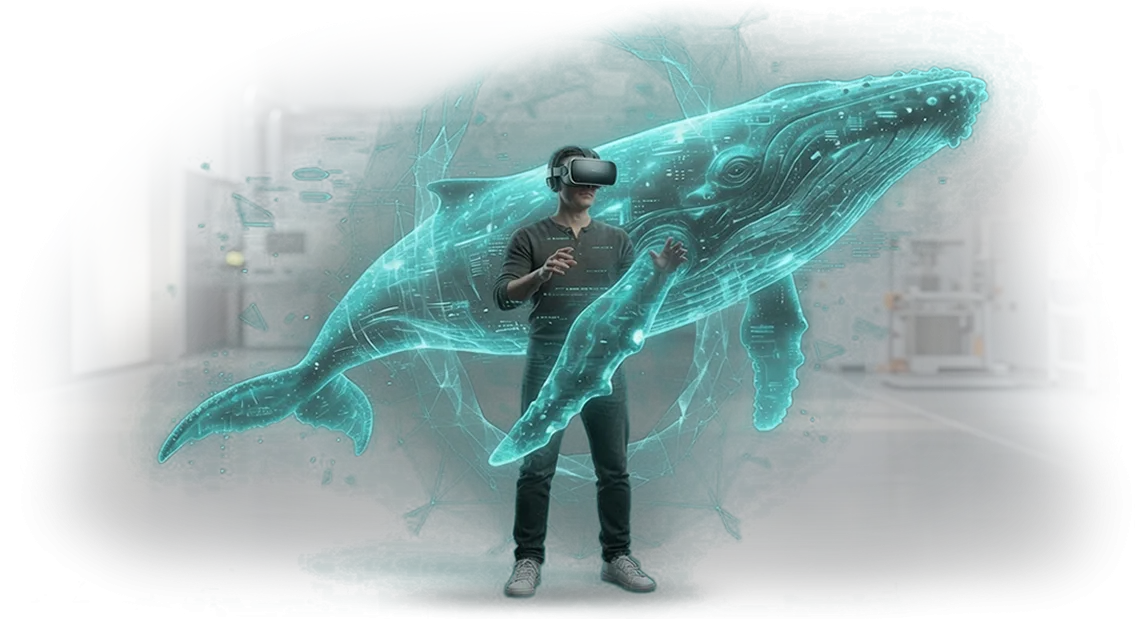
Virtual reality removes these limitations. Equipment, interfaces, and technological processes are recreated in a safe digital environment where commissioning, emergency response practice, and personnel training can be carried out without stopping actual production.
An engineer sees components and mechanisms exactly as they appear on the shop floor, yet can repeat an operation many times without risking equipment or people.
We build VR scenarios on professional headsets, including the HTC Vive — this delivers a stable image and accurate motion tracking, so actions in the virtual environment match real ones.
As a result, the client gets proven commissioning procedures, trained personnel, and confidence that the first real startup will go off without surprises.
VR addresses the key production risks: expensive mistakes, downtime, and insufficient staff qualification — and makes commissioning predictable from day one.
What VR Delivers for Equipment Training and Startup
Engineering and commissioning work is expensive: every mistake means line downtime, spoiled materials, and risk to personnel.
Virtual reality moves training into a safe copy of your workshop, where an employee can try, make mistakes, and practice actions until they become automatic.
We create such scenarios on professional equipment from HTC Vive — it provides precise immersion and stable feedback, so skills transfer to real work.
What changes in daily practice:
- Faster training. Employees master procedures 2–3 times faster: instead of lectures and passive observation, they actively practice operations right in the virtual workshop.
- Fewer errors. The simulator records every action. By repeating complex components and sequences, a specialist stops skipping steps and performs movements automatically.
- Safety. Emergency and abnormal situations can be trained without threatening equipment or health. This is especially important during commissioning and maintenance.
- Cost savings. No need to stop the line, use up consumables, or bring in a mentor for every session. One virtual bench replaces hours of work with real equipment.
- Predictable staff quality. All employees undergo the same scenarios and assessment. You can see who is ready for launch and who needs additional training.
Implementing VR pays off with the first group of specialists: less scrap, faster ramp-up to normal operation, and a smooth launch without downtime.
VR Application Formats for Commissioning Work
VR solution formats for engineering and commissioning work cover a broad spectrum: from simple training simulators to detailed digital twins of equipment.
Each format solves its own task: one shortens the time for initial commissioning, another removes risks in personnel training, and a third helps validate workshop layout before installation.
We work on professional VR equipment, including HTC Vive, so you get a reliable result in real working conditions.
To avoid overpaying for unnecessary detail, it is important to choose the right format from the start. To do this, we break down the task: what the virtual environment should show, who will work in the headset, and which solution will bring the most value. Below are the typical scenarios clients order most often.
| Format | For whom | What it gives the client |
|---|---|---|
| Commissioning VR simulator | Engineers, commissioning specialists | Practice of operation sequences without risk of breakdown, fewer errors at first startup |
| Interactive guide | Maintenance and service teams | Step-by-step prompts right in the headset, fast startup, less downtime |
| Digital twin of a site | Process engineers, production managers | Validation of layout and logistics at early stages, identification of problems before installation |
| Virtual operator trainer | Personnel working with equipment | Safe practice of abnormal situations, skill improvement without stopping lines |
Stages of VR Solution Development for Your Facility
When you order a VR solution for engineering and commissioning work, the main question is how predictable the process is. Unclear stages, missed deadlines, and “surprises” at the final stage cost more than the development itself.
That is why we have built a transparent scheme: you always know what stage the project is at, what you receive now, and what happens next.
Below is a classic project cycle for a VR application for your facility. It works equally well for personnel training and equipment commissioning.
- Brief and task immersion. We discuss exactly where VR will save time and reduce risks: operator simulator, virtual site walkthrough, safety briefing. We record goals and success criteria.
- Scenario and structure design. We develop the interaction logic: what the employee sees, what actions they perform, how the system responds. At this stage, you approve the scenario verbally — without programming.
- Concept and scope approval. We determine which facility elements will be included in the virtual environment, what level of detail is required, and on which devices the application will run. You receive a cost estimate and schedule before active development begins.
- VR environment implementation. We create 3D equipment models, the interface, and the training or commissioning logic. This is the longest stage, but we work in iterations — every 1–2 weeks we show an intermediate result in the headset.
- Testing on your equipment. We verify that the application works correctly in your environment: on your computers, with a stable frame rate, and without failures during long-term use.
- Launch and implementation. We install the software, configure workstations, and train your team. You get a ready-to-use package — “plug in and it works” — with no extra work needed on your side.
- Support and further development. We stay in touch after delivery: we fix user feedback, add new scenarios, and update the environment when your equipment changes. We sign a maintenance agreement if needed.
This approach delivers the most important thing — controllability. You are not buying ‘a pig in a poke’; instead, you approve and control every stage. As a result, you get a VR tool that is actually used in work and does not gather dust after a demo.
What Is Included in VR Application Delivery
Delivery of a VR application for engineering and commissioning work is not just a finished program, but a complete working package.
You get everything needed to launch, operate, and develop the tool with your own team, without hidden conditions or being ‘locked in’ to the contractor.
The delivery includes:
- Project source files — all the digital content of the application. This is your asset: you can develop it with any IT team or hire contractors on a competitive basis. You are not dependent on a single vendor.
- Technical documentation and instructions — clear guides for launching and using the application. An engineer on site will figure things out on their own: how to load a scenario, change a control button, or switch commissioning mode.
- Administrator’s manual — rules for updating content and managing the system without developer intervention. An employee oversees the program like a regular work tool.
- Personnel training — we conduct training for up to two working groups: engineers who will work in VR and administrators who will support the application. After training, we document the procedures and answer questions.
- Warranty technical support — during the contractual period, we stay available through communication channels and resolve issues within agreed timeframes. If an engineer encounters a bug on site, they will not be left alone with the problem.
- Support renewal terms — after the warranty period, you can extend maintenance at a fixed price. No “rush” surcharges or hidden bills.
The main thing you get is independence. Engineers understand the system without your involvement, and if necessary, you can influence further development through a clear process.
our team structures delivery so that the end goal — fast and accurate equipment commissioning — is achieved without unnecessary calls to developers. Ask your manager for the current scope of work for your task and delivery timelines.
Case Study: How VR Reduced Commissioning Time by 30%
When a plant launches a new line, every day of downtime translates into lost revenue. Commissioning demands precise action from engineers within tight deadlines, but training on real equipment carries the risk of breakdowns, injuries, and schedule slippage.
The solution is a virtual simulator that lets operators practice all operations before ever setting foot on site.
For the engineering company Technoprom, we developed a VR simulator for commissioning and startup procedures. Engineers wearing virtual reality headsets completed the full cycle: from checking components to system startup and diagnostics. The model fully matched the real line, so skills transferred directly to production.
The results were measurable. Commissioning time was reduced by 30% — thanks to personnel starting work with a well-practiced sequence of actions. The number of errors at first startup fell by half, and basic training time was cut by a factor of three. This saved budget on business travel and equipment downtime.
These results are not an exception but a pattern. VR removes the fear of making mistakes and enables an unlimited number of repetitions.
Employees memorize procedures faster, and managers get a clear metric of staff readiness: every engineer passed a virtual exam before going on site. That is why the client placed a repeat order and extended the simulator to adjacent areas.
How to Choose a VR Format for Your Tasks?
Choosing a VR format starts with the question of which production task you are solving: training an employee, commissioning at an operating site, or running through a complex engineering scenario before launch.
This determines the requirements for autonomy, detail, and solution cost. The right format is the one that solves the task without overpaying for unnecessary features.
For engineering and commissioning work, we use three basic formats. Below is a comparison of the scenarios clients most often bring to us.
| Format | For which tasks | What it gives the client |
|---|---|---|
| Mobile VR headset | Personnel training, walkthroughs, on-site commissioning without a computer connection | Freedom of movement, quick startup on the shop floor or at a site, minimal preparation |
| Stationary VR system | Detailed commissioning, checking components and mechanisms before physical startup | Maximum detail and stable image, immersion into the nuances of engineering processes |
| MR solution | Combining virtual instructions with real equipment | Employee sees prompts directly on the machine, lower risk of error during commissioning |
Four criteria determine the choice between formats: task complexity, number of employees trained simultaneously, working conditions (stationary workshop or mobile installation), and budget. If you need to run dozens of similar operations at one site, a mobile system is enough.
If it is the complex commissioning of unique equipment where every detail matters, we choose a stationary system.
At our team we do not ‘sell hardware’ — we match a format to your tasks. During the consultation, we ask about your process, test your scenarios, and show how the solution fits into your existing work procedures. This helps avoid overpaying and get exactly the result production needs.
Answers to Frequently Asked Questions About VR Development
Before ordering VR development, engineering departments and managers ask the same questions: how long it will take, how it fits into current processes, and whether data could leak. Below are honest answers without technical details, in plain language.
We work on professional equipment and proven tools, so timelines and quality are predictable. Tell us about your task — and receive a preliminary assessment after your first call.
What are the development timelines for engineering and commissioning work?
Timelines depend on the number of scenarios and how detailed the source data is. A typical project — personnel training or virtual equipment commissioning — takes 2 to 3 months.
At the start, we set stages and milestones so you can see progress and understand when you will get the finished result.
How does VR integrate with our existing systems?
We design the solution around your task and connect it to your current infrastructure without disruption. If needed, we use your drawings, models, or procedures.
Implementation does not require replacing equipment or stopping processes — you get a working tool alongside the systems you already use.
How do you ensure data security?
We sign a non-disclosure agreement and strictly follow internal security policies. Project data is stored on protected servers, and access is role-based — each specialist sees only their own part. Confidential information does not leave your perimeter unless necessary.
What about warranties?
We document requirements in the contract and take responsibility for the result. After project delivery, you receive a support period during which we fix issues free of charge and assist with staff training. After that, a maintenance agreement is available if you wish.
Ready to Launch VR Training at Your Facility?
Launching VR training at your facility is not a complex technological process, but a clear sequence of steps.
We support you from the first request to full rollout, so engineers and commissioning specialists master procedures faster, practice abnormal situations, and work without errors.
You do not need to understand the nuances of virtual reality — we handle all technical content and organization.
VR training already works at industrial sites: the technology creates an accurate copy of a workstation and allows practice without equipment downtime or accident risk.
It delivers measurable benefits — fewer commissioning errors, faster onboarding of new employees, and consistent quality in following procedures.
VR training launch checklist:
- Leave a request for a consultation — specify which tasks need to be solved: initial briefing, practicing commissioning algorithms, quarterly exams, or work authorization.
- Get a consultation — our specialist will review your scenarios, number of employees, and technical infrastructure to recommend the optimal training format.
- Request a project cost estimate — we will prepare a turnkey estimate: scenario development, equipment rental or supply, integration with your procedures, and maintenance.
- Approve the VR project — based on a real workstation, we will create a demo version of the scenario that you can review with your engineers.
- Launch training — we will run a pilot session, train your instructors, and hand over all materials for independent work.
- Evaluate the results — you will receive statistics on completion, common mistakes, and employee readiness for independent work.
Start with a simple step — leave a request for a consultation. We will calculate the cost of a VR project for your specific needs, take the scale of the task into account, and help you choose a solution that will pay off in the first few sessions.