



Why corporate training doesn't deliver results and how to fix it
Employees rarely retain material after regular trainings — by the end of the week, no more than 10% of the information remains. People listen but don't engage: lectures and presentations don't let them try actions hands-on, and without practice, a skill isn't formed. As a result, training becomes a formality that doesn't change work habits.
Low engagement is the main reason corporate programs don't pay off. Participants get distracted, miss important points, and return to old patterns the very next day.
Even a well-prepared trainer can't give each employee individual practice of complex scenarios in conditions close to real ones. Hence the ineffective trainings: money spent, certificates issued, but business metrics haven't budged.
This is especially painful in risk management, sales, and customer service. An employee's mistake in a real situation costs dearly — but practicing it on real equipment or live clients is impossible.
Budget goes to repeated courses, and the result is the same: knowledge doesn't stick, metrics don't grow.
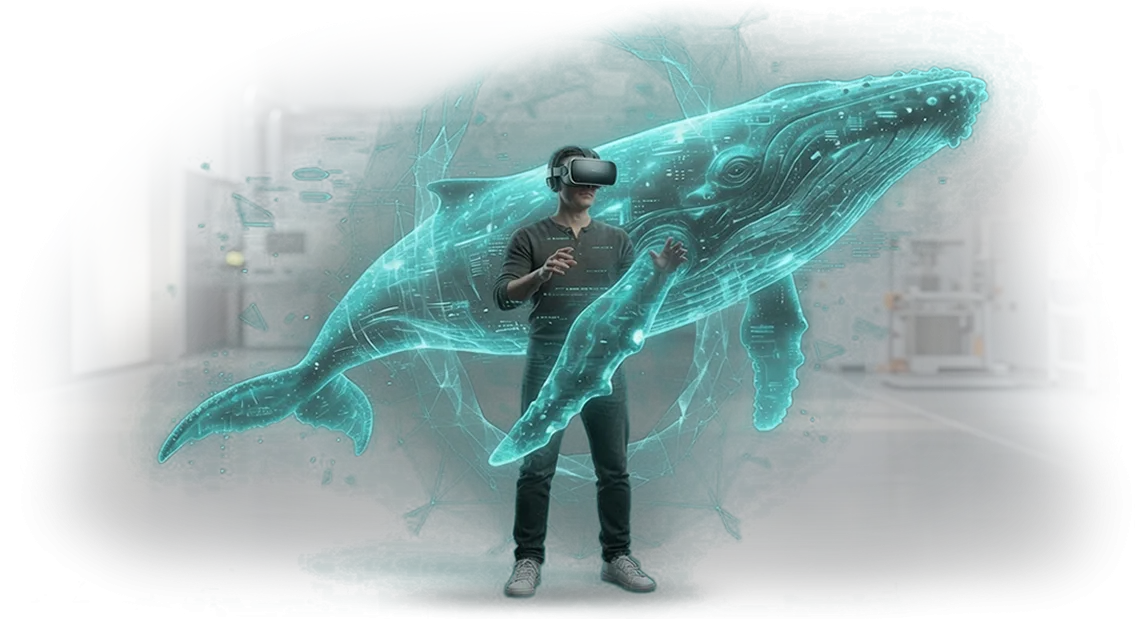
What helps fix this is immersion in a virtual environment where the employee acts themselves rather than observing from the sidelines.
VR training provides practical experience without consequences for the business: you can practice complex negotiations, an emergency situation, or a rare technological process as many times as needed.
The brain perceives such scenarios as real experience, so the skill is retained at the level of muscle memory.
We've been building VR simulators for corporate clients for several years now: from onboarding new employees to upskilling experienced teams.
Our solutions address exactly the problems we discussed above: they engage employees, consolidate skills, and connect training to real business metrics. Tell us about your task — we'll show you how VR will change your training numbers.
What results VR training delivers for employees and business
Companies lose money on classical training: venue rental, instructor fees, and taking employees away from work.
At the same time, after in-person training, only a small part of the material is absorbed, and complex scenarios can't be practiced without risk — especially in manufacturing, medicine, and at hazardous facilities.
VR training immerses the employee in a realistic situation where they can act for real, but without consequences for people and equipment. The skill is consolidated through repeated practice, and a mistake becomes experience rather than an accident.
As a result, a newcomer reaches a working level faster, and experienced staff hone rare scenarios without stopping processes.
Replacing part of in-person classes with virtual simulators reduces staff training costs: no consumables, business trips, or equipment downtime are needed. One simulator can work around the clock and train hundreds of employees per year.
And the program is updated in days rather than rewritten from scratch — which makes the company more agile.
The training system records every employee action: reaction time, number of errors, accuracy of step execution. A manager sees objective VR training results for each participant and the group as a whole.
The HR department gets clear metrics for evaluating effectiveness and can adjust the personnel training program in time.
We develop simulators for professional equipment — including the HTC Vive line — so the picture stays stable and movements are tracked accurately. This delivers that very sense of presence without which full immersion is impossible. As a result, the business gets not a "toy" but a working tool with a measurable outcome.
Main VR training formats and their capabilities
Each training task is solved with its own format. Somewhere it's important to practice skills in a safe environment, somewhere it's about synchronous team work, and somewhere it's about checking actions in non-standard situations.
That's why we offer three basic VR training formats and adapt them to your goals so you can choose the optimal option without overpaying for unnecessary functionality.
| Format | Who it's for | What the client gets |
|---|---|---|
| Group VR training | Teams that need to practice interaction | Practice of joint actions without risk to people and equipment, instant feedback, improved cohesion |
| Individual VR simulator | Employees who need repeated practice | Practicing a skill until it becomes automatic, the ability to train at a comfortable pace and without depending on a mentor |
| Work process simulation | Operators, technologists, specialists on complex equipment | Safe mastery of processes, fewer errors and accidents, shorter time to full productivity |
Which format to choose? It depends on the specific task and audience. If you need to teach a team to act cohesively — a group training fits. If individual practice to automaticity is important — a simulator. And to master rare or dangerous operations — a work process simulation is better.
We help you choose a format for your task: we analyze your business specifics, employee skill levels, and the expected result. In the end, you get a solution that actually works and pays off by reducing the cost of real training and decreasing the number of errors.
How the project goes: from brief to launch and support
A clear process is what distinguishes a reliable contractor. You always know what stage the project is at, what's already ready, and what happens next. We work according to a transparent scheme proven on dozens of corporate implementations.
- Brief and immersion into the task. We conduct interviews with you and your experts, study regulations, instructions, and the specifics of how employees work. As a result, we record the training goals and success criteria.
- Scenario design. Together with your methodologists, we map out the simulator structure: steps, errors, hints, and the assessment system. We agree on the scenario before development starts — this eliminates rework.
- Prototype and mechanics verification. We build the key scenes on professional equipment (including on HTC Vive headsets) so you can visually assess the logic and ease of interaction.
- Development and interim demos. We run development in iterations: every 1–2 weeks we show a working version. You see progress and make edits without waiting for the final build.
- Testing with real users. We test the simulator on your employees, collect feedback, and refine. This reduces the number of errors to zero before launch.
- Launch and support. We deploy the solution on your equipment, train administrators, and hand over the documentation. After launch we stay in touch: updates, refinements, and technical support — without downtime.
This approach guarantees that you get a working tool within the agreed timelines and without surprises. Each stage ends with approval — you control the budget and the result rather than watching a "black box" of development.
What's included in a VR solution package for staff training
For VR training to truly benefit the business, it's not enough to simply buy equipment. You need to assemble the whole solution — from task setting to post-launch support.
We put together a package for your industry and specifics so you get results rather than having to dig into technical details.
- VR training scenarios tailored to your tasks. Together with you, we identify the situations to practice: from handling non-standard situations to service standards. The finished scenarios model real work cases where an error in the process won't break anything but will provide experience.
- Content and virtual environment close to your reality. The employee finds themselves in a familiar setting — a workshop, warehouse, office, or sales floor. This cuts adaptation time: there's no need to "relearn" abstract conditions, and the skill transfers to work faster.
- Methodological materials for the instructor. A guide to running the session, checklists for assessment, a breakdown of typical errors, and recommendations on how to consolidate the result. Your internal trainer will be able to run sessions without the developers' involvement.
- Training for employees and administrators. We conduct a briefing for users so they can confidently work with the VR simulator from day one. Administrators receive simple instructions for launch and basic maintenance — no dedicated IT specialist on staff is needed.
- Project support after launch. Technical support, content updates, methodology consultations, and help with scaling to other departments or branches. We stay in touch until the training becomes a regular part of the learning program.
As a result, you get a working staff training tool rather than "hardware in a box." Employees train in a safe environment, managers see progress, and we handle the entire technical side — from the first brief to daily operation.
Case study: how we cut production staff onboarding time
Production staff training usually takes weeks: theory, briefings, and working with a mentor. At the same time, some skills are practiced directly on the equipment, and a newcomer's mistake can be costly.
One of our clients faced the situation where new employees took too long to get on the line, and the defect rate in the first months remained high.
We proposed closing that gap with a VR simulator based on HTC Vive.
Our training specialist analyzed the technological process in detail and turned it into a series of interactive scenarios: the employee performs operations in a virtual copy of the workshop while the system points out where they're making mistakes and how to act correctly.
Situation
Before the simulator was implemented, operator training took three weeks on average. Due to a shortage of experienced mentors, the training schedule kept slipping, and the first independent shifts produced a noticeable percentage of defects.
Result
- Training time was cut from three weeks to five days.
- The number of errors in key operations dropped by more than 40%.
- 120 employees completed training in two months without being taken away from production.
Management quickly saw the effect: after the pilot, the program was expanded to two more workshops. And six months later, the client came back to us with a request for a simulator for another line — for us, that's the main indicator that the solution works in real conditions.
How to choose the right VR corporate training format?
Choosing a VR corporate training format starts not with technology but with the question: "What business problem are we solving?" It's one thing to introduce new employees to company processes, and quite another to practice emergency actions or teach salespeople to confidently negotiate.
Each goal requires its own scenario, session length, and depth of immersion — otherwise, the effect of the investment will be lower than expected.
The main criterion is the frequency and scale of implementation. If you train hundreds of employees monthly and want a unified quality standard, choose short 10–15 minute modules with automatic result checking.
If it's about rare but expensive errors — for example, when working with hazardous equipment — it's worth investing in detailed simulations that mimic real conditions and let people make mistakes without consequences.
The audience is equally important. Employees with different experience and digital literacy levels perceive VR differently. Some need 20 minutes to get comfortable; others need an instructor's help in the first sessions.
We match the format to the specific group, build in adaptation for beginners, and adjust the pace so that training doesn't cause stress but builds confidence.
In practice, the scheme looks like this: first we define the goals and desired result, then we assess the audience size and the frequency of knowledge refreshes.
For one-off programs, a standard scenario is enough; for regular training, we build a system with progress analytics and material updates.
This approach rules out overpaying for unnecessary complexity and guarantees that the VR format actually solves the task rather than simply impressing employees with novelty.
We help you avoid a wrong choice from the very start: at a brief session we clarify the goals, test a pilot module on your audience, and only then propose scaling. As a result, you get training that pays off through faster staff preparation and fewer errors in real work.
Frequently asked questions about implementing VR solutions in a company
Before implementing VR training, managers ask the same questions: what happens with the equipment, who will set it up, is it safe for employees, and when will results appear. That's normal — new formats always require clarity.
We've worked with corporate clients for over 10 years, so we answer these questions directly and based on real project experience.
Below is what's most often asked before launching a VR program in a company. If your question isn't here, just contact us — we'll tell you more about your scenario.
What if the VR equipment breaks?
Breakdowns are rare, but we're ready for them. While repairs are underway, we provide a replacement so training doesn't stop, and we handle all maintenance work ourselves.
Is it difficult to install and set up a VR solution?
That's our job, not your IT team's. We deliver the equipment, set it up for your space, and train employees — from the first launch to daily use. All that's left for you is to schedule the trainings.
Is VR training safe?
Yes. The scenarios are designed so that the employee stays in a safe zone and receives a short briefing before starting. We use hygienic replaceable masks and monitor the process at every session.
When will the effect appear, and will it pay off?
The effect is visible after the first groups: employees practice skills without risk to production and several times faster than in a regular format.
And since a VR scenario can be repeated endlessly — with no costs for consumables or venue rental — the training quickly pays for itself.
Submit a request: we'll prepare a plan for your pilot VR project
Corporate training is moving to VR not because it's trendy, but because it's measurable: higher engagement, lower costs for training grounds and instructors.
But to launch a pilot, you need a clear scenario and an understanding of the budget — without these, the project stalls at the approval stage.
We prepare a pilot VR project plan tailored to your task: with cost calculation, scenario selection, and a clear implementation plan. Submit a request — and after a short consultation you'll get a ready action plan, not just a presentation.
What you get from your request:
- Cost calculation for VR training at your scale — without hidden work or "fine print" in the estimate.
- A pilot scenario adapted to your employees' real tasks: from newcomer adaptation to emergency response practice.
- A 30–60 day implementation plan: what stages, who participates, and what results we measure.
- VR training consultation — we'll analyze which scenarios will deliver quick results in your specific industry.
- Demonstrations of similar solutions and examples of how other companies recoup their pilot.
- Clear pilot evaluation criteria: training time, number of errors, engagement — everything to protect the project in front of management.
We work remotely across the country, with more than 10 years of VR projects behind us. The pilot can be launched 2–3 weeks after the plan is approved.
Submit a request for VR training — we'll discuss your tasks and prepare a pilot project plan. It will take 15 minutes, and from there you'll move forward according to a clear plan instead of guessing where to start.