

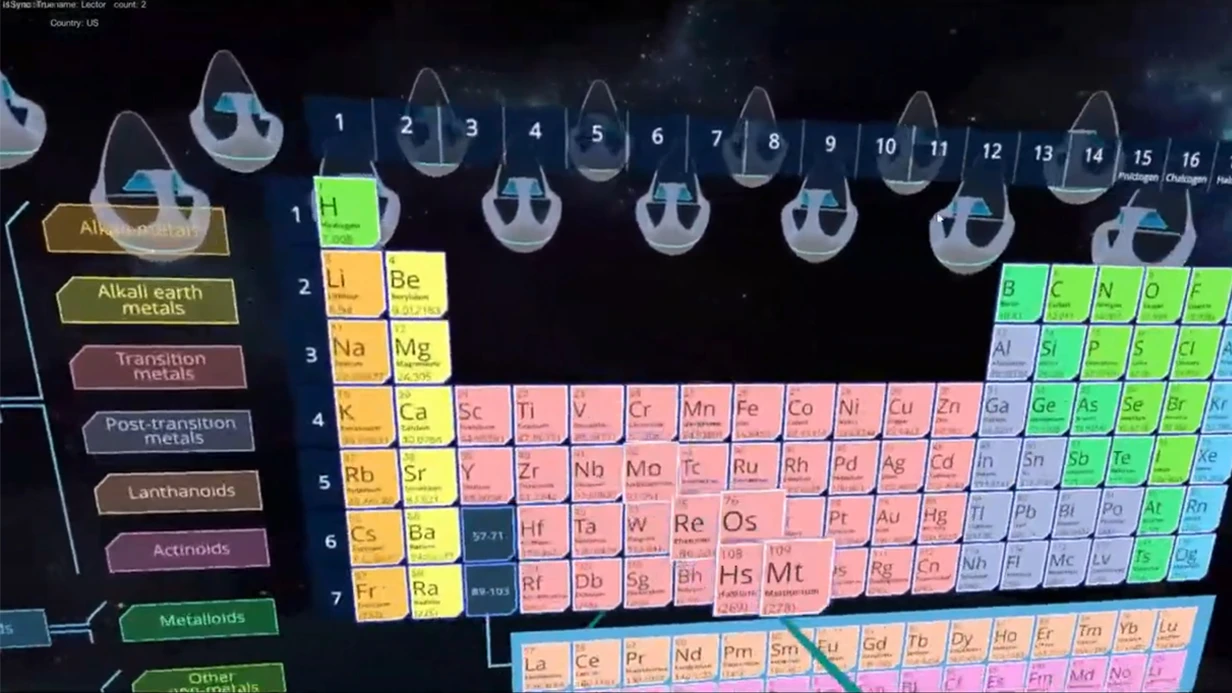


Why scientific research needs specialized VR solutions
A scientific experiment rests on measurement precision and reproducibility of conditions — while ordinary VR applications are created for entertainment, not for research.
They lack strict parameter control: response latency, tracking errors, and unpredictable object behavior distort the picture, and the data stop being trustworthy.
The researcher gets not clean numbers but "noise" that cannot be reproduced on another setup or in another laboratory.
The cost of an error in science is high: conclusions built on inaccurate data do not stand the test of time, and experiments have to be redone.
An ordinary game engine or an off-the-shelf application provides neither the required calibration nor variable control — they are simply not designed to serve as a measurement instrument.
For research, a virtual laboratory is not a picture in a headset but a controlled environment. Every parameter must be specified and recorded: object positions, reaction time, movement paths, and viewing angles.
Only when a stimulus is presented identically to every subject and data are collected in sync with actions can we speak of correct statistics and publications that colleagues trust.
That is why we build research rigs on professional VR hardware: calibrated scenarios, controlled variables, and export of results in a format convenient for analysis.
This covers the needs of psychology, neuroscience, ergonomics, and cognitive research laboratories — from pilot tests to large-scale samples.
What a virtual laboratory gives a research group
A research group spends months preparing experiments, and a single mistake in a physical setup can cost budget and time.
A virtual laboratory eliminates these risks: experiments run in a digital environment where parameters can be changed, series repeated, and reproducible results obtained without fear for the equipment.
Full safety for experiments
Working with toxic substances, high voltages, or extreme temperatures is a high-risk zone. In a virtual environment such experiments become completely safe. Students and lab technicians train on realistic scenarios, but no person gets hurt and no instrument breaks down.
Reduced research costs
Every run of a physical setup requires reagents, electricity, and maintenance. A virtual rig consumes no materials — costs go only to scenario development.
The number of runs is unlimited: the same series can be repeated hundreds of times until a statistically significant result is obtained.
Engaging students and young scientists
For modern students, lectures and static diagrams are not enough. A virtual laboratory gives them the opportunity to independently conduct a complex experiment, make a mistake, and immediately see the consequences.
Live interactivity raises interest in science and accelerates the development of practical skills that were previously learned without hands-on practice.
A shorter research cycle
Setting up a physical mockup takes weeks, and changing conditions takes hours. In a VR environment the configuration changes within minutes: just load new parameters. Hypotheses are tested sequentially without downtime, and data enter processing immediately after the series.
Comparison of classical and virtual laboratories
| Scenario | What it gives the researcher | What the group gets |
|---|---|---|
| Dangerous experiments | Test reactions without risk to people | Complete safety, clean statistics |
| Expensive equipment | Refine the methodology before a real run | Saving budget and resources |
| Student practicums | Give every participant personal experience | Engagement and rapid progress of the group |
| Long protocols | Compress time between iterations | Short research cycle |
Such a laboratory becomes a permanent asset of the group: it can be replicated for other tasks, refined for new hypotheses, and used for many years without additional material costs.
VR project formats for a scientific team's tasks
A scientific team rarely needs entertainment VR. The tasks are different: test a hypothesis, train an operator, rehearse a scenario that cannot be reproduced in reality.
That is why we select a format for each specific stage of research — from a quick check of an idea to a full-fledged virtual testing ground.
The table below shows four typical formats used by laboratories and research groups. For each one we indicate who it suits and what results it brings.
| Format | For whom | What it gives the client |
|---|---|---|
| VR demo | Managers, grant applicants | A visual illustration of the hypothesis for applications and defenses. Shows the essence of the work in 5–10 minutes even to a non-specialist |
| Process simulator | Researchers of complex systems | Repeated reproduction of the experiment, parameter changes, data collection. Less dependence on expensive equipment |
| Operator trainer | Engineers, medical staff, operations services | Practice of rare and emergency scenarios without risk. The skill is retained faster than with instruction manuals |
| Virtual testing ground | Interdisciplinary teams | Safe hypothesis testing, statistics collection, simultaneous work of participants in one space |
The choice of format always starts with a brief. We look at the research goals, the number of participants, and the required data accuracy — then propose an option that solves the task without unnecessary costs.
If the format is not obvious, we do a short prototype so the team can "see" the result before making large investments.
How a VR rig is developed for your laboratory
Developing a VR rig for a scientific laboratory is not an experiment but a well-honed process. We go from the first brief to implementation and further support so you receive a working tool exactly on schedule. At every stage you see the result and control what is happening.
- Brief and research objectives. We gather context: what hypotheses you are testing, what parameters need to be recorded, and in what conditions your staff works. The result is a clear plan with goals, timelines, and success criteria.
- Interface and scenario prototype. We show an interactive model of the future rig: what the zones look like, how a staff member interacts with objects, and what is visible on the screen. You evaluate the idea before money is invested in full development.
- Scenario review with scientists. We discuss the experiment logic with you and your colleagues: whether the sequence of actions is suitable, whether response accuracy is sufficient, and what data to collect. All edits are made to the scenario before the main code is written.
- Test launch on your equipment. We install the rig on work machines and test it in real laboratory conditions rather than in an ideal demo environment. We eliminate failures so researchers are not distracted by technical issues.
- Implementation and team training. We configure the system, hand over clear instructions, and hold a short session for your lab technicians. Staff use the rig confidently, and you are not dependent on a single developer.
- Support after launch. We stay in touch: update scenarios, help with refinements, and provide consultations. Research tasks change — the rig evolves with them.
What is included in the delivery set of a scientific VR solution
We deliver not just a program but a ready-to-work instrument for your laboratory or research group. The delivery set includes everything needed to launch, master, and further develop the VR solution — from installation files to support for your team.
- Distribution kit for your scenario. An installation package tailored to specific research tasks: required environment parameters, hardware calibration, and launch configuration. This lets you start experiments from day one without lengthy setup.
- Source code and developer documentation. Full commented code, project structure, and a description of the internal logic. For scientific work this is the ability to reproduce experiments, modify scenarios, and hand the solution over to colleagues.
- User manual. A clear instruction in Russian: how to prepare the room, put on the headset, launch a session, change stimulus parameters, and save results. Minimal time to get started.
- Employee training. A practical session for your team: reviewing scenarios, practicing typical situations, and answering questions. Your staff works confidently with the system right after the first training session.
- Technical support. Direct contact with our specialists at all stages of operation: help with configuration, troubleshooting, and consultations on functionality refinement. A guarantee of stable operation of the solution throughout the entire research cycle.
Case study: virtual simulator for a research center
A cognitive research laboratory faced a problem typical of scientific work: how to create identical conditions for hundreds of subjects without losing data purity. The physical scene, the instructor, even the lighting — everything introduced distortions.
We proposed moving the experiment into virtual reality so that every session would take place in an absolutely identical environment.
We built a simulator on professional HTC Vive hardware, adapted the scenarios to the scientists' methodology, and trained the staff.
Within a month the laboratory had an instrument that let them change experimental conditions in a couple of clicks instead of a week of reconfiguration.
What changed for the research center:
- The test series cycle was reduced from 4 months to 3 weeks
- More than 300 subjects were processed under repeatable conditions
- Errors of the "human factor" in recording actions were eliminated
The laboratory director noted three key results of the work:
"Previously one experiment took a week because of preparation. The virtual environment gave us the ability to set up and tear down a task instantly — a level we could not reach with classical methods."
"Subjects behaved naturally, without being distracted by the observer. The data became noticeably more reliable, and repeated sessions confirmed the results — we had never seen such stability before."
"After the first project we moved two more research directions onto this platform. The simulator is now a core part of our grant applications."
This client's story became a benchmark for us: a scientific environment requires not a visual show but precision and reproducibility.
That is why we continue to develop VR tools for research tasks and hear from clients that the simulator pays for itself on the very first large-scale study.
How to choose a VR format for your scientific research
Choosing a VR format for scientific research starts with the question you want to solve: what exactly is being studied and which conditions need to be controlled.
This determines whether you need full immersion, the ability to move through the virtual scene, or a static scenario with controlled stimuli.
The main criteria are experiment reproducibility, data recording accuracy, and control over conditions. VR lets you change environment parameters within minutes and repeat the experience identically for all participants.
But it is important to decide in advance which metrics to collect: reaction time, movement trajectory, gaze angle, or responses after the session. This determines the interface format and integration with the data collection system.
The project budget and development timeline depend on the complexity of the scenario. Standard stimuli and reaction recording are covered by configuring a ready-made environment. A unique virtual world, physics, or work with biofeedback requires custom development and more time. That is why, after the briefing, we immediately state the timeline range and cost.
The reliable path is iteration: first a prototype with the basic version of the experiment, then analytics and further refinement. This way you get an instrument at an early stage and test the hypothesis before full development.
We work on professional VR hardware, including HTC Vive, and select the format to fit your methodology, not the other way around.
Answers to common questions about VR for research tasks
Research work requires predictability: equipment must work reliably, data must be sound, and timelines must be met. We have gathered answers to the questions that most often concern scientific groups before a project starts.
Is the application compatible with our equipment and operating system?
Yes. We develop for specific VR headset models, including HTC Vive, and adapt the project to your configuration: controller type, room requirements, and PC capabilities. Before launch we run a test session on your equipment to ensure correct operation.
How accurate are the data collected by the VR application?
Accuracy is a key parameter for research. We calibrate the virtual environment to the real dimensions of the space and control the synchronization of the subject's actions with data recording.
In the report you receive raw metrics in a clear format suitable for further statistical processing.
We will need refinements after the first tests. Is that possible?
Of course. We design the architecture so that changes can be made quickly: adjusting scenarios, stimuli, interface, or adding new experimental conditions.
Refinements are discussed at every stage — you do not pay for "rewriting from scratch" but get targeted edits to working modules.
What guarantees and support do you provide after launch?
We fix the warranty period in the contract and stay in touch after delivery. Support includes technical assistance, consultations on operation, and prompt bug fixes. If the tasks change during the research, we help adapt the application without losing the accumulated data.
Still have questions about your research scenario? Ask them — we will advise how a VR solution fits into your scientific process.Let's discuss your project and estimate the scope of work
Every research project is unique: different tasks, hypotheses, and participant audiences. It is important for us to understand what you want to test and what data to collect.
That is why we do not sell "boxed" offers — first we assess the project and together determine where VR will accelerate the work and improve data reliability.
Fill out the consultation request form — we will prepare a cost estimate, an implementation plan, and a pilot version. It is non-binding, but you will get clarity on timelines and scope of work before the start.
What our proposal includes:
- Project assessment: breakdown of tasks, hypotheses, and virtual environment requirements, plus platform recommendations — from mobile headsets to HTC Vive.
- Cost estimate: a transparent stage-by-stage estimate — from prototype to the final study, with no hidden surcharges.
- Implementation plan: a step-by-step schedule with checkpoints so you understand when you will get the first results and where to involve colleagues.
- Pilot version: we will offer a test module — you test the hypothesis and evaluate the effectiveness of the VR solution before full development.
- Guarantees and support: after delivery we stay with you — we adapt the application to new tasks, train employees, and help with publishing results.
Submit a request via the form — within one business day we will get back to you with questions, cost expectations, and a plan. This way you will quickly understand whether the VR approach is right for you and will be able to pitch the project to management or a grant funder.