




VR for Dentistry: Why Clinics Lose Patients
Fear of treatment is one of the main reasons patients postpone visits to the dentist and sometimes switch clinics altogether. This is not just discomfort but a barrier that directly hits appointment bookings, chair utilization, and the regularity of preventive checkups.
Every patient with dentophobia is a potential loss not only of the current bill but also of loyalty for years to come.
They look for a clinic where they can relax, and if your staff cannot ease their tension before and during the appointment, the patient goes to competitors who offer more than just "fast and high-quality" dental treatment.
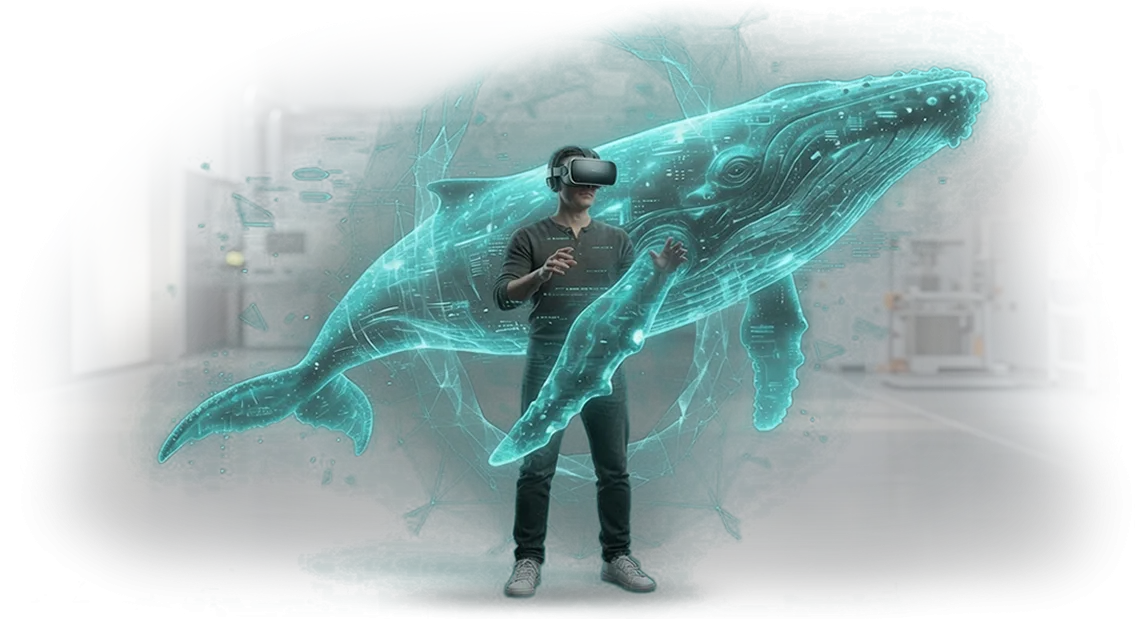
Virtual reality in dentistry solves exactly this problem. VR headsets distract the patient from the sound of the dental drill and the sight of instruments, turning the appointment into a calming scenario — a walk in the woods, an ocean dive, or watching a favorite movie.
As a result, cortisol levels drop, the person stops gripping the armrests, and tolerates even lengthy procedures more easily.
For the clinic, this works as a client retention tool. You don't need to explain to the patient why they should come back to you: they will remember the feeling of calm themselves and recommend the clinic to friends. For the doctor, it's the opportunity to work without rushing and without extra tension in the room.
We design VR solutions for dental clinics so they integrate into a standard appointment without delays or complex setup. We help address the patient's fear as early as the waiting-room stage and keep them with you for years to come.
What VR/AR/MR Implementation Gives a Clinic
An empty examination room and the sound of the dental drill are patients' main fears even before the appointment begins.
These are the reasons people postpone visits, skip preventive care, and switch to competitors where "it's not so scary." VR/AR/MR turn the wait into a game and the appointment itself into a calm experience for which the clinic receives gratitude rather than complaints.
We address this fear with technology that has already transformed medicine. Below are four measurable benefits a clinic gains after implementing virtual reality.
Benefit: Patients stop fearing treatment
While the patient waits for the appointment in a virtual reality headset, their attention is fully absorbed by relaxing worlds — the ocean floor, a mountain forest, or a favorite movie.
Anxiety levels drop within minutes, and the doctor walks into the room to find a calm person ready to cooperate.
As a result, the clinic hears "I'll think about it" less often and "book me for the next visit" more often. Patients who once had a panic fear of treatment become regulars, and word of mouth brings in their friends and relatives.
Benefit: Saving doctor and staff time
A calm patient fidgets less in the chair, doesn't keep asking questions, and doesn't demand long pauses. The doctor spends every minute on work rather than pleading "just bear with it a little longer." This allows seeing more patients per day without losing quality.
The administrator's job is easier too: the headset is handed out in a couple of minutes, and the scenario launches with the press of a button. No complex setup or staff training — a short instruction when handing over the equipment is enough.
Benefit: Higher average bill
A clinic is a business, and VR works for revenue here. When the fear is removed, the patient is more willing to agree to additional procedures: implant placement, whitening, bite correction. What previously scared them into refusal is now discussed calmly and thoughtfully.
Experience shows: clinics with VR zones get more treatment plan approvals and a higher average bill at the initial appointment. Virtual reality is not an expense but an investment in the clinic's profitability.
Benefit: Clinic loyalty and reputation
A modern clinic that cares about patient comfort is remembered and recommended. VR headsets become that "wow" factor that people tell friends and colleagues about, and photos from your clinic appear on social media.
We work on professional equipment HTC Vive — that is a guarantee of stable results without failures during the appointment. The kit is designed for intensive use, so the clinic gets a reliable tool for long-term growth.
VR Project Formats for Dentistry
Dentistry is a field where patient trust and calm matter more than technology. VR project formats are selected based on the business task: whom to train, what to show, how to reduce fear of treatment, and how to speed up recovery.
We work on professional equipment, including HTC Vive, so the results are consistently reliable both in training and in the treatment room.
Staff training and patient demonstration
VR training allows practicing skills without risk to patients: a newcomer gets into the working rhythm within days, and experienced staff refresh their technique.
A VR demonstration of a treatment plan shows the patient their situation clearly — they understand the stages and timeline, so they hesitate less and postpone treatment less often.
Treatment and rehabilitation
VR in treatment distracts the patient during the procedure: anxiety is lower, and the doctor works more calmly and quickly.
VR rehabilitation after surgery restores masticatory function under specialist supervision — the patient sees the result and does the exercises more willingly.
| Format | For whom | What it gives the client |
|---|---|---|
| VR training for doctors and assistants | Head physician, training center | Staff get up to speed faster, fewer mistakes involving patients |
| VR treatment plan demonstration | Patient, marketer | Clear treatment stages, higher consent to procedures |
| VR in treatment and distraction | Doctor and patient during the appointment | Calm appointment, less anxiety and fewer complaints |
| VR rehabilitation after surgery | Rehab specialist, patient | Faster recovery, motivation to do exercises |
| VR clinic tour | Owner, marketer | Patients get familiar with the clinic in advance, recognition grows |
How VR Development for a Clinic Works
Work on a VR project for a clinic begins not with code but with the task. We analyze exactly where virtual reality will bring value: reducing patient anxiety, training students, presenting treatment plans.
our team runs the project under a transparent process — at any moment you know what stage the work is at and what you'll get as the final result.
Stages 1–3: From brief to scenario
- Brief and audit. We meet and define the goals: what the VR zone in your clinic should accomplish — calm a child before treatment, prepare an adult for implantation, or show the result of prosthetic restoration.
- Concept and scenario. Together with your doctors, we script the virtual visit: what objects the patient sees, what actions they take, and how this affects their emotions. We determine the session length and staff areas of responsibility.
- Prototype and approval. We build a visual 3D model of the future application — you see the scenes and logic before major resources are invested, and you can make changes without redoing everything.
Stages 4–7: Development, launch, and support
- Development and testing. After the prototype is approved, we build the application and test it in conditions close to a real treatment room: lighting, sounds, session time — so the doctor doesn't get distracted by technical setup.
- Integration and training. We install the system in the waiting area or treatment room and configure it to your schedule. We provide brief training for administrators and doctors: powering on, launching, and replacing content.
- Pilot launch. We launch with real patients, collect feedback, and make final adjustments to the scenario or interface so the session runs smoothly without the doctor's involvement.
- Maintenance and updates. We stay in touch: we update content for new services, help with failures, add scenes, or change texts. The clinic gets not a "file on a disk" but a working tool with predictable results.
What Is Included in the VR Solution Delivery
You get a turnkey VR solution for dentistry ready to go — no need to understand the intricacies of the technology. The delivery includes everything needed to launch: from the application and VR equipment to setup, staff training, and warranty obligations.
- Ready-to-use VR application for dentistry — adapted to your scenarios: getting acquainted with the clinic, distracting the patient during treatment, and hygiene education.
- VR equipment kit — headsets, controllers, and charging stations, fully tested and ready to work.
- Installation and setup — our specialists deliver, connect, and check everything on site so you can launch on the day of handover.
- Staff training — a training session for doctors and administrators: how to turn on the system, choose a scenario, and guide the patient.
- Warranty on VR equipment and application — official commitments from 12 months and support for the entire period of operation.
- Updates and refinements — regular improvements to the interface, scenarios, and compatibility with new devices.
- Methodological materials — simple guides for staff and use-case scenarios for different appointment situations.
- Technical support — we answer questions and help resolve any issues during business hours.
In the end, you get a working tool that immediately benefits patients and increases clinic recognition. No self-assembly, no hunting for contractors, no dealing with tech issues — everything is already included.
Case Study: VR Helps Dentistry Grow
Here's a story from our practice: a private dental clinic came to us with a pain point — patients doubted their treatment plans and postponed decisions. Complex schemes, braces, implants — all of this is hard to explain with words or a picture on a screen.
We proposed a VR consultation: the patient puts on the headset and literally sees their smile after treatment, turns their head, and views the result from different angles.
The result exceeded expectations. Over six months, the flow of new patients grew by 27%, and the average bill rose by 18%.
People stopped fearing "scary" procedures and were more willing to agree to comprehensive plans because they saw the end result before treatment even began. Repeat visits also grew separately — by 15%.
We use professional equipment — we work on HTC Vive, which delivers a stable picture without lag, so the patient experiences no discomfort or motion sickness.
The clinic's head physician commented on the results: "VR changed the conversation with the patient: we stopped persuading and started showing. People come back on their own and bring friends — that's the best advertising, and it costs nothing."
For us, this case is telling because VR works not as a "wow attraction" but as a tool that impacts the clinic's key metrics: more patients, a higher average bill, stronger loyalty. We're now applying this experience to other projects in medicine and cosmetology.
If you want the same result — we'll start with a short brief: we'll see where VR can deliver a quick effect for your clinic.
Frequently Asked Questions About VR Implementation
VR in dentistry is not the future but a working tool that removes patient fear and increases loyalty to the clinic. However, managers naturally have questions: will the technology interfere with the appointment, is it safe for patients, and how much does implementation cost. We address the main concerns.
Will VR interfere with the doctor during the appointment?
The patient wears the headset, and the doctor works as usual: all instruments and procedures remain the same. VR simply creates a calming visual experience that distracts from the sound of the drill and reduces anxiety.
The doctor sees a control panel and can stop the session at any moment. The procedure time doesn't increase, and patients agree to complex treatment faster — fewer cancellations and reschedulings.
Is VR safe for the patient's eyes and well-being?
Modern professional headsets, such as the HTC Vive, are designed for repeated use and do not affect vision during short sessions. Before the procedure, we rule out contraindications: epilepsy, severe dizziness, and certain psychiatric diagnoses.
For hygiene, replaceable individual face masks are used, and all surfaces are disinfected. The patient can end the session at any moment — this is built into the interface and clear even to a child.
How much does development cost, and when will it pay off?
The cost depends on the format: a ready-made turnkey scenario or a custom application with unique clinic content. We calculate the scope of work in advance so you receive an accurate estimate before the project starts.
VR pays off not only through increased loyalty but also through a higher average bill: patients decline complex procedures less often and recommend the clinic to friends more often. With a regular flow of visitors, the investment pays back within the first few months.
How difficult is it to implement VR in a clinic and train the staff?
No special knowledge is required from the clinic: we deliver the equipment, configure it for your office, and train the staff in one day. Administrators and dental assistants easily master the system, and the instruction manual stays at the clinic.
Technical support accompanies you at every stage: from the first launch to expansion into other rooms. You don't need to hire a separate specialist — all maintenance is already included in the service.
Order a VR Application for Your Clinic
Patients choose a clinic where it doesn't hurt and where the experience is engaging.
A VR application turns the visit into an immersive journey: it distracts from the sounds of the drill, explains treatment in a game-like format, and gives patients a reason to tell friends about you.
This is not just technology but a tool that increases loyalty, attracts new patients, and sets the clinic apart from competitors.
By ordering turnkey VR development, you get a ready-made "all-inclusive" solution: from the idea and scenario to equipment installation and staff training. We handle the entire cycle — all you have to do is accept the work and start using it. In the end, you get:
- A VR application for your clinic, developed to match your goals and brand identity.
- Scenarios for different situations: from pediatric appointments to complex consultations.
- Equipment and setup — nothing extra to purchase or learn on your own.
- Training for doctors and administrators: they'll start working on day one.
- Technical support and a warranty on everything — we stay in touch after launch.
- Ready-made marketing materials: a video and photo zone for social media and your website.
Each item saves you time and stress. You get not "raw code" but a working tool that delivers value from day one.
Shall we discuss your project? Leave a request — in 30 minutes, we'll tell you what your VR application will look like, give you the timeline and cost. Turnkey development with a guaranteed result is the next step toward making your clinic memorable.
Order a VR application for your clinic
How to Choose VR for Dentistry?
Choosing VR for dentistry starts not with headset specs but with the problem you're solving. Does the patient fear treatment? Does the staff need to explain therapy plans visually? Does the clinic lack differentiation from competitors?
The format may be the same, but the value is different. So first, define who the primary user is: the patient, the doctor, or marketing.
If the goal is to reduce patient anxiety, choose a format that works in the moment, right in the chair. Virtual reality shifts attention: instead of the sounds of the drill, the person sees a calm landscape and doesn't fixate on the procedure.
This increases comfort, reduces stress, and often shortens appointment time because the patient is relaxed. This scenario pays off by making the patient more willing to schedule the next visit and recommend the clinic to friends.
If the task is to explain complex cases or show the result of future treatment, you need an augmented reality mode or a virtual 3D model.
The patient sees everything clearly: how their smile will change after bite correction, or why a tooth with internal inflammation needs treatment.
This reduces the number of "why?" questions, increases trust in the doctor, and helps patients make a decision in a single visit rather than after a week of deliberation.
The third important format is staff training and practice. VR makes it possible to simulate clinical scenarios without risk to patients, so assistants and doctors can rehearse their workflows.
For the clinic, this means quality standardization and faster onboarding of new employees. This option is chosen when the goal is to scale the practice rather than just attract one-off attention.
The main criterion is not the headset brand but a complete solution together with content and support.
We use professional equipment and build a scenario tailored to your clinic: from treatment demonstrations to a waiting-area experience the patient can dive into before the appointment.
Over 10 years of work, we've verified which formats deliver measurable results in medical facilities, and we'll help you choose exactly what will accelerate your return on investment.