




Why healthcare loses patients without modern VR solutions
Modern patients choose a clinic not only by price and reputation of doctors, but also by how much the clinic uses modern technology.
In healthcare, competition is growing, and if a competitor already shows procedures in virtual reality, while your medical center only offers booklets and pictures, the patient goes where everything is clear and visual. This is how a clinic loses patients even before the first visit.
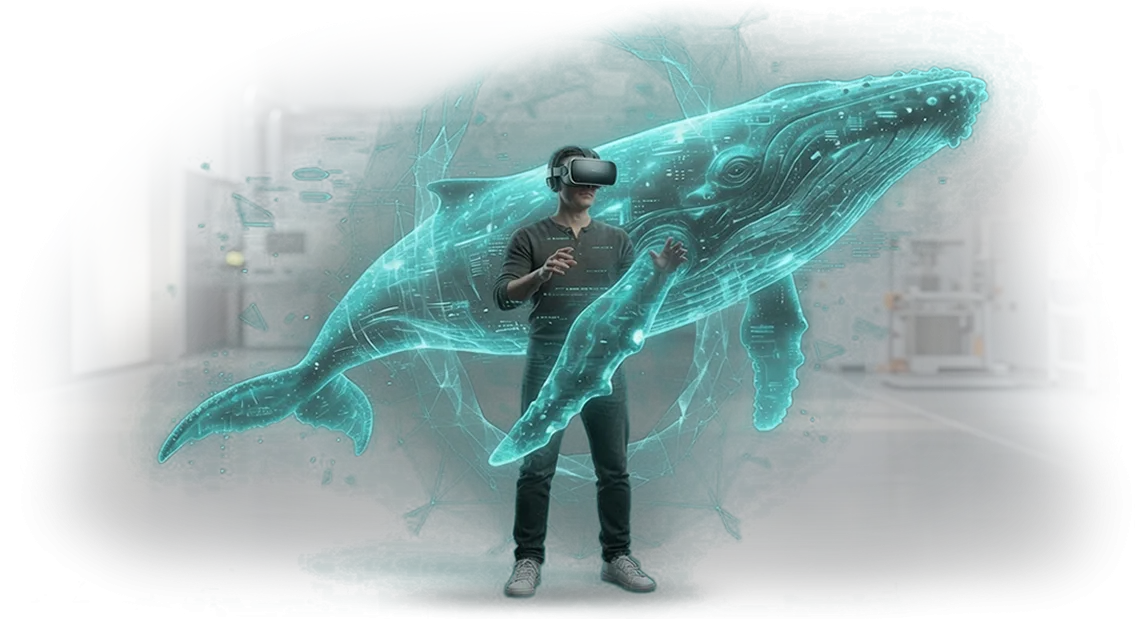
VR for a clinic is not a toy, but a medical marketing tool. With virtual reality, you can show a patient how a procedure goes, what results to expect, and relieve fear of treatment.
This increases trust and conversion to appointments, and also reduces consultation time — the doctor doesn't waste words on explanations but demonstrates right away. Patients remember better what they saw with their own eyes and return more often.
Outdated staff training methods also cost the clinic money. New employees take a long time to learn protocols, make mistakes, and patients feel it.
Modern VR simulators based on professional equipment such as HTC Vive allow practicing skills without risk to patients and get doctors into the work rhythm faster. This reduces the burden on mentors and accelerates the employee's transition to full workload.
We develop VR solutions for healthcare tailored to your clinic's tasks: from demonstrating services to patients to training staff. Implementation takes several weeks, and the effect is visible immediately — growth in appointments, increased loyalty, and recognition. We help close the problem of losing patients and get ahead of competitors.
VR for healthcare: patient attention and loyalty growth
For a medical center, every patient is a chain of impressions: booking, waiting, appointment, treatment. The more anxious a person is, the lower the trust and willingness to return.
VR technologies change the rules of the game: the patient immerses in a calm virtual environment and remembers care, not pain.
our team develops VR applications for healthcare — from surgery preparation to rehabilitation. We combine professional equipment and scenarios created by doctors and psychologists, so the result is tangible for both the patient and the clinic.
VR implementation is not entertainment, but a tool for increasing loyalty and attracting new patients. Virtual reality relieves anxiety, reduces the perception of time during procedures, and makes rehabilitation more varied.
Patients are more likely to choose a clinic that cares in unconventional ways. A person recovers faster and shares positive experiences — this increases satisfaction and repeat visits.
For a private clinic, VR is a competitive advantage that cannot be copied with a discount. And for a large center, it's a way to reduce stress while waiting for an appointment and ease the workload on staff.
We take the path from idea to launch and support: we study the specifics of your department, design the scenario with your specialists, and test it on patients. Support and updates are included — the technology doesn't become obsolete.
If you're thinking about implementing VR in your medical center — start with a short conversation. We'll offer a solution for your task and show how it works in practice.
VR application formats for healthcare: choose by task
In healthcare, VR addresses three typical tasks: staff training, patient rehabilitation, and stress reduction before procedures. The chosen format directly determines how quickly you get measurable results. Below are the main formats and tips on which one fits your task.
| Format | For what task | What it gives the clinic |
|---|---|---|
| Virtual tour | Familiarization with the department, preparation for a procedure | Reduces patient anxiety, saves medical staff time |
| Training simulator | Practicing skills, algorithms, rare cases | Trains staff without risk to patients or equipment |
| VR rehabilitation | Restoring movement, balance, cognitive functions | Increases engagement in exercises and provides progress data |
How to choose a format
Determine who the user will be and what result you want to measure. For staff training, choose a simulator with error analysis and action assessment. For patients before surgery — a virtual tour that reduces fear and speeds up adaptation.
For recovery after injuries — rehabilitation programs with adaptive difficulty so the patient doesn't lose motivation.
We work on professional VR equipment, including HTC Vive — this guarantees stable operation even with intensive use. We'll help you choose a format, adapt it to your scenarios, and integrate it with current processes.
Start with a short brief — we'll answer your questions, offer a solution for your task, and calculate timelines.
How we implement VR in healthcare: project stages
Implementing VR in a medical organization is a project that must fit into everyday processes. Patient safety and doctor trust are at stake. That's why we divide the work into stages: you see intermediate results and control every step.
Stages of VR development for healthcare
-
Brief and task audit. We study your request: rehabilitation, staff training, patient distraction. We determine where VR development will deliver a measurable effect.
-
Scenario design. Together with your specialists, we describe scenarios and session durations. We align the protocol so VR helps rather than hinders medical staff.
-
Prototype and expert testing. We show doctors a working prototype and collect edits — before investing in full development.
-
VR application development. We create content and an administration system. You see intermediate versions regularly, not just at the end of the project.
-
Pilot operation. We launch a pilot in the department with a small group. We check who is responsible for equipment and refine the product based on feedback.
-
Implementation and team training. We configure the system, prepare instructions, and train doctors. Staff quickly start using VR confidently.
-
Support and new scenarios. After launch, we stay in touch: we update content, add exercises, and evaluate how VR affects results.
This process is flexible: if your medical organization has different priorities, we'll start with the stage that matters most for the specific project.
What you get as a result of VR solution development
Developing a VR solution for healthcare is not just an "app in a box." We deliver a complete product that your team can use independently: from first launch to daily work with patients.
Below is the full scope of delivery so you know exactly what you're paying for and what remains yours after project completion.
- VR application for your task. A ready-to-launch solution for HTC Vive, adapted to the clinic's scenarios: rehabilitation, stress reduction, staff training, or patient preparation for procedures. The interface is clear without special training.
- Delivery package. Source codes, deployment instructions, and licenses — everything is documented and transferred to your server. You are not dependent on the vendor and can develop the system with your own team or bring in any contractor.
- Documentation. A physician's guide, a scenario administrator's manual, and patient safety regulations. All documents are in simple, clear language with pre-session checklists.
- Staff training. We conduct in-person or online training for your employees: how to launch sessions, monitor patient condition, and quickly resolve common issues. 2-3 sessions — and staff works independently.
- Post-launch support. Warranty support and updates for your tasks. If new scenarios appear or regulations change, we'll refine the solution without rewriting the entire system.
- Transparent handover process. Acceptance based on pre-agreed criteria: stable operation, compliance with medical protocols, staff readiness. You accept the result only when it is confirmed in practice.
In the end, you get not just technology but a working tool integrated into the clinic's processes that delivers a measurable effect from the first weeks.
A clear scope of delivery removes the risk of hidden costs and makes the result predictable — that's exactly how we work with medical institutions.
Case study: how a VR simulator improved diagnostic accuracy in a clinic
Implementing a VR simulator in a medical center is not a story about technology, but a story about accuracy and the doctor's time.
Our client, a network of diagnostic clinics, faced a typical pain point: trainees and interns took a long time to learn to interpret complex clinical cases, and experienced specialists spent up to 20 minutes on each examination.
We proposed a VR-based solution: an interactive simulator with realistic disease scenarios. The doctor "immerses" into a virtual office where a patient with a set of symptoms is in front of them.
The specialist's task is to conduct the examination, ask questions, and make a diagnosis. The system records every action and provides an assessment.
The results exceeded expectations. After three months of use, diagnostic accuracy among young specialists increased by 34%, and the average time to make a preliminary diagnosis dropped from 18 to 11 minutes.
The clinic's management received transparent statistics for each doctor and was able to address weak points precisely. After a pilot launch in one department, the simulator was implemented across all branches of the network.
Metrics that speak for themselves
For you as a manager, it's important that the result is measurable and fits into reporting. We've compiled the key case indicators into a table — it's easier to see what tasks the VR simulator addresses.
| Metric | Before implementation | After implementation | Effect for the clinic |
|---|---|---|---|
| Diagnostic accuracy among trainees | 68% | 91% | Fewer errors, higher patient trust |
| Average examination time | 18 minutes | 11 minutes | More appointments per day without overloading doctors |
| Patient return visits | 30% | 44% | Higher loyalty and revenue |
| Trainee training time | 40 hours | 14 hours | Faster transition to independent work |
The clinic recouped its investment in the simulator in 5 months — thanks to an increase in the number of appointments and a reduction in diagnostic errors.
We continue to support the project: we update scenarios to align with new clinical recommendations and help adapt the simulator for cardiology and neurology departments. If you'd like to discuss a similar case for your clinic — contact us, we'll show a demo on your data.
How to choose the right VR format for your clinic?
The answer depends on the tasks facing the clinic. If you need to speed up the adaptation of young specialists and practice rare scenarios without risk to patients, an interactive simulator with virtual reception scenarios is the right fit.
If the goal is patient recovery after injuries or strokes, you'll need a format with motion capture and exercise adaptation for a specific person. We always look at the clinical result first, and only then select the format and equipment.
The audience also influences the decision. For elderly people and those encountering VR for the first time, the simplest scenarios, calm graphics, and short sessions are essential — such formats reduce the risk of disorientation.
For young patients and staff, more dynamic simulations with high engagement can be used. We determine the appropriate format at the brief stage so that hardware limitations don't come as a surprise after launch.
The next criterion is the duration of use and integration into existing processes. If VR is used as part of regular rehabilitation, a stationary solution is chosen that doesn't require constant configuration by a specialist.
If we're talking about mobile programs or multiple offices, a mobile configuration that can be easily moved between locations is more sensible. It's important that VR fits into the schedule and doesn't create extra burden on medical staff.
Finally, the total cost of ownership is assessed: not only the development cost, but also support, content updates, staff training, and technical support. We offer solutions that remain relevant for years and always document this in the project development plan.
In any case, choosing a VR format is not a matter of technology but a matter of alignment with the clinic's tasks — and here it's better to rely on expert experience rather than generic solution catalogs.
We analyze your scenarios, suggest the optimal format, and justify its effectiveness before development begins. This helps avoid unnecessary costs and focus immediately on a result that matters to doctors and is safe for patients.
Answers to frequent questions about VR development for medicine
Questions about VR for medicine are always the same: is it safe, how much does it cost, how to implement it. We answer the most common ones.
How long will VR development for medicine take?
A simple simulator for training or rehabilitation is launched in 2-3 months; more complex scenarios take up to six months. You see the result on the prototype and fine-tune details before release.
What is needed to start?
A description of the task is enough: who will use the VR and what result matters most. We'll propose scenarios, select equipment, and create a plan with stages and timelines.
How safe is VR for patients?
We use professional equipment and short sessions with breaks to avoid discomfort. Medical scenarios are reviewed together with the clinic's specialists.
Why does the cost differ?
The price depends on the number of scenarios, workstations, and integration with your systems. We'll find an option for your budget; the estimate will be transparent and agreed upon before start.
Which technical issues do you handle?
We configure scenarios, results collection, and compatibility with your equipment. Doctors don't need to understand the technology — the interface is simple, and support continues after launch.
Didn't find your question? Write to us — we'll advise whether VR fits your task and propose a plan with first results.Discuss your task: get a VR solution estimate in 1 day
VR solutions in healthcare are already helping clinics accelerate rehabilitation, reduce patient stress, and improve staff training quality. But before investing in development, it's important to understand which format fits your specific task and what it will cost.
We offer a consultation and a VR solution estimate in one day — you'll get a clear plan with budget and timelines.
You don't need to understand technologies or research the market. Just describe your task — we'll pick the optimal solution and prepare the estimate.
Thanks to our experience with medical VR projects, we immediately cut out the unnecessary and offer realistic implementation timelines.
What's included in the estimate:
- Assessment of VR applicability for your clinical task and current processes.
- Format selection: surgery simulation, rehabilitation simulator, staff training, or patient visualization.
- Cost calculation for development, testing, and technical support.
- Approximate implementation timelines broken down by stage.
- Recommendations for integrating the solution into the clinic's workflow without stopping appointments.
- Option to view a demo version before the final decision to launch the project.
Leave a request on the website or write to us via messenger — by the next day you'll know how VR can strengthen your clinic. At the consultation we'll discuss the task, answer questions, and if the solution fits, prepare a detailed estimate. Start with a conversation — it's non-binding, but gives you clarity and confidence in the decision.