



Why don't staff training and retraining deliver the desired results?
Classic formats — lectures, presentations, video courses — turn staff training into passive listening. Information is absorbed only partially, and within a week most employees remember only isolated fragments. As a result, you invest resources, but training effectiveness remains low.
Retraining faces an even bigger problem: new skills require practice, but training on real equipment or in a live process environment is too risky. A beginner's mistake leads to downtime, defects, or missed deadlines. So employees learn slowly and often never reach the required level of competency.
The market changes quickly — companies must master new technologies and processes in a matter of months, not years. When corporate training lags behind the pace of change, the business loses ground: work speed drops, service quality falls, and turnover rises.
We close this gap by moving training into a virtual environment. The employee gets the chance to act rather than listen: they immerse themselves in a realistic scenario, practice as many times as needed, and immediately see the consequences of their decisions.
Mistakes are made in a safe space and do not harm the business — but the skill is formed just as it would be when working with a real object.
This approach makes staff retraining fast, visual, and measurable: you know in advance which scenarios employees will work through, and you can see each employee's progress.
Training turns from a formal procedure into a tool that directly affects your company's operational efficiency and competitiveness.
What does the metaverse bring to your business and employees?
Employees learn faster when they are inside a work situation rather than listening to theory.
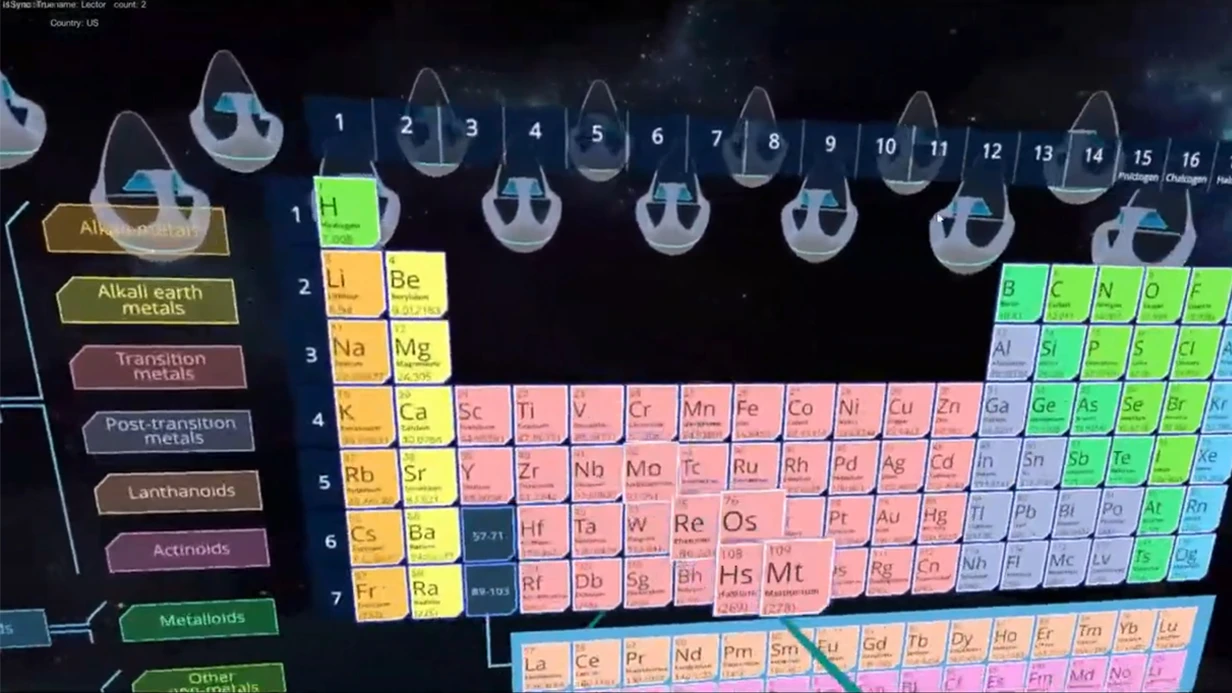
A corporate metaverse creates exactly that environment: a new specialist enters a digital replica of a workshop, warehouse, or meeting room and masters processes through hands-on practice from day one.
This cuts the onboarding period from several weeks to several days and lets a newcomer reach full performance earlier than with classic lectures and briefings.
Engagement in virtual training is fundamentally higher. Instead of passively watching presentations, the employee acts, makes decisions, and sees the consequences immediately. Interactive scenarios hold attention, and elements of competition and achievement sustain motivation.
As a result, knowledge is absorbed more deeply and stays in memory longer — this directly affects work quality and reduces the number of errors.
Practicing complex and dangerous skills in the metaverse carries no risk for people or equipment. The employee can try different approaches, deliberately make mistakes, and learn from them without harming the business.
This is especially valuable for manufacturing, medicine, logistics, and service industries, where the cost of an error is high and staff qualifications determine the company's reputation.
Modern job seekers, especially young professionals, choose an employer who keeps up with technology. Having virtual training and a corporate metaverse becomes a strong argument in the battle for talent.
The company gains the image of a progressive employer and also the ability to quickly retrain the team for new standards and products. This is not just training — it is a strategic advantage that pays off through increased efficiency and employee loyalty.
VR/AR solution formats for different company tasks
Executives often perceive VR/AR as a "box-ticking technology" — expensive and non-essential.
In practice, it is a set of ready-made formats, each addressing a specific business task: from initial training for newcomers to retraining a team for new standards and regulations.
We select a format not "out of love for technology" but based on your process and the expected result.
That is why one project can combine several solutions — the key is that each one delivers measurable value: faster time-to-role, fewer errors, lower costs for in-person training.
| Format | Business tasks addressed | What it delivers for the company |
|---|---|---|
| Virtual trainers | Practicing repetitive operations until they become automatic | Reduced preparation time and fewer errors in real work |
| VR simulations | Complex, dangerous, or rare situations | Safe training without risk to staff or equipment, with no downtime |
| Virtual classrooms | Group training for employees in different cities | A single standard of knowledge and savings on travel and venue rental |
| AR instructions | On-the-job guidance right at the workplace | Faster time-to-performance for new hires and reduced load on mentors |
Formats are easy to combine: first, the employee goes through a virtual simulation, and then receives AR prompts in real work. This creates a complete cycle — from initial training to retraining experienced staff for new processes.
We will help you choose the optimal option for your tasks, team size, and budget. Simply describe what your employees need to learn — we will then propose the format that will get you to the desired business metrics fastest.
How a corporate virtual space is implemented
Implementing VR in training seems complicated only while the process is opaque. We structure the work so that the client understands at every stage what is happening, why it is needed, and what result they will get. No "black boxes" — only clear steps, timelines, and accountability for the result.
- Brief and task audit. We capture which skills need to be developed, who will be learning, and how the result will be measured. The output is a scenario and a VR implementation plan.
- Prototype and scenario. We show what the virtual space and exercises will look like. We agree on details before development begins — changes at this stage cost less.
- Turnkey development. We build the learning environment, populate it with scenarios and an interface. The client receives regular demos and sees progress.
- Testing with your employees. We check with real users: usability, clarity of instructions, absence of errors. We incorporate feedback before launch.
- Launch and administrator training. We deploy the system, connect equipment, and hand over clear instructions to the team. Employees will be able to launch sessions on their own.
- Support and evolution. We stay in touch after launch: updating scenarios, adding exercises, helping expand the training program.
This sequence makes implementation predictable and eliminates surprises. You know the timelines, project stages, and cost in advance — and in the end you get a working training tool that pays off through faster staff preparation and reduced training costs.
What is included in a VR/AR project delivery
The client receives not just an application but a ready-to-use working tool for training and retraining staff. We take on the entire cycle — from scenario to implementation and support. The delivery includes everything needed for launch and effective use.
- Training scenario: we design learning objectives, narrative, and interaction logic so the employee masters the material through practice.
- Design and 3D graphics: we create interfaces and visual scenes that are clear and comfortable for the user.
- VR/AR/MR application: we develop it for your tasks and make it compatible with equipment you already have — or help you select suitable hardware.
- Integration with learning systems: we connect results tracking, progress recording, and build clear reports for the manager.
- Documentation and instructions: we provide materials for administrators and employees so that launch does not depend on one specialist.
- Support and evolution: we ensure stable operation and make changes as your programs grow.
This approach is true turnkey development: you get a complete project that immediately serves your business objective. Just describe the skills your staff needs to develop — we will take care of the rest and deliver the result.
Case study: how a distributor cut new-hire onboarding time in half
A large distributor with branches in six regions faced a typical problem: new employees only reached independent work after five to six weeks.
Classic training — lectures and mentor shadowing — did not provide the needed speed, and experienced specialists spent up to a third of their working time repeating the same instructions.
We proposed a corporate metaverse instead: a trainee enters a virtual copy of the warehouse, sales floor, and customer zone. Here they can practice typical situations without risk to the business — from processing a return to handling an irregular delivery.
A mistake does not lead to losses, and the system prompts the correct procedure right in the process.
What changed after implementation
- The average onboarding time for new employees was cut in half — from five weeks to two and a half.
- The number of repeated errors in the first month of work fell by almost a third.
- The load on mentors decreased, and turnover during the probation period dropped noticeably.
"Previously, training quality depended on which mentor you got. Now every trainee goes through the same scenarios — the result has become predictable.
For the first time, we saw how an entire shift can be retrained in a week rather than a month," noted the head of the training center at Восток-Дистрибуция.
Six months later, the client returned for a second module — to retrain experienced employees for a new business line.
This confirms the key point: the metaverse solves not a one-off problem but becomes part of the company's training system, delivering measurable results with every new cohort of hires.
How to choose the right virtual program format?
The key question is not about technology but about how the format solves the training and retraining task. Virtual programs vary widely: a short trainer for skill practice, a full corporate metaverse with multiple roles and scenarios.
We match the format to your specifics — number of employees, complexity of operations, and the need for reporting to management.
Here are the main concerns we hear from clients before the start, and how they are addressed in practice.
How much does development cost?
The cost depends on the number of scenarios and whether integration with the learning base is needed. We calculate the exact estimate after the brief and offer options — from a pilot module to a full corporate program. Payment is tied to your tasks, so you always see what you are paying for.
Is VR difficult for employees to use?
No preparation is needed: the controls are learned in a couple of minutes, and instructions are built right into the scenario. You only need one person on your side to issue the equipment and manage the schedule. Updates, configuration, and technical support are handled by us.
Is this kind of training safe?
Programs are designed without sudden movements or unnecessary strain on the vestibular system. Sessions typically last 20–30 minutes, and each participant goes through a short individual setup before starting. All scenarios are checked for comfort before launch.
Can it work with current training?
The virtual module does not replace briefings and theory — it strengthens them. Results are transferred to your learning system, and the manager can see each employee's progress — who has already practiced the skill and who needs another attempt. Existing processes are not disrupted; they simply become more effective.
The bottom line is simple: the right format is one that solves the training task and delivers a measurable result. Submit a request — we will propose a specific format for your process and calculate the cost of the pilot.Order the development of a VR project for effective training of your team
Staff training is an investment that pays off only when employees truly absorb the material and apply it in practice.
VR trainers deliver that result: safe skill practice without risk to equipment or people, engagement from the very first session, and measurable progress statistics.
But to get such a project, you don't need to understand technology — just submit a request, and we will handle the rest.
What you get immediately after reaching out
Contacting us is the first step toward a working solution for your team. Within one business day we will get in touch, provide a consultation, and show how VR training fits your specific task. Here is what the first contact includes:
- Consultation with an expert — we discuss your task, audience, and training goals, without technical details or complex jargon.
- Review of your existing scenario — we analyze your training materials and advise which format will deliver maximum effect.
- Format selection for your task — VR, AR, or a mixed solution: for skill practice, mentoring, or mass onboarding.
- Preliminary project plan — stages, timelines, and resources needed for launch, explained in plain language.
- Transparent budget estimate — you receive an investment range before work begins, with no hidden surcharges.
- Implementation recommendations — how to quickly integrate training into current processes and measure results with KPIs.
How we begin the work
After the consultation, you receive a prepared proposal with goals, stages, and timelines. No "we'll call you later" — within a couple of days you have a ready plan in hand. Then we launch the design phase, align the scenario with your experts, and begin development.
Take the first step — submit a request to order a VR project, and we will help turn your team's training into a systematic, measurable, and engaging process. The results won't take long to arrive.