




Customers Are Switching to Competitors — They Want Furniture and Interior in VR
Furniture buyers rarely make a decision based on a picture: in photos, scale and compatibility with the interior finishes aren't obvious.
The customer goes to a showroom where they can "touch" the product, or to a competitor that already offers virtual furniture fitting. Lost orders aren't about missing assortment — they're about the visitor's uncertainty in their choice.
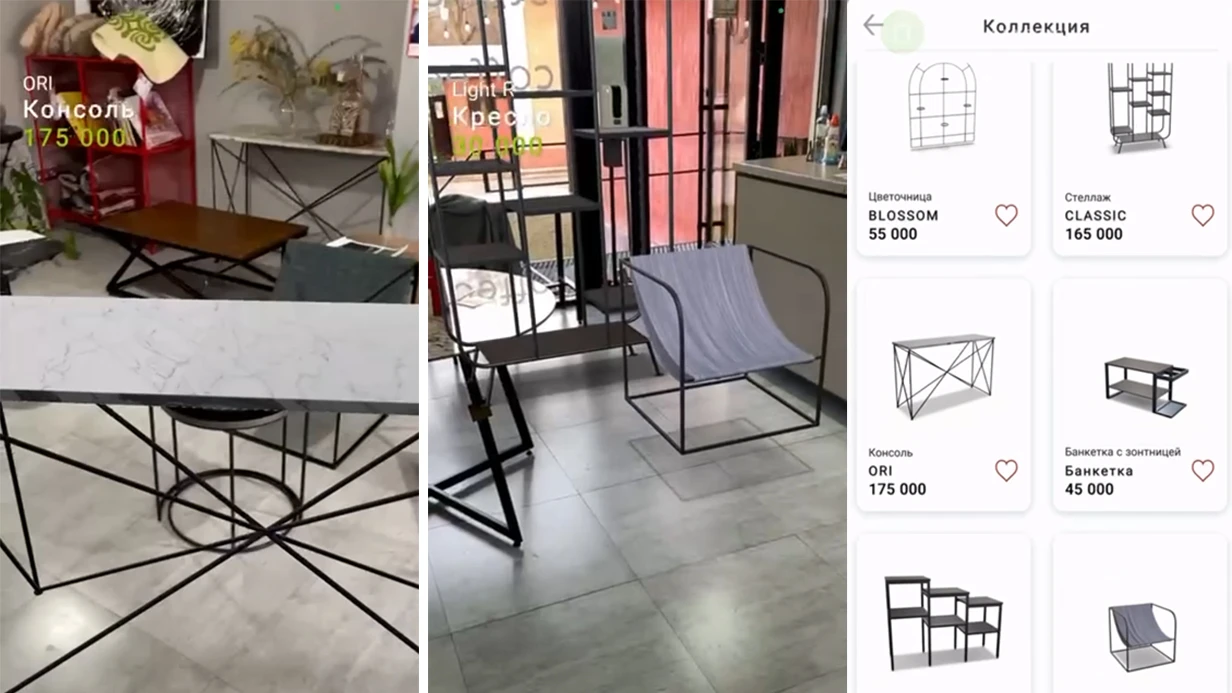
Furniture and interior design are about the feel of a space. Virtual furniture fitting removes the main barrier before purchase: the buyer sees how a specific sofa or wardrobe will fit into their room, changes the color, material, and placement.
Convenient interior selection without trips to stores and the risk of getting the size wrong — that's what customers expect from a modern brand. Without such a tool, the buyer keeps looking where it exists.
Online furniture shopping becomes a deliberate step when the customer can "walk into" their interior and examine the item from every angle.
This experience builds trust, reduces returns, and increases the average order value: the customer is bolder about adding extra items.
That's why the search for "furniture and interior in VR" is growing in popularity — it's already the standard in online furniture retail.
We develop virtual showrooms and furniture fitting applications that turn doubt into a purchasing decision. Your customers will stop switching to competitors — they'll try the product before they pay. Contact us to discuss virtual fitting for your catalog.
What Benefits Your Business Gets from a VR Application
A furniture and interior buyer often hesitates to make a purchase because they can't picture how a new sofa or kitchen set will look in their room. Catalog photos don't convey scale, and doubts about making the right choice stall the decision. As a result, the store loses customers: conversion drops and the share of returns increases.
Virtual fitting in a VR application for Pico solves this problem. The customer puts on the headset and sees the selected item at real size right in their own apartment — they can walk around it, change the color, and even move it to another room.
This selection format removes fears, helps make a decision faster, and increases the store's conversion without discounts or concessions.
The average order value also grows. When a buyer sees an entire interior, they notice that an armchair, coffee table, or floor lamp would pair perfectly with the new sofa.
Trusting what they see, they're more willing to add complementary products to the cart — and you get additional sales.
Returns also decrease: the buyer assesses sizes, materials, and compatibility with the wall color in advance, so they're far less likely to change their mind after delivery. This saves you money on logistics and reselling.
In addition, using VR fitting increases trust in your brand: customers see that the company invests in customer convenience and modern technology, which means it can be trusted.
We know how to turn these benefits into a working tool for your store. We develop VR applications for Pico focused on furniture and interior design, and we support the project from concept to launch.
The result is higher conversion, a larger average order value, fewer returns, and loyal customers who come back for more purchases.
VR Project Formats for Furniture and Interior: Which One to Choose
For furniture businesses and interior studios, VR is valuable not for the technology itself but for the outcome: increased sales, customer engagement, and time savings.
Each format solves a different task, so start by defining your goal — present a collection, help choose a product, or offer a tour of a future interior.
Format Comparison
| Format | Who It's For | What It Provides |
|---|---|---|
| Virtual showroom | Salon, store, dealer | The entire assortment in one space without renting new floor area. Visitors walk through the halls and choose furniture as if in person. |
| 3D configurator | Sales department, online catalog | The customer changes fabric, color, and layout in real time, sees the price, and decides on an order faster. |
| Collection presentation | Marketing, buyers, exhibition | New arrivals are remembered better: guests view them in VR, share their impressions, and leave contacts. |
We develop projects for Pico and other popular headsets — you don't need to worry about the hardware. We'll find an option for your budget: from a standalone headset to a stationary VR system.
How to Choose a Format
Focus on the main task. For fast conversion growth, choose a 3D configurator. For an exhibition or salon opening, choose a virtual showroom. For launching a new collection, choose a VR presentation.
We often combine formats: the visitor explores the space in the headset and then changes furniture and decor in the same application.
Stages of VR Application Development: From Brief to Launch
You already understand why you need a VR application for furniture and interior design, but what matters just as much is how we'll get there. To keep the project smooth, without surprises in timeline and budget, we've built a transparent seven-step process. At every stage, you can see the interim result and influence the workflow.
- Project brief. We define the goals: what the user should do, which furniture models we show, and on which devices we launch. The output is a document that eliminates any ambiguity.
- Planning and estimate. We determine the scope of work, timeline, and team. You receive a plan with checkpoints — this is the basis for budget approval.
- Prototype and scenarios. We map out the logic: how the buyer examines the sofa, changes fabric, and measures dimensions. We approve the scenarios before development begins — this makes revisions cheaper.
- Design and mockup approval. We present the visual style, interface, and presentation of the models. Once you approve the mockups, we move to production.
- Development and integration. We build the application, connect your 3D models, and configure physics, lighting, and controls. We also prepare builds for the target devices — from Pico to other popular headsets.
- Testing on real hardware. We check usability, performance, and the absence of errors. You participate too: you see the application in action before the official launch.
- Launch, support, and updates. We hand over the application, instructions, and training. We stay in touch: we help with updates, adding new products, and refinements.
This sequence guarantees you won't lose money on "blind" development — each stage ends with a concrete result. In the end, you get a sales tool, not a raw prototype that no one knows what to do with.
Ready to discuss your project? We'll start with a brief to understand your task.
What's Included in the Delivery of a VR Solution for Your Task
When you order a VR solution for furniture and interior design, you get not just an application but a complete business-ready tool.
We've thought through the delivery package so that after launch you're left with no questions — neither about the product, the team, nor the process.
Here's what's included in a standard VR project delivery:
- Ready-to-use VR application — visualization of your furniture and interiors, adapted to the equipment you use. It works from day one, without any "finishing touches" required from your team.
- Project source materials — 3D models, scenes, and files stay with you. You own the entire digital asset and can update it or hand it to another contractor if needed.
- Instructions for staff — clear step-by-step guides: how to turn on the equipment, launch the application, select a product, and end a session. Your managers and sales staff will master them in one go.
- Staff training — we conduct a hands-on session with your team, answer questions, and walk through typical customer scenarios. After that, your staff works without needing the developers.
- Technical support — for an agreed period, we stay by your side: we answer questions, help with updates, and resolve any issues quickly if they arise.
- Installation and setup — we handle the configuration of the VR equipment and check that the system works before handover. You switch it on — and it works.
This package addresses the client's biggest fear: being left alone with an application that no one knows how to use. Our VR project delivery isn't "here are the files — goodbye," but a full launch together with you: from installation to confident work by your staff.
The result is not just technology, but a working tool that delivers value and pays for itself in daily operations.
Case Study: Showroom Doubles Conversion with VR
A showroom is a compromise: it's impossible to display dozens of samples, and buyers can't imagine how a sofa they like will fit into their room. The result is prolonged hesitation, delayed decisions, and lost sales. That's exactly the problem a furniture chain owner brought to us.
We developed a VR application on the Pico headset that customers put on right in the showroom. They enter a virtual copy of their own apartment, choose furniture, change fabrics and colors, move items around — and immediately see the result at 1:1 scale.
No tape measures or calculation sheets: the buyer sees for themselves that the wardrobe will go exactly where they planned, and how the armchair matches the wallpaper. The salesperson just records the order.
The results exceeded expectations. Visitor-to-buyer conversion doubled, and the average selection time dropped from several days to a couple of hours. Returns due to "wrong size" virtually disappeared — the customer saw the dimensions before purchasing.
In the pilot salon, over 80 people tried furniture in VR in a single month, and more than half of them placed an order. Many returned with their family to show the interior to their spouse or children — the VR zone became an additional reason to visit the store.
The chain has already ordered the rollout of the VR zone to every salon. That's the clearest sign the case works: higher conversion, confident customers, and a repeat order to expand the project.
How to Choose the Right Format for Your Task?
Choosing a VR format starts not with technology but with the business task: what should the customer do inside the application? If the goal is to inspire and present a complete atmosphere, a virtual showroom is enough.
If you need to engage customers in choosing materials and furniture, you'll need a configurator. And for working with a large product range, an interactive catalog is more convenient.
Comparing a virtual showroom and a configurator shows two different sales logics. A showroom works on emotion and brand image, quickly "immersing" the visitor in a finished interior.
A configurator holds attention longer: the customer changes colors, textures, and layouts themselves — and comes out with exactly their own version. An interactive catalog speeds up the search and reduces order errors.
| Format | What Task It's For | What It Gives the Business |
|---|---|---|
| Virtual showroom | Present finished interiors and collections | Emotional presentation, greater brand recognition, viral guest photos |
| Configurator | Let the customer assemble their own furniture or room variant | Engagement, more time spent with the brand, more leads |
| Interactive catalog | Quickly find a product in a large assortment | Shorter selection time, fewer returns and clarification requests |
How to choose? Base it on the usage scenario. Presenting new salon arrivals — a showroom. Launching a kitchen or sofa line where the customer needs to "try on" colors and materials — a configurator.
If the assortment is huge and the salesperson spends a lot of time on selection — go with an interactive catalog with filters.
In practice, formats are often combined: in a virtual showroom, some exhibits open up into a configurator. The guest is first inspired by a finished picture and then creates their own project without leaving the application.
We help you choose the optimal setup for your niche — and only offer what will deliver measurable results for your direction.
Frequently Asked Questions Before Ordering
Before a project starts, clients always have practical questions: what happens to the source materials, how long until the result, and what happens if the equipment fails. We answer directly so you can make a decision without hidden risks.
How much does VR project development cost for furniture and interior design?
The cost depends on the number of finished interiors, the number of furniture models, and the format — virtual showroom, configurator, or staff training. At the start, we provide a commercial proposal with a fixed price after a short brief — it doesn't change during the process.
If you already have 3D models in a format suitable for visualization, that reduces the budget. We'll advise you on what needs refinement and what can be used right away.
What are the implementation timelines and what affects the speed?
A typical project takes 3 to 6 weeks: from preparing the first prototype to delivering the finished application. The timeline depends on the number of scenes, the complexity of the furniture interaction, and how ready your source materials are.
We set a schedule with checkpoints in advance. You see results as early as the first week — in the form of a working prototype, not a "picture in a presentation."
Do we need to provide drawings, photos, or 3D models?
To get started, floor plans, photos, or links to furniture models are enough. From there, we convert them into a unified standard: photorealistic textures, exact dimensions, and surface materials.
If you don't have 3D models, that's not a problem. We'll recreate the interior from the manufacturer's catalog and approve it with you before the final build.
What happens after launch if the equipment breaks or we need refinements?
We work with professional equipment designed for intensive use in showrooms and display halls. All delivered devices come with service maintenance and fast replacement under warranty.
For refinements, we don't lock you into a "subscription service." We agree on the scope of changes, set the price, and make the edits — just as transparently as at the start. Plus free support for the first few months after launch.
If you're unsure where to start, just write to us, and within one business day we'll prepare a preliminary estimate of timelines, deliverable scope, and budget for your task.Calculate the Cost of a VR Application for Your Task
Leave a request on the page — and within one business day you'll receive a cost calculation for a VR application tailored to your task.
For furniture and interior design, we don't calculate abstractly — we work from your scenario: virtual showroom, augmented reality catalog, staff training, or collection presentation at an exhibition.
You'll get not a quote for the sake of formality, but a working document you can use to plan your budget and launch the project.
Immediately after you reach out, you receive:
- Preliminary estimate — the exact development cost for your scope and format, with no hidden work or fine-print asterisks.
- Consultation — we explain where virtual reality will deliver the maximum effect: greater customer engagement, lower sample costs, or wider social media reach.
- Implementation plan — step-by-step timelines, team composition, and a list of what's needed from your side for launch.
- Format selection — we show which option fits you best: AR furniture fitting in an interior, a VR tour of a future space, or an interactive catalog.
- Risk assessment — we see problem areas in advance and propose solutions before development starts.
After your request, we follow a clear timeline: brief — concept — prototype — development — testing — launch. At any moment, you know what stage the project is at and when you'll get the result.
We document all decisions in writing so there are no gaps between expectations and the final outcome.
Ordering a VR application is simple: fill out the short form below, and we'll contact you at a convenient time. We start with the estimate and consultation — you make the decision without pressure or rushing.