



Why is e-commerce without VR/AR losing customers?
An e-commerce customer makes decisions in seconds, and their biggest fear is "not what I expected." Regular photos and videos don't convey the real sense of size, material, or scale.
Every second visitor hesitates, postpones the purchase, or leaves for a store where they can see the product up close. That is a direct loss of customers for your business.
Today, customer expectations are shaped by market leaders: they already use interactive formats — virtual try-on, 3D viewing, augmented reality in the interior.
While your online store shows flat images and same-type videos, competitors let customers "place" a sofa in their living room, "try on" glasses, or see how a jacket fits a figure.
The buyer chooses the e-commerce where it's easier to imagine the product as their own — and that isn't always you.
Losing customers in e-commerce isn't just about missed orders. It's a lower average order value, more returns, and fewer repeat purchases. When a person doubts a product, they look for a safer option and find it with competitors.
Meanwhile, you lose revenue and reputation while investing in ads that bring visitors but not purchases.
Interactive formats change the mechanics of choice: instead of guessing, the buyer gets an experience. VR/AR solutions allow customers to examine a product from all sides, change its color, and check how it fits a space. This removes the main objections and speeds up decisions. This is how e-commerce transforms from a display window into a tool for confident selling.
We help close that gap. We develop VR/AR solutions that integrate into your online store and work at every stage — from the product card to the cart. The buyer sees the product at real scale, interacts with it, tries it in their own environment — and decides in your favor. This is a way to win back lost customers and increase your e-commerce conversion rate.
What integrating VR and AR into your online store delivers
A customer can't hold the product, try it on, or understand its scale — that's why they hesitate and leave. VR/AR removes this barrier: integrating a virtual fitting room and AR catalog lets you show the product in the context of the customer's life before the purchase. The result — higher conversion and more confident orders.
Virtual try-on — for clothing, footwear, accessories, and even cosmetics. The customer points their camera and sees how the item looks on them or fits the interior. This reduces returns: people get what they expected because they've already "tried it on" in advance.
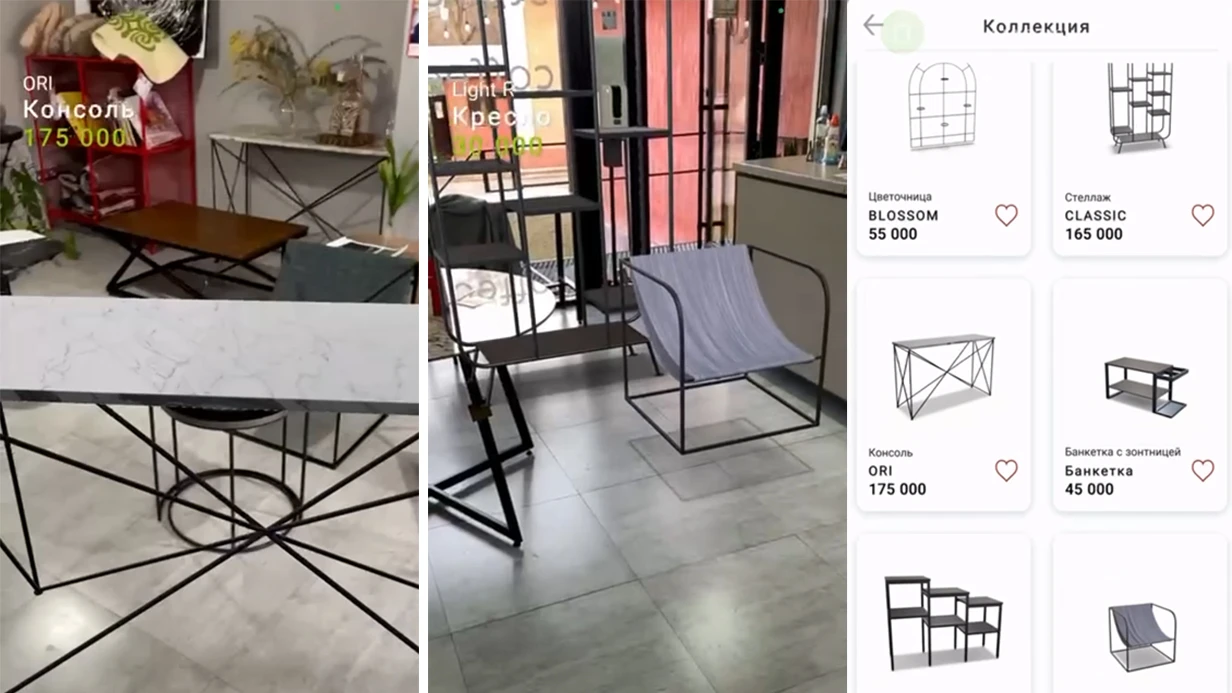
An AR catalog adds engagement: instead of a static product card, there's an interactive 3D model that can be rotated, enlarged, and placed in a room. This interaction holds attention 2-3 times longer than regular photos and encourages exploring other catalog items.
And every product demo becomes a reason to share the experience on social media, expanding brand reach without an advertising budget.
There's also a brand-image bonus. A store that adopts modern formats first is perceived as a tech-savvy leader, not a follower. This increases trust and brand value in the eyes of a young audience already used to interactive shopping.
In short: integrating VR and AR into an online store works on three business metrics at once — higher conversion, fewer returns, and stronger brand.
For our part, we've already delivered such projects for e-commerce: we'll help you choose the right scenario for your product, calculate the effect, and launch a solution that pays for itself.
VR/AR solution formats for e-commerce
It's hard for a customer to commit to a purchase if they can't picture the product in real life. Photos and specifications only give a general impression — questions about size, scale, and compatibility remain. That's why carts get abandoned and returns eat into profits. We close this gap with three augmented and virtual reality formats for e-commerce.
All formats integrate into your website and work on regular smartphones and tablets. The customer doesn't need to install complex apps — they simply open the product page and point their camera or put on VR glasses.
Three formats for your specific task
| Format | What task it serves | What the customer gets |
|---|---|---|
| VR fitting room | Choosing clothing, footwear, or accessories without going to a store | The buyer sees the item "on themselves," feels confident about size and fit — fewer returns and higher conversion |
| AR catalog | Showing the product in a real environment | The user "places" furniture, appliances, or decor in their own room and makes a faster decision |
| VR showroom | Exploring a wide assortment in a 3D space format | The visitor browses the display like in a store, without renting floor space or geographic limits |
Any of these options connects to your product database and updates along with your assortment. Just choose one format to start with, then connect the others as sales grow.
How development goes from brief to launch
Developing a VR/AR project for e-commerce is like opening a new storefront: without a clear plan, it's easy to get lost in details. We've organized the process so you're involved at every key stage and approvals take minimal time. From brief to launch, you see how an idea becomes a working sales tool.
-
Brief and goal setting. We get on a call and break down the goals: higher conversion, fewer returns, brand awareness. We lock in expectations and timelines, and you receive a work plan.
-
Scenario approval. We show how the customer will examine the product, try it on, or use augmented reality. You make edits before the main development starts — this saves budget.
-
Design and mockup approval. We prepare a visual solution aligned with your brand. At this stage, you make the final decision on style — the app looks like a natural extension of your website.
-
Development with regular demos. Every 1-2 weeks, we show a working part of the project: the product catalog, virtual try-on, the cart. You track progress and shift priorities as needed.
-
Testing and stability. We test the app on popular devices and give you access for your own testing. We collect feedback and polish scenarios until they work reliably.
-
Launch and support. We publish the app in stores and connect it to your website and accounting system. We train your team and stay in touch for post-launch improvements.
What's included in the delivery of a VR/AR solution
When you order a VR/AR solution for your e-commerce, it's important to understand what you'll get in the end. We hand over not just a link to a packaged app, but a complete package that makes you independent from the contractor and lets you develop the project at your own pace.
The delivery includes:
- The full set of created assets: scenes, models, graphic resources, and project files — everything used in development.
- Technical documentation and launch instructions: your team will quickly understand how the system works and how it connects to the product catalog.
- Employee training: we show how to add new products to the VR storefront, change display conditions, and manage scenarios without constant developer support.
- A warranty on the solution's functionality: we fix any errors or failures that may occur during operation free of charge for an agreed period.
- Post-launch support: we answer questions, help with updates and refinements, and support integration with your e-commerce platform.
The warranty and support are written into the contract — you know the response times and scope of maintenance work in advance. This eliminates surprises and hidden fees: the cost is fixed at the start, and all agreements are documented.
In the end, the delivery is a transparent package that covers everything: from source files to training and ongoing support. You get a working VR/AR solution, clear documentation, and a team that stays with you after launch. All that's left is to connect the storefront to your store and start welcoming new customers.
Case study: an in-app fitting room increased conversion by 34%
Returns and pre-purchase doubts are the biggest headache for an online clothing store. A product you can't touch or try on always triggers the fear of getting it wrong: what if it's too big, too small, or the fabric drapes wrong.
That's why about half of all carts are abandoned at the final stage, and shopping itself becomes a lottery with returns.
The client — FashionNet, an online fashion retailer. We implemented a virtual fitting room in their branded app: the customer creates a profile with their body measurements and literally "puts on" the item they like.
They see the fit, length, and cut, and rotate the model from every angle before clicking "Buy." Everything runs smoothly and fast: we used Unity so the app works reliably even on mid-range smartphones.
The effect exceeded forecasts. Conversion from view to purchase grew by 34%, and the average order value rose by 23% — customers stopped setting aside items that fit them well.
The share of returns dropped by nearly 20%, because shoppers can see the product on themselves beforehand. The store gained a loyal audience: customers started returning for repeat purchases, and the app itself became a full-fledged revenue channel.
In the end, the store got not just "an app with 3D models," but a working sales tool. Customers voluntarily share try-on screenshots on social media, generating free reach.
If your store already has a steady flow of visitors, such a fitting room pays for itself in the first season and delivers a measurable revenue boost.
How to choose the right VR/AR format for your task?
There is no universal format that suits everyone — the choice between VR and AR depends on the problem the store needs to solve.
If you want to show a product at real scale and in the customer's interior, augmented reality is the answer: the visitor "places" a sofa in their living room or tries on sneakers without leaving the app.
Virtual reality is stronger where the goal is to fully immerse the customer in the brand's atmosphere — for example, in a virtual showroom or at a new collection presentation.
The key criterion is the customer's path to a purchase decision. For products where size, color, and compatibility with the environment matter most, AR reduces hesitation and lowers returns.
For emotional and status purchases, VR creates an impression that sticks and builds loyalty. Our specialists help you honestly assess your assortment and choose a format that delivers measurable results, not just a "wow effect."
Budget and risk are the second key question. We suggest starting with a pilot: a small but telling scenario that launches several times faster than a full project and costs significantly less.
Based on the pilot results, you see real engagement figures, customer conversion, and user behavior — and only then do you decide on scaling. This approach lets you rely on facts, not guesswork.
We measure VR/AR payback in e-commerce through business metrics: higher add-to-cart conversion, lower return rates, higher average order value, and time spent with the product.
In our projects, interactive visualization increased conversion by dozens of percent, and return rates on products where customers "try on" the item dropped noticeably. We build these metrics into the goal and track them after launch.
We don't sell "technology for technology's sake" — first we analyze your assortment and purchase scenario, then we propose a specific format and pilot plan. You get a clear forecast, timelines, and success criteria before development starts.
That's the answer to "which format to choose": the one that solves your business problem with minimal risk and predictable payback.
Common client concerns before starting a VR/AR project
Before starting a VR/AR project, clients typically have the same concerns: how complicated is it, how much does it cost, will it work for their customers, and will the investment pay off. That's normal — new technology always raises questions.
We've collected the most common fears and address them directly, without tech jargon, so you can decide with a clear picture.
"Complexity: I won't understand it, isn't it too technical?"
We build the project around your business goal, not around the technology underneath. The interface is intuitive: employees master it in a couple of hours, and customers understand it at first glance. We handle all the technical side for you — you get a working tool, not a "black box."
"Price: it's expensive and I don't understand what the budget consists of?"
At the brief stage, we give you a cost range; after the design phase, we lock in an exact estimate. You always know what you're paying for: development, integration with your catalog, testing, and support. No hidden fees or "sudden" extra charges along the way.
"Compatibility: will it work for my customers on their devices?"
We test the project in advance on current phone and tablet models and optimize loading and rendering.
As a result, the app runs stably for the vast majority of users — no complaints about lag and no demands to "buy a new phone." Your customer shouldn't have to think about settings; they just open the camera and get the experience.
"Payback: how do I know the project will bring profit?"
Before launch, we help you establish metrics: product view conversion, interaction time, repeat visits. After release, you compare these numbers against regular sales and see the effect.
In our case studies, VR/AR projects for e-commerce increase conversion and average order value — customers decide faster when they see the product "live."
If your concern isn't on this list, that doesn't mean the question doesn't exist. Ask it at a consultation: we'll analyze your situation, show relevant examples, and propose a plan for the first steps. That way, you get peace of mind and clarity about where you're headed.Order VR/AR development for your online store
An online store can present a product beautifully, but the customer still hesitates: did they get the size, color, or texture wrong. VR/AR resolves those doubts and reduces returns, while customers spend more time in the catalog and complete their orders more often.
Turnkey development from our team transforms your storefront into an interactive experience that increases conversion.
Leave a request for a consultation — we'll calculate your project. No obligations: you'll get an estimate of timelines and scope, plus an understanding of which scenarios will bring the most value to your specific assortment.
What you get after reaching out:
- A project estimate and an honest cost assessment — no surprise add-ons during implementation.
- A demonstration of VR/AR capabilities using your actual products, not abstract pictures.
- Realistic launch timelines: from first results to a concrete release date — from one week to two or three months depending on the scenario.
- Scenario recommendations: try-on, virtual storefront, product visualization in the interior — what will deliver quick results in your niche.
- Readiness to scale: a solution that grows with your catalog without requiring a complete rebuild in six months.
- Post-launch support: we stay in touch, train your team, and help update content.
Send a request — we'll find a solution for your goals and show how VR/AR pays off in e-commerce. The consultation includes an estimate.