



Why Retail Loses Customers Without VR/AR
Shoppers no longer visit a store out of habit. Today they compare prices on their phones, read reviews, order with delivery — and if an offline location offers nothing but shelves, they leave.
Competition for attention and wallets is growing, and retail continues to lose sales conversion: there are visitors, but no purchases.
The problem is not assortment or prices. The customer cannot try on, imagine the product in their interior, or see it in action — and hesitates. Hesitation kills the sale. That is why the shopper goes online, where products are shown from every angle and confidence is higher.
VR/AR change this. Virtual try-on lets the customer "put on" clothes or accessories without a fitting room; an interactive catalog lets them rotate the product, change color, and see it in action. This removes the main objection — "not sure it suits me" — right in the store.
The technology also works for retention: people spend more time in the interactive zone, get involved in the process, and experience an emotion. And emotion turns a one-time visit into a regular one.
The store becomes a place people return to — and this directly affects sales conversion and average order value.
We help retailers implement VR/AR in a way that delivers measurable results: higher conversion, repeat visits, fewer returns. We design a solution around your business needs, not just "install equipment" — so shoppers get value, and you get profit.
What VR/AR Gives Your Store: 5 Key Benefits
Today's shoppers choose not just a product but an experience. A regular window display holds attention for a few seconds, while a VR/AR zone turns a shopping trip into an event people talk about.
This is not entertainment for its own sake — each of the five benefits directly affects revenue and loyalty.
First benefit — engagement. When shoppers "try on" clothes with AR or assemble a product in VR, they spend much more time in the store.
The longer a guest interacts with a product, the higher the purchase probability — that rule works in both digital and physical retail.
Second — repeat sales. An interactive experience is memorable, and customers return to show it to friends or try new scenarios.
Additionally, AR filters and virtual windows support omnichannel: a shopper may start a fitting at home and complete the purchase in the store, or vice versa.
Third benefit — brand awareness. The unusual format itself becomes a news hook: visitors share photos and videos on social media, and the advertising reach grows without extra budget.
Finally, VR/AR gives the store behavioral analytics: which items were tried on, how long they were studied, what was set aside. This data helps fine-tune displays, assortment, and personalized offers.
Together, these five effects turn the store into a platform that sells not only products but also experience. Professional Unity development using proven tools guarantees stable operation of solutions — from mobile AR filters to full VR showcases. The implementation pays off through higher average order value, repeat visits, and loyalty.
VR/AR Formats for Retail: Which to Choose
In retail, shoppers make decisions in minutes, and if they cannot inspect or try on an item — they go to competitors. VR/AR closes that gap: without replacing the physical store, it brings the store into an environment where the customer is comfortable. The retailer’s task is to choose the right format for their goal and audience.
Below are four working scenarios for retail: virtual showroom, AR navigation, 3D display, and clothing try-on. They are proven in real projects — they increase conversion, reduce returns, and give customers extra reasons to come back.
| Format | For whom | What it gives the customer |
|---|---|---|
| AR clothing try-on | Clothing, accessories, optics stores | Reduces returns, raises average order value, keeps users in the catalog |
| AR mall navigation | Shopping malls, boutiques, exhibitions | Guides visitors to the right department, increasing foot traffic and sales |
| 3D display | Brands, showrooms, marketplaces | Shows the product from any angle, encourages detailed exploration |
| Virtual showroom | Distributors, manufacturers, wholesale | Demonstrates assortment without renting space, speeds up deals |
The table is only a guideline. The right choice depends on what matters most: traffic, average order value, or repeat purchases. We start with a brief, analyze your audience, and propose a format that fits into current processes — from a web showcase to a mobile app.
In the end, you get not "technology for technology's sake" but a measurable result: higher conversion, fewer returns, a noticeable edge over competitors. Describe one pain point — we will handle the rest.
How We Build a VR/AR Project for Your Business: 7 Steps
A transparent development process matters to business: you know exactly what you will receive, in what time frame, and what decisions you make at each step.
We have structured our work so that you control the project's progress and can influence the result without surprises or hidden stages.
-
Brief and task immersion. We listen to your goals, study the audience, use cases, and context — showcase, staff training, product presentation. We define how VR/AR solves a specific business task, rather than simply "doing a template."
-
Audit and plan. We assess requirements, determine the optimal format, timeline, and budget. We prepare a roadmap with milestones — you see in advance how long each stage will take and what we are responsible for versus what you are.
-
Prototype. We create an interactive model of the future solution using simple objects. You test how it works, evaluate the logic and usability. At this stage, changes are cheap and fast — it is your chance to adjust details before full development begins.
-
Prototype approval. We lock down the visual design, scenarios, and technical specification. We approve the full scope of work and acceptance criteria — after that, there is no "let's add this" in the middle of development. Any changes are planned separately with a clear estimate.
-
Development. We build a fully functional application using professional equipment. We regularly show intermediate results — you see progress, test key mechanics, and make edits along the way, not at the end when rework is already expensive.
-
Launch. We test the solution on real devices used by your customers, fix discrepancies, configure installation and integration. We help train staff and prepare manuals — so the rollout happens without downtime.
-
Support and growth. After launch, we stay in touch: updating content, fixing bugs, adding new modules when business needs change. You always have a dedicated manager who knows your project and is responsible for the result.
This approach eliminates the risk of getting "the wrong thing": you participate in all key decisions, while we take responsibility for expertise and execution. That is why most clients return to us for their next projects — the best indicator of trust.
What You Get: Delivery Package
When you work with us on a VR/AR project for retail, you get more than just an application — you get a complete working tool that can be deployed and used the very next day.
We assemble the delivery package so your business doesn't have to figure anything out or finish anything: everything needed for launch and maintenance is already included in the project.
What's included:
- A ready-made application tailored to your tasks: virtual fitting room, product presentation, or interactive catalog. The solution is adapted to your equipment and runs reliably in a store or showroom environment.
- An admin panel for independent content management. You can change assortment, prices, promotions, and 3D models without developer involvement — just upload new data through a clear interface.
- Clear instructions for staff and technical personnel. No complex manuals — short guides that let the team quickly learn the system.
- Staff training through live demonstrations and scenario walkthroughs. We work with your salespeople and administrators so they confidently use the app in daily work and help customers.
- Source code of the project. You are not tied to us forever — the code stays at your disposal, and if needed, any future modification can be done by your in-house specialist or another team.
- Warranty and technical support for the entire period of cooperation. In case of questions or failures, you get prompt assistance, plus updates for new requirements and formats.
This package covers every stage — from first launch to daily operation. You get a solution that does not require constant developer presence on site, quickly pays for itself through customer engagement, and leaves you in full control of the product.
Case Study: How a VR Display Increased Sales by 27%
The client was a clothing store chain, "Trend," located in a shopping mall. The main pain point: window displays attracted attention, but visitors rarely came into the store and rarely shared impressions on social media.
We suggested replacing some static mannequins with a VR display: wearing a headset, shoppers "try on" several outfits, browse the collection with gestures, and immediately see how the garment fits.
Launch took 18 days — from the first discussion to a working display, without stopping the store's operations. In the first month alone, in-store sales grew by 27%, and average time at the display increased from 10 seconds to 4 minutes.
Most importantly, visitors began bringing friends to show them the unusual experience, and the share of repeat visits grew by a third.
We delivered the project turnkey: from concept and installation to content and staff training. Employees needed no additional expertise — the display is intuitively operated by the customer.
The store manager notes: "We expected young people to be interested, but the VR display became a point of attraction for all ages. Sales grew, and customers still remember the experience on their next visit — that's the best indicator for us."
From the chain's perspective, it was also a free PR opportunity: guests posted photos and videos, adding hundreds of brand mentions without any advertising budget. The case showed that even a single changed zone near the entrance can change shopper behavior and affect revenue.
How to Choose a VR/AR Format for Your Retail Location?
We hear this question often, and it is indeed key: the wrong VR/AR format can turn out to be just an expensive toy, while the right one can become a sales growth tool.
The answer depends not on trendy technologies but on the specifics of your store: what you sell, how customers make purchase decisions, and where the main doubts arise.
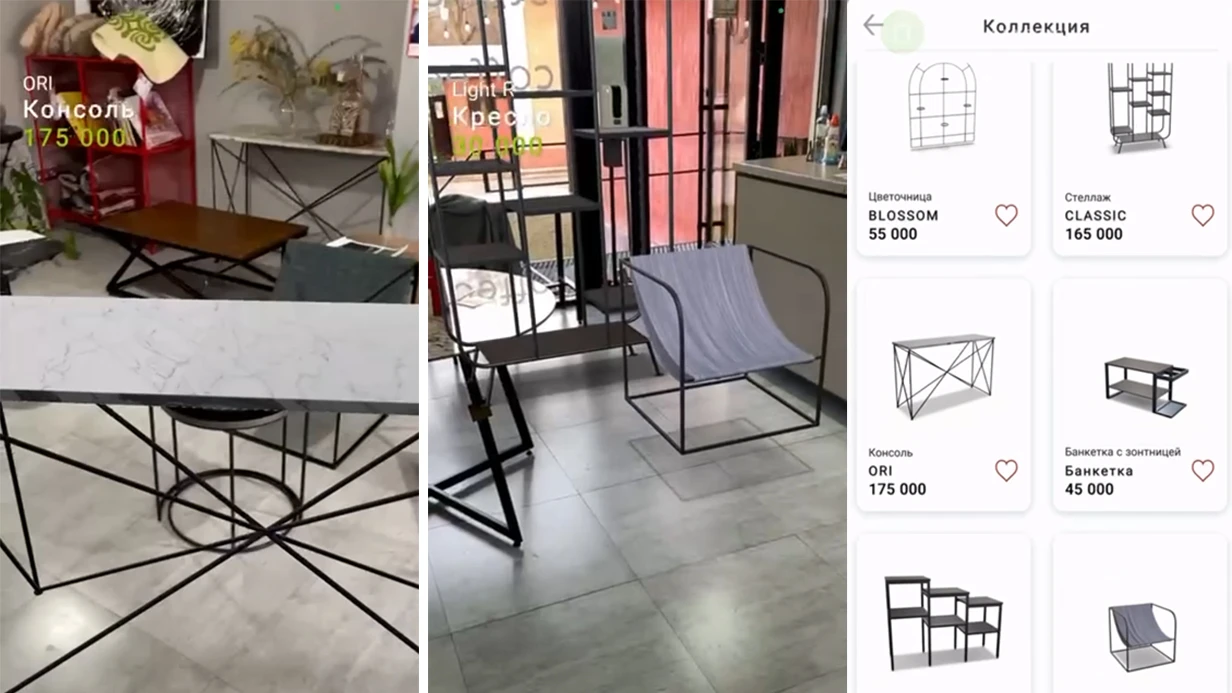
Start by analyzing the customer journey. If the main issue is uncertainty about how a product will look in real life (clothing, glasses, furniture, decor), your format is virtual try-on or AR product overlay onto the customer's space.
This removes the main barrier and speeds up the choice. If the assortment is wide but the floor space is limited, a VR catalog that shows hundreds of items on a small display will be effective.
For large stores or complicated layouts, AR navigation that guides the customer by the shortest route to the desired product provides real value.
Also consider your target audience. Young people engage easily with interactivity, while for older shoppers the interface should be as simple and intuitive as possible.
If your store operates in the impulse-buy segment, quick AR filters are enough; for considered purchases, you need a full VR zone with a consultant.
A properly chosen VR/AR solution always solves a specific business problem: it increases conversion from trying on to purchase, reduces time spent in queues, or raises the average order value.
Our specialists help select the right format for your retail location based on an analysis of the customer journey and your sales strategy. We will conduct a short audit ourselves and propose a scenario that delivers measurable results already at the pilot launch stage.
The key rule: the format should work for your store, not the other way around. Bring us your task, and we will help find a solution that pays off.
Common Doubts: What If VR/AR Doesn't Work?
Are you worried that VR/AR won't "work" in your store? That's normal: the technology seems complex, and the investment substantial.
We have worked with retail for 10 years and know how to turn virtual reality into measurable sales growth — through try-on, navigation, and interactive displays.
Return on investment is built in before the start. Together we set the metrics: reach, conversion, average order value, repeat visits. Based on these numbers, you decide which scenario to launch first.
We take on the technical risks: we integrate the solution with your accounting system, train staff in one day, and support a test run in a single department or store. In retail, this works immediately: virtual try-on reduces returns, and AR navigation increases upsells.
After a successful test, we decide together about scaling. The contract includes guarantees: functionality, achievement of agreed metrics, support response time. Support remains with us — from monitoring during peak sales hours to quick updates when the assortment changes.
What if the project doesn't deliver the expected result?
The guarantee is written into the contract: if the test launch does not meet the agreed metrics, we refine the solution at our expense or refund part of the payment.
The commercial result is preceded by an audit of your store and the selection of a scenario that matches your audience.
Who supports the system after launch?
All technical support is on our side. A personal manager and a monitoring team are available during business hours and peak sales periods. Critical issues are resolved the same day; others within a couple of hours.
Don't put off the decision: write to us, and we will show examples from retail chains where VR/AR paid off within the first months. We'll explain how to pick a scenario for your format — from a furniture showroom to a grocery store.Order Development of a VR/AR Application for Your Retail Business
Retail is going through a period where customers need to be surprised and retained. Simple displays and catalogs no longer deliver the required effect — customers want to interact with the product, try it on, and see it in their own space.
VR/AR applications change the game: they turn shopping into a vivid experience and directly affect revenue.
We develop such solutions for retail chains, brands, and shopping malls. Over 10+ years, we have created dozens of projects — from virtual fitting rooms to interactive displays that raise the average order value and bring customers back.
We use Unity as the industry standard: the application runs reliably on smartphones, tablets, and VR headsets, so your customers get the same experience from any device.
So you immediately understand the value of working with us, here is what you get after submitting a request:
- A consultation with a domain expert — we'll discuss how VR/AR fits into your store and which tasks to solve first.
- A cost and timeline estimate aligned with your budget — a transparent quote with no hidden fees.
- Format selection for your audience: virtual try-on, 3D catalog, AR display, or staff training.
- A prototype demonstration before development starts — you see what you are paying for and can adjust the idea.
- Integration with your CRM and accounting system — orders and customer data automatically reach the relevant departments.
- Guarantee and post-launch support — updates, refinements, and technical maintenance without surprises.
Why is it advantageous to work with us? We handle the entire cycle: from idea to launch. We work under a contract with a fixed price and clear deadlines. We have experience in retail, so we speak your language and understand what matters for sales and loyalty.
Leave a request on this page — we'll call you back within the day, answer all your questions, and prepare a personalized estimate. You can decide whether to continue after the consultation and action plan. We'll start by discussing your task — just write to us.