



What VR/AR implementation brings to construction
Implementing VR/AR in construction changes the project's economics: the cost of fixing errors falls, and the speed of decision-making increases.
A virtual model of the building brings together the client, architect, engineer, and contractor — everyone sees the same object rather than abstract drawings.
The main benefit is clarity. An investor or client can "walk through" future floors, check insolation, materials, and layout before work begins. There is no need to explain two-dimensional diagrams: objections are addressed before they turn into rework.
Clarity directly affects savings. An error found in the virtual model costs next to nothing compared to demolition, purchasing new materials, and crew downtime.
Early-stage VR checks reveal utility clashes, awkward heights, and the logic of people's movement — things that later become a construction site's biggest headache.
The speed of approvals increases manifold: instead of a series of meetings and lengthy exchanges of revisions — a short session in a virtual model or an AR tablet right on site.
Decisions are made in a single presentation, edits are recorded visually and immediately enter the shared model. This shortens the cycle from architectural concept to working documentation.
Another key value is sales and marketing. With a VR application, a company can showcase the future building in a showroom, at an exhibition, or on the construction site itself.
Buyers make decisions faster, trust in the project grows, and the number of cancellations and disputes drops.
Implementation does not require re-engineering processes: the virtual model is built on the basis of your project documentation and updates alongside it.
As a result, the company gains a working tool for all stages — from initial sketches to handing the facility over for operation — with lower losses and higher margins.
VR/AR formats for construction
A construction project involves dozens of decisions that need to be shown to different people: buyers, investors, engineers.
One format won't cover all tasks: some need to feel the space of a future apartment, others need to verify the actual state of a building against the project. That's why the format is chosen according to the specific stage of work and the client's task.
There is no one-size-fits-all solution, but there are proven scenarios that we implement in construction. From virtual tours for sales to AR overlays for site control — each option solves its own business problem.
| Format | For whom | What it gives the client |
|---|---|---|
| Virtual tour of the property | Sales department, clients | Shows apartments before construction begins, increases buyer confidence and speeds up the deal |
| VR project review | Project manager, investor | Allows "walking through" the future building, assess ergonomics and identify errors before construction starts |
| AR overlay on site | Chief engineer, construction control | Overlays the virtual model onto the real object — deviations from the project become visible, easy to coordinate nodes |
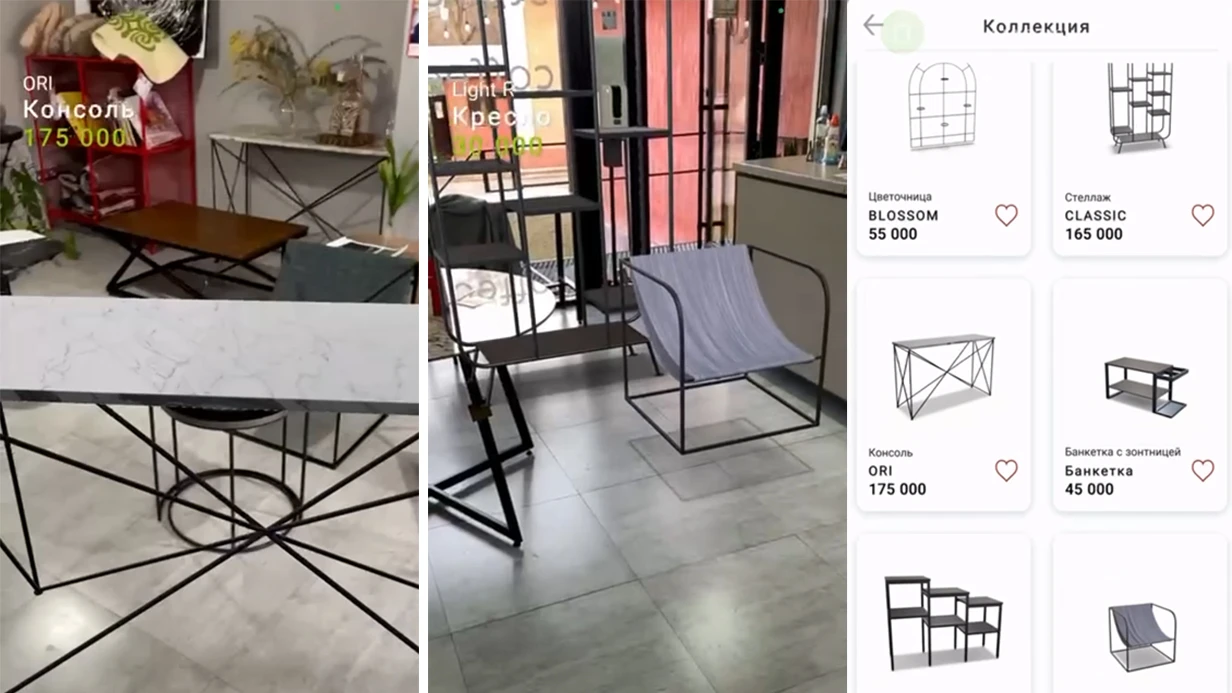
| AR interior overlay | Clients, designer | Shows finishing and furniture options directly on the plan, helps choose the final solution |
We implement every format so that it can be used by someone without technical training — on familiar devices, without complex setups. The client gets not a demo reel but a working tool: for sales, for control, or for project approval. The main thing is to define which task comes first, and we'll choose the right solution for it.
Stages of VR/AR development for construction
In construction, every mistake costs money, and misunderstandings between client and contractor cost lost weeks. That's why we structure VR/AR project work as a clear process with specific stages: you always know what is happening, what you get as a result, and how long it takes. No magic — just transparent steps agreed with you at the start.
-
Brief and task immersion. We define the goal: show the facility to an investor, train employees, or approve solutions with the client. We identify the site, audience, and expected outcome — so the project solves your business task from the very start.
-
Documentation and drawing analysis. We study layouts, the BIM model, estimates, and regulations. Based on this, we prepare a technical specification that both your engineers and our specialists understand — with no double interpretations.
-
Scenario prototype. We show how the user will move through the facility, what they will see, and what they will interact with. You approve the scenario before the main development begins — this eliminates expensive changes at the final stage.
-
VR/AR application development. We assemble the virtual object, configure realistic lighting, materials, and interactive elements. At this stage, you can already evaluate the intermediate result on your device or in our demo mode.
-
Testing on real devices. We test the application on the equipment you will use: headsets, tablets, or smartphones. Our specialists run through all scenarios so that nothing freezes or breaks on the day of the presentation.
-
Launch and support. We hand over the project, train your team, and stay in touch. If something needs to be improved after the first presentations, we make changes promptly.
This approach keeps the project under control and makes timelines predictable. You don't wait for a "result in three months" — you see progress at every stage and can adjust the course of work.
What is included in a VR/AR solution delivery
When you order a VR/AR solution for the construction industry, you get not just an application but a working package that your team will start using on the very first day. We provide everything needed: from a ready-made program to employee training and technical support. This is a tool that integrates into your processes, not a "box" with an unclear future.
- Ready-made application for your task. VR walkthrough of a future facility, AR installation of engineering nodes, or an interactive presentation for an investor — the solution is adapted to your process and your specific needs.
- Source data and documentation. Working models, scenes, settings, and instructions stay with you. You are not dependent on the contractor and can develop the project with other vendors.
- Employee training. We conduct sessions for engineers, site supervisors, and managers: we show how to use the solution in daily work, not just "press buttons".
- Accessible admin panel. You upload new layouts, change materials, and update the project yourself without contacting developers — saving time on each approval cycle.
- Launch and on-site implementation. We help with installation, equipment setup, and the first run — so the technology doesn't sit idle but delivers results immediately.
- Support and updates. We provide consultations after handover, promptly fix issues, and adapt the solution to new tasks. The warranty period and support terms are specified in the contract.
This package covers the entire cycle: from the first demonstration to daily use in the sales department, the engineering department, or on the construction site. You get not files but a manageable tool that pays off through faster approvals, clarity, and fewer errors.
Case study: how we implemented VR for a developer
Developer Atlant was selling apartments in a building that hadn't been built yet — and every day lost time on buyer objections. People didn't trust the layouts on flyers, and the sales department spent weeks on verbal explanations and follow-up letters. As a result, some clients went to competitors who were already showing their properties.
We proposed a VR solution: buyers in the sales office could put on a headset and "walk around" their future apartment — see the real sizes of rooms, lighting, the view from the window, and even switch between finishing options.
This removed the fear of buying a "pig in a poke" and made the selection process clear. The application was ready in a month and immediately integrated into the sales process.
After two months, the developer saw measurable results: layout approval time with clients was cut by 3 times — from three weeks to five days. Sales in properties with VR presentations grew by 25%, and the conversion from initial viewings to deals increased by 18%.
The sales department no longer faced the same typical objections, and every third buyer hesitated less before signing.
After the launch, Atlant ordered VR tours for the next two buildings right away — the project paid for itself and became the standard for working with clients.
We don't create visuals for effect; we build a working tool that saves a developer's resources and directly impacts revenue.
Frequently asked questions about VR/AR implementation
Construction clients rarely ask "why VR/AR" — the benefits are obvious. More often, they ask how implementation will affect timelines, budget, and team workflow, and whether they'll have to restructure established processes. Below are answers to the most common concerns we encounter during negotiations.
We intentionally provide short, concrete answers without technical depth — so you get the full picture before signing a contract. After the project starts, all details are recorded in the work plan, so the risk of surprises is minimal.
How difficult is it to implement VR/AR in a construction company's workflow?
Implementation does not require re-engineering processes or hiring new specialists. We adapt the solution to your current tasks: show the project to the client, check for clashes, and train staff.
Your team learns the program in a few hours — usually a short instruction and one training session are enough.
How long does application development take?
A typical project takes from two to six weeks, depending on the number of features and the volume of models. At the start, we define the stages and timelines, so you always see where development stands and when the result will be ready.
Urgent tasks can be completed in an accelerated mode if it's critical for a tender or an investor presentation.
How expensive is it and when will it pay off?
The cost of developing a VR/AR application is comparable to the price of regular business software.
But the effect is felt quickly: you see errors in the project earlier, spend less on approvals and site corrections, and a virtual reality presentation often becomes the decisive argument for a client. One successful tender or one prevented clash covers the investment.
Is the application compatible with our equipment?
In most cases, you don't need to buy expensive devices — we adapt the solution to what you already have, or suggest the best rental option.
We use professional equipment and popular headset and tablet models, check compatibility at the first stage, and give recommendations on selection if devices are still needed. You won't spend anything on equipment that won't work.
If you still have doubts, ask us directly — we'll respond within one business day and show examples of similar projects. It's important that you understand all the details before starting.Submit a request for VR/AR development
We understand that implementing VR/AR in construction is a significant step: you need to not only choose the technology but also understand how it will pay off.
That's why we don't sell a "flashy demo reel" but offer practical help — from task assessment to a working application that shortens approval timelines and helps win tenders.
Submit a request for VR/AR development — within one business day you'll receive a consultation from a specialist and a commercial proposal tailored to your project.
We'll review suitable scenarios: virtual walkthroughs for investors, worker safety training, interactive material catalogs, or quality control on the construction site.
In response to your request, you'll receive:
- an assessment of VR/AR applicability to your tasks with construction examples;
- a selection of existing cases for similar facilities;
- an implementation plan with stages, timelines, and responsible parties;
- a development cost estimate for a specific budget;
- a demo of an interface prototype before development starts;
- support and further improvements after launch.
This is without any obligation: you decide whether to move forward.
To make the conversation productive, think in advance about what task you want to solve — showing the project to a client at the excavation stage, training employees, or preparing a presentation for an investor. If you don't have a precise request, we'll help you formulate one.
Fill out the form below or write to us in any convenient messenger. We'll call you back, clarify the details, and arrange a consultation. Your project starts with a request — take the first step.
How to choose VR/AR for your task?
The direct answer: the choice between VR and AR is determined not by fashion but by the specific task.
VR fully immerses the user in a digital model — it's the right option when you need to show an object that doesn't exist yet: present a project to an investor, walk a client through future floors, or train employees in a safe environment.
AR, on the other hand, overlays digital data onto the real object and is indispensable on a construction site, where you need to compare the project with the actual state, control installation accuracy, or clearly show the crew where utilities will run.
To decide, ask yourself one question: what should change after implementation — perception or action? If you need a person to remember the project and make a financing decision, choose VR: it creates a sense of presence and works more powerfully than any drawings.
If the task is to speed up on-site work and reduce errors, AR helps an engineer see the project over a real wall without being distracted by tablets and paper.
The user scenario also matters. In an office, at an exhibition, or during sales, VR is convenient for groups and demonstrations, while AR is more practical on a construction site because it leaves your hands free and doesn't require stationary equipment.
We also consider the scale: for small facilities, one format is enough; for large projects, a combination of VR and AR is often effective, when the office shows the big picture and the site shows details in place.
Our approach to selection is based on task auditing and rapid prototyping. We study who exactly will use the solution, what processes it affects, and what outcome you expect, then propose an option that saves budget and time rather than experimenting for the sake of technology.
You don't need to decide in advance that only VR or only AR is right for you. Send us your task — we'll analyze it and suggest something that actually solves the problem, not just looks good in a report.