



Customers leave because there is no product try-on
Every other online shopper leaves a product page without deciding to buy. The reason is simple: without trying the product, doubt remains — will the size fit, how will it look, will it have to be returned.
That doubt costs businesses lost sales, and the losses are visible both in small stores and large marketplaces.
It gets worse from there. A user who did not get the experience they needed is unlikely to return to the store, and a negative "it did not fit" experience or a long return process quickly becomes the subject of reviews.
Brand reputation suffers, and competitors who already offer virtual try-on take the customer with one click. Every such exit is not only a lost deal, but also a lost loyal customer for years to come.
The problem is compounded by the fact that standard photos and videos do not convey how an item fits on a specific person. Even a detailed size chart does not remove the fear of making a mistake, because every customer is unique.
Online retail wins where the customer can see the product on themselves almost like in an offline boutique. While you only offer a picture, your competitor offers interactivity — and the choice is obvious.
This is exactly the opportunity provided by virtual try-on based on VR/AR solutions. We help set it up for your product range and website so that visitors stop hesitating and confidently place orders.
Lost sales turn into increased conversion — we'll show you how it works for your product. A simple scenario is enough: a customer turns on the camera, selects a product and sees it on themselves; then the purchase decision is made easily and quickly.
What results a virtual showroom delivers
A virtual showroom is not just an opportunity to "rotate a product" on a phone. It is a tool that shortens the distance between interest and purchase: the customer sees the item in a real environment and makes a decision faster and more confidently.
We create such solutions on the professional Unity engine, so the result looks natural and works smoothly on any device.
Here are the concrete results you get after launching virtual try-on:
- Increased conversion. The customer does not guess how the product will fit — they see it immediately. Interactive try-on removes doubts and pushes toward ordering.
- Fewer returns. Accurately shown size, color and fit reduce the percentage of dissatisfied purchases. Returns go down, and margins grow.
- Customer engagement. Virtual try-on is a mini-game that holds attention 2–3 times longer than a regular photo. While the user interacts with the product, the brand stays in their memory.
- Higher average order value. When a customer sees how an item combines with others, they more often add an additional product to the cart. The average order value increases naturally, without pushy discounts.
Each of these points is measurable: you see the dynamics before and after launch. We record metrics for each project and provide you with a clear report — that is enough to evaluate the return on the solution.
Product try-on formats for different categories
When a customer cannot try on a product, they hesitate before buying: will the size fit, does it match their appearance or interior? These doubts hurt conversion and increase the share of returns.
WebAR try-on solves the problem: the customer opens the store page and sees the product in their real environment via the smartphone camera. For high-priced items where mistakes matter, this option is especially valuable because it eliminates unpleasant surprises.
Try-on formats differ depending on the product category. We have collected typical scenarios in a table so you can choose the right one for your assortment.
| Category | Try-on format | Business benefit |
|---|---|---|
| Clothing | Overlaying the model on the customer’s image | Fewer returns due to incorrect size, higher customer confidence |
| Eyewear | Real-time try-on on the face | Increased conversion, the customer sees how the model fits them |
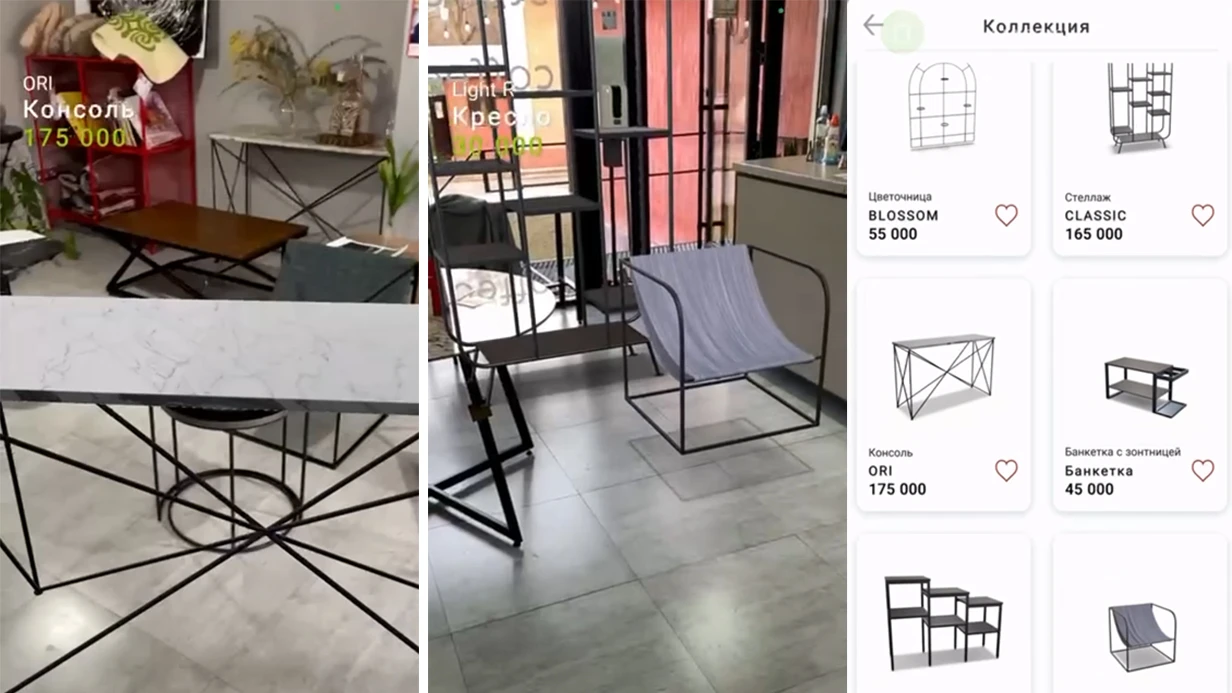
| Furniture | Placing the model in a room at 1:1 scale | Fewer disputes about sizes, easier purchase decisions |
| Accessories and jewelry | Try-on on the wrist or near the face | Emotional attachment to the product, more spontaneous orders |
No matter what product you sell, we will choose a format that shows its advantages as accurately as possible. The customer will feel the item is "theirs" even before buying, and you will reduce returns and stand out from competitors.
The format works directly in the browser, so it is easy to embed into a product card and advertising campaigns without installing an app.
How we launch a project from scratch to result
We have been launching projects from scratch for 10 years, so we have built a process with no "black box" and no hidden surprises. Each development stage ends with a clear result that you see and approve, while we set timelines and budget.
How the work is structured:
- Brief and discovery. We study your product, audience and try-on scenario. In return, you receive a clear technical specification and an estimate — without vague wording.
- Prototype and approval. We show what the try-on will look like and how the customer will interact with the product. You make edits before the main development starts, not after it is completed.
- Development and testing. We build the WebAR solution and test it on different devices so that the try-on opens instantly and works stably on any smartphone.
- Launch and integration. We place the code on your website or in your app and connect analytics. You get a working tool and the first data on how customers use it.
- Support after launch. We monitor stability, update compatibility with new devices and refine scenarios for your tasks. You are never left alone with technical issues.
This process delivers a predictable result: agreed decisions, clear deadlines and a tool that starts working for conversion right away. You get not just a "product try-on", but a sales channel that can be developed and improved.
What's included in the final delivery
You get not code and technical reports, but a ready-to-use tool for your showroom. The try-on immediately integrates into the sales process: customers try the product, staff help and advise, and you see real usage numbers.
We handle debugging, setup and training so that the result appears on day one, not "sometime later".
The delivery includes a complete kit for launch and support:
- A working try-on prototype — tested on real devices and in your scenarios. Visitors can virtually put on a product, view it from different angles and make a purchase decision.
- Integration with your showroom — product catalog connection: names, prices, photos and stock levels are pulled in automatically. This removes manual work and prevents errors when adding new items.
- Staff training — a short guide and a practical demo for your employees. They learn how to launch the try-on, help a visitor and quickly navigate the settings.
- Technical support — we are available during business hours: we answer questions, help with updates and handle unexpected situations. Your team is never left alone with the system.
- Statistics and analytics — a report on how many visitors tried on products, which items were chosen most often and how long they studied the product. This data shows what to focus advertising on and which assortment to strengthen.
- A design mockup in your brand style — the interface is styled to match your brand so the tool looks like part of your showroom, not a foreign add-on. Visitors will not notice the transition from product selection to try-on.
You receive the entire package before launch: first we test on your products, then train the team, and only then hand the solution over for operation. If anything changes in the assortment or the showroom format, a request is enough — we make adjustments and test again. This way the try-on remains a working tool that delivers value not for a week, but continuously.
Case study: how we increased sales by 30% in two months
The marketing director of a clothing store came to us with a problem: website visitors looked at products but did not decide to buy — the risk of choosing the wrong size or style was too high.
Carts were abandoned at the selection stage, and conversion remained twice below the market average. We suggested giving customers the ability to "try on" items instead of relying on text descriptions.
What we did
We built a virtual fitting room based on a WebAR solution that works directly in the browser — no app downloads required. The customer turns on the camera, selects a clothing model and sees how it fits their body in real time.
For the customer this looked simple and convenient, and for the business it was a manageable solution: integration into the existing catalog took just over two weeks. We connected the try-on to the product cards of the most popular items and set up hints for users.
Results
The effect appeared in the very first month: conversion from view to purchase doubled, and the average order value increased by 15% — customers became more confident about adding several items to the cart at once.
In two months, sales in the category with try-on grew by 30% with the same traffic. We also noted a reduction in returns: people made fewer sizing mistakes because they saw the fit before ordering.
Now the store uses the fitting room as a permanent tool and is rolling it out to new categories. We accompanied the launch with analytics and training materials for the team — the owners got a measurable result, not just a nice demonstration.
How to choose the right format for your task?
Choosing a try-on format is not a matter of "which technology is trendier" but "which business problem you are solving".
The same goal — showing a product to a customer — can be approached in different ways: increasing cart conversion, reducing returns from the wrong size, engaging event visitors or raising brand awareness. So first define the desired result, then choose the tool.
If your goal is maximum reach and instant access to try-on for any customer, the WebAR format is optimal. It works in the smartphone browser, requires no app installation, and therefore gets the customer to the result faster. This is the main argument for online stores, where an extra step in the funnel means a lost order.
When the task is a premium demonstration of a large or expensive product, such as furniture or a car, the spatial VR-showroom format creates a full-presence effect.
This approach is suitable for showrooms, exhibitions and limited collections where detailed scenario design matters.
How to choose in practice? Assess the customer journey: where do they encounter the product — in the catalog, on social media, in an ad layout, at an offline point?
This determines whether you need quick launch via a link or QR code, whether the try-on will be part of the product card, and how you will measure its impact on sales.
Also check your audience's readiness: for the broad market WebAR is more familiar, while for a tech-savvy audience more immersive formats work better.
We help choose the right format for your task: we analyze your business, test a prototype with real users and show clear metrics — conversion, interaction time, share of repeat visits. This way you get not just technology, but a tool that delivers measurable value.
Addressing common doubts before placing an order
Before ordering augmented reality product try-on, the same doubts usually come up: how will it fit into the existing website, how long will it take, and how much will it cost. We answer based on experience from dozens of launches — briefly and in terms of results.
Is it difficult to integrate the try-on into an existing website or catalog?
No. We launch the solution as a separate module that does not break the current structure. You do not need to change the design or rewrite processes — we handle integration, setup and final testing.
In a few days you get a working link that can be added to a product card or sent to customers in a newsletter.
How much does WebAR try-on development cost and what does the price consist of?
The cost is calculated after an audit of your product range, try-on scenario and integration method, not from abstract "programming hours".
We offer standard configurations for common tasks and fix the scope before we start, so you understand the budget without surprises. A transparent estimate and milestone payments remove risks.
What is the launch timeline — when will I get the ready solution?
A typical project takes two to three weeks: from defining the task to a ready link to a working prototype. If you need a simple try-on for a single product, we can do it faster.
We fix deadlines in the contract and report at each stage, so you can plan an advertising or promotion launch with confidence.
Let's discuss your project and launch the solution
Leave a request — and during the consultation we will analyze your task and propose a solution. WebAR product try-on launches faster than you think: from the first conversation to a working prototype takes just a few days.
You immediately see how the tool will look to your customers and understand what benefits it will bring.
We do not burden you with technical details. We ask about goals, audience and use case, then propose a clear plan: what we will do, how long it takes and how we will measure the result. All you need to do is approve — we take care of the rest. The consultation comes first, and no upfront payment is required.
After ordering, you receive:
- a consultation and audit of your current product page or catalog;
- a WebAR try-on prototype adapted for mobile browsers;
- clear instructions for integration with your website and online store;
- test runs on real devices and scenario adjustments;
- recommendations for promoting the tool among your audience;
- post-launch support and opportunities to develop the solution.
This works for the benefit of your business: the customer sees the product "on themselves" before buying, hesitates less, and therefore returns orders less often. Such a tool attracts attention and becomes a reason to share the experience with friends. In the end, you get not just a technology, but an additional channel for sales and loyalty growth.
Do not postpone the launch — customers today expect fast and visual choice. Leave a request on the website or call us: during the consultation we will define the scope of work, propose timelines and an option for your budget.
A quick start begins with the first message: write to us, and within a day we will propose an action plan.