




Without Real Estate Visualization, Clients Leave for Competitors
A real estate buyer votes with their eyes. While they only see blueprints and static photos, they cannot picture what their future apartment will look like: where the sofa will go, how much light the bedroom gets, what the view from the window is.
Doubts arise — “what if it’s not right?” — and they leave for those who can present the home in three dimensions. Every such departure is a lost deal you could have closed.
Today, buyers choose not just square meters, but a picture of a lifestyle. Developers who deliver that picture through volumetric property presentations get more inquiries and hear the objection “we need to think about it” less often.
Interactive real estate catalogs and augmented reality for sales have become the market standard, not a luxury. If competitors are already showing apartments in 3D, your sales office with flat floor plans loses before the first meeting.
The problem is not the lack of a good product — it’s how you present it.
The buyer needs confidence: “I know exactly what I’m buying.” This is delivered by an apartment presentation where they can “walk through” rooms, assess the scale, look at finishing options, and even feel the atmosphere of the future home.
This removes the main fear — buying a pig in a poke. A client who has seen their home in advance makes a decision faster and pays more willingly.
We help developers and real estate agencies close this need. We create visualizations that sell: from interactive catalogs to augmented reality where the buyer “places” furniture or sees the home on an actual plot.
You don’t need to understand the technology — we handle the entire process, and you get a tool that increases conversion to a deal. Tell us about your property — we’ll show you how to present it so that clients choose you.
What Benefits a Volumetric Property Presentation Brings
A buyer chooses not square meters, but the future life inside them. Ordinary photos and floor plans don’t convey the feeling of space and light, so the decision drags on, and the developer loses the client at the comparison stage.
A volumetric presentation in WebAR shows the entire property — from the floor plan to the view from the window — and this removes the main barrier to purchase.
Live Visitor Interest and Growing Brand Recognition
At exhibitions and sales offices, an interactive 3D model works more powerfully than any brochure. Guests linger near the stand, explore the property from different angles, pass the smartphone to each other — that creates genuine interest that stays in memory for a long time.
The unusual format itself becomes a news hook. Visitors record the screen and share it on social media, and the developer gets free reach before any official advertising.
The brand is remembered as modern and tech-savvy, which directly influences the choice in the company’s favor.
More Leads from Events
A volumetric presentation turns passive visitors into an engaged audience. Instead of silently taking a flyer, people start interacting with the property, asking questions — and leave their contact details to continue the conversation after the event. These leads are warm: the client has already seen the property and is ready for dialogue.
Faster Deals and Higher Sales
When the future property is visible in advance, the main doubts disappear: “what will it actually look like?” Buyers make decisions faster, and sales managers get a clear tool for handling objections.
Interactive display is especially effective for under-construction projects and early-stage lots. The client sees apartments that construction hasn’t reached yet — and makes a choice.
The developer accelerates sales and shortens the deal cycle, and can also show several options in different buildings at once, raising the average check.
Volumetric Presentation Formats for Different Business Tasks
A real estate buyer makes a decision based on emotions and the sense of space, not just floor plans. The same property can be shown in different ways: a quick online view via a link, an impressive exhibition zone, or full immersion at negotiations.
The goal is to choose the format that shortens the path from “interesting” to “I want to see it with my own eyes.”
We select the format for your sales scenario — from a light touch to full engagement. Below is what works for typical tasks.
| Format | For Whom | What It Gives the Client |
|---|---|---|
| Web display format | Clients on the website, in messengers | Instant viewing of the property without installing apps — works from a phone or tablet |
| Exhibition presentation | Stand visitors, flow-through audience | Attracts attention, keeps people at the stand, creates a queue, and gathers contacts |
| Interactive property tour | Family viewings, remote buyers | Independent movement through apartments and grounds at a comfortable pace |
| Immersion for negotiations | Buyers at private showings | Full presence in the property before construction — helps make the purchase decision |
Formats are easy to combine: for example, you send the web version before the meeting and use full immersion during negotiations. We’ll prepare the right option for your task, help you choose a scenario, and integrate it into your existing sales funnel.
How Real Estate Visualization Works: Stages and Timelines
We understand: predictable timelines and a clear process matter in real estate visualization. That’s why we’ve broken the work into stages — you always know what’s happening, what you’re getting, and when the project will launch.
-
Brief and task assessment. We discuss the property, the audience, and the display scenario: where the visualization will be seen — on the website, on social media, or at an exhibition. We set the visualization timeline and scope of work.
-
Mockup approval. We create the structure and design concept: how the user moves through the apartment, which viewpoints matter. You approve the mockup, and we make edits until it fully matches your expectations.
-
Prototype development. A few days after the mockup is approved, we build a working sample. You see the interaction mechanics and understand how a client will experience the property.
-
Project launch. We integrate the visualization into your website or promo zone and set up access. Everything works in the browser — visitors don’t need to install apps.
-
Quality control and testing. We check loading speed and correct performance on different devices. You get a stable tool that won’t fail at the moment of a client presentation.
-
Support and refinements. We stay in touch after delivery: we update content, add properties, and make changes. The visualization grows along with your business.
The development stages pass without surprises, and visualization timelines are set before the start. The main thing is that the tool genuinely helps sell real estate.
What’s Included in the Delivery: A Complete Kit for the Sales Department
You get not just a finished application, but a working tool for the sales department — it can be used immediately after handover. We put together the kit so that managers don’t have to deal with the technical side and can spend their time talking to buyers.
Here’s what’s included:
- Ready-made display scenarios — 3–4 typical scenarios: an apartment from scratch, a house with a plot, commercial premises, turnkey renovation. The manager simply selects the right option and guides the client through your property, rather than improvising.
- Manager instructions — a 1–2 page step-by-step guide: how to open the project, how to switch floors and floor plans, how to answer common buyer questions. Training one employee takes 15–20 minutes.
- Access for all employees — every manager gets convenient access to the project: via a link from a phone or tablet, through an app, or via QR code. No workplace setup required.
- Presentation materials — a short intro page about your property with key advantages: location, infrastructure, floor plans. Suitable for both in-person meetings and sending to a client in a messenger.
- Brand customization — your logo, colors, and sales department contacts inside the visualization. The buyer remembers you, not an abstract project.
- Post-launch support — we stay in touch for the first month and quickly make edits if you notice inaccuracies or want to change the focus of the presentation.
Let me emphasize: the entire kit is assembled for your specific property and your sales department — no templates. You get a solution that helps you sell faster from day one, not just a “pretty picture” for the website.
Case Study: How a Volumetric Display Doubled Conversion
We came to the developer “Green City” at a point when the sales department was losing buyers at the decisive stage — choosing an apartment.
People spent a long time looking at floor plans on stands, but left to “think it over”: a flat drawing didn’t let them imagine the future home in volume.
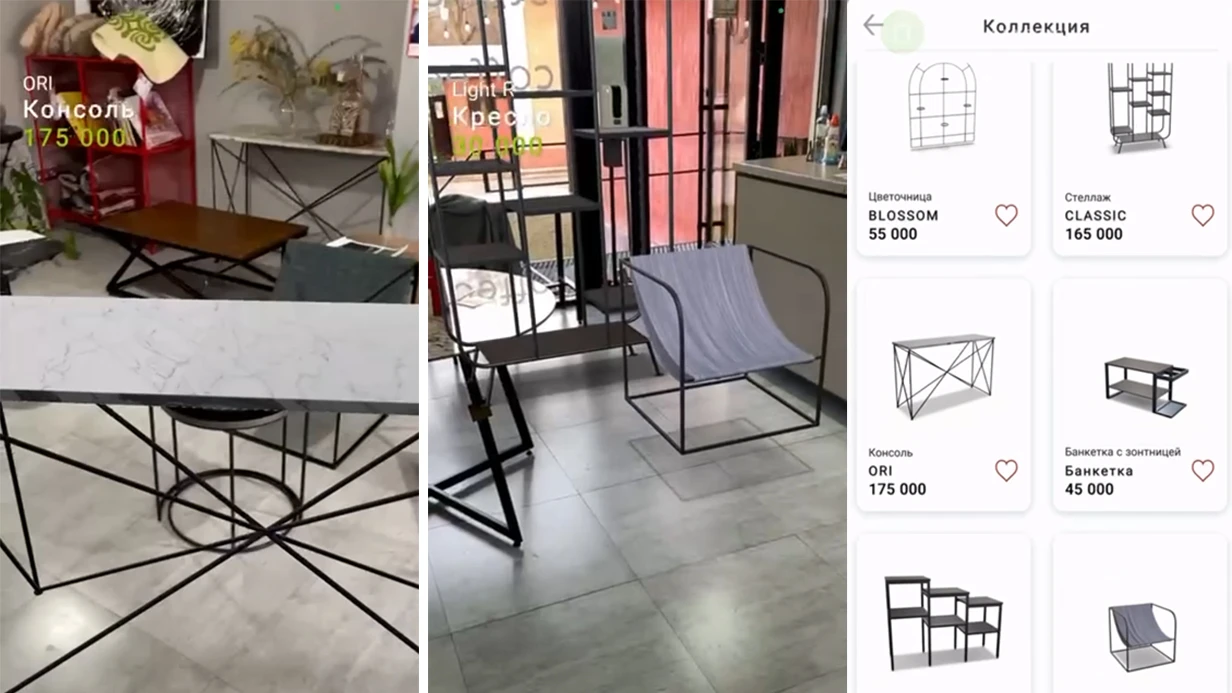
We replaced paper plans with an interactive volume visualization catalog: the buyer points their smartphone camera at a floor-plan model in the sales office and sees a volumetric model of the apartment.
They can “walk through” rooms, assess proportions, and roughly arrange furniture — without installing apps, right in the browser.
Result of Implementation
Over two months, more than 1,200 visitors used the catalog. Every second person spent more than three minutes with the volumetric model, and conversion to sales doubled: among those who “tried on” the apartment, one in seven signed a contract — previously only one in fourteen.
Why It Worked
Managers got a tool that sells instead of explaining. The buyer “lives in” the future apartment themselves and trusts their choice: the number of “we need to think about it” objections dropped noticeably.
The developer valued the effect so much that they ordered an expansion of the catalog to a new residential complex. Today, the volumetric display is the standard presentation for every new property.
How to Choose the Right Format for Your Task?
Choosing a real estate visualization format starts not with technology, but with questions: what exactly are you showing, to whom, and for what purpose. If the task is to introduce a buyer to the floor plan before the building is completed, an interactive 3D model is enough.
If you need to engage a guest at a residential complex presentation and hold their attention, WebAR is a good fit — it opens with a smartphone camera without installing apps.
The first criterion is the display audience. For a younger audience used to stories and filters, augmented reality will be a natural way to “walk through” an apartment.
For investors and corporate clients, accurate floor plans, scale, and the ability to quickly compare options matter more. Once you identify who will view the presentation, you’ll understand which format will inspire trust and which will only cause confusion.
The second criterion is the business goal. If the goal is to collect viewing requests, the visualization should include a button to contact a manager.
If you want to make the property stand out from competitors at an exhibition, bet on an unusual scenario: virtual finishing, changing furniture, day and evening lighting.
The same technology solves different tasks — the important thing is to clearly define what action the client should take after viewing.
The third criterion is the presentation budget. This is not just the development cost, but the ratio of expenses to results. Calculate how many viewings are planned and how many deals each format should bring.
WebAR costs less than a full VR application and requires no special equipment — the client opens a link from their phone. This option often pays for itself on the very first property if the developer actively uses it in mailings and social media.
To avoid mistakes, ask the contractor a few simple questions: how does the solution work on different smartphone models, how long does it take to prepare one property, is there post-launch support, and what happens if floor plan changes are needed.
The answers will show how well the contractor understands your task, not just whether they can code.
We help clients get their bearings at the start — we break down your task, audience, and budget, and then propose a format that delivers measurable results, not just a pretty picture.
Frequent Client Questions: Honest Answers
We’ve collected the questions clients ask most often before starting a project. We answer honestly, without technical complexity — only what matters for your business and your clients.
Will the visualization work on my clients’ phones?
Yes. We build the visualization for the browser — the client doesn’t need to download or install anything. The solution works on most modern smartphones and tablets, and we check compatibility with popular models and operating systems. If a client has a weak phone, we adapt the load so the display remains smooth.
How long does development take?
A standard project takes two to four weeks. The timeline depends on the number of properties, the level of detail in the 3D models, and the scenarios you want to offer clients.
We set the timeline in the contract and show the work stages: first a brief and concept, then a mockup and test version, and only then — launch. You always see what stage the project is at.
Can edits be made after launch?
Yes. The cost includes a revision stage after you review the working version. We make adjustments to texts, display order, and individual interface elements. Later, you can also order updates — for example, add new properties or change prices. There’s no need to redo the project from scratch.
What equipment is needed for the display?
A smartphone or tablet is enough — this is convenient both for in-person client meetings and for sending a link. If you want to show the visualization at an exhibition or office, you can output the image to a large screen or an interactive panel. Special VR glasses are not required, although we can adapt the project for them if you wish.
We’ll prepare a demo version on your property so you can evaluate the result before full development. Leave a request — we’ll show you how it works and discuss timelines for your task.Order a Volumetric Presentation for Your Property — Let’s Start with a Brief
Starting with a brief is not a questionnaire; it’s a way to save your time. You send the project details, we study the task, and in a short time we come back with a specific proposal: the volumetric presentation format, timeline, and cost calculation.
You don’t need to understand technology — just describe the property, audience, and purpose of the display.
We’ve been working this way for over 10 years, so we’re ready to offer an option for any budget and task: from a virtual apartment tour to a full VR showcase of a cottage community for out-of-town clients.
Every project starts with a brief — this helps avoid unnecessary iterations and hit the target right away.
- Visualization brief — you answer simple questions, and we translate them into a technical solution.
- Cost calculation — a transparent estimate before work starts, with no hidden surcharges.
- Consultation — we answer questions about formats, timelines, and integration into your processes.
- Solution tailored to the task — we offer WebAR, a VR showroom, or an interactive 3D model based on your audience.
- Presentation preparation — we help adapt the presentation for a meeting, exhibition, or website.
- Testing opportunity — you see intermediate versions and make edits before the final launch.
Send us the details of your property — we’ll study the task and come back with a solution that suits your clients. Tell us what needs to be shown, to whom, and in what format, and we’ll take care of the rest.