



Why an Interactive Story Changes Customer Impressions
A regular presentation or video holds a guest's attention for a few seconds — then the gaze drifts, and the information fades from memory.
An interactive story solves this problem: instead of passive viewing, a person steps inside the story, makes their own choices, and influences how events unfold.
At that moment, attention is held automatically — the brain perceives what is happening as a personal experience, not as an advertising message.
VR attractions with story branching immerse the client in an environment where the brand becomes part of an emotional experience. Emotional marketing works through impressions: the joy or surprise experienced becomes linked to your company and stays in memory for a long time.
Such an experience cannot be ignored or scrolled past like a social media feed — it is physically lived through and triggers a response on a feeling level.
The business result goes beyond a single venue. An emotionally engaged visitor shares the experience with friends — you get live brand mentions, photos, and videos on social media that keep working for several weeks after the event.
At the same time, the VR attraction creates a line at your event, increasing guest dwell time and loyalty.
We create an interactive story for the specific task of your business: a promotional site with a sense of presence, an exhibition zone, a training scenario for employees, or an entertaining VR attraction for visitors.
We adapt the plot to your audience and messages, and we handle the technical side — from script development to launch. The client gets a clear, measurable emotional marketing tool that enhances customer impressions and sets you apart from competitors.
What You Get from a VR/AR Application
An interactive story is not "entertainment" but a business tool. A regular booth holds attention for seconds, while a VR/AR application turns the guest from a spectator into a participant. It is participation that delivers measurable value.
Guest Engagement
The guest controls the scenario, makes choices, and gets emotions that a screen or a poster cannot provide. The deeper the immersion, the longer the attention and the stronger the impression. Such moments are remembered and spark the desire to return and tell friends.
Each participant spends several minutes in the zone instead of a couple of seconds at a display. For the organizer, this means live contact with the brand and a natural reason for photos on social media.
Reach and Recognition
Guests themselves become carriers of advertising: they post photos and tag the brand. Each publication expands reach to friends and followers and keeps working after the event. Recognition grows not through budget but through emotions.
Leads and Measurable Results
Built-in mechanics collect contacts at the moment of peak engagement. After the event, you get a base of potential clients and an understanding of what captured the audience. This is a marketing tool with visible results, not an entertainment booth.
Reliability on the Day of the Event
Professional equipment and refined scenarios ensure stable performance even with a large flow of guests. The technical part stays with us — you get a ready result.
Interactive Story Formats for Different Tasks
Every interactive story project solves its own problem: hold guests' attention, engage them with a product, train employees, or make people talk about the brand. The format must match the goal and the audience — what works at an exhibition will not suit a corporate portal. That is why we start not with technology but with the task.
We select an option for your situation: from a WebVR story that opens via a link and requires no installation to mobile AR applications and full-fledged VR zones. Below are typical scenarios clients come to us with. They help you see exactly what suits you.
| Format | For whom | What it gives the client |
|---|---|---|
| WebVR story | For a broad audience, clients, and website visitors | Unlimited reach: the user follows a link from any device, dives into the story, and shares it on social media. No app download needed. |
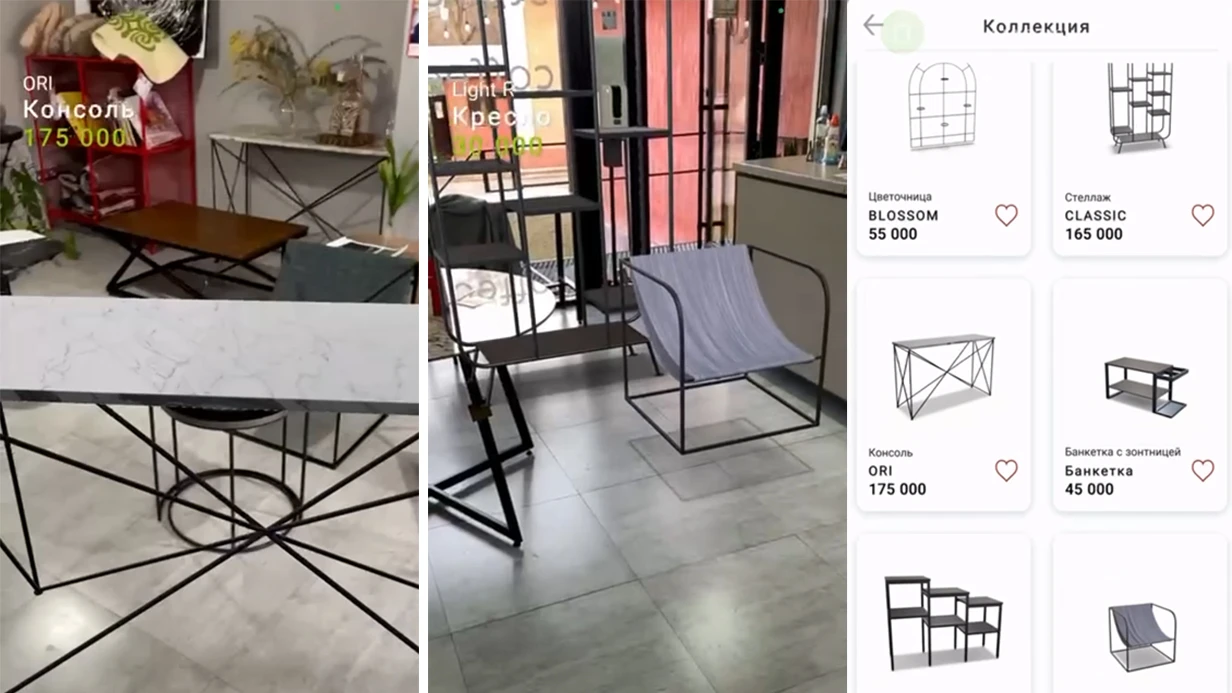
| Mobile AR application | For exhibitions, presentations, and events | Guests point their camera at an object — and see 3D interactivity. This holds attention at the booth and collects contacts in exchange for a unique experience. |
| VR installation | For corporate events, openings, press events | Creates a wow effect: guests are fully immersed in the scenario and remember the event. Strengthens brand recognition and provides striking photos for social media. |
| Interactive website with 3D scenes | For promoting a product or service | The visitor controls the story, explores features, and "tries on" the product. This increases conversion and time spent on the site. |
| AR simulation for training | For sales departments and staff | Employees practice scenarios in a safe environment, and you get a predictable result without the costs of organizing real trainings. |
If you are not sure which format suits your task best, we will discuss it during a consultation. We will advise you on how to get maximum business value without unnecessary production costs.
How We Build a Project: A Clear Process
We do not run a "blind" process: every project has clear development stages agreed with the client. This prevents surprises in timing and budget and lets you see at each step how the interactive story becomes a finished product.
- Brief and objectives. We lock down the goals: what the story should give the brand, what the audience is, and what result is expected. The output is a concise technical specification that all participants work with.
- Planning and scenario. We develop the narrative structure, interaction points, and transition logic. You get a plan that shows how the user will move through the story.
- Concept approval. We present a design mockup and scene descriptions, and discuss the details. Any revisions are made before active development starts — this saves time and money.
- Implementation. We build the interactive story with professional tools, adding controls and adaptation for different devices. You see intermediate versions periodically and stay in control.
- Testing and launch. We verify performance on target devices, fix errors, and help with publication — from installation preparation to user instructions.
- Post-launch support. We stay in touch, update content, and respond quickly if something needs refinement. You get a product that lives and evolves.
Importantly, concept approval happens before the main stage, so you know exactly what you will get and do not pay for rework. The VR/AR creation process is transparent for the client, and we handle all technical details.
What Is Included in the Application Delivery
We work as a single window: you get not just an application but a complete package for launching your interactive story. The delivery includes everything needed for the start — from an approved prototype to training for your team and post-launch project support.
-
Prototype and scenario approval. First, we show the key episodes of the future VR/AR story, approve the narrative logic, and then produce the full version. You see the result before final development and eliminate rework.
-
Complete VR/AR project delivery package. We provide the final build for the required platforms, installation files, and deployment instructions. Source materials and rights remain with you — you own the solution.
-
Adaptation to your equipment. We configure the project for the headsets, tablets, or smartphones you or your visitors already have. No need to buy a new fleet of hardware for the launch.
-
Staff training. We conduct a live training session and provide short video instructions: how to run sessions, welcome guests, and handle typical situations. Your team works confidently from day one.
-
Technical support for the project. A dedicated communication channel with the team, monitoring the application during the warranty period, and updates for new devices. If something goes wrong, we take the solution on ourselves.
-
A foundation for growth. We build a modular structure: you can add new locations, characters, and story branches without rewriting the entire interactive story.
Case Study: Increasing Engagement with a VR Solution
Typical promo zones work on the "looked and forgot" principle: a guest stays for 10 seconds, takes a photo, and leaves. To make a brand memorable, you need a story in which the person becomes the main character. An interactive VR scenario provides that opportunity.
Case Study: How It Works
For the opening of a new branch, the family café chain CafeDom ordered a short VR story from us about its signature dish. We built a scenario where the guest enters a virtual kitchen and chooses ingredients. The ending depends on the participant's decisions — so everyone experiences a unique story.
No lengthy instructions: a person puts on the headset, hears the chef's voice, and simply answers questions. Engagement happens naturally. We also built in a "share your result" feature: at the end, the guest gets their unusual recipe and sends it to friends. This turns a personal experience into word-of-mouth.
Over two days, more than 300 guests went through the virtual kitchen. Brand contact time grew from the usual 15 seconds to 4–5 minutes. The guest lived an episode from the brand's life rather than watching a video.
The results speak for themselves: 70% of participants shared their impressions on social media, and every third guest returned to the café within a month. The reach of posts about the opening grew by 40% without any advertising investment.
This example shows how an interactive story turns a one-off event into a long-term dialogue with the audience. We are ready to build the same kind of scenario for your task — starting with a discussion of goals and audience.
How to Choose the Right Format for Your Task
Choosing a VR/AR application format starts not with technology but with the goal. What should change after launch: guests stay longer at the venue, the brand is remembered, an interactive story emerges that people want to retell?
If you answer this question clearly, it becomes obvious whether you need a full VR environment or a light AR layer on reality.
The second step is to think about where and how the solution will be used. For events with a large flow of people, a WebVR version is often more convenient: it does not need to be installed and runs from any smartphone via a link.
If a maximally immersive experience matters more, a dedicated VR program for special equipment is appropriate. Choosing a solution depends on what is more important to you — breadth of reach or depth of immersion.
Budget and deadlines also affect the format. If you need to launch an interactive story quickly for a broad audience, web solutions based on proven tools are optimal. If the project is large-scale and involves a unique scenario, it makes sense to allow more time for development.
The main thing is not to choose a format for its own sake, but to consider what result it will bring given your circumstances.
Advice on choosing comes down to one thing: determine how you will measure success. Number of participants, average time in the scenario, number of repeat visits, or collected contacts — these metrics should be built into the format.
For example, an AR story can guide a visitor through locations and gently lead them to registration, while VR immersion creates a vivid impression that continues to drive brand recognition.
We help you choose the optimal format for your task and budget — without technical jargon. We show what the result will look like in practice and take on turnkey implementation.
In the end, you get an interactive story that solves a business problem, not just a beautiful experiment.
Frequently Asked Questions About VR/AR Application Development
We have collected the typical questions clients ask before starting a VR/AR project. We answer briefly and to the point — without technical jargon or hidden conditions.
Every project is unique, but clients' concerns are similar: will we make it in time for the event, what does it cost, will it be convenient for users, and what about post-launch support. Below are honest answers to these questions.
How long does it take to develop a VR/AR application?
The timeline depends on the format and complexity. A simple interactive for an event takes from a couple of weeks; a full turnkey project typically takes one to two months.
We start with a brief, lock in the stages, and show a working prototype in 2–3 weeks so you see the result before the final launch.
How much does turnkey development cost?
There is no universal price list — we calculate the cost for your specific task after a short brief. The estimate includes all work: scenario, design, development, testing, and launch. The price is fixed in the contract, so the final amount will not grow during the process.
On which devices will the application work?
We adapt the project to the devices your clients or guests use: smartphones, tablets, VR headsets, or regular browsers. Before launch, we test everything on real equipment so there are no surprises on the day of the event.
What if we need revisions after launch?
We provide a warranty on the work and stay in touch after project delivery. If something needs refinement or additions — we will take it into support and make changes quickly. You are not left alone with the product.
Is it difficult for users to figure out VR/AR interactives?
No. We design the interface so people intuitively understand the actions, without instructions. Before launch, we test the scenario with real users and simplify anything that causes questions — so your guests are left with only positive emotions.
Ask your question — we will tell you how we have solved similar tasks and help you estimate the budget and timeline for your project.Discuss Your Project with Us
You already know that classic presentations do not hold attention: guests scroll their feed and forget your product. An interactive WebVR story turns getting to know a brand into a live experience — the person guides the plot themselves and remembers it for a long time.
But for the story to work, you need to clearly understand who your audience is and what you want to tell them.
Leave a development request — we will call you back within one business day, clarify the task, and offer solutions. The consultation is non-binding: you get an assessment, not advertising promises.
Based on the discussion, we will calculate the cost and timeline, show similar case studies, and propose a format that will deliver results for your specific audience.
What you get after reaching out:
- A consultation with a breakdown of your idea and project goals.
- A cost estimate for development and realistic timelines for your budget.
- A selection of the right interactive story format for your visitors and venue.
- Examples and case studies from our projects so you understand our style of work.
- A stage-by-stage plan: you see what happens at each step and when the result will arrive.
- Post-launch support — we will refine, add, and teach your team to work with the story.
To start a project, simply write to us via the form. We will get back to you within one business day, answer your questions, and help you decide on the first steps. A development request is not an obligation, but an opportunity to get a cost estimate and a quick start.