

VR Electrical Safety: How to Reduce Risks in the Workplace
Electricity is the most insidious risk factor in the workplace: it cannot be seen or heard, and the consequences of a mistake are measured not in minutes of downtime but in people's health and the company's reputation.
Accidents when working with electrical installations remain one of the leading causes of occupational injuries, and every workplace safety inspection ends with orders and fines.
A manager is responsible for people and for the budget, which is why the cost of an unprepared employee is far too high.
Traditional safety briefings are not up to the task: an employee listens to a lecture, but in a real situation acts on autopilot and skips a dangerous step.
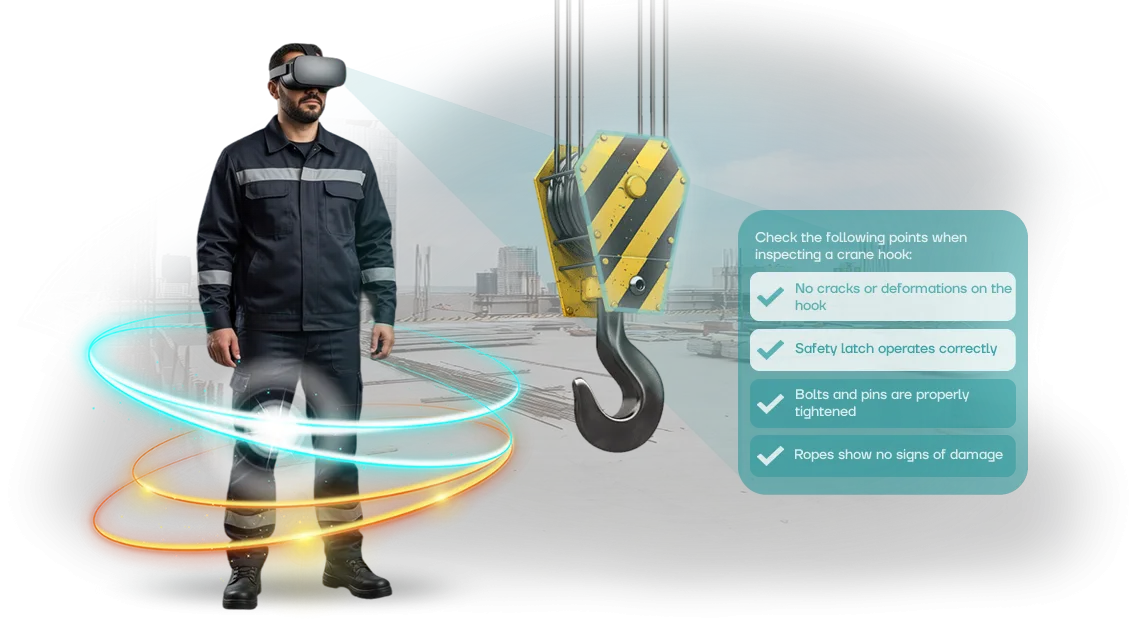
VR electrical safety changes the approach — instead of memorizing rules, a person experiences the scenario in a safe virtual environment. They see the consequences of a mistake, remember the correct sequence of actions, and return to the real facility with a lasting skill.
For the workplace safety department, this is a measurable result: reduced risks in the workplace, improved employee discipline, and readiness for inspections by regulatory authorities.
The manager gets a clear picture of who has absorbed the material and who needs additional training. And employees stop perceiving safety briefings as a formality, because the training looks like real work, not slides.
We develop VR simulators for the specific needs of your enterprise: from standard scenarios to unique layouts of your electrical installations.
With 10+ years of experience, we have learned how to turn workplace safety requirements into scenarios that genuinely change people's behavior. Our engineers use professional equipment and refined tools, so you get consistent results without lengthy setup.
Implementation takes weeks, and the savings from a prevented accident pay for the project many times over.
5 Reasons to Implement Virtual Safety Training
Traditional safety training often becomes a formality: employees listen to lectures, sign the logbook, and within a month they are violating the rules again. The result is injuries, fines from regulatory authorities, and downtime.
A virtual simulator moves theory into practice: a person acts in a realistic environment and develops the right reactions without any threat to life. Here are five reasons why companies adopt this format.
-
Reduced injury rate. An employee enters a hazardous scenario and learns to prevent an accident. Practiced skills reduce the number of incidents, and therefore sick-leave payments, equipment repair costs, and reputational losses.
-
Training cost savings. No need to rent training grounds, purchase consumables, or bring in an instructor every time. A single simulator pays for itself within a few months and can be used repeatedly, while employees are not pulled away from production for a full day.
-
Employee engagement. Instead of passively listening to lectures, an employee solves tasks in a virtual environment. The material is absorbed more deeply, and an engaging scenario makes people want to go through it again — this raises the overall safety culture.
-
Regulatory compliance. The system automatically records the date, time, and result of each completed session, so you provide objective reports during inspections.
The simulators take into account the requirements of GOST 12.0.004 and industry regulations, which reduces the risk of enforcement orders.
-
Rapid content updates. Have the rules changed or has new equipment been introduced? You update the scenario within a few days — no need to reprint instructions or conduct manual unscheduled briefings. All employees immediately see the current version.
Comparison of Virtual Training Formats
Virtual electrical safety training does not have to be the same for every employee. Some need a full course with certification, others need a short refresher before the start of a shift, and some need practice on a rare emergency scenario.
If the format does not match the task, the company either overpays for extra hours or risks missing important skills.
We select the format for a specific group of personnel and your particular situation.
The foundation is not a "linear recording" but interactive VR electrical safety scenarios: an employee operates inside a virtual substation or switchboard, sees the consequences of a mistake, and remembers the safe procedure. Below is a comparison of the main options so you can choose based on your budget and work schedule.
| Format | Who it is for | What it gives the business |
|---|---|---|
| Full course | All employees upon hiring and annual certification | A uniform knowledge standard, covers workplace safety requirements and reduces the risk of fines |
| Short modules | Experienced staff before a shift or after a long break | Minimal time away from work, quick refresher of critical rules |
| Custom scenarios | Newcomers, employees performing high-risk operations, and managers | Practicing emergency situations without threat to people, personal assessment of actions |
All formats are stored in a single tracking system: you can see who has completed the training, which mistakes keep recurring, and which topics need stronger preparation.
For the company, this means transparent control, measurable results, and time savings — employees master the material faster than in traditional classrooms, and knowledge retention improves by up to three times.
If you are not sure which option is right for you, send us a list of positions and tasks. Within 1–2 days, we will calculate the scope, timeline, and training cost.
Stages of Virtual Simulator Implementation
Implementing a VR electrical safety simulator does not require technical knowledge from you: we manage the project from the first brief to launch and handle all the routine work.
The process is designed so that you see the result at every stage and can influence it without delays — from defining the task to the finished scenario.
-
Brief and task immersion. We conduct a short audit: which situations need to be practiced, where mistakes most often occur, and what skill level your employees have. The output is a clear understanding of goals and success criteria.
-
Plan and cost estimate. We propose the optimal simulator format and training scenarios, and lock in the timeline and cost. You get a transparent plan with no hidden fees or "extras."
-
Concept approval. We present the scenario structure, action logic, and results assessment. We make revisions before development begins — this is cheaper and faster than reworking a finished product.
-
Development and assembly. Our engineers build the virtual scenes and fine-tune the scenarios on professional equipment. You do not need to understand the technical details — you receive interim demos and control the process.
-
Launch and employee training. We install the simulator, set up the workstations, and conduct staff orientation. Employees start practicing their skills from day one, with no lengthy adaptation period.
-
Support and development. After launch, we stay in touch: we update scenarios to meet new requirements, add situations, and help with hardware. The simulator does not become obsolete as your tasks evolve.
The entire cycle takes from a few weeks to a couple of months, depending on scenario complexity. You get a ready-made training tool that immediately works toward safety and risk reduction.
What Is Included in the Virtual Simulator Delivery Package
The delivery package includes everything needed to launch training without hiring outside contractors. We handle installation, setup, and material handover — all you need to do is schedule the first training session.
The VR electrical safety simulator is a complete solution that includes:
- Ready-made scenarios — practicing response to electric shock, working under voltage, and providing first aid. The scenarios are adapted to standard regulations and workplace safety requirements.
- Equipment installation and configuration — our engineers deliver, connect, and verify the simulator at your site. Everything works immediately after acceptance.
- Integration with your training system — training results are exported in a convenient format and can be included in your overall personnel reporting.
- Training for employees and administrators — we provide on-site or remote instruction on how to launch sessions, change scenarios, and view statistics.
- Methodological materials — instructions, checklists, and templates for embedding the VR course into your briefing and knowledge-assessment program.
- Technical support — phone and remote assistance for the entire period of use, with scenario updates on request.
This package covers the manager's key concerns: employees quickly master the skills, and you retain full control over the training process. No hidden work — all stages are included in the cost.
VR Electrical Safety: A Real Case Study at an Enterprise
How We Trained 240 Employees in Four Months
Electrical safety is an area where a mistake costs dearly: electric shock, fire, production downtime. The manager of an industrial enterprise approached us with a specific task: reduce injuries and make safety training truly memorable rather than a formality.
We developed a VR simulator based on the HTC Vive — professional equipment that fully immerses a person in the scenario.
Instead of slides and posters, the employee steps into a virtual workshop with live electrical equipment.
They practice the safe sequence of actions, learn to spot hazardous situations, and respond to them — switching off the breaker, putting on dielectric gloves, staying away from an exposed wire.
A mistake in the simulator does not cause a real accident, but it is remembered just as vividly as a real one.
What the Numbers Showed
Over four months, 240 employees completed the training — from electricians to line specialists. Injuries in the area where the simulator was deployed dropped by 35% in the very first reporting period.
The time needed to prepare one person was cut in half: instead of a two-hour lecture, an employee completes the scenario in 30–40 minutes and receives an objective assessment of their actions.
The plant manager saw the effectiveness in direct indicators: fewer interruptions due to accidents, fewer costs for repeat briefings. Six months later, the company ordered two more modules from us for other workshops — one on handling chemicals and one on fire safety.
That is the strongest indicator: the client came back not because they "had to," but because the training began to deliver measurable results.
How to Choose the Right Training Format?
Choosing a training format depends on two things — the specifics of your production and the scale of the task.
When it comes to electrical safety, it is important to consider which risks your team actually faces: working with high voltage, maintaining substations, or operating general-purpose equipment.
A dedicated program is built around these scenarios, not a one-size-fits-all "a bit of everything."
The main criterion is who will be trained and how. For a small group of 5–10 people, a single VR scenario with full immersion in an emergency situation is enough.
If you need to train hundreds of employees across different departments, it is better to choose a format with modular lessons and an automated knowledge-assessment system. This way you quickly cover the need for mass safety training and get data on each individual employee.
The second criterion is the frequency of updates. Safety norms and regulations change, so choose a format that allows easy edits without a complete overhaul.
We usually recommend a modular structure: a base electrical safety scenario supplemented with separate blocks for your internal regulations. This saves budget when legislation changes.
The third consideration is cost-effectiveness. If training is repeated regularly, the VR simulator pays for itself through reduced briefing time and fewer employee errors.
For large enterprises, the benefit is obvious: one instructor can work with dozens of people per shift without traveling to the site. For small businesses, we offer shortened scenarios focused on the most critical actions — so you do not overpay for unnecessary modules.
Our team helps you choose based on your specific task: we look at the number of employees, the types of risks, and your budget. We provide a trial scenario so you can evaluate the experience before making a final decision.
This way, you get a tool that solves your actual problem, not just "VR for the sake of technology."
Frequently Asked Questions About Virtual Simulator Implementation
Implementing a VR electrical safety simulator opens up new training opportunities, but it also brings questions. We have gathered the most common ones so you know in advance how everything will work and what falls within our scope of responsibility.
What if the simulator breaks down?
We provide a warranty on the equipment and support the project after launch. In the event of a failure, an engineer resolves the issue remotely or with an on-site visit — employee training does not stop. Device replacement is handled promptly at our expense if it is a warranty case.
Is it difficult to integrate the simulator into the current training program?
No. We adapt the simulator to your scenarios, instructions, and regulations. Employees complete the VR module as part of the existing course — nothing needs to be rebuilt from scratch. Integration happens without production downtime.
How much does it cost and when does it pay off?
The cost depends on the number of scenarios and the equipment set. At the same time, the VR simulator replaces expensive courses with traveling instructors and rented venues. The investment typically pays for itself through reduced injuries and fines within the first few months.
What is the implementation timeline?
A standard project takes 3 to 6 weeks. It all depends on the complexity of the scenarios. We lock in the timeline in the contract, and after handing over the simulator, we train your instructors and remain available for support.
Order the Implementation of Virtual Workplace Safety Training
Employee safety is not a piece of paper with signatures — it is a skill that kicks in at a critical moment. A virtual simulator lets employees practice actions to the point of automation, but the key is starting with the right approach.
That is why we structure our work so that you see the value from the very first days and can make a decision without risk.
After the project starts, you receive:
- Personal consultation with a domain expert: we analyze your workplace safety tasks and show where VR will deliver quick results — no fluff, no generic templates.
- Cost calculation for your scope: we prepare a transparent estimate based on scenarios and employee count, so you know the budget before work begins and do not overpay.
- A demo scenario based on your example: we show you what training looks like on a real situation from your production — you evaluate the impact before making the full payment.
- A project plan with stages and timelines: you know when the first simulator will be ready and when employees will start training — no surprises.
- Scenario selection matched to your risks: we model the exact emergency situations that have occurred at your site, so employees train the correct responses.
- Training for your instructors: we pass on the methodology for launching and updating content, so you are not dependent on us for day-to-day operations.
Place an order for a consultation — we will get back to you within one business day with a cost estimate and offer a demo scenario for your site. This way, you lock in a project with a clear price and understand exactly how VR training will fit into your workplace safety system.