

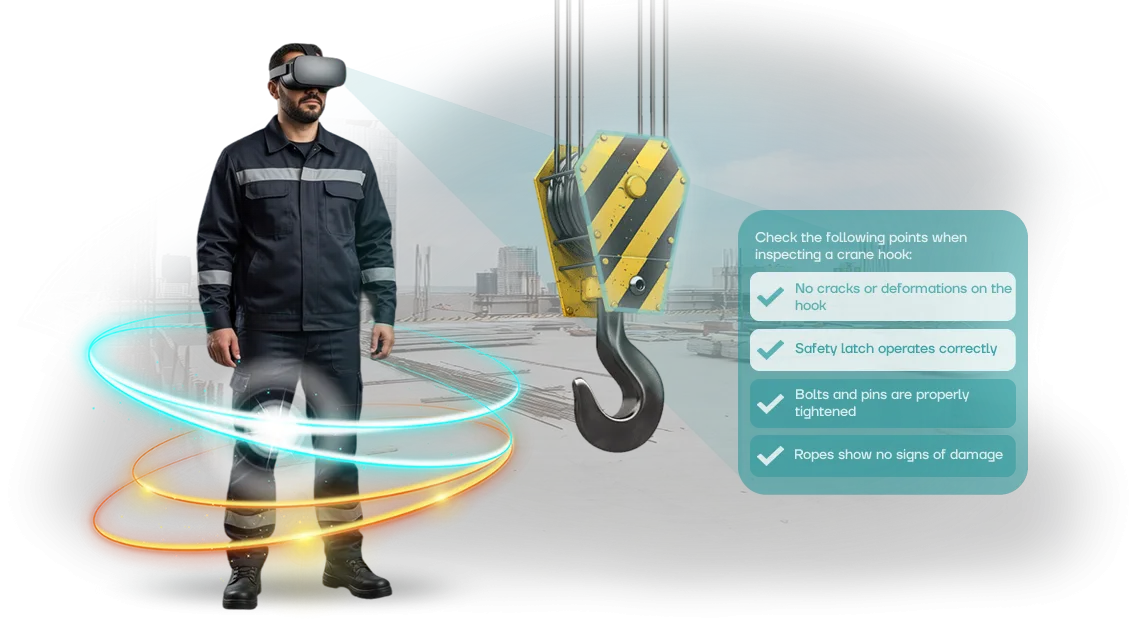
VR tactical training: old drills don't prepare you for combat
Traditional exercises and drills require real equipment, dedicated sites, and a large number of participants—and they always involve risk. A mistake on a simulator or in the field can lead to injury, costly repairs, or schedule disruptions.
And the environment itself is often far from a real incident: the instructor cannot quickly simulate smoke, equipment failure, or people acting in panic.
That is why classical formats fail to deliver the necessary experience. An employee practices movements but does not learn to make decisions under pressure—and in a critical situation acts on autopilot, without panic or unnecessary motion. In the end, exercises are run just for show, while real readiness remains unchanged.
VR simulators change the approach to tactical training. They create realistic scenarios that cannot be safely reproduced live: fire, hazardous substance leaks, evacuation in poor visibility.
At the same time, the participant is fully immersed in the environment, hears sounds, sees smoke and fire, and interacts with objects—but remains safe. This is training without losses: you can make mistakes, try different strategies, and risk neither health nor property.
The virtual environment allows actions to be practiced repeatedly and in different variations. The same scenario can be run 20 times, changing the input conditions—incident location, number of people, time of day.
This builds a lasting skill: the employee internalizes the action algorithm to the point of automation. After such drills, reaction to a real incident becomes faster and more confident, which means fewer losses and greater safety at the facility.
We help you integrate VR tactical training into your training system: from scenario selection to analysis of each employee's results. You get not an “obligatory event” but a measurable level of team readiness for non-standard situations.
Experience that is impossible to obtain on an ordinary simulator is now available without risks and with full quality control.
What you get from implementing simulators
VR simulators for tactical training give employees the opportunity to practice action algorithms in an environment close to reality, but without threat to life.
The participant goes through the entire scenario, learns to make decisions in a limited time, and immediately sees the consequences of their mistakes. This improves qualifications and confidence, and actions become automatic.
Reaction speed is a key skill in emergency situations. The simulator allows you to repeat challenging moments until a consistent result is achieved, without consuming materials, stopping production, or using additional sites.
The company gets employees ready for non-standard situations and simultaneously saves resources on traditional training with training grounds and consumables.
Reduced injuries are a direct result of systematic preparation. When actions are practiced to the point of automation, accidents and incidents decrease, and so do payouts, downtime, and reputational risks.
The manager sees an objective picture of the team's skills: where results are already consistent and where training needs to be strengthened in a targeted way.
Implementing simulators pays off through reduced costs for incident response, training new employees, and equipment downtime. This is not a one-off initiative but a systematic tool that makes safety manageable and measurable.
As a result, you get predictable injury rates, higher discipline, and a team ready to act in any situation.
Training formats: choose your option
Every unit operates differently, and a universal training format often fails to deliver the desired result. Virtual tactical training solves this problem: you choose the scenario, participants, and difficulty level for your task. Below is a comparison of the formats to help you decide.
All formats run on the same professional equipment, so the result is equally stable. Training is risk-free for health, independent of weather and training grounds, and each participant receives an objective assessment of their actions.
This is especially important for tactical training: a mistake at a real site costs a lot, while in virtual space it can be practiced without consequences.
| Format | For whom | What it gives the client |
|---|---|---|
| Group sessions | For units where coordination matters | Practicing team interaction, unified tactics, shorter preparation time |
| Individual training | For individual operators and specialists | Targeted skill development, flexible schedule, personal progress statistics |
| Scenario-based training | For practicing specific situations—ambush, assault, evacuation | Risk-free simulation of real conditions, repeated practice until automatic |
| For special forces | For rapid response groups and security services | Advanced scenarios, small-group work, decision-making in stressful situations |
Formats are easy to combine with each other. For example, operators first go through individual training, then practice team interaction, and then move on to complex scenario-based tasks.
We will help you build a program for your objectives and budget so that training delivers measurable results—from reaction speed to unit cohesion.
How training is delivered: project stages
Work on a VR simulator for tactical training is structured as a clear process. Each stage is covered by clear agreements: at any moment you know what has been done, what comes next, and where your decision is needed.
- Assignment and brief. We gather requirements: how exactly your employees train, which algorithms and conditions need to be practiced, and which skills should be considered key. We write the goals into a short document—this is what we check results against at every step.
- Plan and scenario. We develop the exercise structure: what situations we simulate, what errors we track, and how we evaluate actions. You receive the training plan and approve it before development starts—this eliminates unnecessary rework.
- Prototype. We build a working version with the key mechanics. At this stage you see how an employee interacts with the environment and can adjust details before all resources are invested.
- Full implementation. We bring the simulator to its final form: adding realistic scenarios, explanations, and an error and result scoring system. On request, we integrate completion reports for progress monitoring.
- Testing with your employees. We run trial sessions with your people (or group representatives), collect feedback, and refine the interface and scenarios. It is important that the briefing is convenient and clear for those who will use it.
- Launch and support. We deploy the simulator, train your instructors, and hand over instructions and access. After launch, we stay in touch: we help with questions, update scenarios to meet new requirements, and support the project as long as needed.
The full cycle takes from several weeks to a couple of months, depending on the complexity of the scenarios and the number of exercises. You are never left alone with our “internal process”: at each stage there is a concrete result and an approval point.
What's included in the delivery: a complete training package
A complete training package is not just a headset and controllers. We build a solution around your unit's objectives: from receiving the equipment to having instructors ready to run sessions.
What is included in the delivery:
- Equipment. Professional VR headsets with protective housing and replaceable ear cushions—designed for intensive use in training classrooms.
- Software. Preinstalled modules with baseline and industry-specific scenarios; updates and technical support for the entire contract term.
- Training scenarios. A library of 10+ situations: from fire response to evacuation and first aid. Scenarios are adapted to your procedures.
- Methodological materials. Training programs, action assessment scorecards, and handouts for the instructor—nothing needs to be developed from scratch.
- Instructions and briefing. A detailed setup and configuration guide, plus in-person/online briefing for your employees.
- Warranty and service. Equipment replacement in case of malfunction during the warranty period, phone consultations, and remote diagnostics.
Such a package allows you to launch training within a few weeks after delivery. The instructor gets a ready-made lesson scenario, and employees get realistic practice without risk to life. Everything else is taken care of by us.
Implementation results: operators' speed and accuracy
For operators, reaction speed and accuracy of actions are a matter of mission success and life. Classical training runs into the limitations of the training ground: it is impossible to quickly simulate a non-standard environment and measure every step of an operator.
We close this gap with virtual tactical training scenarios, where every mistake is recorded and turned into a clear performance metric.
Implementation case study
The Vityaz Training Center approached us—they needed to increase the decision-making speed of an assault group. Previously, results were measured with a stopwatch and verbal debriefing, and objective data was lacking.
We deployed a VR training ground for their standard scenarios: building entry, hostage rescue, and actions during sudden contact.
After two weeks of training, reaction speed increased by 40%—operators identify threats faster and open fire sooner. The number of errors in the scenario decreased by 30%: unnecessary movements, shots into friendly sectors, and delays in reporting are now less frequent.
After each session, the system automatically generates a report on time, accuracy, and sequence of actions—the commander sees the progress of every operator.
Manager's testimonial
Previously, we argued about who acts how in combat. Now we have numbers: speed, errors, dynamics.
This has completely changed our approach to training—we see what each specific operator needs to work on, not “on average across the group.” And the results at exercises confirmed it: decisions are made faster, and losses in scenarios have become noticeably fewer.
This approach pays for itself already at the implementation stage: you get not just a simulator but a tool for managing unit effectiveness. Analytics helps build a training program around each person's weaknesses—without sports stopwatches and subjective assessments.
For a manager, this is a transparent picture of the group's readiness and well-founded training decisions.
What if we have specific requirements?
Specific requirements are not a limitation but a reason for interesting work. We understand that every enterprise has its own standards, equipment, and safety culture, so we do not try to fit everyone into a single template.
Instead, we take the time to understand the customer's conditions and build the project around them.
Adaptation begins with studying your reality: regulations, instructions, typical emergency situations, site characteristics, and even the familiar terms your employees use. Based on this, we design scenarios that replicate your processes rather than abstract textbook examples.
If a non-standard solution is required—for example, practicing evacuation from a workshop with a unique layout or interaction with rare equipment—we find a way to bring it into the virtual environment so that the training is useful and safe.
An individual approach means you don't get a boxed product with someone else's settings. Each simulator is tailored to your specifics: employee skill levels, industry risks, and internal standards are all taken into account.
At the same time, task complexity does not scare us: we break it into stages and offer phased implementation so you can start with one scenario and gradually expand the system.
This flexibility allows us to handle even tasks that at first glance seem too narrow or too complex for VR.
We have already dealt with non-standard requests—from training for emergency situations to practicing skills on specific equipment—and in every case we found a working solution. Your goal is the main thing, and everything else adapts to it.
If you have special requirements and are not sure whether a virtual simulator will work for you—tell us about them. We will analyze the task, propose implementation options, and help you adapt the training to your specifics.
Answering common questions about implementation
Implementing VR tactical training for occupational safety is an important step, and common concerns arise before it: how reliable the equipment is, whether employees will find it difficult to master, and whether the new technology will disrupt familiar processes. We answer these questions.
What happens if the equipment breaks down?
All equipment is covered by an extended warranty and service. In the event of a malfunction, we arrange repair or replacement, and during the work we provide a replacement kit—training does not stop.
Is it difficult to train your staff?
The simulator is intuitive to operate, but we help even with that: we conduct a short training session for employees and leave simple instructions. After a few sessions, everyone works confidently.
How do we integrate VR into our current program?
You don't need to rewrite regulations. The simulator supplements briefings and allows you to practice emergency scenarios that cannot be reproduced in reality. We coordinate the scenarios with your specialists, and integration proceeds smoothly.
Is it really more effective than ordinary lectures?
In VR, the employee acts instead of listening to an instructor, so they remember actions several times better. The result is a lasting behavioral skill in threatening situations and fewer workplace injuries.
We are ready to show you the simulator at a demo and answer any remaining questions—just contact us.Request a consultation on simulators
Submit a request and get not general words but a concrete plan for your task. We review each inquiry individually: we listen, clarify the nuances, and propose a solution that will actually work in your conditions. It is absolutely non-binding.
The consultation takes place at a time convenient for you—by phone or video call. There is no need to prepare in advance: we will gather all the details ourselves, and you will get a complete picture.
What is included in the consultation:
- Task analysis: we will look at your current situation and the result you need.
- Format selection: we will suggest which simulator suits you—from a short scenario to a comprehensive program.
- Cost calculation: we will give you a budget range and timeline so you can plan.
- Implementation plan: a step-by-step plan for launch and integration into training.
- Guarantees and support: we will explain what is included in the price and how we help after launch.
- Practical examples: we will show similar tasks and client results.
To get all this, submit a consultation request. We will contact you within one business day, ask a couple of questions, and prepare a personal offer. No obligations—only value for your business.