

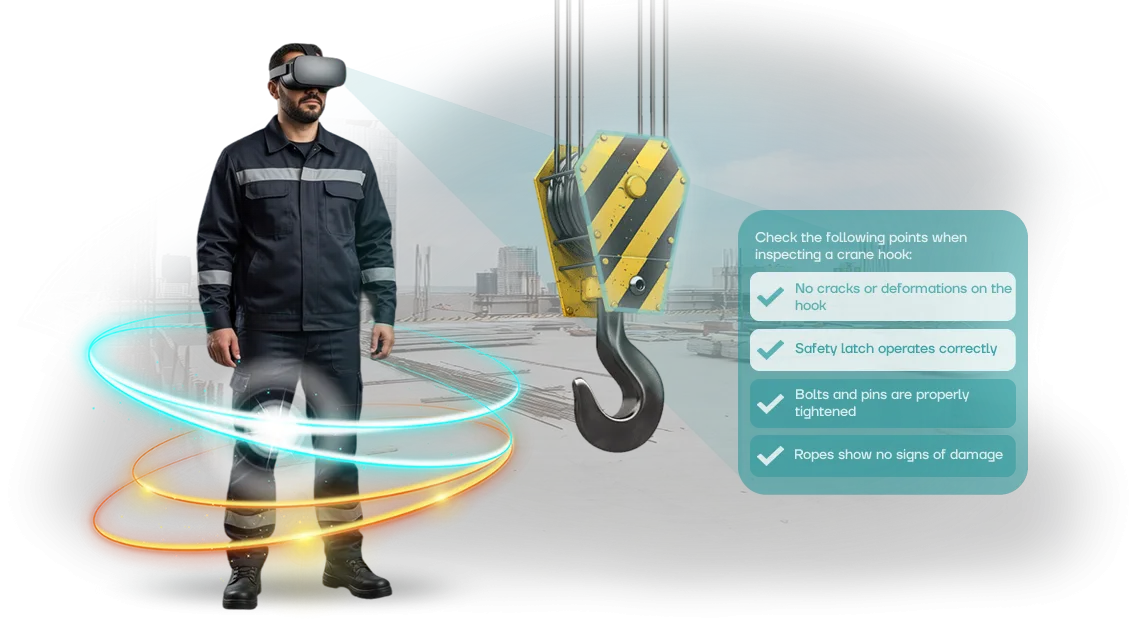
VR Tactical Simulator: How to Avoid Losses in Training Exercises
Each year, companies lose significant funds on large-scale tactical drills: renting training grounds, purchasing consumables, equipment downtime, and paying for instructors’ time.
Even well-planned training carries risks — human error, mistakes in complex scenarios, injuries, and equipment damage. The question is not whether drills are needed, but how to make them as effective and safe as possible without sacrificing quality of training.
A VR tactical simulator addresses this need: employees practice actions in a realistic environment, but without physical danger and the costs of organizing real events.
The same scenario can be run repeatedly, critical situations can be simulated, and the difficulty level can be adjusted for each participant. This turns training from an expensive event into a regular, manageable process.
Optimizing drills becomes obvious: there is no need to prepare the site, handle logistics, or purchase disposable materials. Training can take place at any time, in a convenient location, and for a large number of employees simultaneously.
The company gets objective metrics for each participant’s actions and can fine-tune the training program. As a result, solid skills are formed faster, and money goes not into consumables but into growing the team’s competencies.
Training safety is the main argument for this kind of preparation. Participants can make mistakes, repeat a difficult element, or find themselves in an extreme situation without risk to health or equipment.
This is especially important for fields where a real-world mistake can cost lives or lead to serious consequences. Employees are not afraid to experiment, and the quality of training improves through full immersion in the scenario.
We develop VR tactical simulators tailored to your enterprise’s objectives: from individual exercises to comprehensive scenarios for entire departments. Our engineers use professional equipment and proven tools to deliver stable results in a short time.
In the end, you don’t just save on exercise budgets — you build a training system that works for your team’s safety and efficiency every day.
What You Get: From Skill Practice to Measurable Results
When practicing actions in extreme situations, what matters is not theory but the speed and correctness of reaction. Conventional training is hard to repeat: it requires outings, special training grounds, and instructors, and rare emergency scenarios are only partially practiced.
A VR tactical simulator lets each employee experience a dangerous scenario as many times as needed to build a lasting skill.
Results of VR training are visible immediately. The system records every action: when the employee noticed a threat, what decision they made, how quickly they responded, and which instruction items they completed.
You get an objective comparative assessment — the skill levels of each team member before and after the course. This is not an instructor’s opinion but data that can be used for certification and a development plan.
Skill assessment in the simulator is based on repeatable scenarios. Each employee goes through the same inputs, so you can easily see weak points: someone is slow to react, someone ignores the rules.
Training in a virtual environment is safe — a mistake won’t cause an injury but will be remembered as real experience. You can play out emergency situations that cannot be recreated safely in real life: fire, smoke, equipment failure, crowd behavior.
Training savings come from several items. You don’t need to rent a training ground, hire extras, purchase consumables, or pay for production downtime during the drills. The same scenario can be run simultaneously for dozens of employees, and training takes hours rather than days.
For a typical group of 30 or more, the annual savings compared with traditional courses are calculated after an audit.
In the end, you get not just a ‘tick mark’ that training was done, but a measurable result: faster reaction times, fewer errors on checklists, and employee readiness for emergencies. This data can be shown to management, an insurance company, or regulators.
We handle the task from the first briefing to launch and support — and we always start with an audit of your real risks.
Training Formats: Team, Individual, or Mixed
Different scenarios require different approaches to training: some need coordinated action from the whole shift, while others need an employee’s personal response honed to automation.
We offer three VR training formats that address these needs without stopping production and with measurable results.
| Format | For whom | What it gives the client |
|---|---|---|
| Team drills | Shifts, crews, and operational personnel who work together | Practicing interaction in emergencies, role distribution, and a common action algorithm. The manager immediately sees where coordination breaks down. |
| Individual training | New employees, workers with skill gaps, rare hazardous operations | Personal pace and repetition until a confident result. Progress is recorded for each person; the instructor gets objective data. |
| Mixed format | Companies with multiple sites, shift schedules, or high turnover | Flexible schedule without removing people from work: some scenarios are done in a group, others independently. Training organization costs decrease, and onboarding is faster. |
The choice of format depends on specific risks: if accidents happen due to uncoordinated crew actions, we strengthen team drills; if errors are related to individual reaction, we set up personal training. In the mixed option, you can change the proportions as skill levels rise.
In any format, the client gets clear analytics: the number of completed scenarios, the share of successful attempts, typical mistakes, and each employee’s readiness for real work.
Based on this data, you can easily adjust the training program and show inspectors that staff truly practiced the skills rather than just listening to a briefing.
Simulator Development Stages: From Brief to Launch
Developing a VR trainer is not a ‘black box’ but a transparent process with agreed deadlines. We’ve broken it down into seven stages, and at each stage you know what is happening and can influence the outcome.
-
Brief and understanding your specifics. We meet with your specialists, study real scenarios, and analyze incidents. The output is the trainer’s goals and success criteria.
-
Scenario design. Together with your experts, we describe situations, employee actions, and consequences of mistakes. The scenario is approved before development starts to avoid rework.
-
Aligning the plan and timeline. We fix stages, checkpoints, and delivery dates. You always see who is responsible for what and when it will be ready, and you can make edits.
-
Implementation and interim demos. We build a working version and show it at key stages. You see what the trainer looks like and adjust it along the way.
-
Testing with your employees. We check how well the material is understood, usability, and reliability. You receive a test protocol and a list of refinements if needed.
-
Launch and handover. We install the equipment, train the instructors, and hand over all materials and access. The trainer works from day one.
-
Support and development. We help with updates, refine scenarios to meet new regulations, and answer the team’s questions.
What’s Included in the Delivery: A Complete Package for Launch
When you order a VR trainer, it’s important to understand what you get in the end. We put together the delivery as a turnkey solution: from equipment to employee training. Below is the full contents of the kit you’ll use to launch the program with no extra investment.
-
Professional VR equipment. Modern headsets and controllers, already configured for your tasks. You don’t need to buy anything extra — the kit is ready to use right after unboxing.
-
Industry-specific occupational safety scenarios. Simulators built on real risks in your production: work at height, electrical installations, hazardous substances, emergencies. Scenarios are adapted to your internal instructions.
-
Results tracking system. The instructor sees who completed the training, where mistakes were made, and which topics should be repeated. This allows you to monitor each employee’s skill level.
-
Instructions and manuals. Clear guides for instructors and users, as well as safety procedures for working with the equipment.
-
Training for your staff. Our specialists prepare your instructors: launch, setup, administration. Within a few days, they can run training on their own.
-
Technical support. We stay in touch for the entire service life: consultations, scenario updates, refinements for new regulations. Warranty service is included in the price.
In the end, you get not just a set of hardware but a working system for regular employee training. We are responsible for getting it running at your site and delivering measurable results — fewer injuries and compliance with occupational safety requirements.
Case Study: How We Cut Training Costs by 30%
Traditional safety drills are expensive, lengthy, and unrealistic: production must stop, a training ground must be rented, and instructors must be brought in. Employees often see them as a formality — and act incorrectly in real situations. At the same time, actual emergency actions remain unpracticed.
We replaced mock-ups with a VR trainer. An employee enters a virtual copy of the workshop and practices actions during a fire, leak, or accident — in conditions as close to real as possible. Scenarios are adapted to the enterprise’s needs: from evacuation to crew coordination.
A notable project was for the metallurgical holding company Metallinvest. We developed a trainer for practicing actions in the event of a fire.
The result: 200 employees were trained in one month instead of six, the time per person dropped from two days to three hours, and training costs were reduced by 30%. Payback period — five months.
The head of the occupational safety department sums it up: “We used to pay for rent and shop-floor downtime, while people just sat on the sidelines. Now everyone actually practices the scenario with no risk to life.
Training costs dropped by a third with a much better result.” After the pilot, the client expanded the project to four more sites.
This approach works in energy, mining, construction, and logistics. We handle the entire cycle — from risk analysis to personnel training. You get a tool that reduces accidents and costs, with measurable results in the first months.
When you come to us, you get not just a program but a skill-practice system that pays for itself within a few months.
How to Choose a Training Format for Your Needs?
Safety training is not a one-size-fits-all thing: the same format won’t suit both a small workshop and an enterprise with thousands of employees.
To choose correctly, you need to consider the number of trainees, the specifics of their work, and business goals — reducing violations, speeding up onboarding, or preparing the team for emergencies.
That is why we start not with the technology but with your task: we analyze what result should be measurable and how training will fit into current processes.
If you need to quickly train hundreds of people, we’ll offer compact VR scenarios that take 10–15 minutes and don’t require stopping production.
When it comes to complex actions — evacuation, working with hazardous equipment, or practicing an algorithm under stress — a full VR tactical simulator with a detailed environment and step-by-step control is a better fit.
In both cases, you get not “watched a video” but a real skills check: the system records mistakes, reaction time, and the final score.
We help you decide on a format based on your specific situation: for a small group, individual training with a detailed review of mistakes is effective; for mass coverage, a modular program with automated report generation works well.
The selection criteria are simple — the number of employees per year, how often scenarios need updating, and industry requirements.
Our engineers adapt the solution to your regulations and deploy it either on-site or remotely. We’ll also work out the economics: how much one employee’s training hour costs in different formats.
As a rule, VR training pays for itself just through shorter onboarding time and fewer mistakes in real production.
Submit a request — within two days we’ll prepare a selection of formats for your needs and send you a benefit calculation. And if you want to see it in practice, we’ll arrange a demo with your employees using real scenarios — you’ll immediately see what suits you.
Common Concerns: Safety, Payback, and Guarantees
Any new training format raises questions: will the equipment break, who will maintain it, when will the investment pay off, and is it safe for employees? Let’s address the most common concerns — the same way we answer clients during the sales process.
Is a VR trainer really safe for employees?
Yes. Training takes place in a controlled space without real risks: an employee cannot be injured, fall, or damage equipment with an incorrect action.
Scenarios are designed so that practicing an error — from pressing the wrong button to an emergency stop — happens in the virtual environment, not on the production floor.
What if the equipment breaks or becomes outdated?
We use professional headsets designed for intensive daily use, not one-off demonstrations. During repairs, we provide a replacement kit so training doesn’t stop. If new scenarios become available, we update them remotely without sending a team to your site.
Is the trainer difficult to operate and maintain?
The trainer starts with one button, and an instructor only needs 15 minutes to learn it. The entire process — from authorization to exporting reports — happens in an intuitive interface.
Scheduled maintenance and update control are covered by our contract, so your team doesn’t need to deal with technical details.
When will the trainer pay for itself?
We calculate based on your data: number of employees, frequency of briefings, and current training costs. In a typical scenario with 300–500 people, savings on instructor time, consumables, and fewer mistakes cover the investment in 6–12 months. We show exact figures in the estimate after the briefing.
Guarantees are not just words about reliability but contract terms: fixed launch deadlines, support for the entire period of use, and transparent service costs. With these conditions, it’s easy to plan a budget and not worry about hidden expenses.Get a Project Estimate and Commercial Proposal
Submit a request for a calculation — we’ll send you a commercial proposal with the exact cost and benefits for your field. It’s non-binding: we’ll prepare the details, and you’ll get a clear picture for making a launch decision.
What you get at the evaluation stage:
- A preliminary consultation: we analyze your tasks, work scenarios, and requirements for the result.
- Two calculation options — basic and extended — so you can choose according to budget and goals.
- Exact launch timelines broken down by stage: you’ll know when you can start using the solution.
- A list of what’s included in the result: content, progress tracking, updates, and training materials.
- Examples of similar projects and metrics achieved by other clients.
- A dedicated specialist who manages your task from briefing to launch.
After you submit the request, we’ll clarify the details at a time convenient for you and respond within one business day. No extra emails — just the calculation you can immediately discuss with your team. Leave your contacts, and we’ll prepare a commercial proposal tailored to your task.