

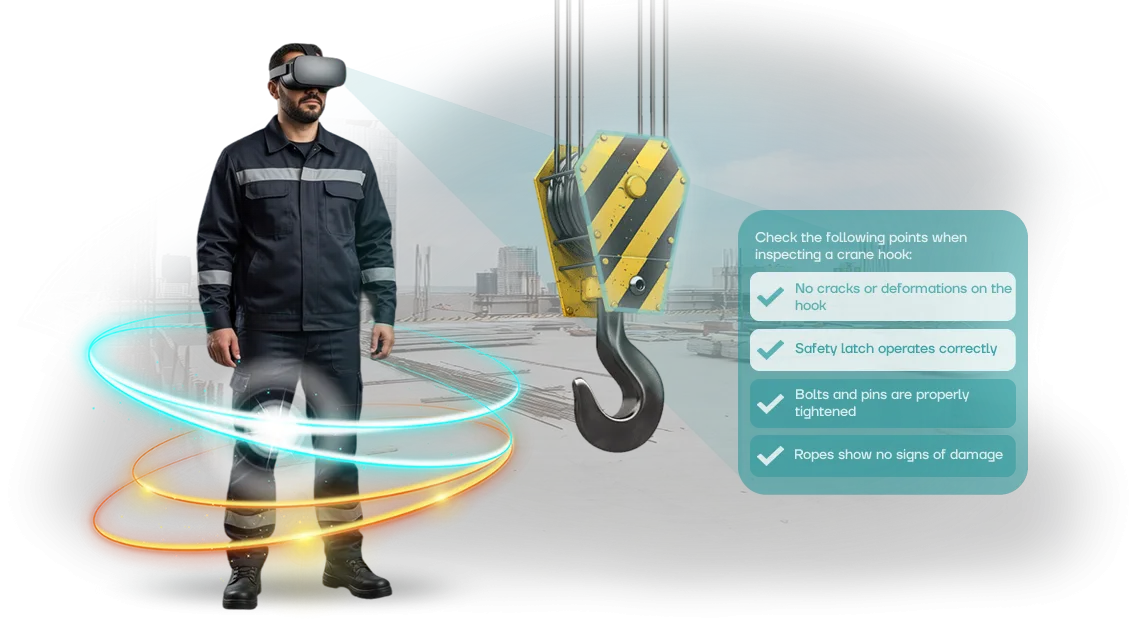
Defense training simulation: why are real-life drills dangerous?
Real-life occupational safety drills are a balancing act on the edge of risk. Every scenario involving fire, chemicals, or working at height can end in injury—and that means compensation payouts, inspections, and human tragedy. But organizations are forced to run them again and again: regulations and common sense demand it.
Even when drills go off without incident, their value is questionable. Employees subconsciously understand that "this is just pretend"—and react without the tension that arises in a real emergency.
Rare accidents cannot be fully rehearsed: it is too expensive, too dangerous, and too difficult to organize. As a result, in a real emergency people act confused because the brain does not recognize the conditions.
This is exactly where defense training simulation comes in—an approach that moves dangerous scenarios into a virtual environment as close to reality as possible.
The employee learns to act during a fire, a leak, a collapse, or the threat of an armed attack—without risk to life or health.
Such trainers allow exercises to be repeated many times, scenarios to be adapted to the specifics of the enterprise, and provide objective evaluation of each person's actions.
We have been developing exactly these solutions for many years: our engineers know how to turn complex regulations into clear and engaging exercises, and every employee receives full feedback.
Below, we will explain how this works in practice—and why you can stop worrying about your people during mandatory drills.
Key benefits for your department
Implementing VR trainers is not a replacement for live training but a reinforcement of it. The department gets a tool that works toward results: safety, speed, and savings without losing quality.
Safety without risk
Practicing complex and emergency scenarios in a virtual environment eliminates any threat to life and health. A mistake that in reality would lead to injury or equipment damage simply becomes experience here.
The skill is reinforced, and the consequences for people and machinery are zero. Each such scenario can be repeated dozens of times until the action becomes automatic—while the cost of error does not increase.
Resource savings
Real-life drills require fuel, ammunition, lubricants, and time for setup. A VR trainer allows the same tasks to be practiced without consuming resources, repeating exercises as many times as needed.
The costs are recovered after the first training cycles, and the freed-up budget can be directed to other department needs.
Faster training
A scenario starts in minutes and requires no logistics or approvals. One instructor can manage several groups, while trainees study at convenient times without falling out of the schedule.
As a result, time-to-ready is reduced, and the department reaches the required level of readiness faster.
Training effectiveness
The immersive environment holds attention and engages muscle memory: the skill is practiced to the point of automation. Objective data on the trainee's actions allows the instructor to correct errors precisely and evaluate progress.
This delivers a higher level of preparation than instructions or videos—and the result is easy to verify in real work.
Simulation training formats for your tasks
Every department has its own tasks, and readiness is determined not by identical exercises but by precise practice of specific scenarios. At the same time, real training is often limited by weather, resource consumption, and injury risk.
Virtual trainers remove these limitations: the soldier makes mistakes in a safe environment, and the result carries over into practical skills.
We have compiled the key training formats that address different defense-related needs—from individual preparation to group coordination.
If your case does not fit any of the items, send us a description of the situation—we will adapt the scenario and methodology to your regulations. We adapt training scenarios to your tactics and equipment.
| Format | Who it is for | What it gives the client |
|---|---|---|
| Individual trainer | For practicing individual soldier skills | Confident actions in an emergency without risk to life or equipment |
| Group scenario | For coordination of a team, crew, or platoon | Practice of interaction and communication in an environment close to real conditions |
| Tactical command post | For commanders and staff specialists | Decision-making practice under time pressure and analysis of alternatives |
| Technical training | For weapons and equipment specialists | Rapid mastery of procedures and response to abnormal failures |
| Combined training ground | For mixed units | A full training cycle: from individual skills to whole-group coordination |
How we implement programs: work stages
Any trainer development project is a risk if the process is not transparent. We have structured our work so that at every stage you understand what is happening with the budget and timeline, and you see measurable results. No surprises—just steady progress toward the goal.
- Brief and task audit. We dive into your regulations and workflows. We record training objectives and information security requirements.
- Program development. Together with your experts, we design scenarios: from standard operations to emergency situations. We approve the structure before programming begins.
- Prototype approval. We show the future interface and trainer mechanics. You make edits before the main development begins—this saves budget and time.
- Development and testing. We build the full trainer, verify stability and compliance with requirements. You receive intermediate builds for review.
- Launch and integration. We configure equipment, install software, and train instructors. The trainer is immediately embedded in your training program.
- Support and development. We update scenarios for new regulations, add exercises, and quickly resolve issues throughout the entire service life.
The result is not a "demo version" but a working tool integrated into your occupational safety system. It directly helps reduce injuries and increase employee qualifications, protecting people and the business from downtime.
What is included in the VR trainer delivery
When you order a VR trainer for occupational health and safety, you receive not just a standalone program but a ready-made solution for employee training.
The package is assembled so that training can begin immediately after installation, and results can be monitored without involving developers.
The delivery includes:
- Scenarios based on your regulations: we model real situations—from equipment operation to emergency response and evacuation. For defense tasks, exercises are close to combat conditions.
- Training materials: instructions, reference sheets, and tests for knowledge assessment. Use them as a separate course or as a supplement to the training program.
- Software with an administrator panel: assign training sessions, track completion, and receive error statistics in the form of convenient reports.
- Equipment and setup: we select professional VR headsets, deliver and configure them on your premises, and verify everything works.
- Instructor training: in two or three days, your staff learn to work with the trainer independently and launch training sessions without us.
- Support and updates: after launch, we provide ongoing support, update scenarios when regulations change, and help with any questions.
This package covers all stages—from scenarios to equipment and personnel training. All you need to do is allocate space and employee time; we handle the rest.
Case study: how we trained 500 employees in 3 months
A manufacturing holding company faced a tough challenge: train 500 employees in occupational health and safety in three months.
Lectures and briefings did not produce the required level—knowledge faded within a week, and on real equipment people acted out of habit rather than according to procedure.
We proposed a virtual trainer based on Unreal Engine—a platform that delivers realistic graphics and stable performance even during large-scale launches.
Instead of abstract slides, each employee entered a digital copy of their own workshop, where they had to apply the rules in practice: assess risks, choose the right tool, respond to an accident.
What we achieved in 12 weeks
All 500 employees completed the training without leaving production—each session took 20–30 minutes within the work schedule.
Final tests showed an average score of 94% (before the program, it was 62%), and the number of dangerous errors when working with equipment dropped by 41%.
The trainer automatically recorded results and granted employees access to work, reducing permit processing time from two days to a few hours.
How it was implemented
We started with an audit of typical violations and an analysis of real incidents at the enterprise, then built scenarios for each profession and role. Setup took four weeks, and another two were spent on a pilot group of 50 people. After feedback, we refined the interface and quickly scaled the training to all teams.
Each department manager saw their people's progress, error zones, and readiness for inspection in a personal dashboard. The project was completed on time, and the client immediately requested a second module—for onboarding new employees and annual recertification.
This confirms: a practical VR trainer solves the task faster and more reliably than classic briefings, and the result is easy to measure and control.
How to choose the right training format?
"What is better—one trainer for everyone or separate programs for each task?" This is perhaps the most common question we get before a project starts. And the honest answer is: there is no universal solution, and that is normal.
The format should be determined by what exactly you are practicing: mass training of personnel on basic standards or rehearsing rare but critical actions under special conditions.
We match the format to your task, not the other way around. At the start, our engineers and methodologists analyze what risks your employees face, how many people need training, and what result you want to measure.
So for one client we propose a compact scenario for regular briefings, and for another—a multi-level program with emergency-response practice, up to whole-department coordination.
If your goal is to quickly raise the general safety level and cover hundreds of employees, short scenarios that replace outdated lectures and video screenings are optimal.
If you need to prepare personnel for high-responsibility situations where the cost of error is great, we create in-depth simulations with multiple branching outcomes. In such programs, the employee does not just memorize an instruction—they learn to make decisions under pressure. This is what builds confidence and reduces the risk of human error.
It is also important how the training fits into your current preparation system.
We make sure the trainer is not a separate "toy" but works as a full-fledged tool: you see completion results, understand which employees have absorbed the material and which need additional practice.
We use professional equipment and proven development tools, so the result is stable: no failures at the most critical moment.
If you are unsure which format suits you—that is normal. Send us a description of your task, and we will propose an option that solves it with the required effect and without unnecessary costs.
Our goal is to give you a clear training system that pays for itself through reduced risks and increased employee competence.
Answers to common client questions
We know that before ordering a trainer, questions arise: how reliable is it, who will support it, how to integrate the training into existing programs. Below are answers to the most frequent ones. If you do not find your question, write to us—we will discuss the details.
What guarantees do we have that the trainer will work in our conditions?
We record the requirements in the technical specification, show intermediate results at each stage, and test on real scenarios with your employees. If something is wrong—we fix it before launch.
After delivery, we provide an official guarantee on the trainer's operation and its compliance with the stated functions.
Can changes be made during development?
Yes, that is normal. We work in stages: you see the result at every step and adjust details—from scenarios to the interface. All changes are documented so that the agreed budget and timeline are preserved.
What happens after launch? Who helps if something breaks?
We provide ongoing support: we advise employees, update training scenarios for new regulations, and quickly resolve failures. We usually sign a one-year contract, but a one-time format is also possible—depending on your task.
How long will development take?
It depends on the complexity of the scenarios and the number of modules. Typically, the first release is ready in 4–8 weeks. Exact timelines are fixed in the contract, and we work with phased payments—you see progress and do not pay for "air."
Our employees have never used VR. Will they find it hard to adapt?
The trainer starts with a single button, and instructor assistance is needed only during the first sessions. We train your team, give reference materials, and support the launch. After that, employees work independently—no special technical skills are required.
Start preparing your personnel for real threats today
Starting preparation for real threats is easier than it seems—and our team will help you do it without internal roadblocks, faster and more accurately than competitors who only talk about a "new approach." We know how to fit such training into shift schedules without losing productivity, and we are ready to demonstrate the result on your task.
If you leave a request now, you get not just a project estimate but a meaningful action plan that addresses the main fear: "what if implementation drags on for months." Below are the bonuses that make department heads start working with us even before the budget is approved.
- Consultation tailored to your specifics—not "a talk about VR in general" but an analysis of your specific risks and scenarios on the first call.
- Fast cost estimate—you understand the cost within a day or two, without a week of internal approvals.
- Pilot demonstration—we show your key training exercise in the trainer so management sees the result before signing off on a major phase.
- Ready-made adaptation to your regulations—we integrate the system into your current occupational safety instructions rather than making you learn "from scratch."
- Protection against schedule slips—after launch, you receive a support and update plan so the trainer evolves together with industry requirements.
This is an easy entry point. Leave a request for a consultation or cost calculation—we will send training options for your scenarios and tell you how much time implementation really requires.
We will discuss your task, show how our engineers handle such cases, and design a solution for your specifics.