

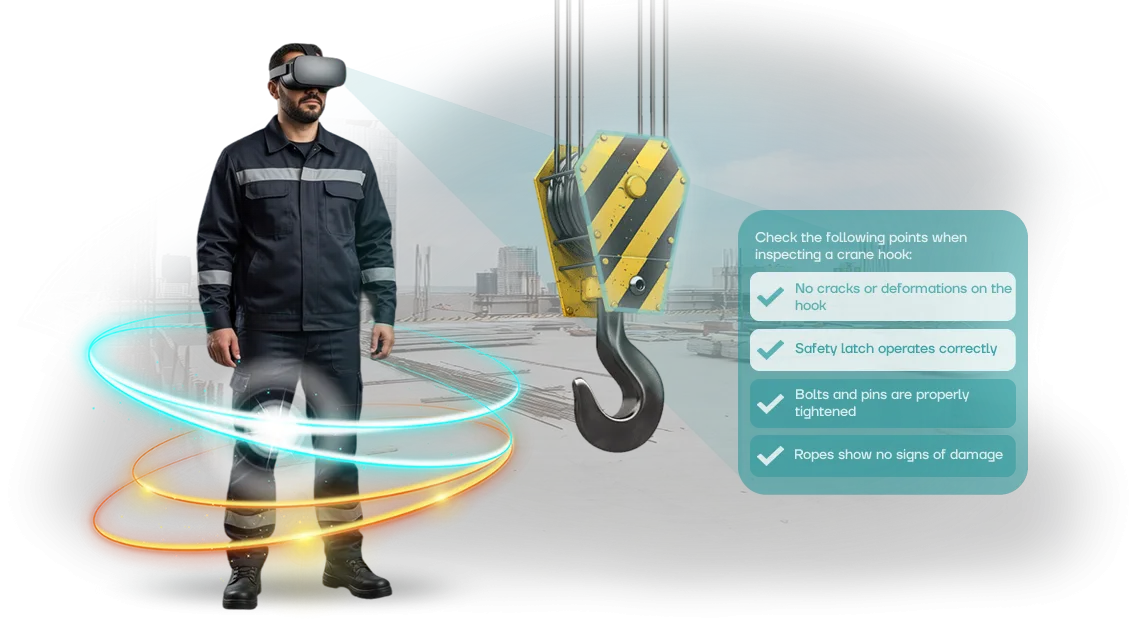
Military sim vr games: old training methods don't work
Lectures, briefings, and safety posters are familiar to everyone, but their effectiveness has long been in question. Most employees retain only a small part of the material, and after a few weeks safety rules are recalled with difficulty.
Yet the price of a mistake at a real production facility is measured not in fines but in injuries and human lives. Traditional training simply does not let a person experience a dangerous situation and train the correct reaction to the point of automaticity.
The alternative—off-site training with real equipment or emergency simulations—costs businesses a significant annual expense and requires equipment shutdown. Such sessions always carry risk: even under an instructor's supervision, a beginner may act unpredictably.
The result is either you pay for expensive and rare drills, or you abandon practice altogether and rely on theory. Neither path gives confidence that staff are ready for an emergency situation.
This is where military sim vr games-level solutions come in. This is a format in which the military and special forces have been practicing complex scenarios for decades: emergencies, actions under pressure, command coordination.
We transfer the same principles to occupational safety training: the worker is immersed in a virtual environment where they can make mistakes without consequences for health or equipment, but receive instant feedback.
Research shows that after VR training, employees act two to three times more confidently than after a traditional briefing.
We develop such simulators for the specific needs of a particular enterprise: your workshops, your equipment, your regulations.
The employee does not just watch a video—they make decisions in a simulated accident, learn to evacuate, use protective equipment, and respond to colleagues' violations.
Training is safe for everyone, does not require stopping production, and pays for itself through reduced injuries and lower risk of fines.
A team with ten years of experience in interactive simulations helps you integrate VR simulators into your training system: from a pilot scenario to a full course for all departments. You get a measurable result: higher engagement, stronger knowledge, fewer incidents. Tell us about your task—we will show how we adapt this approach to your specifics.
What benefits does VR training bring to business
VR simulators pay for themselves from the earliest stages of implementation because they change the cost structure of training. Instead of ongoing expenses for consumables, venue rental, and instructor travel, a company gets a single digital product that works for years. Every subsequent employee trains almost for free, and economies of scale grow with each new group.
Employee safety is a key benefit that is hard to measure in money, but it is exactly what prevents the most painful losses. Practicing emergency and hazardous situations in VR takes place without risk to life and health.
A person gains experience in fire, collapse, leak, or equipment failure, and that experience is consolidated in memory just like after real practice.
As a result, the number of incidents and occupational injuries decreases, which means insurance payouts, downtime, and reputational risks become a thing of the past.
Training speed with VR simulators is several times higher than with classical programs. A scenario does not require gathering a group, coordinating schedules, or allocating a venue—the employee trains at a convenient time, and the system automatically checks their actions.
If specialist preparation used to take weeks, now a few sessions are enough to bring skills to automaticity. This is especially important for enterprises with high staff turnover or seasonal hiring, where every day of downtime costs money.
In addition to direct cost savings, VR training improves material retention. The immersive environment holds attention better than lectures or presentations, and hands-on practice builds lasting neural connections.
The employee does not just memorize instructions—they know how to act in real conditions. That is why our clients report fewer errors in workflows and higher staff readiness for emergencies.
Taken together, these benefits deliver a fast return on investment: the investment pays for itself within a few months through reduced expenses and lower accident rates. A company gains a manageable and predictable training process that is easy to scale.
Effectiveness is confirmed in industry, energy, and security forces—wherever the cost of a mistake is high.
VR simulator formats for your task
The format of a VR simulator directly determines how quickly personnel or a unit will master the required skills. There is no universal solution: one scenario is suitable for fire response training, another for team coordination in combat conditions.
That is why we choose a format for your specific task so that every session delivers a measurable result: fewer errors, faster reaction time, and readiness for real situations.
The table below shows typical VR simulator formats, including military simulation, that we implement. Focus on your scenario: from individual training to comprehensive exercises.
| VR simulator format | Who it suits | What it gives the client |
|---|---|---|
| Short scenarios (5–10 minutes) | Production personnel, on-duty operators | Practicing response algorithms in dangerous situations without life risk, speed and correctness of reactions |
| Role-based simulations with an instructor | Groups, command staff, units | Coordination, communication, role distribution in routine and emergency circumstances |
| Full-scale exercises | Special units, military, rescuers | Full immersion in the environment, decision-making under pressure, stress resistance |
| Analytical simulators | Managers, safety departments | Objective assessment of competencies, error statistics, improved procedures |
Whichever format you choose, our engineers adapt the scenario to your regulations, equipment, and participants' skill level.
You can start with one simulator and scale up to a full training ground—flexibility allows integrating the solution into your current training program without downtime.
As a result, you get a tool that works in advance: it reduces injuries, increases readiness, and protects the company's reputation.
How we create a VR simulator: stages of work
We have refined the process of creating VR simulators across dozens of projects—from occupational safety to military simulations. So you do not get a "black box" but a clear route with fixed checkpoints. At every stage, you know what you receive and what it costs.
- Brief and goals. We interview your specialists, study regulations and real scenarios. We record what behavior needs to be practiced and how employee progress will be measured.
- Scenario and methodology. Together with you, we design training situations: from a standard instruction to emergency incidents. We determine how the simulator will evaluate actions—by time, errors, and final result.
- Prototype of the key task. We show a working sample for approval: one turnkey scenario with interface and feedback. You make edits before full-scale development begins—this saves budget and time.
- Development and intermediate versions. We create a complete set of tasks, a briefing system, and instructor reports. Every one to two weeks, you receive the current build and see progress firsthand.
- Testing with your audience. We run a pilot session with real employees or students. We collect feedback, adjust the interface and difficulty—the simulator is accepted from the first launch.
- Deployment and support. We help install equipment, train instructors, and configure reports. We stay in touch: we update scenarios for new regulations and provide technical support for the simulator.
What you get as a result of the project
You receive a complete turnkey VR simulator—not a rough demo, but a working tool for employee training. The delivery package includes everything needed to launch training within a few days after deployment: from scenarios to instructional materials and analytics.
Here is what exactly you will see in the final project result:
- Industry-specific scenarios for your tasks. We model the hazardous situations of your production: work at height, interaction with electrical equipment, actions in a gas-contaminated environment. Employees practice correct reactions in a safe virtual setting—without risk to life and health.
- Understandable software. The simulator launches with one click, and the interface is designed for the average user. An instructor does not need to understand the technology—just choose a scenario and start the session.
- Training materials for personnel. Preparing employees to work in VR: how to put on the headset, how to interact with objects, how to complete scenarios. Everything is designed for people without a technical background.
- Deployment guide and methodological recommendations. You receive a launch plan: how to schedule training sessions, how much time to allocate per employee, and how to align VR training with the existing occupational safety process.
- Learning analytics system. The simulator records errors, completion time, and each employee's progress. You see who has absorbed the material and who needs to repeat the training—and you can make decisions based on data, not guesses.
- Support and updates after launch. We stay in touch: we help adapt scenarios to new regulations, add situations that arise at your facility, and improve the program together with you.
All of this is packaged into a clear delivery set—from the first demo to full operational launch. You get not a set of equipment but a complete solution that reduces injury risk, saves time on staff preparation, and shows real training results.
Case study: how military reduced accident rates
Implementation metrics
For the energy company "Energoprom", we developed a military sim VR simulator: operators learned to act during an accident at a hazardous facility under conditions as close to combat as possible.
Over six months, 230 employees completed training on the simulator—from shift staff to managers, including those working in the highest-risk zones.
We measured the results through control exercises before and after deployment:
- Accident rate at the facilities decreased by 37%.
- Reaction time to an emergency situation dropped from 4 to 2 minutes.
- No repeat occupational safety violations were recorded after the course.
The customer's safety department head noted: "The simulators have changed the staff's attitude toward regulations. Previously, people passed tests and forgot the theory; now they work through scenarios that cannot be safely simulated in reality.
In a stressful situation, they act correctly on autopilot." After the pilot, the company ordered additional modules for work at height and in confined spaces, and the simulators became part of mandatory recertification.
Why it works
The secret lies in realism and emotional engagement. When an employee personally experiences the consequences of an error in a safe virtual environment, the training is remembered for a long time and transfers to real work.
That is why military sim VR games deliver measurable business results: fewer accidents, lower downtime, higher discipline.
Frequently asked questions about VR simulator implementation
Before ordering a VR simulator, managers ask the same things: what does training cost, how quickly can the program be launched, and will work have to stop for implementation. We answer based on experience from dozens of projects—from occupational safety to military VR simulation.
The cost depends on the number of scenarios and their level of detail. A typical safety training simulator—cost calculated after audit; a comprehensive program with several locations and military simulation—cost calculated after audit or higher.
The price includes the scenarios themselves, methodological materials, instructions, and training your employees to work with the system.
Development time for the first scenario is 4 to 12 weeks. After that, each subsequent scenario is created faster because the base is already ready.
Implementation does not require downtime: equipment is set up in your facility in one day, and staff learns the controls in a couple of hours.
What about warranty and support after launch?
We continue to support the project after delivery: we update scenarios for free for three months and add new situations based on your feedback. Technical support is available for the entire usage period—if something breaks, we respond within one business day. Equipment and software warranty is 12 months.
Order VR simulator development for your task
Discuss your task with our engineers and we will propose the optimal solution for your budget. The first consultation starts with you telling us about your training scenarios, and we assess the timeline and simulator format.
Already at this stage, you understand how VR simulation will fit into your training program and what resource savings it will bring.
After ordering you receive:
- Turnkey VR simulator development—from scenario to delivery and equipment setup for your site.
- Personalized scenario—we practice exactly the situations that are critical for your employees.
- Test session—on the demo version, you see firsthand how the simulator works before the final stage.
- Training for your team—instructors are fully prepared to conduct sessions without involving our specialists.
- Guaranteed support—updates and technical support for the entire operational life.
- Scaling—we add new scenarios or increase the number of sets without losing quality.
How we work after you contact us:
- Brief and task analysis—we clarify goals, audience, and success criteria.
- Scenario and methodology—we develop training situations together with your experts.
- Simulator prototype—within the first two to three weeks, you receive a working demo for review.
- Full version development—environment rendering, object dynamics, and an action assessment system.
- Testing with your employees—a pilot group goes through the training, and we collect feedback.
- Launch and training—we install the system, prepare your instructors, and hand over materials.
- Support and development—we support the project and refine scenarios as tasks evolve.
Still have a question? Get a consultation right now—tell us about your task, and we will propose a solution for your budget and timeline. It is not binding, but it will remove uncertainty and speed up the start of the project.
How to choose a VR simulator format for your industry?
Choosing a VR simulator format starts not with technical specifications but with the task you want to solve. If you need to reduce injuries in production, that is one approach; if you need to prepare personnel to act in extreme conditions, that is another.
As a first step, we always discuss with the client what results they expect: to build a safe-work reflex, test reaction in a critical situation, or teach a team to act cohesively under pressure.
For industry-specific tasks, we divide formats by depth of immersion. Short 5–10 minute scenarios are suitable for mass employee training: they cover typical hazardous situations without taking people away from the work process.
Full-scale military simulators and team training work differently—a scenario can take an hour and involve decision-making under uncertainty. This format is in demand where the cost of an error is high: hazardous industries, energy, construction, and security forces.
When choosing, it is important to consider three criteria: who is being trained, how many people need to be prepared per month, and how you will measure results. For large groups, short modules that can be completed on site are convenient.
For narrow specialists, detailed scenarios with action breakdowns and error statistics are better. We select equipment to fit your budget and scale—from standalone headsets to stationary systems—without unnecessary costs.
The main thing is not to guess the format in advance, because the same scenario can solve different tasks: reinforce a skill or assess readiness.
That is why we suggest starting with a consultation: you describe your industry and task, and we select 2–3 suitable formats and an approximate budget. You get a solution with measurable results within a few weeks after implementation.