

Why you lose time and resources without combat training simulation
Traditional safety briefings and lectures create an illusion of readiness. An employee passes a test, receives a permit, but in a real accident acts at random — panic, wasted time, mistakes.
That is why production risks do not decline even after regular training, and every incident results in injuries, downtime, and reputational losses.
The problem is that theory does not reproduce a stressful environment. In combat conditions — when there is fire, smoke, or chemical leaks all around — the brain works differently, and without automatic reflexes skills fail. Developing the right reaction requires a simulation as close to reality as possible.
Large companies such as Walmart already use VR safety training for exactly this: interactive training lets an employee make mistakes in a virtual environment and remember the correct actions without risking their life.
Training effectiveness increases many times over — people retain up to 70–80% of material through practice instead of 10–20% in a lecture.
We are a development team with ten years of experience, and we create virtual reality occupational safety simulators. This is true combat training simulation for your production: accidents, fires, evacuation, work with dangerous equipment — in complete isolation from real risks.
The employee trains to act correctly, and you get predictable safety, reduced downtime, and personnel readiness for any emergency.
What you get from implementing VR simulators for occupational safety
Implementing VR simulators for occupational safety is not a replacement for classic briefings but a new level of employee training. The virtual environment makes it possible to practice actions in conditions as close to real life as possible, but without risk to health.
We create scenarios on the professional Unity engine so that training runs stably on an ordinary office computer.
What this gives the company — point by point:
- Increased engagement. A boring briefing is replaced by an active training session where the employee makes decisions themselves. Material retention grows severalfold, and knowledge is reinforced with practice.
- Reduced injuries. Dangerous situations — from working at height to interacting with equipment — are practiced in a safe environment. Mistakes don't lead to injuries, and the gained experience carries over to real work.
- Training cost savings. There's no need for consumables, training range rental, or paying for repeated briefings. The same scenario can be completed any number of times without additional costs.
- Practice for rare scenarios. Actions during a fire, gas leak, or emergency shutdown are hard to simulate in real life. VR recreates them in detail and prepares employees for any emergency.
- Improved safety. The system records errors and scenario completion time. You can see which topics are poorly understood and target your training accordingly.
In the end, the company gets a working training system that reduces risks and saves budget. Our engineers adapt the simulators to your regulations and equipment, and deployment takes weeks, not months.
Simulation formats: from fire safety to tactical drills
There is no universal simulator for every task — and there doesn't need to be. One client needs to practice an employee's actions during a fire, another needs group coordination in a tactical situation.
That's why we match the simulation format to a specific goal: what exactly we're training, how many people participate, and what result the manager wants.
Which format fits your objective
| Simulation format | For whom | What it gives the client |
|---|---|---|
| Single-player scenario | An employee who must clearly know the sequence of actions | Quick practice of the algorithm without involving others, clear knowledge assessment |
| Fire safety | Staff in offices, production facilities, warehouses | The skill to act in fire and smoke without risking life, automation of the first seconds |
| Tactical training | Rapid response groups, security personnel | Practicing movement, communication, and decisions in limited visibility |
| Team exercises | Units that need to work as a single organism | Coordinated actions, role distribution, visibility of interaction errors |
| Emergency response drill | Managers and command staff | Decision-making practice under pressure, verification of evacuation and communication plans |
Each format is not just "put on a headset and look at a picture." It's a simulated situation that reacts to the participant's actions: change your route — conditions change; make a mistake in a command — the system shows the consequences.
We match the format to your specifics as early as the briefing stage. If needed, we combine several options: first solo practice, then a team exercise with a group debrief.
As a result, you get a simulator that solves a specific problem rather than simply demonstrating technology.
Simulator development stages: from brief to launch
Transparent simulator development is not a "black box" but clear stages of VR simulator creation with a result at every step.
We fix project deadlines, areas of responsibility, and acceptance criteria, so you know in advance what you're paying for and when you'll receive the finished product.
- Brief and task immersion. We study your regulations, instructions, and typical employee errors. Result: a technical specification and a fixed-deadline cost estimate.
- Scenario alignment. Together with your occupational safety specialists, we work out training situations: how the employee behaves, what constitutes a violation, and how the simulator assesses their actions. Result: an approved scenario with no ambiguities.
- Prototype and design. We build an interactive model that immediately shows what the simulator will look like and how it will work. You make edits at this stage instead of after the work is completed.
- Main simulator development. We create the full scenario, graphics, sound, and action evaluation system. You receive intermediate versions every 1–2 weeks — no surprises at the finish.
- Testing and debugging. We test the simulator with real users from your team, fix errors, and make it stable. Result: a product that won't let you down at the most critical moment.
- Simulator launch and support. We install the equipment, train your instructors, and support the project after launch. Result: a working system and a team that knows how to use it.
This approach lets you go from idea to working simulator in 6–10 weeks, depending on the number of scenarios. You always see what stage the project is at, what has already been done, and what decisions are needed from you.
What's included in the VR simulator delivery: complete package
The VR simulator delivery package includes everything needed for launch and operation: scenarios, equipment, training materials, instruction, and support. The client only needs to appoint a responsible person — we handle the rest.
- Scenarios for your industry — we model real work situations: from working with equipment to emergency response. You get a library of ready-made modules that can be combined for different employee categories.
- Professional VR equipment — reliable headsets and controllers tested for multi-day operation. We deliver, set up, and install the hardware in your facility — no need to understand the technical side.
- Training and methodology materials — a complete package of documents: instructor guide, training programs, knowledge assessment forms, and error analysis procedures. Embed the simulator into your training system without writing manuals from scratch.
- Training for your instructors — we conduct a training session for your staff so they confidently manage the system. Afterward, they can run sessions independently and make changes to settings.
- Technical support — we help at every stage: consult, update scenarios, and visit your site if needed. We work with you on an ongoing basis, not just at the time of delivery.
- Adaptation to company objectives — we add specific risks from your production or integrate internal regulations into scenarios. The simulator works specifically for your safety goals.
This complete VR simulator package covers all project stages — from the first demonstration to regular training. You pay once and get a working tool that pays off through reduced injuries and downtime.
Case study: how we reduced workplace injuries by 40%
On production sites, injuries are costly: compensation payments, downtime, lost reputation. Briefings and posters don't change behavior — the employee knows the rules but acts on autopilot in a stressful situation. We suggested the client test theory with practice without risking lives.
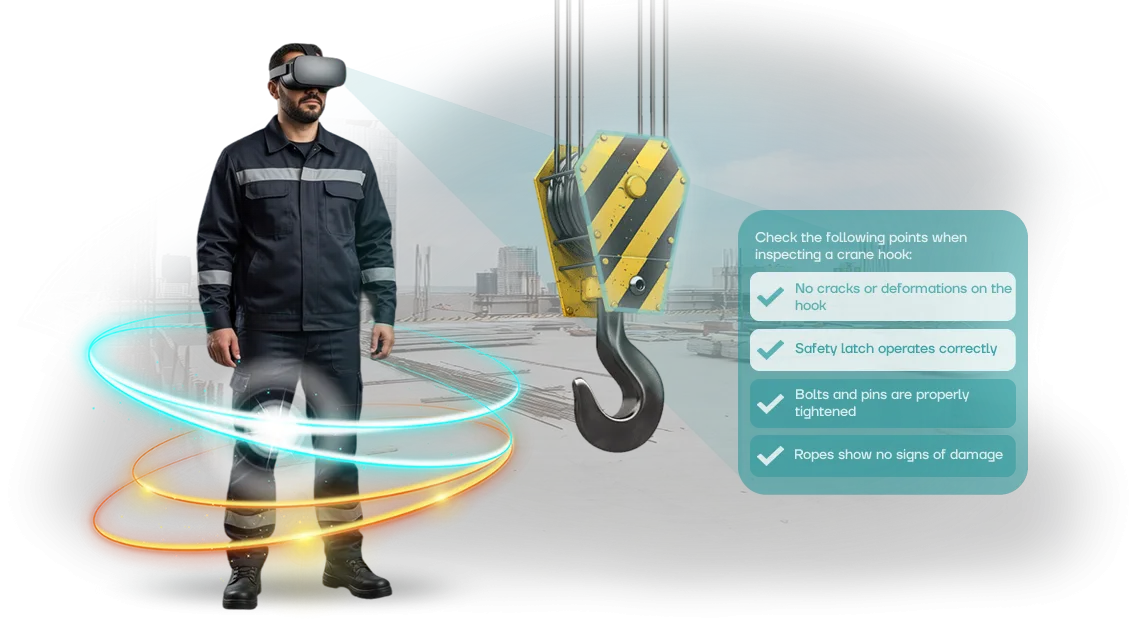
We developed a VR simulator that replicates real workshop scenarios: working under a crane, sparks during welding, a forklift passing through a narrow aisle.
The worker is placed in a situation that is impossible in ordinary training — the situation requires a decision in seconds, and a mistake here does not mean an accident. This approach helps build safe skills before they are needed in reality.
The implementation results speak for themselves: in the first year, the number of accidents fell by 40%, and compensation costs dropped severalfold.
Metrics that weren't direct goals also improved: onboarding briefing time was cut in half, and employees began reporting potentially hazardous areas more often. The effect persisted after training — the case showed that VR training changes habits, not just provides information.
"We expected improvements, but a 40% reduction — no equipment or course has ever delivered that," notes the occupational safety director at Ural Machine-Building Plant. After the pilot, the client expanded the program to all workshops and new specialties.
This example is not unique: on average, VR training cases reduce injuries by 30–50% in the first year, and the return on investment comes faster than the payback of a single piece of expensive equipment.
If you want the same results, we'll show a demo based on your scenarios and calculate the economic impact for your site.
How to choose the right simulation format for your task?
There is no direct universal answer — the simulator format is determined by three things: task, budget, and industry specifics. If the goal is to practice actions during a fire or evacuation, a single-player scenario with fixed stages is enough.
If you need to teach a team to act cohesively in an emergency, a multiplayer role-based mode is required. And for regular knowledge checks, short 10–15 minute modules are better — they're easy to fit into the schedule without stopping production.
Budget also affects the format, but not in the way people usually think. More expensive doesn't mean better: simple simulations on affordable headsets are effective for mass employee training, while complex full-immersion scenarios are justified for rare and dangerous operations.
We always suggest starting with a pilot on one group — that way you see the result before scaling and understand which format pays off in your specific conditions.
Industry specifics determine details that cannot be copied from someone else's experience. Construction, oil and gas, logistics, energy — each has its own typical risks and regulations.
We adapt the scenario to your instructions rather than forcing a template: the employee trains on the situations they actually encounter at your site.
Ultimately, format selection comes down to simple logic: the higher the cost of a mistake in reality, the more realistic the simulation should be.
The main thing is not to choose "by eye" but to work from a measurable result. Define what should change after implementation: fewer accidents, faster reaction in an emergency, a higher share of employees who pass the assessment.
Around that result, we select the format, scope, and development cost — with clear deadlines and a guarantee of integration into your processes.
Addressing common client concerns
Clients often ask whether a VR simulator will become an unnecessary expense item or complicated equipment that no one knows how to maintain. Let's address the most common concerns honestly, without technical detail or embellishment.
Hard to integrate into current training?
Implementation is phased and doesn't require pausing classes. Our engineers configure scenarios to your regulations, integrate the simulator into the schedule, and train the staff. You get a ready-made solution, not an assembly manual.
Is it expensive and won't it pay off?
The simulator's cost is comparable to several in-person training sessions for one group, but the simulator itself lasts for years. It replaces consumables, site rental, and instructor fees. In some cases, the project pays for itself in 2–3 months through reduced injuries and downtime.
Will we need constant technical support?
Support is included in the contract: maintenance, scenario updates, and consultations are our job. You focus on training, not on configuring hardware, so you won't need to hire additional staff.
Employees aren't used to VR, will there be resistance?
The simulator is intuitive; adaptation takes less than the first session. We provide a quick-start scenario and support the first sessions so the team accepts the format without stress.
If your concern isn't on the list, or you want to discuss your specifics, send us a request. We'll prepare a calculation for your tasks and show examples of similar implementations.Order simulation development and get results on time
We take on the entire cycle — from brief to launch and training of your instructors. For every client, we prepare a clear estimate with fixed cost and a timeline, so you know the price and completion date before the work starts.
When you order turnkey simulation development, you receive:
- A proposal with the scope of work, timeline, and cost within 2 business days after the call.
- A fixed estimate with no hidden surcharges — the price doesn't change during the project.
- A working version of the simulator delivered in stages, with results visible every 2–3 weeks.
- Training for your employees on using the simulation and ready-made methodological materials for instructors.
- Technical support after launch and scenario refinement based on the first training sessions.
- Complete project archive: scenarios, settings, and material rights remain with you.
We have been delivering turnkey projects for businesses, industrial enterprises, and training centers for over 10 years. Our portfolio includes dozens of simulators for practicing emergency responses, so we can calculate the cost for your scenario without extra research.
To get a calculation, leave a request on the website or call us. During the call, we'll clarify the goals, the number of workstations, and the skill-building formats — then we'll prepare a proposal within 2 days.
Start with a consultation: it's non-binding, and you'll already know the cost range and timeline. You can order a VR simulator with any level of source materials — from an idea to a ready-made training plan — and we'll take it from there.