

Mistakes in the electrical engineering industry: how to avoid fines?
In the electrical engineering industry, the cost of a mistake is measured not only in human risk. Every occupational safety violation identified during an inspection results in orders, investigations, and shutdowns of production areas.
At the same time, costs for fines and legal support grow, and the company's reputation with supervisory authorities and partners suffers noticeably.
The problem often lies not in the absence of instructions, but in the formal nature of personnel training.
Traditional briefings provide theory that employees check off "for the record," but in a real situation — under voltage, noise, and time pressure — they act on habit, not procedure. It is precisely such actions that cause accidents and repeat orders.
As a result, the enterprise pays twice: first for training that does not change behavior, then for the consequences of mistakes — downtime, investigations, lost contracts.
When it comes to industrial safety, personnel reliability becomes as much an asset as equipment, and it must be built through practice, not lectures.
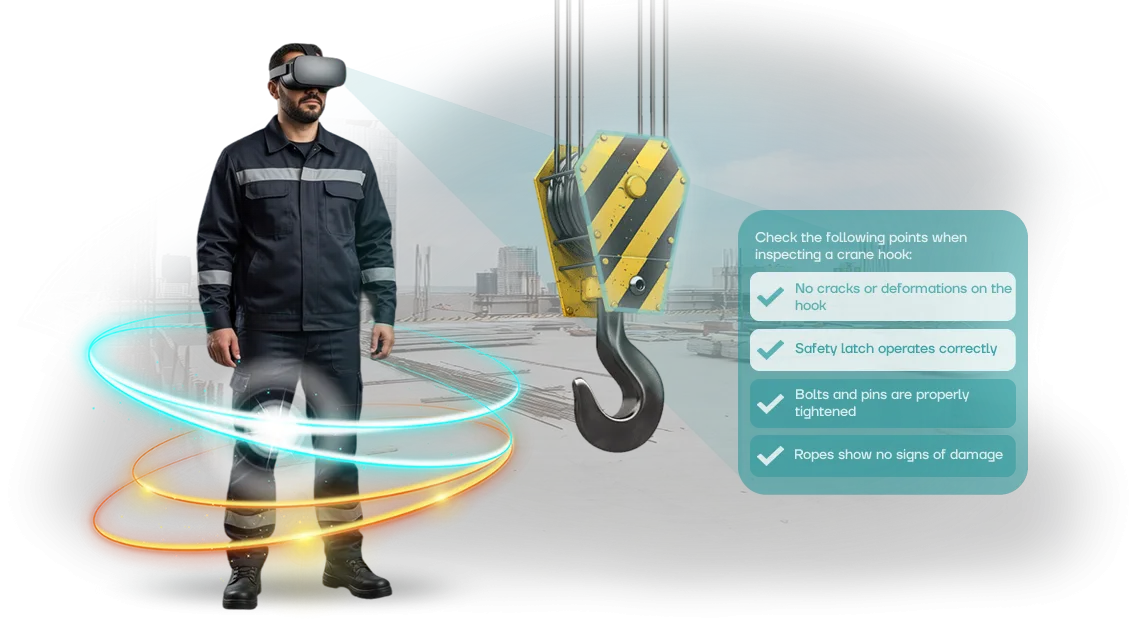
VR training solves this problem: an employee practices actions in scenarios as close to reality as possible, but without risk to life or production. They learn to notice hazards, make decisions in stressful situations, and automate the correct procedure.
This is not "getting acquainted with theory," but a practiced skill that stays with the person when they step onto the floor.
We help companies in the electrical engineering industry close occupational safety issues before regulatory bodies take an interest.
Virtual trainers structure training so that employees not only answer questions, but know how to act safely — which means fewer grounds for fines and stronger arguments at any audit.
What VR training provides: benefits for business and employees
In the electrical engineering industry, the cost of a mistake is especially high: working with voltage leaves no room for a formal approach.
Regular briefings provide theory but do not build a lasting skill — the employee retains only a small part of the material and freezes in an emergency.
VR training changes this: the employee acts in a realistic workshop environment where a mistake does not lead to injury, but is fully experienced and remembered.
We develop VR trainers to match a specific enterprise's regulations and scenarios. Below are the key benefits that businesses gain from the very first groups of employees.
Faster training without stopping production
An employee completes a VR session in 40–60 minutes instead of several days of lectures and tests. Training runs in parallel with work: the trainer can be set up right in the workshop or in a training room, without taking staff off-site. As a result, new employees are brought up to speed faster and equipment downtime is reduced.
Reduced injuries through practice of dangerous situations
In VR, employees learn to spot risks: a severed cable, improper fencing, a broken lockout. They practice actions during a short circuit, fire, or accidental contact with live parts.
This experience builds "muscle memory" and a calm reaction that reduces the number of incidents and their severity.
Staff engagement and improved retention
An immersive environment holds attention better than any video or slides. Instead of passive listening, the employee makes decisions and sees the consequences.
This increases engagement and trust in training, and the material is absorbed more deeply — knowledge stays with the person months later.
Budget savings on training and retraining
After initial development, a VR scenario can be replicated without costs for consumables, training ground rental, or repeated instructor visits. The number of damaged equipment and potential injury payouts decreases.
For the occupational safety department, this means predictable expenses instead of constant additional outlays for retraining.
VR trainer formats for the electrical engineering industry
In the electrical engineering industry, one safety training program does not fit all employees. Operational staff need complex scenarios, newcomers need fast onboarding, and distributed crews need a format that fits around their work.
That is why we have created three types of virtual trainers that cover different tasks and ensure a high level of safety.
Each virtual trainer immerses the employee in a realistic environment and allows them to practice correct actions without health risks. The difference between formats lies in duration, depth, and the way they fit into the training program.
| Format | For whom | What it gives the customer |
|---|---|---|
| Full immersion | Operational and maintenance personnel, frequent emergency situations | Lasting skills, high engagement, testing reaction to emergency situations |
| Short modules | All employees, scheduled briefings and checks | Regular repetition of rules, fast coverage, saving working time |
| Blended learning | New employees, combining theory and practice | Shorter onboarding time, reduced instructor workload |
The choice of format depends on your goals: broad coverage, practicing rare emergencies, or faster adaptation. We will help you set priorities and prepare a solution that fits into your current process without rebuilding the entire system.
All formats run on professional VR equipment, so the visuals and scenarios are stable and cause no discomfort for employees. This guarantees consistent results with every session.
How the project proceeds: from brief to launch and support
For the electrical engineering industry, safety training is a matter of employees' lives and health. We have structured the process so that you understand what happens at each stage and can influence the outcome. Below is how a personnel training project using VR trainers is built.
- Brief and study of your specifics. We examine your regulations, scenarios, and typical employee errors. We set training goals: what skills an employee should have after the trainer.
- Project plan and estimate. We agree on timelines, stages, and team composition. You receive a clear document that spells out both parties' commitments.
- Scenario development. Together with your safety specialists, we work through situations close to real conditions. We account for the specifics of working with electrical equipment, including hazardous zones.
- Pilot version. We build a key scenario so you can see what the trainer looks like and how it works. At this stage, we make corrections before the full version is launched.
- Full development and testing. We create all modules and test them on different devices. We involve your employees — they assess realism and ease of use.
- Launch and implementation. We install the trainers on your equipment, train administrators, and run a pilot session with a group of employees.
- Support and development. We support the trainer after launch: we update scenarios when regulations change, monitor statistics, and resolve technical issues promptly.
In the end, you get not just a program, but a working training tool integrated into your safety system. All stages are transparent and focused on results — reducing risks and raising personnel qualifications.
What's included in the delivery: a complete training package
You receive not just a VR program, but a fully complete training system that can be launched from day one. The entire package is assembled for the electrical engineering industry: from scenarios to instructions for personnel.
What's included in the delivery:
-
Training scenarios — 5–7 practiced situations: working under voltage, servicing electrical installations, actions during a short circuit. The scenarios are close to the real conditions of your workshops, so the employee practices exactly the risks they encounter every day.
-
Methodological materials — an instructor's guide, handout reminders, and assessment sheet templates. You don't need to develop anything extra: the instructor gets a ready-made training program, and the employee gets clear instructions before and after the session.
-
LMS integration — results are automatically sent to your learning management system. This settles the control question: you always see who has completed the training, what mistakes they made, and who needs to take it again.
-
Launch instructions — step-by-step guides for the administrator and instructor: how to prepare equipment, load a scenario, run a session, and collect statistics. Even an employee without technical experience can figure it out in an evening.
-
Training management dashboard — a simple interface showing each employee's progress, completion time, and skills mastered. Generate reports for management or regulatory bodies in a couple of clicks.
-
Updates and scenario revisions — when regulations change or new risks appear, we make adjustments to the program. You don't get stuck with outdated training: the package evolves with your processes.
The entire delivery is configured for your site: number of workstations, shift schedule, and employee skill levels. We handle the launch and initial training of your instructors, so you can use the system right away without wasting time.
Case study: reducing workplace injuries by 70%
At an electrical production facility, every mistake when working with high-voltage equipment can cost an employee their health and the enterprise its uptime and reputation.
Classic briefings and posters do not create the needed level of involvement: people listen, but don't experience the dangerous situation. We went further and built training on experience — through VR scenarios close to real workshop conditions.
We took a typical electrical engineering enterprise with about 12 incidents per year and deployed VR training for all line employees — from electricians to duty staff.
Over two quarters, 450 people completed 1,200 virtual sessions practicing actions during short circuits, work at height, and within the induced voltage zone. The result: workplace injuries down 70%, with training engagement doubling compared with regular lectures.
Customer testimonial
The enterprise's chief engineer noted: "For the first time, employees themselves ask to extend the training — the VR scenario forces them to think before an accident happens.
We saw not a formal checkbox, but real skills: people began noticing hazardous factors before starting work." After the pilot, the company expanded the program to adjacent workshops and signed a contract for training new employees — which confirms the effectiveness of trainers when it comes to safety and risk reduction.
What the case study gives: a replicable model
The described approach can be repeated at any electrical production facility with similar risks: we adapt scenarios to your infrastructure and safety standards, and you get a measurable result — fewer injuries, lower compensation payouts, and greater employee confidence in unusual situations.
This effect is achieved through regular training in a safe virtual environment without stopping production. The metrics recorded in this implementation can serve as a basis for target KPIs at your enterprise as well.
How to choose the right VR training format?
Choosing a VR training format is not a technology question, but a question of objectives.
For a company in the electrical engineering industry, it's important to understand what you want to get: mass training of line personnel, preparation of engineers, or knowledge testing for employees working in hazardous areas.
This determines where to place the emphasis — on the number of scenarios, the realism of conditions, or the built-in error control system.
Selection criteria include company size, training frequency, and budget. If you need to train dozens of people once a quarter, one universal kit with several scenarios is enough.
If you're talking about several hundred employees and regular checks, a modular platform that accepts new scenarios without rebuilding the project is more cost-effective.
For a small enterprise, an optimal solution is a compact "all-inclusive" set that deploys in a few days and is ready to work immediately.
In the electrical engineering industry, the risks of electric shock are high, so the key criterion is the detail level of work situations.
It's better to choose a format where the employee works with their hands: connects equipment, follows the permit-to-work, and responds to emergency situations.
Such training is remembered better than video lectures and posters, and mistakes made in VR have no consequences in reality.
We recommend starting with a pilot project: this way you can assess employee reactions and calculate savings in time and consumables. We select a format based on headcount, inspection frequency, and corporate standards, show a demo, and only then finalize the decision.
This approach turns VR for business into a measurable result rather than a one-off flashy demonstration.
Answering pre-order questions about implementation
Before ordering a VR trainer, owners and managers ask the same questions: will the equipment break, is it hard to fit the solution into current processes, when will the return come, and will the project diverge from industry standards. We answer these concerns — briefly and to the point.
What if the equipment breaks down?
We use professional headsets and controllers built for intensive use in industrial environments. All components come with a warranty, and if something breaks, we replace the device as quickly as possible — just contact support.
We also train your staff in basic maintenance, so minor issues are resolved on site without stopping training.
Is it hard to integrate VR into existing processes?
Implementation doesn't require stopping production or rebuilding IT infrastructure. We connect the trainer to your LMS or training department, set up access, and launch a pilot group — this usually takes a few days. All work is done remotely, and your specialists receive a simple guide for independent launching.
When will it pay for itself?
A VR trainer pays for itself by reducing accident rates, cutting costs for consumables used in regular drills, and shortening induction training time.
In the electrical engineering industry, one prevented incident covers the cost of training, and repeat courses for new employees require no additional investment.
On average, our clients see a return within the first year, but we make a precise calculation based on your scenarios.
Do you adapt scenarios to our safety standards?
Yes, that's the foundation of our work. We take your internal instructions, regulations, and typical situations from electrical production and turn them into interactive scenarios.
After implementation, you receive documentation confirming the trainer's compliance with current standards, and when rules change, we update the content with minimal cost.
We have been implementing VR training at industrial enterprises for over 10 years and know which questions concern customers. It's important to us that you make a decision without hidden risks — so we openly discuss timelines, costs, and limitations already during negotiations. Write to us, and we'll answer your questions and send a calculation for your task.Discuss your task: get a VR training estimate
Leave a request, and we'll get back to you within one business day with a consultation and a preliminary estimate for your task.
We work with enterprises in the electrical engineering industry, so we understand the specifics: complex technological processes, high safety requirements, and the need for rapid staff adaptation.
Immediately after you reach out, you'll receive:
- An analysis of your task and a suitable VR training format — from short briefings to a full personnel training cycle.
- Cost calculated after audit, plus implementation timeline, with no hidden conditions.
- A demo: we'll show on a real project what VR scenarios for electrical personnel look like.
- Recommendations for integrating trainers into your current training and knowledge-checking system.
- A pilot launch plan: how to quickly train the first group of employees and measure the result.
- A presentation with examples of our work and the metrics customers receive.
- A personal manager who supports the project from brief to implementation and technical support.
Tell us about your task — we'll suggest the solution that will deliver the greatest effect and pay off the fastest. Leave a request, and we'll prepare an estimate for your inquiry.