

Why does the power industry lose time and money on outdated safety briefings?
Safety briefings in the power industry often become a formality: an employee listens to a lecture, signs the logbook, and a week later no longer remembers how to act in an emergency.
Yet the cost of an error at power facilities is not a fine or downtime, but people’s health and the uninterrupted operation of the entire enterprise.
Traditional personnel training conveys information but does not build a skill. When an employee first encounters a real threat — be it an electric arc, electric shock, or depressurization of equipment — they act by inertia, not by a practiced algorithm.
Hence workplace injuries, which auditors and insurance companies rightly associate with insufficient staff training.
At the same time, the costs of outdated briefings continue to grow: people must be pulled away from work, classrooms rented, instructors engaged, and the result remains the same — low engagement and poor retention of the rules. In effect, the enterprise pays for the appearance of training, not for real safety.
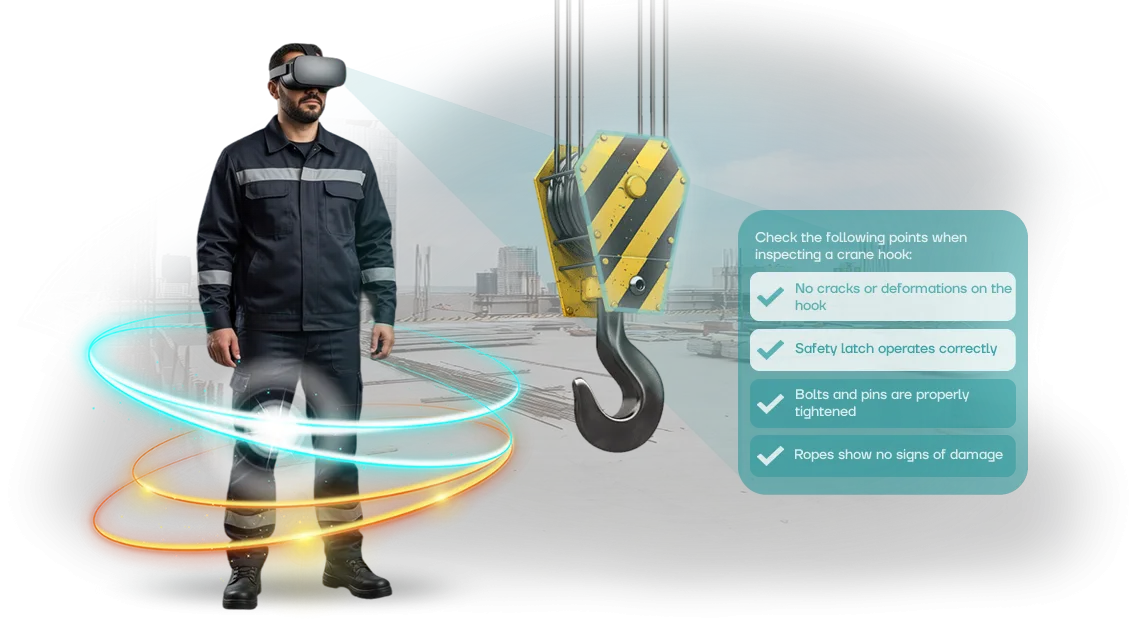
We address this problem differently. VR occupational safety simulators in the power industry make it possible to practice actions under conditions as close as possible to real work — without risk to life and equipment.
The employee personally goes through an emergency scenario, makes decisions, and sees the consequences. This approach turns knowledge into a durable skill, and therefore reduces the number of incidents and the associated costs.
What a VR training simulator gives the occupational safety service and business
A VR training simulator for the power industry is not just a modern training method, but a tool that measurably affects safety and business economics.
We develop such solutions on professional equipment, so the simulator operates reliably and delivers predictable results even under intensive use.
Occupational safety is often perceived by personnel as formal theory with regulations that are easy to forget. Virtual reality immerses an employee in a realistic work situation — from inspecting equipment to actions during an accident.
This engages emotional memory and physical reactions, so the material is learned more deeply than when reading instructions. Staff engagement grows manifold: people themselves strive to complete the scenario and discuss it with colleagues.
Knowledge assessment becomes objective and visual. The VR scenario records every decision an employee makes: whether they stopped work in time, whether they secured protection correctly, how they reacted to an emergency.
Based on the training results, it is clear which skills are lagging — for a specific person or for an entire department. This diagnostics is more accurate than any test because it models reality, not questions from exam tickets.
Reducing injuries is the main economic effect. Practicing actions in dangerous situations happens without health risk, but forms the correct reflexes.
An employee who has completed VR training acts more attentively at the production site — they have already “lived through” a mistake in the virtual environment and do not want to repeat it in real life. This directly reduces the number of accidents and incidents.
Finally, clear reporting: a manager sees data on who has completed training, which mistakes workers make most often, and which scenarios need reinforcement. There is no longer any need to collect paper logs and take people at their word — the whole picture is in numbers.
The occupational safety service receives a transparent management tool, and the business receives a measurable result in the form of reduced risks and preserved resources.
Formats of VR simulators for different power industry tasks
At power facilities, briefing often turns into a presentation demonstration rather than practicing real actions. When it comes to an emergency situation, an employee acts from memory, not from skill.
VR simulators close this gap, but only if the training format matches the task: a newcomer needs step-by-step preparation, a crew needs joint actions, and a manager needs an objective assessment of personnel.
We have three basic formats that cover all typical tasks in the power industry. Below is a table showing what is beneficial to the client in each case.
| Format | For whom | What it gives the client |
|---|---|---|
| Individual training | New employees, workers performing rare or dangerous operations | Practicing actions at one's own pace, multiple repetitions without risk to production |
| Group training | Crews, shifts, repair teams | Coordinated actions in emergency situations, understanding of roles and responsibilities |
| Combined format: training + personnel assessment | Managers, occupational safety services, talent pool | Full cycle: preparation, group drills and objective measurement of each employee's competencies |
Individual training is convenient for authorization to work independently: a person returns to a complex scenario until they do everything correctly.
The group format includes a competitive element — crews go through the scenario for speed and result, and the manager sees who takes the initiative.
The combined option is usually used before certification: it provides a clear snapshot of knowledge and actions, on which personnel decisions are made.
In practice, a hybrid most often works: first, an employee masters the rules individually, then joins group drills, and finally undergoes assessment in a VR environment.
You get not just a mark of training completion, but a safety management tool: clear reports, a coordinated team, and reduced risk of human error. We select the format for your task and help combine them so that training brings measurable results.
How a VR training simulator project works: 7 steps
Building a VR training simulator for the energy sector is a project with transparent stages: from the first brief to launch and support. At every step you see the result and understand which business task the simulator solves.
- Brief. You describe the tasks, typical violations and occupational safety requirements. We clarify the scenarios where employees most often make mistakes.
- Analysis and scenario. We study the regulations and real emergency situations. We propose a training scenario and a list of skills — you see the content before development starts.
- Approval. You approve the scenario, the appearance of the workstations and the level of detail. Edits are made before the environment is built — this saves budget and time.
- Development. We create a realistic environment: equipment, tools, actions and prompts. At key stages we show versions so that you see the result instead of waiting for the final build.
- Testing. Your employees try the simulator, and we check the usability and clarity of the instructions. We take feedback into account and adjust the scenario.
- Launch. We install the hardware and software and set up completion tracking. We provide training for administrators and integrate the simulator into your program.
- Support. We update the scenarios when regulations change, help with questions and refine the module for new tasks. You get a working tool with support.
This order delivers a predictable result: you approve the scenario before development, test it with your own employees and get a simulator that fits into your current training system.
What is included in the delivery of a VR occupational safety simulator
You receive not individual files but a ready-made turnkey solution — with configured scenarios, teaching materials, and usage rights. This allows you to launch employee training within a few weeks after delivery instead of spending months on independent development.
The delivery package includes:
- Ready-made training scenarios — 5–7 realistic situations specific to the energy sector: from working in switchgear to actions during a fire. Each scenario is a complete storyline with instructions, mistakes, and a debriefing of consequences.
- Teaching materials for the instructor — a detailed lesson plan, criteria for assessing employee actions, and recommendations for debriefing mistakes. No need to invent the lesson structure yourself — everything is ready to use.
- Administration module — the workplace of the occupational safety specialist, where each employee's progress, completion results, and mistakes are visible. It is easy to monitor who has already completed training and who still needs to be assigned a training session.
- Scenario updates and adaptation — we modify the exercise logic to match your internal instructions, new regulations, or the specifics of a particular site.
- Rights to all content — you receive full rights to use and modify the materials within your company.
We separately note: the system can be used by an employee with minimal computer skills. The administrator interface is intuitive, and all reports are generated automatically — you will not need to hire a separate specialist to maintain the training database.
Case study: how a VR simulator reduced injury rates at an energy facility
Energy facilities are high-risk zones: any personnel error can lead to an accident, injury, or equipment shutdown. Standard briefings and posters do not let an employee feel the real situation, and training drills are conducted rarely and do not cover all scenarios.
That is why we developed a VR simulator that allows practicing actions during emergency situations without risk to life or equipment.
The virtual environment reproduces an exact model of the energy facility: substations, distribution panels, high-voltage zones. An employee wearing a VR headset goes through a scenario from the occurrence of an emergency situation to its full containment.
They make decisions and act with their hands as in reality, while the system records every violation of the algorithm.
What implementation delivered
Within six months, the number of practice runs at the facility tripled: each employee went through the scenario not once but trained until the actions became automatic.
Injury rates and the number of violations of occupational safety requirements decreased by 40% — this was confirmed by internal audits.
The head of the occupational safety service noted that personnel began to act more confidently in non-standard situations, and briefing time was cut in half. “The VR simulator has become not just a training aid but a real risk management tool.
We have seen measurable results and plan to expand the program to other facilities,” says the head of the occupational safety service at EnergoProm LLC.
After the pilot project, the customer ordered additional modules for working at height and actions during a fire. The case study showed that VR training pays for itself through reduced downtime, investigation costs, and insurance payouts.
This is exactly the approach — with measurable metrics and customer feedback — that we build into every occupational safety project.
How to choose a VR training simulator format for your task?
The VR training simulator format directly determines how quickly employees will acquire skills and what the implementation cost will be.
It depends on the type of tasks: some skills need to be practiced on an exact copy of the equipment, others — in a simplified environment where the main thing is reaction and the algorithm of actions.
Therefore, first formulate the learning goal: to practice a specific operation, to teach how to act in an emergency, or simply to improve overall safety culture.
Direct answer: if the task is to practice a strict production regulation to automaticity, choose full immersion with detailed graphics and physics.
If you need to mass-train personnel in actions during an emergency — a format with simplified graphics and a focus on decision logic, which works even on weak computers, will be suitable.
The main criterion is the realism of the scenario, not the picture. For the energy sector, the accuracy of object behavior is important: short circuit, smell, sound, sequence of switching.
Ask the contractor how this reliability is achieved and which real instructions and regulations formed the basis of the scenario.
The second criterion is mobility. If you have several sites and need to quickly reconfigure the simulator, choose a format with a modular architecture: you change the scenario code, not the entire program. This reduces the cost of updates and adaptation time.
The third is the cost of ownership. The same task can be solved on stationary complexes with maximum presence effect or on standalone glasses with basic practice. The latter is several times cheaper and allows training employees without building a separate classroom.
Don't chase perfect graphics — it consumes up to 60% of the budget but does not add useful skills. First determine the frequency of repeated passes and the number of trainees. The more people undergo training, the faster even an expensive VR complex will pay off.
If we are talking about training narrow specialists, a compact solution without a stationary classroom is sufficient.
Checking your choice is simple: ask the contractor to show a demo version of the scenario for your task, not a general catalog. A conscientious developer will always offer to test the simulator on several employees before purchase.
From such a test, you will see staff engagement and the speed of learning instructions even before full implementation.
Frequent questions about implementing VR training
Any innovation raises questions — and VR training is no exception. Most often, managers worry that the equipment will break down, employees will not be able to master the headsets, and the new format will not fit into the existing training program. These concerns are understandable, so let us address them one by one.
We have been implementing VR simulators for industrial safety for more than 10 years. Over this time, we have developed solutions that address all three concerns even before training begins.
What happens if the equipment breaks down?
VR headsets are equipment, and they can fail. That is why we structure the work so that a breakdown does not stop training: we provide spare kits, give instructions for quick replacement, and stay in touch during working hours. The average resolution time is one day.
Plus, at the delivery stage, you receive equipment with warranty and servicing as part of the project.
Is it difficult for employees to master VR? Operating the simulator is based on simple actions: look, press a button, pick up an object. A clear instruction directly inside the scenario guides the user step by step, so the first steps take no more than five minutes.
Older employees complete the training without involving IT specialists — this has been proven on hundreds of projects.
How will VR fit into the current training program? We do not replace existing briefings but supplement them. The simulator can be launched as a separate block in the training classroom, included in quarterly checks, or used to practice emergency response actions.
We adapt scenarios to your regulations and regulatory requirements, configure the session duration and the format for evaluating results — this way VR becomes part of your existing system, not a separate "attraction."
If you still have a question of your own, ask it directly. We will advise how VR training will fit into your occupational safety processes and what is needed specifically for the power industry.
Discuss the task and get a VR simulator calculation
Energy industry employees work under voltage, at heights, and in high-risk zones — here the cost of a mistake is measured in human life. An experienced specialist performs the same actions for years and does not notice the risk until an accident occurs.
A VR simulator allows them to safely practice emergency situations and turn knowledge into sustainable skills, but for the solution to truly meet the enterprise’s needs, it must be designed for your facilities, scenarios, and occupational safety requirements.
That is why we start with a conversation. Send a description of your task — and receive a VR simulator calculation that takes into account the specifics of your production, the number of employees, and the training program. No one-size-fits-all templates — we analyze the specific situation and propose a solution for it.
What you get after contacting us:
- expert consultation on training scenarios and learning objectives — without fluff or technical jargon;
- an assessment of which operations can realistically be practiced in virtual reality and which are better left in a classroom format;
- calculation of timelines and project stages for your personnel training schedule;
- a clear estimate with configuration options — from a pilot simulator to a rollout across dozens of sites;
- demonstration of similar projects so you can picture the final result before work begins;
- a ready-made technical specification as a gift — if you decide to move forward.
At this stage, you are not obligated to anything: you get the full picture, timelines, and cost, and make your decision calmly, without pressure.
Send a request via the form or contact us in any convenient way — we will respond within one business day and prepare a calculation personally for your enterprise.