

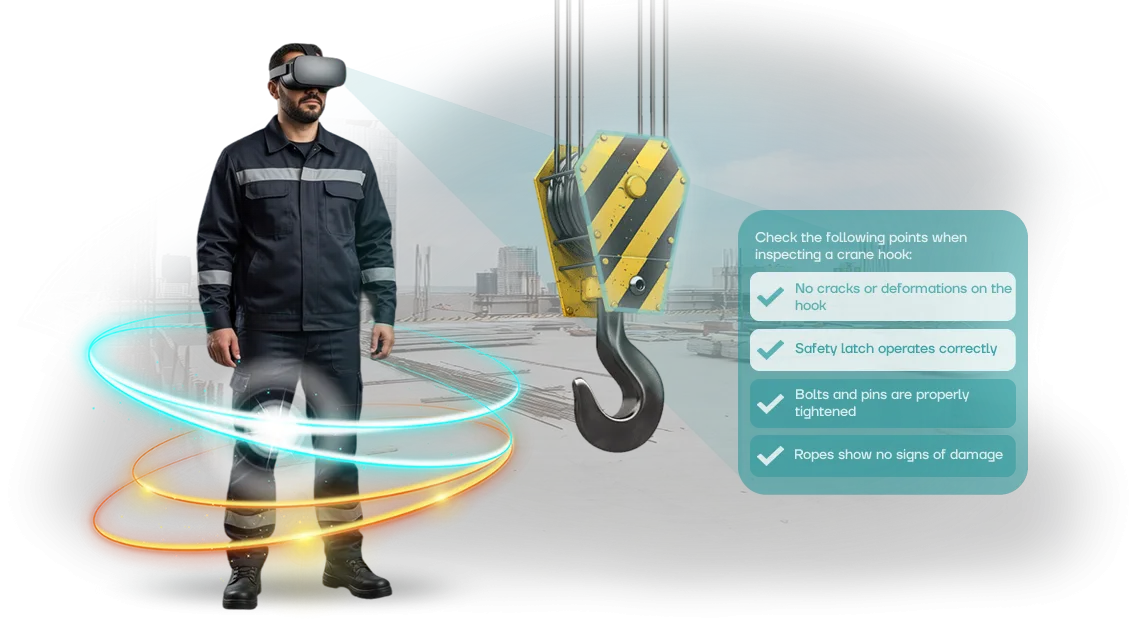
VR Safety Training Simulators for the Pharmaceutical Industry
Pharmaceutical manufacturing is an environment where the cost of a mistake is especially high: even the slightest violation of regulations can result in a spoiled batch, an employee injury, or a line shutdown.
Traditional briefings and lectures provide theory but do not build lasting skills for responding to abnormal situations. An employee first encounters a real risk exactly when there is no time to hesitate — for example, during a reagent spill or equipment depressurization.
This is especially acute in the pharmaceutical industry, where the human factor is one of the most common causes of deviations.
VR safety training simulators change the approach to staff training.
In a virtual environment, it is possible to safely practice chemical spills, fires, equipment failures, and other scenarios that cannot be reproduced on a real production floor without endangering people or products.
Training becomes practical, visual, and memorable — the employee experiences the situation rather than just listening to a briefing. This is particularly important for the pharmaceutical industry, where regulations are strict and every action must be verified.
This is why we at our team develop VR simulators for the pharmaceutical industry. Our solutions help improve workplace safety, reduce the time needed for initial training, and ensure consistent staff performance in abnormal situations.
Moreover, training does not require stopping production processes — employees practice skills in a safe virtual copy of the workshop.
As a result, the company gets prepared employees who know not only the theory but also how to act in practice. That means fewer accidents, less downtime, higher quality, and compliance with industry requirements.
We support the project from risk audit to implementation, ensuring the simulator matches your specific needs.
What VR Training Brings to a Manufacturing Facility
In pharmaceutical production, a mistake can be costly — from ruining a batch to injuring an employee. Standard briefings do not guarantee that a person has absorbed the material, and knowledge checks often become formal testing.
Implementing VR training changes the approach: the employee is placed in a realistic situation where they need to act, not recite rules.
For Production Floors
The employee practices typical emergency situations without any health risk. They see the consequences of their decisions and memorize the correct sequence of actions faster than with slides. This noticeably reduces injuries and the number of errors when working with equipment.
The results of each session are recorded automatically. The supervisor can see at any time who is ready to work independently and who needs a repeat briefing. Staff knowledge assessment becomes transparent and does not depend on the inspector's mood.
For Office Staff
Office employees also undergo occupational safety knowledge checks, but in a format that does not take them away from work for long. Short VR scenarios take 15–20 minutes and happen right in the meeting room — no need to gather groups or coordinate schedules with production.
The benefits of VR simulators are obvious in the office too: after virtual practice, evacuation rules and emergency response procedures are remembered much better than after a lecture. The employee does not just listen — they experience the situation and take part in it.
Implementing VR training frees up time for occupational safety specialists and reduces the cost of organizing training sessions. One scenario can be launched for any number of people at any time, and a completion report is generated automatically.
We will help you select scenarios for your workshop and office, configure the system around your regulations, and show results on a pilot group.
Our team has been building VR simulators for industrial enterprises for more than 10 years and supports projects from trial launch to full implementation.
VR Simulator Formats for Enterprise Objectives
The VR simulator format is selected based on the specific task of the pharmaceutical facility, not the other way around.
One operator needs to practice a rare operation, another needs a clear algorithm for emergency response, and an entire shift needs coordination in an abnormal situation.
That is why we distinguish three main types of VR training: individual, group, and mixed — and combine them to fit your program.
Individual, Group, or Mixed: What to Choose
The individual format is suitable for practicing the skills of a single specialist. They see their mistakes, repeat the scenario without risk or stress, and the system tracks progress.
This option is convenient for targeted operator training, initial onboarding, and working with employees in “risk groups.”
The group format is simultaneous training for a team or shift. Participants solve a common task, assign roles, and learn to respond to each other’s actions. For the client, this means reduced training time and the formation of a unified safety standard across the enterprise.
The mixed format combines both approaches: some scenarios are completed in a group, some individually, and the results are consolidated into a single report.
This is a flexible solution for large production facilities where many employees with different job responsibilities need to be trained.
| Format | Who It’s For | What It Gives the Client |
|---|---|---|
| Individual | Operators, new personnel, employees in “risk groups” | Personal approach, error correction, objective skill assessment |
| Group | Shifts, teams, departments | Team interaction practice, unified standard, time savings |
| Mixed | Large production facilities, mass training | Flexible plan, full employee coverage, consolidated reporting |
Whichever format is chosen, the simulator integrates into the existing training system and works toward results: fewer violations, faster onboarding, and confident actions in abnormal situations. We will find the right option for your objectives and demonstrate it to you.
How a VR Simulator Is Created: Project Stages
Developing a VR occupational safety simulator is not a “black box” but a clear step-by-step process. We support the client from the first brief to launch: you see what happens at each stage and can influence the outcome.
Below is a typical path for creating a VR course tailored to the needs of a pharmaceutical enterprise.
Stages of Creating a VR Course
- Brief and audit — we meet with your team, study regulations, instructions, typical errors, and risks at the production site. We define the training goals: exactly which safety aspects need to be practiced.
- Scenario and methodology — together with your occupational safety experts, we describe the situations an employee may encounter. We define correct and incorrect actions along with evaluation criteria.
- Concept approval — we show a scenario prototype on screen and in VR. You see what the training will look like and can make edits before the main development begins.
- VR environment development — we build the simulator using professional equipment, refined tools, and according to your requirements. Intermediate versions are shown for approval.
- Employee testing — we run a pilot with a group of workers and collect their reactions and feedback. We verify how clear the hints and interface are.
- Launch and implementation — we install the system on your computers or VR headsets, train administrators, and provide instructions. We help integrate the simulator into your training system.
- Support and updates — after launch, we stay in touch: we adjust scenarios, add new situations, and update materials when regulations change.
As a result, you get a ready-made tool that reduces hazardous situations and strengthens the safety culture at your enterprise. You know every stage in advance, and timelines and budget are fixed at the start.
What Is Included in the Delivery of a VR Occupational Safety Simulator
When you order a VR occupational safety simulator, you receive not a “construction kit” but a ready-to-use working tool. No need to assemble scenarios yourself, write instructions, or figure out technical details — everything required to launch training is already included.
The standard delivery includes a complete package for quick start:
- Ready-made training scenarios — practical situations adapted to the tasks of pharmaceutical production: working with reagents, responding to leaks, and behavior in cleanroom zones.
- Methodological materials for instructors — lesson plans, error analysis, evaluation criteria, and recommendations for conducting training sessions.
- Admin panel for training management — you can see who has completed the training, how successfully, which errors are repeated by employees, and you can generate reports for auditors.
- Training for your team — we instruct those who will work with the simulator so that within a week after launch your specialists can confidently run sessions themselves.
- Technical support and maintenance — we help with launch, provide consultation during use, and make prompt adjustments when necessary.
The admin panel deserves special attention: it is what turns VR training from entertainment into a management tool.
The supervisor always sees the objective picture — which employees have practiced the skill, which topics cause difficulties, and which employees carry higher risks. This resolves the issue of training control without manual spreadsheets and unnecessary approvals.
For pharmaceuticals, it is especially important that the scenarios account for industry specifics and production safety requirements. The manager gets a clear training process without diving into technical details, and employees get real practice in a safe environment. All that remains is to assign training sessions and track results.
Case Study: VR Simulators in the Pharmaceutical Industry
For the pharmaceutical industry, occupational safety is not just a formality. Working with chemical reagents, complex equipment, and strict regulations leaves little room for error — each mistake could cost an employee’s health or cause production to stop.
To reduce risks, one plant — let’s call it PharmPro — implemented VR simulators for practicing responses to abnormal situations.
Employees learn in a virtual environment to recognize danger, act correctly during a reagent spill or fire, and do so without risking their lives on the real production floor.
The result: within three months, injuries at the enterprise decreased by 40%.
What’s more, employees did not just gain new knowledge — they changed their attitude toward their own safety, which is especially important for the pharmaceutical industry, where the cost of a mistake is extremely high.
The plant’s occupational safety manager assessed the results this way: “Previously, we gave briefings on paper, and people completed them formally. The VR simulator forced everyone to actually experience a dangerous situation. It changed the attitude toward safety — and the numbers confirm it.”
This case shows that VR training in the pharmaceutical industry solves not only the problem of formal onboarding but also genuinely reduces injuries.
This approach makes it possible to quickly adapt the program to a specific production site and scale training to new locations without losing quality. The experience of PharmPro is already used as a benchmark by other enterprises in the industry.
How to Choose the Right VR Simulator Format for Your Task?
There is no universal VR simulator “for all occasions” — the right format is determined by three things: the number of employees to be trained, the specifics of your production processes, and the available budget.
The answer to the question “which one to choose” starts with these three criteria, and only then comes technical implementation.
The number of employees directly affects the scale and the way the training is launched. If you have a dozen specialists, one ready-made scenario focused on specific actions is enough.
If you need to train hundreds or thousands of people, it is better to choose a format that allows you to change staffing assignments, restart sessions without losing quality, and track each participant’s progress. This is not about the hardware but about how quickly you achieve full staff coverage.
Process specifics are the second key factor. In pharmaceuticals, this means cleanrooms, work with reagents, strict regulations, and behavior during leaks or emergencies.
A good VR simulator must replicate your actual scenarios, not an abstract “factory site.” That way, an employee wearing a headset acts in the same way as in the real workshop, and a mistake on the simulator has no consequences — while the correct skill is reinforced.
Budget determines the starting point. You can begin with a short pilot module for one shift — that is a quick way to test effectiveness and get supporting figures from managers. Or you can immediately roll out a full-scale program with multiple scenarios and a reporting system.
We always propose an option that solves the task without overpaying: the format is selected to fit your budget, not the other way around.
The main thing is not to look for a simulator in a catalog but to set a goal: what the employee should learn and how you will measure the outcome.
At the meeting, we will ask these questions, suggest 2–3 suitable formats with projections for coverage and timelines, and you will make a decision based on concrete data. That way, you get a tool that pays off in practice rather than “just VR for show.”
Frequently Asked Questions from Clients About VR Simulators
Before ordering a VR simulator, most clients ask the same questions: will it fit our processes, how much does it cost, how quickly can we launch, will employees cope, and is it safe.
We have collected five typical concerns and answer them briefly — and we also explain what guarantees we provide.
Will the VR simulator not be suitable for our pharmaceutical specifics?
We do not sell a boxed solution. First, we study your regulations, instructions, and typical scenarios, then we adapt the simulator to your production processes.
The specifics of cleanrooms, work with substances, and specific equipment are taken into account — the employee trains on exactly what they encounter on their own line.
Is it too expensive — how long will it take to pay off?
A VR simulator is comparable in price to a classic in-person program, but it works for years and requires no repeated investment. It reduces the risk of accidents, fines, and downtime, so it pays off quickly. And if your budget is limited, you can start with one scenario and scale up gradually.
How long will development and implementation take?
A typical scenario is ready in two to three weeks; a more complex one takes one to two months. We prepare methodological materials and train your instructors in parallel, so the time from briefing to launch is minimized. Timelines are fixed in the contract, and we take responsibility for them.
Will employees find it difficult to use the VR simulator?
No IT experience is required: the employee puts on the headset and follows simple prompts inside the scenario. The controls are intuitive even for those who have never encountered virtual reality before.
You receive a short instruction, and our specialists support you at every stage — from launch to regular use.
Is the training physically and psychologically safe?
Training takes place in a fully safe environment: the employee sees dangerous situations but is not exposed to real risk. The headset is lightweight, sessions are short, and their intensity is adjustable for each person.
Contraindications are minimal, and before starting we provide a briefing and help choose a comfortable training mode.
Order a VR Simulator for Your Production Facility
To make employees in pharmaceutical manufacturing follow safety rules, a single briefing is not enough — they need practice that stays in memory.
A VR simulator immerses personnel in realistic scenarios without health risks and helps them rehearse actions until they become automatic.
Leave a request — we will show you a demo of VR training on your scenario and advise how to integrate it into your existing staff training system.
Ordering a VR simulator is simple: you describe the task, and we prepare a solution for your production area. After your inquiry, we contact you within one business day to clarify details and send you test access to the demo version. Here is what you get with your order:
- Scenario adaptation to your technological process and typical emergency situations.
- Access to a VR training demo so you can evaluate the effect before full payment.
- Consultation on integrating the simulator into your training and certification program.
- Methodological materials for instructors and skills reinforcement after the session.
- Reporting setup for each employee’s results and for the person responsible for safety.
- The ability to extend scenarios when regulations change.
- Technical support and content updates for the entire duration of operation.
The client receives not a “program on a tablet” but a ready-made tool for controlling staff preparedness. You can see who completed the scenario, where mistakes were made, and how much time was needed for the correct solution.
This reduces the burden on instructors and provides a transparent picture of competencies on the production floor.
Do not put off safety for later. Leave a request, get a VR training demo and a consultation — after that, all that remains is to approve the scenario and integrate the simulator into the training schedule.