

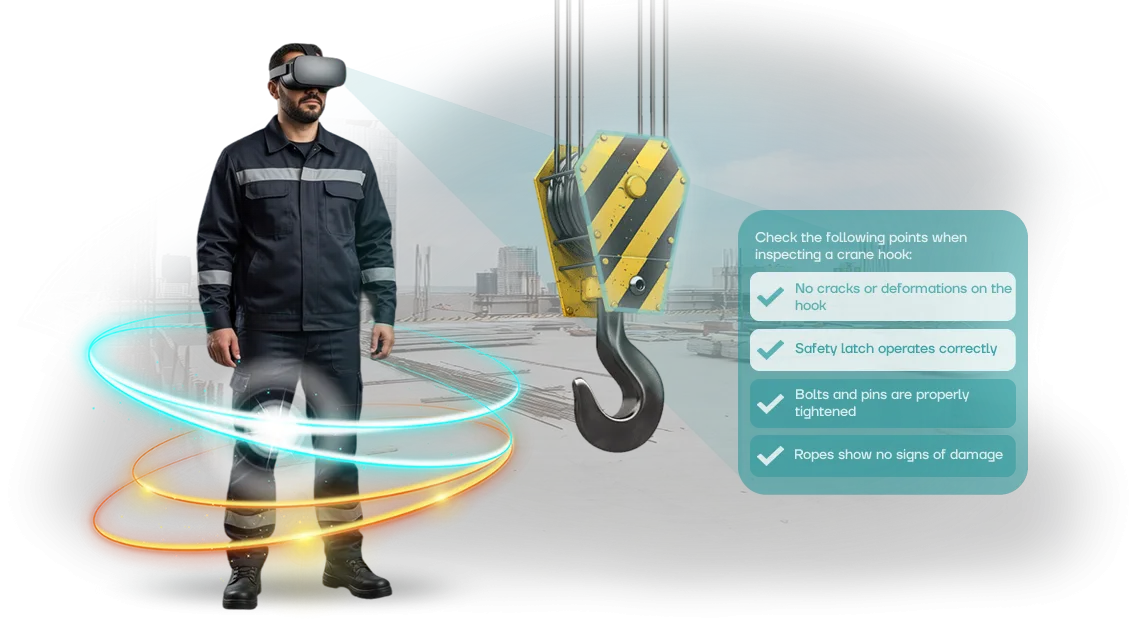
VR Simulators for Safety Training in the Dairy Industry
Safety briefings in the dairy industry often become a formality: an employee watches a video, signs a log, and a month later no longer remembers how to act when alkali spills or smoke appears.
This way of presenting material does not build lasting skills—and in a facility with wet floors, hot steam, moving conveyor belts, and chemical solutions, the cost of a mistake is far too high.
A virtual simulator changes the learning logic. The employee enters a realistic copy of the workshop and practices actions in safe conditions: eliminates a leak, extinguishes a fire, evacuates colleagues.
VR safety training provides practical experience rather than theory—the brain remembers the actions performed, so in a real situation a person acts automatically.
For the dairy industry, this approach is especially valuable: specific risks (acids, alkalis, high temperatures, slippery surfaces) can be modeled without threatening health.
VR briefings in the dairy industry take 30–40 minutes instead of several hours of theory, and the level of material retention is higher. VR industrial safety also reduces costs for compensation and downtime caused by injuries.
We create virtual safety simulators tailored to specific equipment and enterprise regulations. We build realistic scenarios, integrate them into the training system, and support the launch. We close safety issues before they become incidents.
What Implementing VR Simulators Gives Your Enterprise
For a dairy enterprise, safety is not a paper report but a managed process. Every incident means downtime, investigations, fines, and reputational risk.
VR simulators make it possible to practice dangerous situations without health risks—the employee gains experience, and the plant is protected from consequences.
Reducing Occupational Injuries
One of the main goals is to teach personnel to act in abnormal situations, not just know the instructions. The virtual scenario models typical dairy production risks: working with tanks, moving loads, interacting with machinery.
The employee trains correct reactions to the point of automaticity, so on the real site they do not get lost in a stressful situation.
Increasing Engagement and Motivation
Traditional briefings are perceived as a formality: material is forgotten within a few weeks. VR training holds attention and engages emotional memory. This increases the effectiveness of personnel training—knowledge is absorbed faster and stays for a long time.
Protection from Fines and Reputational Risks
Regular training sessions are recorded in reports—you have confirmation that personnel are trained and certified. In the event of an inspection, this reduces claims from regulatory authorities.
In addition, the number of accidents decreases, which means less downtime and fewer unexpected expenses.
The benefit of VR training is not limited to a single shift: we build a program around your processes so that skill practice happens without stopping production.
Employees return to work with a clear understanding of safety rules, and the enterprise gets a stable result.
VR Simulator Formats for the Dairy Industry
Dairy production means filling lines, cold rooms, chemical solutions, and slippery floors. To act confidently in such conditions, an employee needs realistic training without health risks. VR simulators create an exact copy of the workshop where any situation can be practiced.
We use different VR training formats—from individual to team-based and fully replicating your workshop. Below is a guide to which option suits your tasks.
| Format | For whom | What it gives the client |
|---|---|---|
| Individual VR simulator | New employees, line operators | Safe workplace familiarization without stopping production, automatic assessment of actions, and a report for each employee |
| Team VR scenario | Shifts, crews, site supervisors | Practicing coordinated actions in an emergency, role distribution, and the whole team’s readiness for a real incident |
| VR for production workshops | All workshop personnel, occupational safety engineers | A virtual copy of your workshop: employees study hazardous areas and evacuation routes without risk |
| Short VR scenarios for mass briefings | All personnel, including office | Quick regular repetition of key safety rules with high engagement—better than posters |
If you are not sure which format to choose, send us a description of your tasks. We will recommend the optimal scenario and help you launch a pilot project. Formats can be combined: first individual skill practice, then a team training session in a shared virtual workshop.
How VR Simulator Development Works: Stages and Timelines
A clear process—from a short brief to a working simulator integrated into your training program. You do not need to understand technical details: we handle the design, development, implementation, and support of the VR project. You see intermediate results, control deadlines, and know in advance what you will get at the end.
Stages of turnkey VR simulator development:
- Brief and task audit. We study the specifics of dairy production, hazardous areas, and occupational safety requirements. We record goals and evaluation criteria.
- Training scenario design. We create a storyline: from briefing to practicing abnormal situations.
- Prototype and approval. We show key scenes at an early stage—you see what the simulator will look like and make changes before full development.
- Simulator development. We create the virtual environment, interactive elements, and automatic assessment of employee actions. You get a working product, not an experimental sample.
- Testing and debugging. We check scenarios against real situations, eliminate errors, and confirm stability.
- Launch and implementation of VR training. We install the system, train instructors, and integrate the simulator into the current training program. Employees start sessions within the first days.
- VR project support. We update scenarios for new regulations, provide technical support, and advise on how to expand the program.
Timelines depend on the number of scenarios and the complexity of production processes—usually from four to eight weeks. We fix them in the contract and stick to them.
What Is Included in the VR Simulator Delivery Package
The VR simulator package is assembled so that you get a working training tool, not just equipment. The composition of the VR system is designed for quick launch: scenarios, teaching materials, instructions, and analytics are already included in the delivery.
You do not need to refine anything or buy anything separately—everything is ready for the first session.
- VR scenarios for the dairy industry—reflect real risks: working with tanks, chemical agents, electrical equipment, and emergency situations. Employees train in a safe environment and remember the correct actions.
- Teaching materials for the instructor—a lesson plan, exercise scenario, control questions, and error analysis. The instructor does not need to develop a program from scratch, saving hours of preparation.
- Instructions for employees and administrators—simple guides for launching and working with the system. Personnel start training without a long introduction.
- VR training analytics—the system collects data on each employee: completions, attempts, typical mistakes. You see team progress and can strengthen preparation in time.
- Configured VR modules—the simulator connects to your network, and user accounts are already prepared. Training can be launched on the day the package arrives.
- Technical documentation and support—engineers help deploy the system, and during operation you receive consultations on any issues.
Case Study: Reducing Injuries by 40% with VR Implementation
Employees at dairy plants work daily with tanks, pumps, and filling lines—any wrong step leads to injury, downtime, and costs. Formal briefings and paper tests do not build a skill: a person remembers for a day or two and acts on autopilot in a stressful situation. As a result, the accident rate remains high, and fear of equipment reduces productivity.
We took a real example of implementing VR training for a large dairy producer—let's call it Dairy Plant. The enterprise had a high injury rate when servicing the homogenization line, and training was limited to lectures and signatures in a log.
In three months, together with their technologists, we analyzed all emergency scenarios and created a VR simulator that exactly replicates the workshop and abnormal situations.
What the Case Showed
The result exceeded expectations: injuries in the area decreased by 40% in the first year. Employees trained for 15–20 minutes without leaving their shift—there was no need to stop the line or gather people in a conference room.
Most importantly, workers stopped being afraid of equipment because, in the virtual environment, they could make mistakes without consequences and see what safety violations lead to.
The example of VR simulator implementation paid off faster than expected. Through reduced downtime and lower injury compensation payments, the enterprise recovered its investment within six months.
A repeat order to expand modules for other areas came within two months, and the number of training requests from other departments tripled.
Why This Works for You
We adapt every such VR training case to a specific production: your workshops, your equipment, your regulations. We do not just draw a "universe"—we model risks that have already occurred at your enterprise and teach employees to react correctly.
VR simulator results are always measurable: completion time, number of errors, readiness to act in a real situation.
If you want to see what such a simulator looks like and how payback is calculated, request a demo. We will show it using the example of your workshop.
Frequent Customer Questions about VR Simulators
Customers of occupational safety VR simulators usually ask the same questions: how much does the training cost, is it difficult to implement, and how to update content. Below we address the main doubts so you understand what you get in practice.
What affects the cost of VR training?
The final price depends on the number of scenarios, the complexity of modeling, and the format—a simulator for one employee or a group session.
But for business something else matters more: VR training pays off through reduced briefing time, lower risk of errors, and savings on renting training rooms. We calculate an exact cost estimate after the brief, so from the very beginning you see what you are paying for.
How difficult is it to implement VR simulators in an existing training system?
Implementation takes a few weeks and does not require restructuring the training department's work. Our specialists connect the equipment, adapt scenarios to your regulations, and introduce instructors to the program.
Employees can start training after the first briefing—without lengthy approvals or replacing existing processes.
How often does VR content need to be updated?
Content is updated when instructions, safety standards, or production process features change. Instructors can request adjustments—we update scenarios within a few days.
Updating does not require buying new equipment: it is enough to modify the program, which is much cheaper than repeated in-person training.
Is VR training suitable for the dairy industry?
Yes, it is for dairy production that we often create simulators for typical risks: working with acids, high-temperature equipment, slippery floors.
An employee practices actions in a realistic environment without health threats, and the scenario can easily be adapted to a specific workshop or technological process. Such training increases personnel engagement and reduces the likelihood of accidents.
Order VR Simulator Development for Your Production
Occupational safety at dairy production is not only requirements from supervisory authorities but also real risks: injuries, downtime, fines. Ordinary briefings are quickly forgotten, and knowledge checks are reduced to checkboxes.
A VR simulator turns training into practice without danger to the employee—they practice actions in emergency situations just as they would in real life, but without consequences for health or equipment.
We develop VR simulators for production with full support: from idea to implementation in the training process. You get a ready-made tool that reduces injuries, increases personnel engagement, and closes safety requirements. Below is what you will get after contacting us, without fluff or hidden conditions.
What You Get Immediately After Your Request
- VR training consultation—we analyze your task and advise which scenarios are effective specifically for your production.
- Prototype of the future simulator—you see what the training will look like before final development. This saves time and budget.
- Implementation plan—a step-by-step schedule: from development to launch in the training process, with clear responsibility distribution.
- Exact VR simulator cost calculation—an estimate by scenarios, graphics volume, and timelines. No vague starting prices—concrete figures for your facility.
- Clear technical specification—you know what you will get and can control the result at every stage.
Ordering a VR simulator for dairy production is not about technology for technology's sake but about reducing risks and saving on training. Employees acquire skills faster, make fewer mistakes on the real line, and you get clear reporting for each trained employee.
VR development for production in our team is delivered turnkey: we handle scenarios, modeling, and technical support.
Leave a request—and we will prepare a VR cost calculation for your site, show examples of similar projects, and offer a solution that fits your budget. Start with a short call: we will discuss the task, timelines, and next steps.
How to Choose the Right VR Simulator Format for Your Task?
To choose the right VR simulator format, first determine which task is more important. An individual scenario is needed when an employee must be responsible for every step: sequence of actions, reaction to an abnormal situation, knowledge of instructions.
A group format develops interaction: role distribution, coordination during evacuation or emergency response.
In the dairy industry, choosing a VR simulator often comes down to a couple of typical situations. Line operators and employees working with tanks are better suited to an individual format: a person goes through the scenario alone and immediately sees their mistakes.
For practicing actions in the event of a spill, smoke, or evacuation, a group scenario is more logical—it tests coordination and the ability to communicate.
To understand which VR simulator you need, assess the size of your audience. If you need to train dozens of employees across different shifts, choose short individual sessions: they are easy to fit into the schedule without stopping production.
If you want to test department interaction, plan group training sessions of 4–6 people. Practical VR advice: do not implement everything at once—run a pilot in one area, compare both formats, and decide what gives the greatest result for your specific situation.
The main principle is that the VR training format should solve a production task, not just be a novelty. We help select a scenario for a specific area, test it on a small group, and integrate it into the briefing system. We need a problem from you; we provide a working solution.