

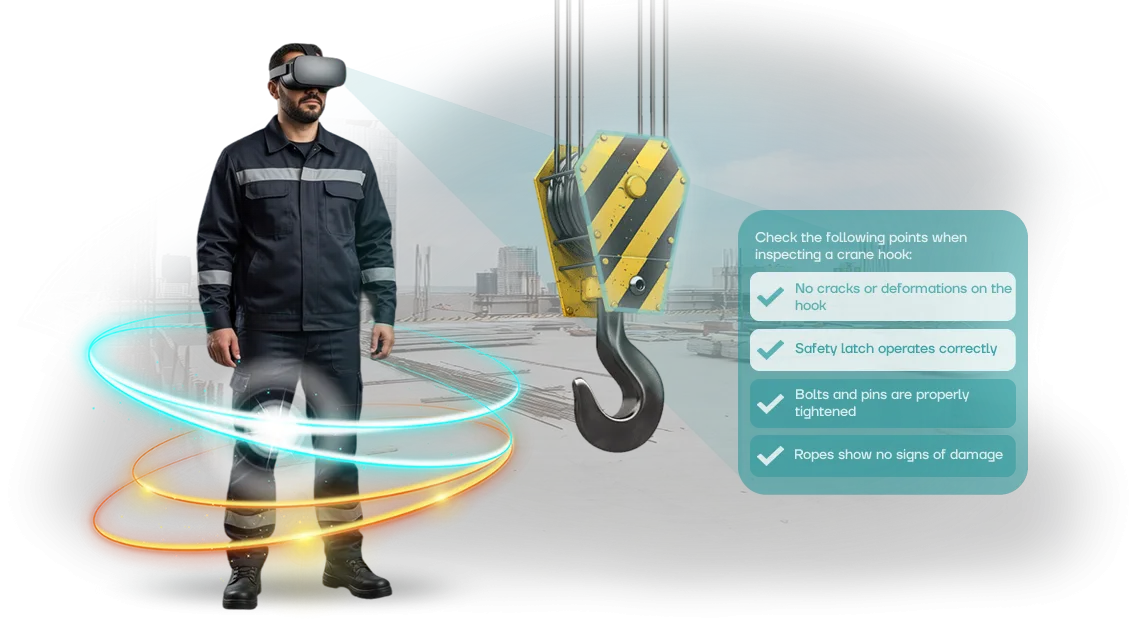
Why the Food Industry Lacks VR Simulators for Occupational Safety
Food production involves no fewer hazards than any heavy industrial facility: slippery floors, cutting equipment, hot surfaces, and work with chemical agents.
But traditional safety briefings usually boil down to a lecture at a table — the employee signs the logbook and a week later no longer remembers how to act in an abnormal situation.
The formal approach reduces risks only on paper; in reality, injuries keep happening again and again.
The consequences are not just sick leave. They include line downtime, fines from regulatory authorities, and loss of reputation with partners and suppliers.
A manager understands that the approach needs to change, but training people on real equipment is dangerous: a mistake during training can lead to a serious injury. That means a way is needed to practice actions without threatening an employee's health.
A VR simulator provides exactly that. The employee is immersed in a virtual copy of their workshop, sees hazardous situations, and learns to respond to them.
We build simulators adapted to the specifics of the food industry, from working with crushers and conveyor belts to responding to chemical spills.
A mistake in the virtual environment does not cause injury, but it leaves a vivid emotional impression — and the correct behavior pattern is remembered for a long time.
As a result, occupational safety stops being a formality: employees are genuinely prepared for abnormal situations, and the enterprise's industrial safety is strengthened without additional downtime or risks.
What Benefits Does a VR Occupational Safety Simulator Offer
A production manager is responsible for every employee, but ordinary briefings often become a formality. People listen to lectures, yet act differently in real situations.
A VR simulator solves this problem: it models emergency and abnormal situations in which the worker must make the right decision. This approach reduces injuries while simultaneously improving training effectiveness.
We implement all of this in practice — our team develops VR solutions for industrial enterprises.
Reduced Injury Rate
An employee enters a virtual environment that closely mirrors the workshop and learns to act during a leak, fire, or equipment failure. A mistake in the simulator has no real consequences, but it is remembered just like real experience. After a series of such training sessions, the reaction to danger becomes automatic.
Training Cost Savings
VR training does not require a large number of instructors, consumables, or venue rentals. One simulator can be used repeatedly, and updating scenarios takes minimal time.
Production downtime is reduced because training takes place right at the enterprise without stopping work processes. As a result, employee training costs are reduced significantly.
Increased Employee Engagement
The immersive format holds attention far better than slides and posters. Workers themselves want to complete the scenario and compete on results. This improves material retention and builds a safety culture at the enterprise.
Transparent Results Monitoring
The system records every employee action: reaction speed, number of errors, and compliance with procedures. The manager sees objective data and understands who is ready to work and who needs additional training.
VR Training Formats for Occupational Safety in the Food Industry
In the food industry, employees work daily with raw materials, equipment, and strict sanitary standards. The cost of a mistake is not only people's health but also brand reputation and fines from regulatory bodies.
That is why the VR training format is chosen for a specific task: initial induction, practicing response to an incident, or verifying knowledge retention.
We develop VR simulators that integrate into your personnel training system. There is no need to change existing processes — just choose the right format or combine them for a full training cycle.
| VR Simulator Format | For Whom | What It Delivers to the Client |
|---|---|---|
| Workplace simulation | New employees, production line workers | Skill practice without downtime or risks, fast ramp-up to full productivity |
| Interactive scenario | Operators, safety specialists | Decisions in abnormal situations without consequences, readiness for real incidents |
| Knowledge testing | All personnel categories | Objective assessment, automatic protocols for certification and control |
Which format should you choose? If the goal is to verify knowledge, testing is enough. If you need to build a lasting safe-work skill, choose a simulation or scenario. We will help you select the best option for your objectives and production specifics.
How VR Simulator Development Works: Stages for the Client
It is important for the client to understand how the work on a simulator will be structured so they can plan budget and timelines. We have broken the VR simulator creation process into clear stages — from the first brief to launch and support. Each step is accompanied by reporting, so you always know what stage the project is at.
- Brief and immersion in production specifics. We study your regulations, typical employee errors, and occupational safety requirements.
- Scenario and training methodology. We turn instructions into interactive situations that practice responses to accidents and violations.
- Prototype approval. You see what the simulator will look like before full development — and make changes without unnecessary costs.
- Development and assembly. We create a full VR module and test it against the real tasks of your production.
- Launch and staff training. We configure hardware and software and conduct administrator briefings.
- Support and results analysis. We collect completion statistics and adjust scenarios if regulations change.
This sequence eliminates misunderstandings and surprises: you always know what is happening and what it costs. As a result, you get a simulator adapted to the food industry — accounting for the specifics of your workshops, sanitary standards, and typical risks.
It is a working tool that quickly pays for itself through reduced injuries and improved employee qualifications.
What's Included in the Delivery of a VR Occupational Safety Simulator
When you order a VR occupational safety simulator for food production, you receive a complete turnkey solution. The delivery package includes everything needed to launch training: the scenario, content, methodology materials, and technical support.
This simulator composition lets you immediately integrate training into the employee preparation process.
The delivery package includes:
- A training scenario built on real food production risks: work with equipment, sanitary requirements, and actions in abnormal situations.
- VR content with immersion in the production environment — the employee practices skills that are difficult and dangerous to train at a real facility.
- Methodology materials for the instructor: lesson instructions, assessment checklists, and ready-made plans for initial and refresher briefings.
- A learning management system: completion tracking, automatic reports for each employee, and results stored in a single database.
- Professional equipment with a manufacturer's warranty, configured for your training room or mobile zone.
- Launch support and training for your administrators: staff quickly master the program, and you receive technical support for the entire period of use.
This package covers all tasks, from familiarization with standards to verification of real skills. The methodology materials can be easily adapted to your company's internal regulations, and the tracking system eliminates manual logbook checks.
In the end, you get not just a "helmet with a picture" but a full-fledged training tool. The manager sees results, employees see clear scenarios, and the occupational safety department gets a ready-made program for briefings.
Case Study: How a VR Simulator Reduced Injuries at a Plant
In food production, the cost of a mistake is not just a lost batch — it is an operator injury and proceedings with regulatory authorities.
Ordinary briefings are conducted just to check a box: the employee listens to a lecture, signs the logbook, and a month later no longer remembers how to act when smoke appears.
That was the request a dairy plant brought to us — six incidents in a year, each resulting in line shutdowns and inspections.
Instead of slides, we proposed a full-fledged simulator. For the client — the food enterprise — we developed a virtual workshop with real scenarios: working on a bottling line, servicing a pasteurizer, and cleaning up a caustic soda spill.
The employee finds themselves in a situation, makes a mistake, and immediately sees the consequences — but without any harm to health. Such training leaves a mark on memory unlike text on a screen.
The Result Seen in the Occupational Safety Report
One year after implementation, the number of accidents at the plant fell by 40%. At the same time, operator training time was cut in half — the instructor stopped repeating the same thing ten times over and moved on to practicing complex scenarios.
The plant's management appreciated the approach, and we received another order — this time for a program for packers and warehouse workers at the second site.
This case is not an isolated one. It shows that VR training pays off not with beautiful numbers in a presentation, but with reduced injuries, shorter downtime, and trouble-free inspections.
If you have similar problems at your production facility — tell us about your situation, and we will put together a solution for your needs.
How to Choose the Right VR Training Format for a Food Enterprise?
Choosing VR training for a food enterprise starts not with technology but with a specific task. One plant needs to quickly familiarize new employees with basic hygiene and safety rules; another needs to practice responding to chemical spills or fires.
There is no universal simulator, so first it is worth identifying which scenarios most often lead to risks at your particular production.
If the main goal is mass training for a large number of employees, short VR modules of 10–15 minutes are optimal.
They allow you to run all workers through typical situations without taking them away from production and to get clear statistics: who has absorbed the material and who has made mistakes.
For practicing rare and dangerous emergency situations, deeper scenarios with branching storylines are better suited, where each step affects how events unfold.
It is important to realistically assess the scale: for a pilot launch, one or two modules covering the most frequent violations are enough. Once you see the results, the range can be easily expanded.
We help you choose the format that fits your tasks and budget without pushing unnecessary options — every simulator solves a specific safety problem rather than simply "amazing" employees.
A common mistake is choosing the most spectacular option without analyzing the real incidents at the enterprise. Start with your internal statistics: what most often causes injuries or violations of sanitary standards?
The answer to this question will immediately indicate which VR format will bring maximum benefit and which will remain unneeded.
The right VR training choice is when the technology integrates into your briefing system rather than existing separately.
We conduct a short audit of your objectives, propose a format and scope that fit your budget, and after launch show a measurable result: fewer violations, faster training completion, and employee readiness for abnormal situations.
Frequently Asked Questions and Concerns When Ordering a VR Simulator
Implementing a VR simulator for occupational safety training in the food industry sometimes raises concerns: will the equipment break, how difficult is it to integrate into current processes, and what will it cost? We answer the most common questions briefly and to the point.
What happens if the equipment breaks?
The equipment remains operational for years — we use professional headsets designed for a demanding training schedule. During the warranty period, service support is available: device replacement or repair within a short time so that training does not stop. You do not need to understand the hardware — just call us.
Is it difficult to integrate a VR simulator into the current training process?
Implementation takes a few days: we ship the ready-made solution, configure scenarios to match your instructions, and train your staff. The simulator works autonomously — the instructor only starts the session and views the results.
There is no need to change the entire process: VR becomes part of your existing occupational safety programs.
Isn't the cost too high?
The cost is calculated based on the specific enterprise's objectives — it depends on the number of scenarios and the number of workstations. You get not a single device but a training system that works without consumables and can be rolled out to all new employees. It typically pays for itself by reducing the risk of injuries and downtime.
After that, we move on to our own experience: we will tell you how VR simulators help food industry enterprises reduce the number of violations and bring new employees into safe work faster.Ready to Discuss a VR Simulator for Your Production?
Let's discuss how a VR simulator will fit into your occupational safety system and which risks it will help address in the coming months.
Tell us about your objectives — we will propose a training format that requires no production stoppage and fits into your employees' schedules.
Submit a request or book a consultation — our team expert will contact you within one business day. After a short conversation, you will receive:
- A preliminary estimate: how much the VR simulator will cost for your scenarios and what equipment package you will need.
- A demonstration of solutions: we will show with real examples how sessions are conducted and what the employee sees.
- A scenario plan: we will analyze typical situations for food production, from working with equipment to actions during an accident.
- A comparison with classic training: figures on time, engagement, and material retention.
- Integration recommendations: how to build VR sessions into your existing briefings without disrupting certification.
- Post-project support: scenario updates for new regulations and operational assistance.
No abstract promises — only specifics for your facility. Fill out the form on the website or write to us via messenger: we will call you back, clarify the details, and suggest the steps to get started.