

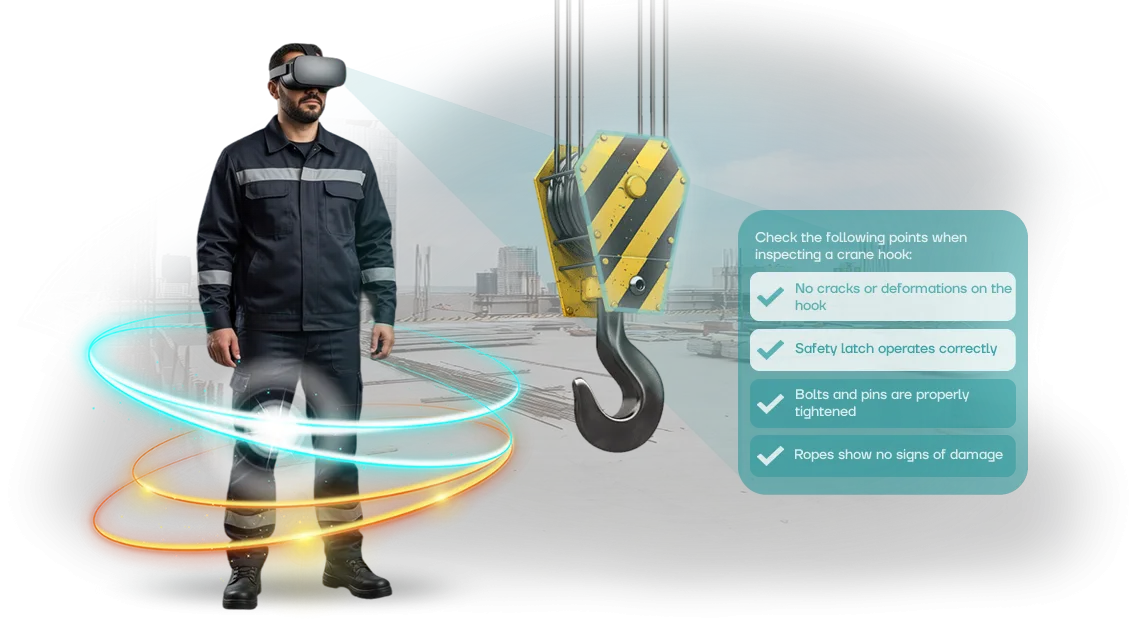
VR Simulators for Vocational Schools: Occupational Safety Without Risk
Occupational safety in vocational schools is most often taught through lectures: the student knows the rules, but in a real production environment acts out of habit. And habit is formed only through practice.
Sending a student to a real site with risks means putting their health and the institution's reputation on the line.
That is why VR simulators for education are becoming the standard for training: they transport the student into a workshop, a construction site, or an electrical installation without a single real threat.
Risk-laden production scenarios are played out dozens of times — until they become automatic. A mistake does not lead to injury: it becomes a debriefing and is remembered more vividly than any set of notes.
For colleges and vocational schools, this addresses several objectives at once. Student safety is fully ensured, and the level of training grows: the immersive format engages even those who do not respond to dry instructions.
Practical experience is absorbed several times more effectively than reading regulations — the student lives through the situation rather than memorizing it.
An additional advantage is the graduate's readiness for real conditions: production risks have already been practiced in the simulator, so the student encounters them for the first time in a safe virtual environment rather than on site.
Employers value an employee who can act calmly. The vocational school gains a competitive edge: the good reputation of its graduates attracts enterprises to partnership.
We have been developing VR simulators for education and industry for over ten years. We take on job analysis, scenarios, and launch — the vocational school receives a ready-made program that can be immediately integrated into the curriculum.
What VR Training Provides: Skills, Retention, Safety
Occupational safety training in vocational schools often becomes a formality: students listen to lectures, pass tests, and a month later forget the key rules.
VR simulators solve this problem — they place the student inside a real production situation where every decision has consequences.
This format delivers several business outcomes at once: higher engagement, stronger material retention, and real practical skills without health risks.
For Students
The benefits of VR training for students are obvious: instead of a boring outline — an immersive scenario that requires action. The student makes decisions independently: how to bypass a dangerous area, when to stop equipment, what to do in an emergency.
This boosts student motivation — they are not distracted and work through the scenario with interest, as in a video game.
At the same time, the effectiveness of VR simulators is achieved through muscle memory and emotional imprinting: the brain remembers the correct sequence of actions at a reflex level, not as dry theory.
Practical skills acquired in a virtual environment transfer directly to reality. The student does not merely know what personal protective equipment should look like — they have seen it in action, heard the signals, and responded to abnormal situations.
After such sessions, they arrive at the exam prepared — answering tickets confidently and solving situational problems with ease. Most importantly, they develop the right attitude toward safety: not as a set of requirements, but as a personal habit.
For Instructors
For the instructor, VR simulators become a tool for monitoring and diagnostics. The system shows where a particular student made a mistake and how much time they spent making decisions.
This allows gaps in knowledge to be addressed precisely, without spending hours repeating the entire topic.
The effectiveness of VR simulators here is measured not by abstract "prevalence" but by the group's real academic performance and a reduction in errors during subsequent practice.
A special value is the reduction of injuries. Students practice dangerous scenarios in virtual reality, where the price of a mistake is simply another attempt — not a fracture or a burn.
By the time they enter a real production environment, they already have experience handling emergency situations, and their hands remember what to do.
This reduces the burden on the instructor, who is no longer the sole carrier of experience, and gives the vocational school's management proof of training quality: every graduate has actually practiced the key safety algorithms.
VR Training Formats for Vocational Schools
In a vocational school, VR simulators address several tasks at once: one student practices a skill at their own pace, a group learns to work together, and an exam demonstrates real readiness for work.
That is why we offer VR training formats that fit into the curriculum and cover each of these tasks.
| Format | For Whom | What It Provides the Client |
|---|---|---|
| Individual scenarios | Students who need to practice a specific skill | The ability to repeat actions without limits and without risk to others |
| Group training | Study group, team | Practice of interaction, role distribution, and responsibility |
| Exam simulations | Instructors, certification committee | Objective assessment of knowledge and skills without "guessing answers" |
Basic Package
Includes individual scenarios on key occupational safety and industrial safety topics. Suitable for regular sessions: the student works through the scenario at their own pace, and the instructor sees a full error report and can adjust the program.
Extended Package
Adds group training and exam simulations. This is already full-scale certification: several students work together, distribute roles, and the exam module records each person's result.
The extended package makes it possible to conduct team drills and final assessments without leaving the classroom.
The formats are easy to combine: first individual practice, then group training, and the cycle concludes with an occupational safety exam. This builds a complete learning chain — from the first step to qualification confirmation.
How VR Simulators Are Integrated into the Educational Process
Integrating VR simulators is a sequential project with clear stages. We accompany the vocational school from the initial brief to stable operation, and you control every step.
- Brief and task analysis. We study programs, specialties, and safety requirements, and determine the necessary scenarios.
- Content preparation. We develop scenarios for your topics, and you approve them before installation.
- Installation and setup. We deliver the equipment, connect it, and verify operation — a 2×2 meter space is required.
- Instructor training. Teachers work through the scenarios, learn to launch the system, and work with results.
- Launch and pilot sessions. We conduct training with groups, collect feedback, and fine-tune details.
- Support and updates. We help with questions, add scenarios, and ensure stable operation.
The Client's Role
You are not left alone with technical details. At every stage there are checkpoints: scenario approval, implementation schedule, equipment acceptance. Instructors receive ready-made materials and lesson plans — they do not need to understand VR.
This approach allows VR training to be implemented without disrupting the educational process. Within a few weeks, students are practicing skills in a safe environment, and you receive class reports.
Delivery Package for VR Simulators for an Educational Institution
An educational institution needs not just a set of devices, but a ready-made solution for launching classes. The delivery package includes everything necessary — from equipment to methodological materials and instructor support.
- Turnkey VR equipment — headsets, base stations, and accessories, already configured and verified. No need to understand the technology: plug in and work.
- Licenses for the entire content package — legal access to occupational safety and industrial safety simulators with update options.
- Methodological materials for instructors — lesson scenarios, instructions, and assessment sheets for integrating VR into the curriculum.
- Briefing and staff training — we introduce instructors to the system, show how to conduct classes, and answer questions.
- Content updates and technical support — new scenarios and prompt assistance in case of failures.
- Installation and commissioning — we install the system, test it, and hand over a fully ready classroom.
The result is a turnkey package without hidden costs or the need to find subcontractors. Students safely acquire skills, and management gets a clear system with a predictable budget.
Case Study: How an Educational Institution Reduced Injuries by 50%
Task and Solution
In vocational schools, the problem of injuries during practical classes is acute: students master dangerous operations for the first time, and the price of a mistake is lost days, sick leave, and the institution's reputation.
We proposed that the college move the riskiest exercises into a virtual environment, where an incorrect action does not lead to physical harm.
College "Higher School of Safety" implemented our VR simulators for working at height and with electrical equipment. Over six months of training cycles, injuries during practical classes decreased by 50% — from four incidents to two.
At the same time, students manage to make 30% more attempts because no site preparation is needed and each error is analyzed immediately.
Director's Testimonial
The college director notes: "Previously, we were afraid to give students complex tasks — any wrong step could end in injury.
With virtual simulators, students first make mistakes in a safe environment, and on a real site they act confidently and calmly." After the first results, the educational institution ordered four more modules — in gas welding and forklift operation.
The case showed: VR training pays off not only through reduced injuries, but also through improved graduate qualifications. The vocational school reduced costs on consumables and practice insurance, and students pass qualification exams faster.
These simulators are now used as primary preparation before work authorization — according to instructor feedback, student confidence and skills have grown noticeably.
Frequently Asked Questions About VR Simulators for Occupational Safety
Vocational school leaders often doubt that VR simulators will fit into the existing educational process. In fact, this is a ready-made occupational safety tool that covers the same requirements as traditional classes, but with greater engagement. Below are answers to the questions we are asked most often.
Is it difficult to integrate VR simulators into the educational process?
No. The equipment plugs into a standard power outlet and is launched automatically by the instructor via a tablet or computer.
To get started, a single demonstration day is enough — we deliver the kit ourselves, show teachers how to launch scenarios, and remain available throughout the entire period of use.
How much does it cost and what does the price include?
We compare the costs not to "virtual reality" but to purchasing a computer lab: one VR training kit replaces several training stands and consumables.
The price includes the simulator itself, installation, adaptation of scenarios to your curriculum, and instructor training. There are no repeated hidden charges — you pay once and use it with all groups.
Will instructors need to be retrained?
No special preparation is needed. A teacher masters the controls within one day: scenario selection, launch, result monitoring. We provide a short manual and conduct a review of a real session.
Usually, even instructors who have never worked with VR are leading classes on their own within a week without our support.
Does this comply with the curriculum and occupational safety requirements?
Yes. The scenarios are built on current occupational safety and industrial safety rules, and class protocols include the same test questions as classic exam tickets. Tell us which topics are in your curriculum — we will adapt the exercises to them. The completion report automatically records each student's result, simplifying attestation.
What if We Have a Limited Budget or Specific Programs?
We understand that vocational schools have limited budgets, and training programs often do not fit standard frameworks. The good news: that is not a reason to abandon VR simulators — rather, it is a reason to choose the format wisely.
We help select a VR simulator for a specific budget and the institution's objectives. This could be a compact solution with several scenarios that covers key occupational safety topics, or a phased implementation: you start with a basic module and add new ones after a semester. That way you get modern training without breaking the budget.
Specific requirements are also solvable. If your programs include profession-specific features, local regulations, or internal instructions, we adapt the scenarios accordingly.
You do not need to change the curriculum to fit the simulator — we adapt the simulator to your curriculum.
An individual approach to cooperation terms is also important. We can offer rental, phased payments, or a flexible delivery schedule — we will discuss what is convenient for your institution.
Choosing a VR simulator always begins with an audit of tasks, not with a top-down dictated solution.
As a result, you get a tool that fits the budget, matches your programs, and genuinely improves student safety. Submit a request — together we will determine the optimal format and terms.
Get a Consultation on VR Training Implementation
Traditional briefings and posters do not let a student feel real danger. VR simulators allow mistakes without consequences and help remember the correct action algorithm.
To understand how this works in your vocational school, you do not need to implement anything blindly — just submit a request. We will provide a consultation and show the solution in practice.
After your inquiry, you will receive:
- An individual consultation — we will review your tasks, number of students, specialties, and curriculum, and propose VR scenarios for your industry.
- A VR simulator demo — using a real industrial safety example, we will show how students practice responses to an abnormal situation.
- A commercial proposal — a transparent cost estimate: VR equipment, software, implementation, and support. We will explain how to stay within budget.
- An implementation plan — a step-by-step schedule with stages, timelines, and responsible parties: from pilot launch to full integration into the educational process.
- Methodological recommendations — example lessons, instructor instructions, and student skill assessment criteria.
- Post-launch support — configuration, scenario updates, instructor support, and technical assistance.
Submit a request — and within two business days we will prepare a commercial proposal, an implementation plan, and invite you to a VR simulator demo. The consultation carries no obligation.
You will get a clear picture of how VR improves safety, student engagement, and material retention, and you will be able to make an informed decision.