

VR Safety Training in the Fishing Industry: Reducing Injuries
In the fishing industry, the cost of error is especially high: falls overboard, heavy equipment, extreme weather conditions, and work in confined spaces. Traditional briefings and posters cannot recreate these conditions, so knowledge remains abstract.
Staff formally know the rules but cannot act in a stressful situation — and that is exactly where injuries happen.
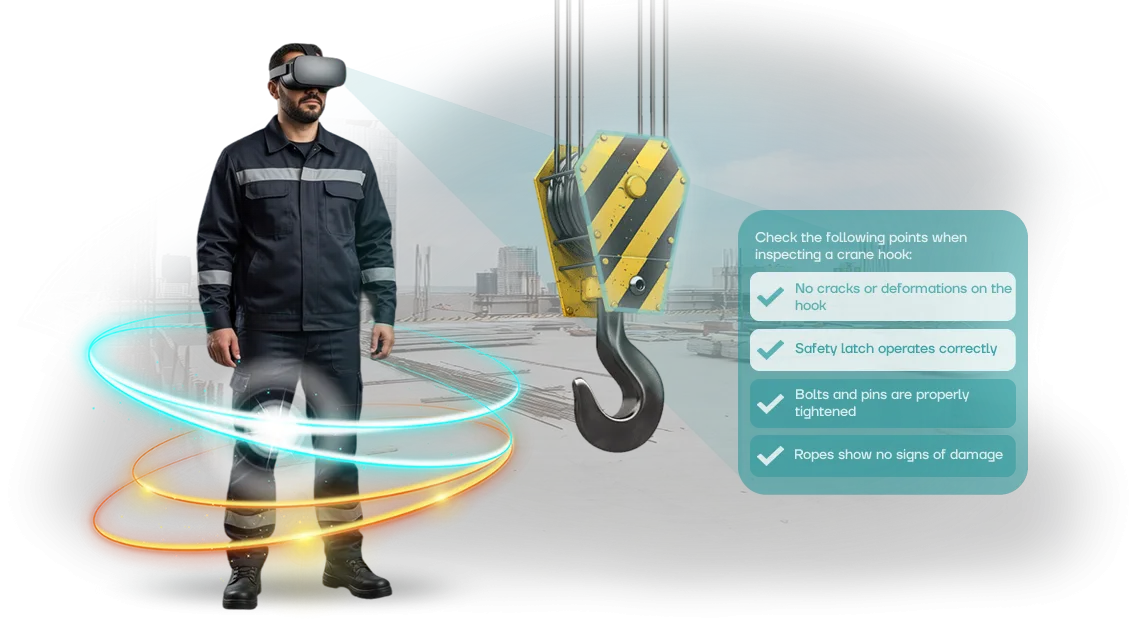
VR simulators place the employee in a realistic enterprise environment: they see the workshop, the deck, and the machinery, and in a safe mode they practise emergency response, fire response, or other abnormal situations.
Mistakes do not lead to injuries, but they do provide immediate feedback. This builds muscle memory and confidence that people carry into real work.
For a manager, this means a real reduction in injuries and related costs: fewer sick days, downtime, fines, and compensations. The training system records each employee’s progress — you can see who has absorbed the material and who needs additional review. Occupational safety stops being a formality and becomes a manageable process.
We create VR simulators for occupational safety and industrial safety tailored to the fishing industry: scenarios are built around your workplaces, real risks, and typical situations.
Staff training takes place without interrupting production, which is especially important for shift schedules and seasonal workloads. The simulator adapts to each worker’s level of training.
VR safety training in the fishing industry is an investment in people and in business resilience. It reduces the number of incidents, improves the safety culture, and prepares the team for any situation. Contact us to discuss how such a simulator can work at your enterprise.
Benefits of VR Occupational Safety Training for an Enterprise
Benefit 1: Reducing Injuries through Accident Simulation
Virtual training allows you to safely model emergency situations — from falling overboard to a fire in the workshop. A fishing industry employee practises actions until they become automatic, without exposing themselves to real risk.
At the Tralflot fish processing plant, the number of micro-injuries halved within six months after the simulator was introduced. Fewer accidents means less downtime and fewer payments.
Benefit 2: Improving Qualifications through Practice
Boring briefings and posters do not motivate learning. A VR simulator immerses the user in a realistic environment, holding their attention, and delivers more skills in 20 minutes than a two-hour lecture.
Professional development becomes practice, not a formality. Employees remember occupational safety rules better and apply them.
Benefit 3: Objective Assessment of Risks and Actions
The simulator records reaction speed, errors, and adherence to procedures. This shows the real level of preparedness and helps adjust the training programme.
For the manager, this is a transparent picture of staff readiness for emergency situations. Risk assessment is based on data, not assumptions.
Benefit 4: Rapid Scaling and Resource Savings
Virtual training does not require renting a training ground, consumables, or business travel. A scenario can be practised at any time and an unlimited number of times.
For enterprises with shift schedules, this is a fast way to maintain the qualifications of the whole team without stopping production. A single training standard for all shifts is an additional advantage for the fishing industry.
VR Simulator Formats for Different Enterprise Tasks
Every company in the fishing industry faces different training scenarios: from introductory briefings for new hires to practising response to an accident on deck.
The same virtual simulator is not always equally suitable for mass training and for individual preparation of key specialists. Therefore, we offer different training formats — tailored to the specific tasks of the enterprise.
Depending on your goal — whether to bring someone up to speed faster, test the team’s knowledge, or practise a rare scenario — an individual, group, or combined format is selected.
All of them use the same scenarios for fishers but differ in process organisation and staff workload.
| Format | Who it is for | What it gives the client |
|---|---|---|
| Individual training | New employees, captains, safety specialists | Full focus on one person, objective assessment of their actions, and the ability to repeat difficult steps without limits |
| Group training | A ship’s crew, a shift, a department | Practising teamwork interaction, a unified action standard, and time savings — several people can be trained in one session |
| Combined format | Enterprises with different categories of personnel | Flexible combination of individual and group sessions, covering all training scenarios with minimal organisational costs |
The table helps you choose the right option, but the key point is that we analyse your task and adapt scenarios to the realities of production: from working in the workshop to fire response on a vessel.
This way, you get more than just a simulator — you get a ready-made solution that addresses a specific business need.
How VR Simulator Development and Implementation Work
Developing a VR simulator for occupational safety in the fishing industry is a transparent process divided into six implementation stages. We do not turn the task into a “black box”: at every step, you see the intermediate result, control the timeline, and can make changes. Below we show how the work proceeds — from the first brief to launch and support.
-
Brief and production analysis. We gather information about your enterprise: what operations employees perform, where violations and accidents most often occur, and what instructions are already in place. Based on this, we form the technical specification for the specific workshop, site, or fleet.
-
Scenario and training methodology approval. We develop the simulator’s storyline, scenarios for dangerous situations, and a system for assessing employee actions. You approve the material — after that, the team moves to technical implementation.
-
Prototype of the key scenario. We create a working version of one training episode: interaction logic, response to errors, and difficulty level. The prototype can be tested and adjusted before the full course is built.
-
Full assembly of the simulator. We add all planned scenarios, a results recording system, and statistics for each employee.
For the fishing industry, we adapt real workplaces: the deck, the processing workshop, and the equipment maintenance area — so the training is as close to practice as possible.
-
Testing and refinement. We conduct pilot training with your specialists, collect feedback, and check the clarity of instructions and the accuracy of assessments. We make final adjustments so that the learning process is convenient for both employees and administrators.
-
Launch and support. We deploy the simulator on your equipment, train administrators, and hand over documentation. Then we support the project: we update scenarios to reflect changes in regulations, help onboard new employees, and maintain system operability.
This approach avoids surprises at the final stage and results in a simulator that is actually used in training — not collecting dust in an archive.
What Is Included in the Delivery of a VR Occupational Safety Simulator
When ordering a VR occupational safety simulator, it is important to understand: you are getting not just a programme, but a ready-made solution for launching training.
The company our team provides a complete package — from modelled scenarios to preparing your instructors, so that sessions can begin immediately after equipment installation.
- Ready-made scenarios for fishing industry risks. Typical situations are modelled: working on the deck, processing workshop, cold equipment maintenance, and fire response. The employee enters a realistic environment and learns to make decisions without any threat to health.
- Methodological materials for the instructor. Detailed guides for conducting sessions, checklists for skills assessment, and tests for knowledge verification. Everything is adapted to occupational safety requirements — the instructor does not need to develop anything from scratch.
- Technical documentation. Commissioning certificates, maintenance regulations, and setup instructions. A complete package for passing inspections without problems and for the occupational safety department’s work.
- Training for your team. Our specialists prepare your instructors and operators: they work confidently with the system from day one and can independently conduct sessions for all shifts.
- Adaptation of scenarios to your regulations. We add local instructions, the specifics of your particular production, and internal standards — the simulator reflects exactly your working conditions.
- Support during launch. We help integrate the simulator into your existing training system: we advise on scheduling sessions and recording results in the briefing logs.
- Support after implementation. When safety requirements change or new risks appear, we refine the scenarios — the simulator does not become outdated along with production.
Such a package saves you from headaches: there is no need to search for contractors, write manuals, or deal with technical details. You get a working training system that reduces injuries and confirms staff qualifications before supervisory authorities.
Case Study: How a VR Simulator Improved Safety at a Production Facility
Injuries at fish processing facilities often arise from typical situations: wet floors, sharp cutting lines, and rushing. It is difficult for a newcomer to learn safe techniques without practice, and training an inexperienced employee directly in the workshop means taking risks.
A virtual simulator resolves this contradiction: it allows practising dangerous operations without a real threat to health.
At the Okean fish processing plant, we implemented VR training for workers in the main workshops. Together with technologists, we identified the five most injury-prone processes: fish cutting, the band saw, the winch, cleaning the hot workshop, and response to a fire.
For each, we created a virtual scenario in which the employee repeats correct movements, learns to notice danger, and reacts without panic.
Training took place in short 10-15 minute sessions before each shift. A mistake in VR does not lead to injury, but it does lead to a review of the situation — this is how safe habits are formed.
Result after 6 months
The main outcome — the enterprise recorded a 40 percent reduction in injuries. Cuts and bruises at the cutting site dropped sharply, as did cases of falls on wet floors. Previously, an injury meant downtime and additional payments; now such situations have become rare.
From the plant management’s perspective, this is not just savings on sick leave and compensations. The plant’s experience shows that VR simulators deliver predictable results and quickly pay for themselves.
For fish processing, this is a way to protect employee health, safeguard brand reputation, and increase production stability.
How to Choose a VR Simulator for the Fishing Industry That Fits Your Specifics?
A VR simulator for the fishing industry should be chosen not by its “pretty picture”, but by how accurately it reflects your real processes.
Universal solutions created for factories or construction sites do not take into account the specifics of working at sea: rolling, confined spaces, weather conditions, and the peculiarities of ship machinery.
Therefore, the first criterion is the depth to which your specific scenarios are developed: from response to a fire in the engine room to emergency evacuation in a storm.
The second criterion is the ability to adapt to your specific requirements. Every enterprise has its own instructions, regulations, vessel types, and equipment.
A good supplier does not offer a “boxed product” but refines scenarios to match your occupational safety documents, your movement routes, and your planned and unplanned situations.
Assess whether the provider is ready to analyse your regulatory framework and adapt the course to it.
The third criterion is practical value for employees. The simulator should provide not just a sense of immersion, but build a lasting skill: bringing actions to automaticity, correct sequence of operations, and the ability to make decisions under time pressure.
Find out how the system evaluates training outcomes: does it record errors, show progress, and produce a clear report for supervisory authorities?
Finally, focus on partnership rather than a one-off transaction. What matters is the vendor’s willingness to support implementation, provide consultations, and update scenarios when rules change.
A strong partner asks questions about your organisation, offers solutions for your risks, and does not simply sell a standard product. If the initial meeting is only about technical specifications and not about your tasks, that is a reason for caution.
We help you choose a VR simulator that fits the specifics of your fish production: we conduct an audit, propose scenarios, and show how training will fit into your occupational safety system.
Book a consultation — we will review your individual requirements and prepare a solution for your fleet, port, or processing workshop.
Frequently Asked Questions about VR Simulator Reliability and Maintenance
Production managers and occupational safety specialists often worry: what if the VR simulator breaks down, who is responsible for repairs, and will training come to a halt. These are understandable concerns — the briefing schedule depends on the equipment. That is why the service is designed so that you do not have to think about the technical side.
What if the VR simulator breaks down during training?
Breakdowns are rare — we use professional equipment designed for intensive use. If a failure does occur, training will not stop: we provide a replacement kit for the repair period, and employee results are saved automatically.
Who is responsible for maintenance and repairs?
We handle the entire technical side. You get direct contact with an engineer: he diagnoses the system remotely, advises on what to do, and, if necessary, comes to the site or arranges a replacement. You do not need to search for contractors or deal with the details.
How often do the simulators need maintenance?
Scheduled maintenance takes place according to a plan — usually once a quarter. We remind you about preventive checks, inspect the condition of the devices, and update scenarios. This keeps operations stable and extends the service life, without you having to keep it in mind.
What is included in the warranty and support?
The warranty covers the equipment and the software part: replacement of components, updates, and consultations. For critical situations, there is a fixed response time — within a working day, an engineer is already working on the solution. This ensures that after launch, the project is not left alone with potential difficulties.
All issues are resolved through a single point of contact — you do not need to figure out who to turn to. And the stable operation of the simulators is confirmed by projects at companies where training runs regularly and without failures.Order a VR Occupational Safety Simulator for Your Enterprise
Occupational safety in the fishing industry is a constant pressure zone: seasonal staff arrive without experience, vessels and workshops operate under heightened risk, and every briefing takes time away from experienced specialists.
At the same time, supervisory requirements are becoming stricter, and mistakes cost too much — from fines to production shutdown. We address this pain point with VR simulators that practise real emergency scenarios without risk to people or equipment.
Leave a request — and get a ready-made solution for your tasks. We will calculate the cost of an individual VR simulator, show a demo based on your scenario, and advise on implementation. After your request, you will receive:
- Cost calculation for your scale — from a simulator for one site to a network of workshops and vessels, taking into account the number of employees and the specifics of your processes.
- Consultation with an occupational safety expert — we will review your instructions and regulations and advise on which scenarios pay off fastest.
- A demo version — see on screen what the training looks like and assess how easy it is for employees of any age.
- An individual project — we will adapt scenarios to your workshops, vessels, machinery, and typical staff errors.
- Improved safety — employees practise fire response, depressurisation, falling overboard, and other incidents before they face them in reality.
Every second client comes to us through a referral — fishing industry enterprises value the results: reduced injuries and transparent reporting for supervision. We work remotely across the entire country and deploy the solution in 3-4 weeks.
Leave a request right now — we will send a preliminary estimate, answer your questions, and propose a time for a demo. Start with one simulator — and within a month you will see the difference in staff preparedness.