

Safety Training Challenges in the Sugar Industry
Every season the sugar industry hires hundreds of seasonal workers, and it is exactly during this period that most accidents and injuries occur. The equipment—hot surfaces, rotating mechanisms, chemical reagent tanks—requires quick reactions and precise adherence to instructions.
But classic occupational safety training delivers theory: a person knows the rules, yet in a real emergency they freeze.
This is especially dangerous when syrup spills onto hot equipment, when a fire breaks out, or when a conveyor suddenly stops. Personnel simply have not practiced emergency responses to the point of automation.
An employee spends precious seconds deciding in their head instead of acting instantly. Those seconds turn a local problem into a serious incident involving line downtime, injuries, and major financial losses.
In addition, sugar factories have high staff turnover. You train an employee, invest time and money, and after one season they leave. A new person starts from scratch again—and you again risk having an inexperienced worker near dangerous equipment.
Traditional briefings and posters fail to hold attention and are quickly forgotten. Knowledge checks in the form of tests show that a person remembers the text, but not how they will behave in a real accident.
As a result, the number of incidents grows and injury compensation costs increase. And the most hidden loss is reputation and contracts. Major retailers and partners are paying more and more attention to industrial safety when choosing a sugar supplier.
Underdeveloped staff skills mean not only fines from supervisory authorities, but also lost contracts in favor of competitors who have things in order.
We close this gap. A virtual simulator gives every employee—a seasonal newcomer and an experienced specialist alike—dozens of practice runs of emergency scenarios without risk to health or equipment.
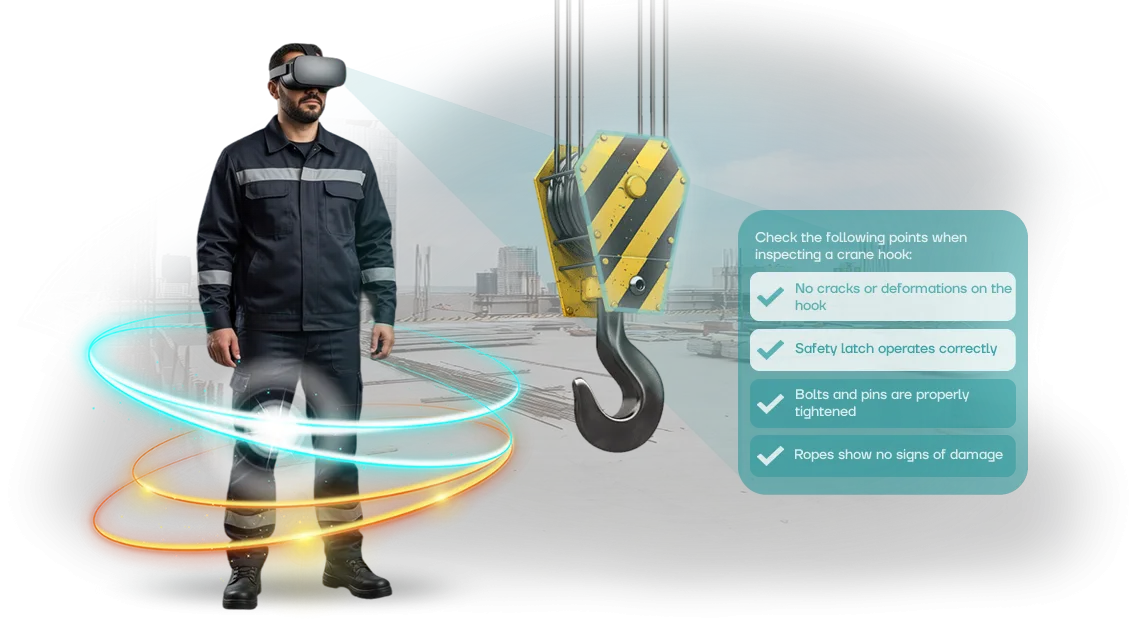
A person learns to act correctly in a safe virtual copy of your plant until the skill becomes automatic. VR training takes 15–20 minutes and provides a lasting skill for the whole season, not just memorization of instructions for a day.
Benefits of VR Simulators for Your Production
A sugar production employee works every day with hot steam, moving mechanisms, and chemical reagents. Training them in emergency actions on real equipment is dangerous and expensive, while training by words is useless.
A VR simulator fully immerses a person in a simulated emergency: smoke, leakage, equipment failure—and allows the correct reaction to be practiced to automaticity.
No one gets hurt, equipment remains safe, and the employee gains invaluable experience that could save their life in reality.
Immersive training fundamentally changes personnel's attitude toward briefings. Instead of passively listening to a lecture, a person acts on their own: makes decisions, makes mistakes, sees the consequences, and corrects the error.
This format holds attention throughout the entire session—engagement increases dramatically, and material retention reaches 90% compared to 20–30% with traditional delivery.
Knowledge stays in memory for a long time because the brain perceives the virtual situation as real experience.
Direct training costs also decrease. There is no need to rent training grounds, pay for instructor travel, buy consumables, or stop production for practice. Training takes place right on site, at a convenient time—for example, before the start of the beet processing season.
One simulator replaces dozens of hours of in-person classes and pays for itself by reducing downtime and lowering the number of incidents.
For the sugar industry this is especially important: the cost of a mistake here is measured not only in employee health, but also in the stoppage of the entire processing line.
Prepared personnel respond faster to abnormal situations, sustain fewer injuries, and do not create dangerous conditions. In the end, you get not just training, but a risk management system—with predictable results, clear effectiveness, and measurable value for production.
VR Simulator Formats for Different Tasks
The intensity of virtual simulators can be easily adjusted to the task: from a short briefing to a comprehensive program.
The format affects implementation speed, employee engagement, and the objectivity of knowledge assessment—so training scenarios are selected according to the profession and the goal.
For Workers: Practice Without Risks
An operator needs to practice technological operations and actions in an emergency. A single-user VR scenario allows training at their own pace, and the system analyzes mistakes at every step.
The employee brings their actions to automaticity, and the enterprise experiences less downtime due to the human factor.
For Engineers and Managers: Team Decisions
Engineers need scenarios with role distribution and personnel coordination during an accident. A group simulator immerses the team in a shared environment: everyone sees the consequences of their decisions. In this way, evacuation and interaction between services are practiced without stopping production.
Format Comparison
| Format | Target audience | What it gives the client |
|---|---|---|
| Single-user scenario | Workers, operators | Practicing skills to automaticity, objective assessment |
| Group scenario | Engineers, managers, safety service | Training team decisions and evacuation |
| Short module | All personnel | Introductory briefing without interrupting work |
| Full training | New employees | Profession-based program with final certification |
The table covers the main types of VR simulators—from single-user to group, from short modules to full training. For different personnel categories, formats are combined to speed up profession-specific training and improve safety at the production site.
How We Create a VR Simulator: Project Stages
Creating a VR simulator for the sugar industry is a well-thought-out process that starts with immersion in your tasks and ends with a working training tool.
We do not just make a "virtual picture"—we design a solution that addresses real production risks: from working with equipment to actions in emergency situations. Below are the stages that every project goes through.
-
Needs analysis. We study the specifics of your sugar production, typical hazards, and current instructions. We conduct interviews with your specialists to identify the main risks. The result is a technical specification for the simulator.
-
Training scenario design. Together with your occupational safety service, we determine which situations to practice: from working with hot surfaces to emergency actions. We approve the scenario—it becomes the basis for development.
-
Virtual environment creation. We develop a realistic 3D model of your site, add interactive equipment and hazard signals. The employee operates in an environment as close as possible to the real workshop, so skills transfer to the job without errors.
-
Testing with the client. We show the pilot version to you and your instructors and let you complete the training. We collect feedback on realism and usability and make adjustments before the official launch.
-
Implementation and setup. We install the simulator on your computers or VR headsets, configure it for shift schedules, and set up completion tracking. We train your instructors so they can run training independently.
-
Support. We maintain the simulator after launch: we update scenarios when regulations change, add new modules, and answer questions. The simulator always meets current requirements.
What Is Included in the VR Solution Package
You receive a ready-to-use system: scenario, simulator, manuals, and administration—everything is already configured and launched on time. There is no need to refine anything or bring in third-party contractors.
VR solution package includes:
- Ready-made training scenario. Real production situations are modeled: working with equipment, emergency actions, walking through the workshop. The employee practices safe behavior skills without risk to themselves or production.
- VR simulator for the headset. It loads onto the device and works autonomously—no powerful computer or permanent internet connection is needed in the workshop. A headset and a free space are enough.
- Instructor's guide. A step-by-step lesson plan: from room preparation to analyzing employee mistakes. The instructor does not need to understand technology—everything is described in plain language.
- Administration panel. You see who completed the training, how many attempts were needed, and which mistakes are repeated. You can easily generate reports for inspecting authorities.
- Integration with the distance learning system. Results automatically flow into your LMS—no need to duplicate data manually or risk errors in reporting.
- Methodological materials. Checklists, tests, and presentations for reinforcing knowledge. Use them for the in-person part of training or as handouts.
After launch, the simulator does not remain without support: when regulations or requirements change, we make updates so that training always matches current standards.
Case Study: Implementation of VR Simulators in the Sugar Industry
At sugar factories, most injuries happen not because of equipment complexity, but because of the human factor: heat, monotony, fatigue, and the habit of skipping briefings.
The employee knows the theory, but in a stressful situation they act at random—and get a burn, a cut, or end up near moving mechanisms.
We implemented VR simulators at one sugar production facility. Instead of lectures, workers complete short scenarios: emergency line shutdown, fire, replacing parts under pressure. A person does not listen—they act, and their brain remembers safe actions at the reflex level.
Results After Six Months of Implementation
After six months, the factory recorded a 30% reduction in injuries, and material retention increased by 50%—employees began answering certification questions faster and more accurately.
Production did not stop due to accidents, which means it did not lose revenue to downtime and compensation.
The head of the factory's occupational safety service noted: "Employees stopped treating training as a formality. Now they actually remember the simulator when they see a dangerous situation on the line. It especially helped newcomers—they start their jobs without fear, but with readiness."
Why Employees Trust the Simulator
The scenarios are designed so that a person feels like they are in a real workshop: machine noise, hot surfaces, limited space.
For this, we use the professional HTC Vive headset—it provides full immersion without delays, so the worker does not get the feeling of a "toy." They act seriously, just like in real production.
Such a result is possible at your enterprise too. We adapt the simulator to your equipment, technological processes, and typical staff errors—and within a few months you see a measurable effect in your occupational safety reports.
How to Choose the VR Simulator Format for Your Task?
Choosing a VR simulator format is not a matter of preference, but a search for a solution that addresses a specific production task.
For the sugar industry, where seasonality and raw material processing specifics affect staff composition and typical risks, there is no universal option.
The first thing to consider is the number of employees and their turnover. If dozens of new workers arrive every harvest campaign and you need to conduct briefings quickly, mobile VR headsets with short scenarios deployed right on site are optimal.
With a small permanent team, a stationary classroom with more detailed simulations is more advantageous—the key is to manage to train everyone without interrupting production.
The second criterion is the types of production processes and characteristic risks. For practicing actions during fires, steam leaks, or work at height, interactive simulators with full immersion and repeated repetition until a stable skill is needed. For familiarizing staff with site routes and behavior rules, panoramic videos are sufficient.
Adaptation to the specifics of sugar factories is not cosmetic: dust, hot surfaces, and moving mechanisms must be built into the scenario, otherwise the employee will not transfer the skill to a real environment.
The third factor is training goals and budget. If periodic knowledge testing is required, a module with visualization of emergency situations and error recording is suitable.
If you need to practice an algorithm of actions for an alkali spill or thermal burn, you will need a full scenario with consequences for wrong decisions.
The budget here affects the depth of detail, not the essence of the format—you can always start with the most frequent risk and then scale the solution to other areas.
In the end, the right format is a compromise between speed of coverage, realism, and cost. We help you find it: we analyze your processes, number of employees, and typical violations, and then offer a simulator that shows a decrease in briefing errors within the first month. Get in touch—we will select the format for your task and the specifics of sugar production.
Frequently Asked Questions About VR Safety Training
We have collected answers to the questions most often asked by sugar enterprise managers before implementing VR training: about cost, payback, technology, and employee attitudes. No complex terms—only what matters for making a decision.
How much does it cost to develop a VR simulator for a sugar factory?
The cost depends on the number of scenarios and the level of detail of your equipment. We prepare an individual proposal for your budget, including all stages: risk analysis, development, setup, and staff training. No hidden fees—the final estimate is known before the start.
How quickly do the investments pay off?
We calculate payback based on your statistics: less time spent on briefings, fewer downtimes and incidents. On average, clients recover their investment within one production season thanks to lower costs for equipment replacement and fines.
What are the technical requirements for the enterprise?
A regular office computer and a 3×3 meter room are enough. Everything else—headsets, sensors, setup, and support—we handle ourselves. We supply a ready-made package that launches within a day, without involvement of your IT department.
Will VR simulators replace instructors?
No, they strengthen the instructor. The simulator practices typical scenarios, while the instructor sees the employee's actions and analyzes mistakes.
This way, the repetitive part of training is automated, while live communication and the specifics of your production remain with the instructor.
Will employees be distrustful of VR?
Skepticism happens, which is why we start with a demo session in a safe environment. The first immersion removes the barrier: employees see a simulation of their workshop and understand the benefit. More than 80% of our clients return for new scenarios—that is the best indicator of trust.
Ready to Improve Safety at Your Production? Contact Us
Every sugar factory has hot surfaces, steam, chemical reagents, and moving mechanisms—and these zones are habitually considered "risky." But most accidents occur not because of machinery, but because of the human factor: a worker failed to recognize a dangerous area or violated instructions.
A VR simulator makes it possible to practice correct actions in a safe environment: an employee sees the consequences of a mistake without threat to health and reinforces the right algorithm in just a few training sessions.
We understand that the occupational safety service needs not just "virtual goggles," but a working system. That is why after your request we offer a clear path: from a conversation with our engineer-methodologist to implementing the simulator in your training program. No obligations at the first step—only benefit for your production.
What you get after contacting us:
- Consultation on VR training tailored to the sugar industry;
- Preliminary audit of your instructions and typical scenarios—we will suggest which situations should be practiced first;
- Cost calculation for your scale: number of employees, production sites, and scenarios—no hidden payments;
- A demo version of the simulator: you and your key specialists can "go through" a real scenario and evaluate the quality;
- Implementation and training plan with timelines and responsible persons—so you know what happens at each stage.
Leave a request in the form below—we will contact you within one business day, answer your questions, and prepare preliminary conditions for your enterprise. The sooner you start, the sooner your employees gain reliable safe-work skills.