

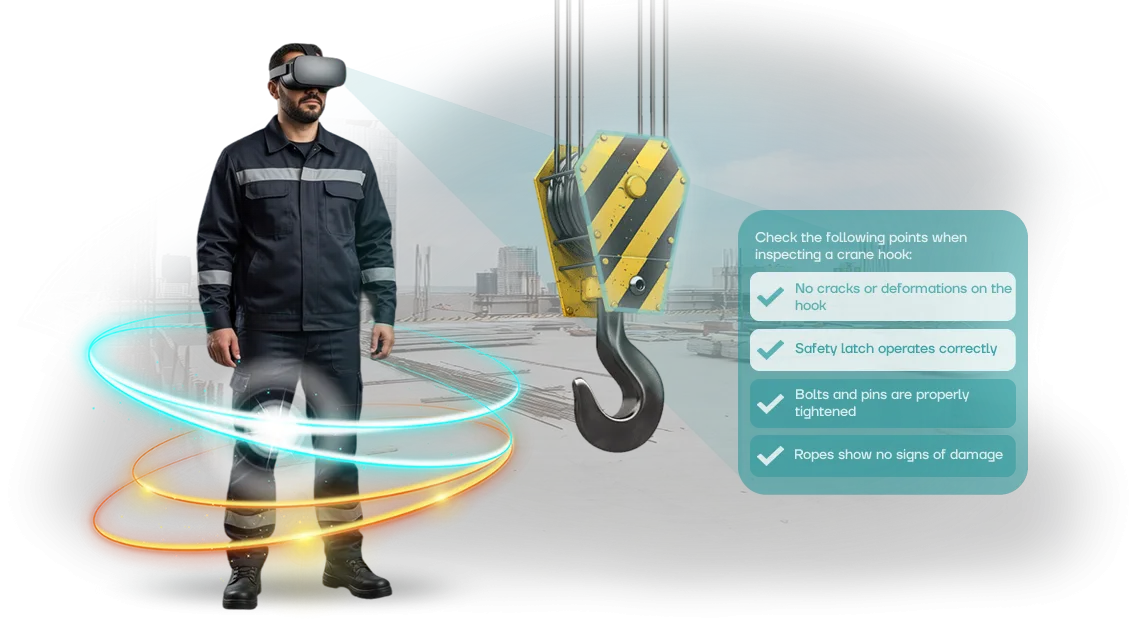
How to reduce injuries in alternative energy with VR training
In alternative energy, personnel have to work in high-risk conditions: servicing high-voltage equipment, working at height, remote sites with limited infrastructure.
The cost of a mistake here is not just production downtime—it is the health and lives of employees, large payouts, fines, and reputational losses.
Traditional workplace safety training often comes down to lectures and briefings that do not provide hands-on experience. People memorize the procedure, but in a real emergency they act hesitantly because they have never encountered such a situation. This is what causes most workplace accidents that could have been prevented.
VR training changes the approach to workplace safety. Instead of a summary, an employee enters a realistic environment where they can practice actions in an emergency: from a short circuit to a fire at the facility.
Mistakes do not lead to real consequences—a person lives through the scenario, remembers the algorithm, and brings it to automaticity, and after the training receives a detailed review of their actions.
This is especially relevant for the alternative energy industry: companies scale quickly, hire new specialists, and launch facilities in different regions. Risks grow with the number of sites, and a unified training standard is hard to establish.
VR simulators make it possible to level the training of all employees regardless of their location and reduce onboarding time without losing quality.
We help reduce injuries by creating VR simulators for the specific risks of your production. Below, we will look at which scenarios are most effective and how quickly you will get your first trained employees.
Why companies choose VR simulators: business benefits
Safety training in alternative energy is a special challenge. Sites are scattered, technical solutions vary, and the cost of a mistake is measured in people's health and downtime. Classic briefings provide theory but do not teach how to act in a non-standard situation.
VR simulators close this gap: an employee finds themselves in conditions close to real ones and makes decisions without risk to themselves or equipment.
Reduced training time and increased engagement
The VR format cuts preparation time by two to three times: there is no need to wait for suitable weather, stop equipment, or gather a group on site. An employee can go through scenarios at a convenient time, and the realistic picture keeps their attention.
According to our data, after VR training employees retain material 30–40% better than after lectures.
Accident prevention and savings on training
In the simulator, employees can practice falling from a height, working under voltage, and actions during a fire—things that are dangerous or impossible to replicate live. This reduces the number of real incidents and injuries, and therefore reduces downtime and fines.
Companies also save on training itself: no need for training grounds, consumables, or stopping production lines.
"After implementing VR simulators, we reduced introductory briefing time by 40% and cut the number of safety violations at sites in half.
Employees themselves ask to repeat scenarios—that never happened before." Head of the occupational safety service, wind energy company
VR simulator formats for alternative energy for any task
Companies in alternative energy have different training tasks: one needs to onboard a newcomer, another needs to refine a crew's actions in an emergency, and a third needs to train personnel in remote branches.
One format will not cover all scenarios, so we offer three configurations of VR simulators—for a specific task and scale.
When choosing a format, it is important to understand what you are training: an individual skill, team interaction, or a unified knowledge standard for distributed departments.
Training scenarios, the number of simultaneously working employees, and equipment requirements depend on this. The table will help you determine which format covers your task.
| Format | For whom | What it gives the business |
|---|---|---|
| Individual scenarios | New employees, operators, maintenance personnel | Practicing actions to automaticity without risk, individual assessment of each employee |
| Team exercises | Crews, shifts, emergency response groups | Coordination in an emergency, role distribution, reaction under time pressure |
| Remote training | Branches, remote sites, distributed teams | A unified knowledge standard, logistics savings, launching training from any device |
We help you choose a format for your task and combine them if necessary: we roll out a basic course remotely for all employees, and practice the most risky scenarios individually or as a team.
We build scenarios on your regulations and typical incidents, so after training an employee acts confidently—just like at a real facility.
How VR training implementation works: stages and timelines
Implementing VR training is a planned process in which we work as one team. First, we examine the specifics of your production and typical risks at alternative energy facilities, then create a simulator that integrates into your existing training system. At each stage, you see intermediate results and understand the timeline.
-
Brief and audit. We meet with your specialists, review occupational safety regulations and real incidents. We determine which skills are critical for your employees.
-
Scenario and prototype. We create a detailed training scenario: situations, employee actions, consequences of mistakes. You approve it before development begins—this saves time and budget.
-
Simulator development. We model virtual objects and conditions close to your sites. We show intermediate versions so you can see how the product grows.
-
Scenario testing. We conduct a pilot test with your employees. We collect feedback and adjust details: from task complexity to hint logic.
-
Launch and implementation. We install the simulator, configure it for your infrastructure, and train instructors. You get a ready-made program, not another "box."
-
Support and development. When regulations change, we update scenarios. When employees have questions, we work with technical support. The program grows together with your tasks.
As a result, you get a clear process without missed deadlines or firefighting. Within a few weeks, employees begin training, and you see its effect—fewer mistakes and more confident actions under real risks.
What is included in the delivery of a VR simulator for your facility
The VR simulator delivery package includes not only the program itself, but also everything needed to launch training at your facility. We have thought through every step so you do not have to figure anything out or configure anything—just take it and use it. This is a ready-made solution that addresses occupational safety and security tasks from day one.
- Ready-made scenarios for alternative energy — situations proven at real production sites: working at height, equipment maintenance, actions in emergency situations. The scenarios are realistic and take into account the specifics of your industry.
- Methodological materials — course program, instructor recommendations, checklists, and assessment criteria. Everything is designed so that any employee can conduct classes, even without VR experience.
- Instructions for personnel — simple step-by-step guides: how to put on the headset, how to complete an exercise, how to get results. No technical complications, minimum questions at the start.
- Technical support — a dedicated specialist on call will help with setup, equipment replacement, and any questions. Average response time is a few hours, so your work does not stop.
- Scenario updates — content is regularly supplemented taking into account new requirements and changes in the industry. You get up-to-date simulators without additional payment or hassle.
- Training for your instructors — a short introductory course after which your team conducts classes independently. We adapt to your schedule and skill level.
This package saves your team time and effort: no need to look for contractors, understand equipment, or write manuals. You get a fully ready system that immediately starts working and delivers a measurable result—reduced risks and injuries at the facility. All that remains is to assign the first employee and start training.
Case study: how an energy company reduced injuries after VR training
Energy companies pay for safety twice: first for prevention, then for consequences.
At one enterprise developing solar generation, injuries during equipment maintenance remained consistently high—new employees made the same mistakes in the same scenarios, and knowledge checks revealed rote memorization of instructions rather than real skills.
We proposed replacing part of the theoretical classes with training in a virtual environment. EnergoSolar agreed to a pilot: 40 operators went through VR scenarios for working with high-voltage installations and emergency response. Instead of lectures—immersion in a realistic situation with immediate feedback and error analysis.
After three months, the results were measured not in test scores, but in production metrics. Injuries during equipment maintenance fell by a third, and the share of employees passing the annual occupational safety check on the first attempt grew from 68% to 94%. The number of incidents caused by human factors halved.
The head of the occupational safety service assessed the results this way: "Virtual simulators gave what briefings could not—a stable skill to act in an emergency.
People stopped confusing the sequence of operations under pressure, and this is directly visible in the violation statistics. We plan to expand the program to all sites."
The case showed: VR training pays off not as a technology, but as a tool for reducing risks and losses. For the company, this means less downtime, lower insurance payments, and confidence that every employee is ready for real work. These are exactly the results we build into every project—from scenario to efficiency metrics.
Common doubts about VR training and how we address them
Managers often doubt: is VR too expensive, will workers cope with the technology, and most importantly, will the simulator take into account the specifics of alternative energy. We hear these questions at every meeting, so we answered the main objections frankly and to the point.
Is VR cost a large upfront investment?
A transparent calculation for your task: you pay only for the scenarios and scope you need right now. At the same time, the simulator pays for itself through reduced injuries, downtime, and instructor costs. For small budgets, there are ready-made modules—they can be combined with individual ones.
Will employees find VR difficult to learn?
No. The interface is intuitive, and training takes the form of short game-like sessions. No experience with technology is needed: most workers learn the controls in 10–15 minutes. A specialist from our team conducts the briefing, and a video guide remains for new employees.
Can a VR scenario really convey the specifics of the energy industry?
Scenarios model real workplaces: solar panels, wind turbines, high-voltage equipment. They practice the hazards that are difficult to demonstrate in an ordinary classroom—falling from a height, electric shock, emergency response. At the same time, a mistake in a virtual environment has no consequences and is remembered better.
What if the simulator does not work?
We support the project after launch: we update scenarios in line with regulatory changes, resolve technical issues promptly, and monitor stable operation. Our clients receive a support guarantee for the entire period of use.
Each of these questions is a reason to calculate the effect of VR implementation. See how simulators address your occupational safety tasks and reduce risks at alternative energy facilities.How to choose the right VR training format for your tasks?
Choosing a VR training format comes down to four criteria: number of employees, types of risks, budget, and geographical distribution. The answer depends on where and how people work, how many people need training, and what hazards they face.
We select a solution for a specific task, rather than selling a "box"—so we first analyze your situation.
If a company has 50–100 employees and one production site, a set for several people and a flexible session schedule is enough. When we are talking about hundreds of employees or multiple branches, stationary classrooms with a progress tracking system are needed.
For geographically dispersed facilities—solar plants, wind parks, substations—mobile kits that can be transported and launched on site are more convenient.
Types of risks determine the content of scenarios. For alternative energy, these are working with high voltage, working at height, maintaining equipment in confined spaces, and actions in case of fire and electric shock.
In VR, you can safely simulate an accident and evacuation drills—the key is that scenarios repeat real emergency situations at your facilities, not abstract examples.
Budget affects the format: either purchasing your own complex and using it fully within a year, or renting for a specific training program, or a mixed option.
For many companies, the optimal approach is to start with a pilot session—train one group, evaluate the result, and only then scale. We will help determine an economically justified scope—so you pay for results, not for unused equipment.
The main thing is not to choose a "one-size-fits-all" format, but to calculate according to your scale. We will analyze your tasks using these criteria and recommend a solution: a stationary classroom, a mobile kit, or on-site rental.
Write to us—we will prepare a proposal within one day with the exact number of sessions, scenarios, and launch timeline.
Order a turnkey VR simulator and get safety at your facilities
Fill out the brief—and in two days you will receive a ready proposal for a VR simulator that solves occupational safety tasks specifically at your facilities.
We collect requirements according to your specifics: working with high voltage, maintenance of wind generators, solar plants, and emergency response. You do not need to understand technologies—we handle design, development, and implementation.
After ordering, you get not just a "simulator," but a working safety tool that pays off by reducing risks and downtime:
- Full cycle of work: from training scenario to launch and support—one contractor, one responsibility.
- Scenarios that replicate your real facilities and regulations—employees practice actions to automaticity without risk to life.
- Analytics module for the manager: see each employee's progress, authorizations, and areas requiring retraining.
- Ready-made protocols and reports for certification and inspections—less paperwork, transparent control.
- Adaptation to your equipment and technical cards—the simulator does not become obsolete when regulations change.
- Training for your instructors: they independently manage scenarios and update the program without involving developers.
One of our clients—an energy company with distributed substations—reduced introductory briefing time from two days to four hours and completely eliminated hazardous training operations on live equipment. Refresher training now takes place remotely, without taking employees away from their shifts.
To get a cost estimate and implementation plan for your task, leave a request on the website. We will prepare a proposal within two working days: timelines, scenario list, cost, and implementation stages.
Start with a short brief—it does not obligate you to anything, but will show how a VR simulator fits into your occupational safety system.