

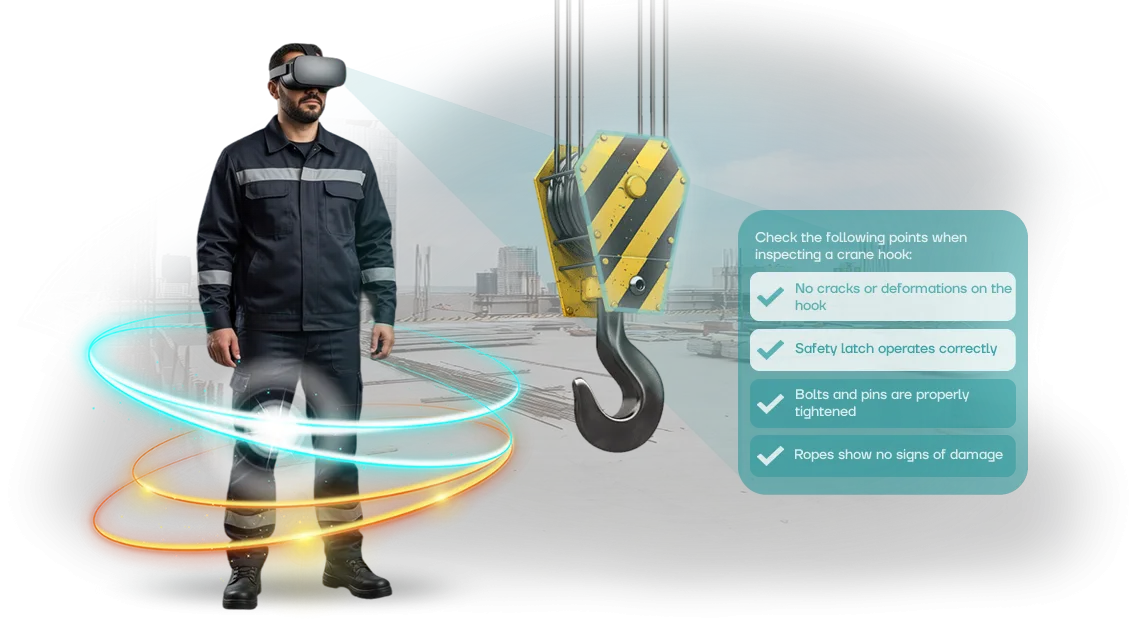
Occupational Safety in Pharmaceuticals: Why VR Trainers Are Essential
In pharmaceutical manufacturing, the cost of error is especially high: the slightest deviation from regulations can lead to a batch being rejected, a line stoppage, or an employee injury.
At the same time, the human factor remains the main source of risk — personnel work with hazardous substances, complex equipment, and strict procedures where acting on instinct is not an option.
Classic occupational safety training in pharmaceuticals often comes down to lectures and tests. It does not let a person experience an emergency and practice actions until they become automatic.
As a result, knowledge fades over time, and in real production the employee acts hesitantly — and that is a direct path to incidents.
A VR trainer solves this problem: it immerses the worker in a realistic shop floor environment where they can safely make mistakes and learn from their actions.
The virtual environment allows practicing scenarios that are impossible or too risky to recreate in reality: chemical spills, fires, equipment failures, emergency procedures.
In the end, the employee enters real production with ready skills, not just a set of theoretical knowledge.
The trainer is easily adapted to a specific site — taking into account room layouts, equipment types, and internal company regulations.
Training proceeds at a convenient pace, and results are recorded automatically: the manager sees who actually absorbed the material and who only passed a formal check.
For pharmaceuticals, this is not just a matter of compliance but a way to reduce injuries, cut losses from defects, and improve the safety culture.
We help create such trainers: we design scenarios for your production, work with professional equipment, and take responsibility for the result.
What Benefits Does VR Training Bring to Occupational Safety
Pharmaceutical production is an environment with strict regulations: clean areas, work with reagents, and the risk of errors when procedures are not followed.
Any occupational safety failure results not only in fines but also in risk to employee health and the company's reputation. VR training moves the practice of these procedures from theory into practice without stopping production or exposing people to danger.
Here are the key results you get after implementing this format:
- Reduction in injuries and violations. The employee experiences an emergency in a virtual environment and remembers the correct sequence of actions. According to our data, after such training the number of errors during inspections and incidents drops noticeably within the first month.
- Increased engagement in training. Instead of listening to an induction, employees actively act: they make decisions, interact with equipment, and correct mistakes. This improves material retention — testing results show that knowledge is retained better than after classic lectures.
- Savings on training organization. There is no need to rent venues, purchase consumables, or take people off shifts for long courses. The same scenario can be repeated multiple times without additional costs, and regulation updates are entered into the program in a matter of days.
For pharmaceuticals, it is especially important that VR trainers allow practicing actions in emergency situations — reagent spills, equipment failures, sterility breaches.
These are scenarios that cannot be safely simulated in a real production hall, yet they most often lead to serious consequences.
Implementation is carried out in stages: we analyze your regulations and typical risks, create a virtual model of your production, and adapt scenarios to specific roles. The result is a ready-made training program integrated into the personnel certification system.
our team has been working with enterprises for more than 10 years, so we know how to align occupational safety requirements with business goals without disrupting the production schedule.
If you need not just to report that induction was conducted, but to actually reduce risks and increase employee responsibility — VR training delivers a measurable effect.
Start with one scenario on a pilot group and watch the dynamics: coverage of completed checks, reduction in the number of remarks, participant feedback.
VR Trainer Formats: Selecting for Enterprise Needs
The format of a VR trainer determines how quickly employees of a pharmaceutical enterprise will master safety rules.
This is not about choosing "headsets" but about a scenario that fits shift schedules, takes into account the number of workers and the specifics of the area — warehouse, production, laboratory, shipping.
Each format solves its own problem: one is suitable for mass induction, another for practicing rare emergencies. It is important to understand in advance which result you want: to check each person's knowledge or to build coordinated team actions during an accident.
| Format | For What Tasks | What It Gives the Enterprise |
|---|---|---|
| Individual | Practicing actions per regulations, checking a specific employee's knowledge | Personal assessment, flexible schedule, calm scenario completion without pressure |
| Group | Training a team for emergencies, role distribution | Team coordination, practicing interaction and communication between departments |
| Mixed | Combines personal preparation and collective scenarios | Maximum incident coverage with limited training time |
For pharmaceuticals, mixed programs are especially valuable, where an employee first memorizes their areas of responsibility and then, together with colleagues, practices interaction during a spill, fire, or equipment failure.
Which format to choose? If you need to quickly train line staff — individual trainers are completed at a convenient time and record each person's result. If it concerns a shift or a team — group scenarios will show who takes the initiative and who needs additional preparation.
We select a format based on the task, not "sell a box." At a meeting, we analyze the staff composition, regulations, and typical risks — and propose a scheme that minimizes downtime and provides clear training metrics.
VR Trainer Implementation Stages: From Brief to Training
Implementation of VR trainers in pharmaceuticals is often slowed not by technology but by a lack of understanding of where to start: which scenario suits, how to fit training into shift schedules, and how to confirm compliance with regulations.
We have built a process where every step is clear to the client and brings them closer to the result — employees master safe work faster, and you see real indicators.
Implementation Stages for Your Enterprise
-
Brief and task analysis. We meet with production and safety managers and examine where errors occur and which risks are critical for your site. As a result, you get clear training goals and expected impact.
-
Scenario and work plan development. We rely on your instructions and internal regulations and create the trainer's narrative — from actions during a spill to evacuation. We approve the scenario before starting implementation to avoid rework.
-
Approval and adaptation. We show how the trainer will look and "feel" in practice. We adjust to real premises, equipment, and terms used at the production site — the employee does not need to retrain.
-
Implementation and internal testing. We build a training version and test it on a group of future users. We collect feedback and make targeted adjustments — so you receive a product that is trusted from the first launch.
-
Launch and staff training. We install the system, set up workplaces, and train your instructors to conduct training independently. The pilot launch proceeds without stopping production processes.
-
Support and development. We provide post-launch support, track completion results, and update materials when regulations change. As the company grows, we add new scenarios for other departments and professions.
This order guarantees that the trainer does not remain a "demo version on a shelf" but becomes a working tool that pays off by reducing risks and accelerating staff preparation.
What Is Included in the Supply of a VR Trainer for Occupational Safety
For pharmaceutical enterprises, the cost of an error in occupational safety is especially high: any violation of regulations can stop production. Therefore, we supply the VR trainer as a turnkey solution — you receive everything needed to launch training in a single delivery.
Here is what the package includes:
- Equipment. Professional VR headsets with a pre-installed platform. The devices do not require a computer or complex setup: turn it on — and the session can be conducted.
- Software. Occupational safety scenarios for pharmaceuticals: working with reagents, evacuation, sanitary standards. If necessary, we adapt them to your regulations.
- Methodological kit. Ready-made lesson plans, assessment sheets, and an instructor's guide. No need to prepare from scratch for each training session.
- Instructions and regulations. Memos for personnel, VR safety instructions, and templates for recording training results.
- Training for your team. Two days of on-site training for your instructors: they master the equipment and integrate training into shift schedules.
- Warranty and support. Scenario updates, technical support, and equipment replacement — without additional payments.
The entire supply follows a clear plan: preparation, delivery, installation, staff training, and launch. You receive a working tool that quickly pays off by reducing injuries and downtime, and employees get safe training without health risks.
Case Study: How a Pharmaceutical Company Reduced Injuries with VR
For pharmaceutical production, injuries are not just statistics but a direct threat to product output: a line stoppage due to an incident costs more than any training.
That is why we implemented VR trainers at the Medicor site — a large pharmaceutical manufacturer where personnel work with reagents, sterile areas, and heavy equipment.
What Changed After Implementation
Over the first six months, the number of workplace accidents decreased by 40%, and the number of micro-injuries almost halved. The number of days of incapacity fell by a third: employees are on sick leave less often, meaning lines do not stand idle.
350 people were trained — from line operators to engineers — and each practiced emergency scenarios in a virtual environment without health risks.
Previously, induction took two days and required equipment shutdown for practice. Now an employee completes a scenario in 20 minutes during a shift, and results are immediately visible to the manager: who has mastered the algorithm and who needs to repeat the material. There is no need to gather a group or distract a mentor — everyone studies at a convenient time.
Why It Worked
The key difference between VR and lectures is muscle memory. The operator does not listen about a leak but closes the valve themselves, presses the alarm button, and evacuates.
In a stressful situation, actions are brought to automaticity — this is what reduces risks in real production. The trainer simulates smell, sound, and the sequence of actions, so the brain perceives the scenario as real.
The client was so convinced of the effectiveness that they ordered a second module — for working with chemical reagents. And the number of repeat inquiries from other pharmaceutical companies confirms that the result is measurable and easily scalable to new areas.
At the same time, the cost of training one employee turned out to be lower than the cost of classic induction with venue rental and instructor fees.
Answers to Frequently Asked Questions About VR Trainers
Implementing VR trainers in occupational safety at pharmaceutical production often raises questions: will processes need to be restructured, is it compatible with current equipment, and is training in a virtual environment safe. Our team hear them every day and have prepared short answers to the main ones.
Is it difficult to integrate VR trainers into an existing training program?
No. Trainers are integrated into existing inductions and knowledge checks as an additional practical module. We help configure scenarios to your regulations, train staff, and support the launch — there is no need to stop production.
Is special equipment or a full replacement of machinery required?
A regular computer and a professional VR headset, which we provide or help select, are sufficient. Our solutions work on a standard equipment base and do not require capital expenditures for re-equipping workshops.
Is it safe for an employee to be in a VR trainer?
Yes. The virtual environment simulates accidents, spills, and equipment failures — without real health risks. At the same time, the person gains practical experience in responding to critical situations, which cannot be practiced in live production.
Such training quickly pays off: the number of violations and micro-injuries decreases, induction time is reduced, and employees better remember the sequence of actions. Our clients from the pharmaceutical industry note that VR scenarios increase engagement and reduce the number of errors in real work. If you still have questions — we invite you to a demonstration: we will show how the trainer works on your scenario and answer taking into account the specifics of your production.How to Choose the VR Training Format for Your Production?
Choosing a VR training format comes down to three questions: how many employees need to be trained, which specific operations require practice, and what investment volume is justified for your production.
Based on this, we assemble a suitable package — from compact modules for a small group to a full program for regular retraining.
Pharmaceuticals impose special requirements: working in clean areas, strict regulations, actions in emergency situations. Therefore, the format must follow the real logic of production processes, not be an abstract instruction. A properly selected scenario practices exactly those actions that reduce risks in your own area.
Here is what a typical choice looks like based on three key criteria:
| Criterion | VR Training Format | What It Gives Production |
|---|---|---|
| Up to 20 employees | Individual scenarios with practice of a specific operation | Targeted training without stopping the line |
| Large workshop or multiple sites | Automated stations and group sessions | A uniform level of preparation for the entire shift |
| High-risk areas | Detailed scenarios with error analysis | Reduced probability of incidents and downtime |
| Regular knowledge checks | Full course with certification | Objective confirmation of work authorization |
We do not offer one format "for everyone." During an analysis, we assess the team size, task specifics, and the logic of your production — and select an option that solves the task without overpaying for unnecessary options. That way you get clear timelines, a measurable result, and training that really reduces risks.
Order a VR Trainer: Get a Consultation and Estimate
For pharmaceutical enterprises, occupational safety training is not a formality but an investment in employee safety and production stability. An accident is expensive: lost working days, fines, reputational damage.
A VR trainer allows practicing actions in emergency situations without real risk, but before implementation it is important to get an honest estimate of cost and timelines.
We provide consultations, analyze your scenarios, and select a format for pharmaceutical production needs.
Leave a request — and within one working day you will receive an implementation checklist:
- Preliminary cost estimate: from a simple scenario to a full course with knowledge testing.
- Consultation on format selection — full immersion, interactive induction, or a combined option.
- Assessment of development timelines and launch stages — with a clear week-by-week plan.
- Recommendations on equipment and workspace requirements — without unexpected infrastructure costs.
- Examples of solutions for pharmaceutical enterprises: what skills we practice and how we measure results.
- An understanding of how the trainer will fit into your training system and document workflow.
For an estimate, we only need the number of employees, types of inductions, and a list of critical situations. We will clarify everything else during the consultation — and without obligation.
It will take no more than 15–20 minutes, but you will get a clear understanding of the budget and expected results.
Send a request through the form below, provide your contact details, and briefly describe the task. A manager will contact you within one working day, answer your questions, and prepare a personal estimate.
You will receive concrete figures for your training plan and understand how a VR trainer will affect safety and the speed of inductions at your production.