

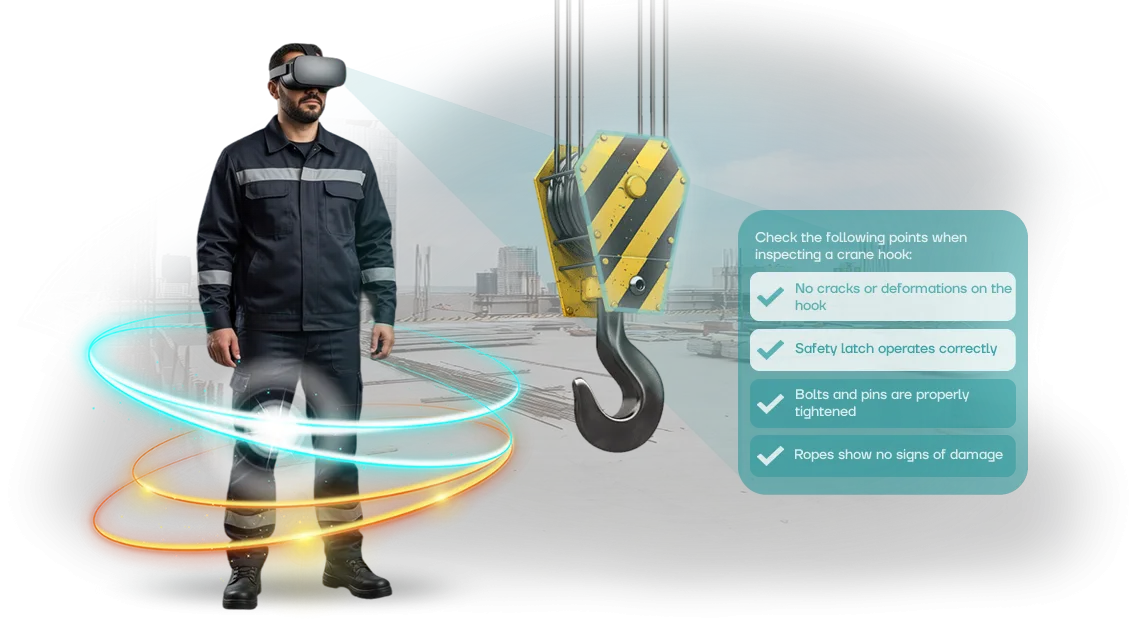
VR training simulators for occupational safety: why it matters for municipal utilities
Municipal utility workers face elevated risks every day: gas-filled wells, power lines, heavy machinery, work at height. The cost of an error here is not a fine or downtime, but a person's health and life.
At the same time, standard occupational safety training often becomes a formality: instruction "on paper" does not give employees real experience in emergency situations.
our team has been helping municipal utility companies change this approach for more than 10 years. We use virtual reality to turn a boring lecture into practical safe-work skill practice.
The employee enters a simulated emergency and learns to act correctly — without risk to life and without consequences for equipment.
VR training does not replace instruction; it makes it truly effective. A person does not just listen to the rules, but remembers them through action: saw, did, got the result.
This learning format increases engagement many times over — instead of putting in hours, the employee actually masters rescue algorithms and correct responses.
For a manager, this means systemic changes: fewer injuries, less downtime due to accidents, fewer fines from supervisory authorities. You invest in safety that pays off through reduced costs and preserved employee lives.
We cover this need "turnkey": we develop scenarios tailored to your enterprise, record them in VR, implement them, and support the results.
What VR training provides: benefits for managers and employees
In municipal utilities, the cost of an error is especially high: work with electricity, heating networks, and machinery involves real danger. Regular staff training provides theory but does not allow the employee to feel the risk and practice actions until they become automatic.
Virtual simulators solve this problem: they immerse the worker in a realistic situation where an error costs nothing, while the skill is retained for a long time.
Reducing injuries and risk assessment
VR simulators model emergency scenarios — from electric shock to gas leaks or fires. The employee trains in a safe environment, and the manager receives an objective risk assessment: the program records every action and shows where the worker hesitates or violates regulations. This turns staff training from a formality into a real tool for preventing emergencies.
Increased labor productivity
Material in virtual simulators is absorbed faster than when reading instructions or listening to lectures. The employee is less distracted, remembers the sequence of actions better, and starts working independently sooner.
Labor productivity grows by reducing time spent on briefings and retraining, as well as through staff confidence in non-standard situations.
Budget savings
Virtual simulators replace expensive training grounds, consumables, and instructor trips. Training takes place at the enterprise at a convenient time, without downtime or business travel.
One simulator can be used repeatedly, paying for itself after the first groups — a significant saving compared to traditional formats.
It is exactly such solutions that our team develops. For more than 10 years, we have been creating VR simulators for hazardous industries, including municipal utilities, and we see how customers reduce injuries and increase employee engagement. Implementing virtual simulators is an investment that protects people and budgets.
VR simulator formats for municipal utilities: solution table
VR simulator formats differ not in equipment but in the scenario and depth of immersion. For municipal utilities, it is important that an employee does not just watch a video, but practices actions until they become automatic — in conditions as close to reality as possible.
Below are typical solutions that cover tasks from initial instructions to practicing rare emergency situations.
| VR training format | Who it is for | What it gives the customer |
|---|---|---|
| Short instructional scenario (5–10 minutes) | New employees, workers before permitting | Quick knowledge check without leaving the shift. Clear who has absorbed the rules and who needs to repeat the course |
| Emergency response practice | Boiler operators, fitters, electricians | A person acts in a safe virtual environment, but their decisions affect the outcome. The employee is ready for an abnormal situation, not just knows the theory |
| "Equipment operation" scenario | Special equipment drivers, pump station operators | Training the sequence of operations without risk of breakdown and downtime. A mistake can be reviewed immediately, not after an incident |
| Full course with action assessment | All personnel categories | A unified assessment standard: the system records every action and issues a report. The manager sees the real skill level of each employee |
The choice of format depends on the specific task. If you need to quickly cover mass instruction, short scenarios will work. If the goal is to reduce the risk of accidents and injuries in hazardous areas, choose full simulators with decision-making practice.
We help you select a format for your specifics: we analyze work processes, typical personnel errors, and occupational safety requirements. As a result, you receive a simulator that integrates into the current training system without production downtime.
Stages of VR simulator implementation: from brief to launch
Implementing a VR simulator for municipal utilities is not buying a ready-made program, but a joint project that delivers measurable results. So that you understand what happens at each stage, we set deadlines, areas of responsibility, and approval points in advance.
In the end, the customer receives not just a development, but a working training system that can be immediately embedded in the instruction schedule.
- Brief and task analysis. We study your occupational safety regulations, analyze typical violations and emergency situations. We determine which skills and reactions employees need to practice first.
- Scenario and methodology. Together with your occupational safety specialists, we build training scenarios: realistic situations in the yard, in the boiler room, when working with tools and special equipment. We agree on criteria for evaluating employee actions.
- Prototype and approval. We show a working mockup of the simulator using your examples. You see what the training will look like and can make edits before full development begins — saving time and budget.
- Development and assembly. We create a full-fledged simulator with graphics, interactive scenarios, and an assessment system. In parallel, we prepare materials for instructors and administrators so that the launch does not depend on one person.
- Pilot testing. We conduct training with real employees. We collect feedback: how clear the controls are, which scenarios cause difficulties. We make final adjustments.
- Launch and support. We deploy the simulator on your equipment or in our cloud system. We train administrators, provide manuals, and remain available for improvements and updates.
This sequence turns simulator development into a predictable process: you control quality at every step and receive a ready solution at launch, not a "project for revision."
VR simulator delivery package: what is included in the solution
By ordering a VR simulator for occupational safety, you receive not a "box with a headset" but a ready-made turnkey solution.
The delivery package includes everything needed to launch employee training in municipal utilities from day one: from professional VR equipment to methodological materials for the instructor.
- VR equipment — virtual reality headsets with controllers, configured for scenarios in your industry. The employee enters a realistic environment: work at height, underground utilities, power tool operation. At the same time, they are fully protected — training takes place in a safe space.
- Software — a set of occupational safety simulators replicating typical situations at municipal facilities. The employee practices actions until they become automatic, and errors do not lead to injuries.
- Methodological materials — ready-made lesson plans, training scenarios, and assessment checklists. The instructor does not need to invent anything: open the plan, conduct the lesson, record the result.
- Automatic accounting system — the program records every employee action: completion time, number of errors, difficult moments. You see who has absorbed the material and who needs additional training.
- Operating instructions — simple rules for operating, storing, and charging the equipment. Support is included, so technical issues are resolved quickly and without your IT department's involvement.
- Training for your employees — a short introductory course for administrators and instructors. After it, your team independently launches training sessions and manages the process.
Case study: How a VR simulator reduced accident rates in urban utilities
Injuries and accidents in municipal utilities are expensive: equipment downtime, sick leave, compensation payments, loss of reputation. Most incidents occur due to human error — personnel do not manage to practice actions in abnormal situations. Traditional briefings provide theory but do not form lasting skills.
We implemented a VR simulator at Gorelektroset, where 850 employees work daily with electrical installations, in wells, and at height.
The task was simple: teach staff to act quickly and correctly during short circuits, fires, and other emergencies without exposing people to real risk.
What was implemented
A series of virtual scenarios was developed for the company, replicating typical work tasks: equipment inspection, fault elimination, evacuating an injured person.
Employees train in a safe environment, and the system records every action — mistakes are reviewed immediately after the session.
VR training took three times less time than classic instruction with travel to a training ground. At the same time, material retention increased — employees remember the correct sequence of actions because they "live through" the situation themselves.
Results after a year
After implementing the simulator, the company recorded a 40% reduction in injuries, and the number of emergency outages fell by a quarter. Additionally, costs for instructions and downtime due to accidents decreased — the savings were a multiple of the development cost.
The main indicator — the company's managers saw the effectiveness of the approach and ordered a second module for dispatcher training. The simulator has now become part of a permanent personnel training system, not a one-time event.
The same result is possible in your organization — you just need to start with one scenario to assess the effect in practice. Leave a request, and we will show you how to integrate VR training into your current safety processes.
Frequently asked questions about VR occupational safety simulators
We often hear from municipal utility managers that VR training is complex, time-consuming, and expensive. In fact, simulators are already working in the utilities sector, and employees undergo training without stopping production.
Specialists face risks daily — working at height, in wells, with power tools. VR allows practicing dangerous situations in a safe environment and reducing injuries. Below we address the questions customers most often ask.
Is it difficult to implement VR simulators in municipal utility operations?
No. You only need a regular computer and a virtual reality headset to get started. Our specialists connect the equipment and train a responsible employee in a few days. Other workers complete their instruction in 15–20 minutes and then train on their own.
There is no need to change schedules or stop production — training sessions fit into the current process.
How long does simulator development take?
A standard scenario takes from two to eight weeks, depending on complexity. Simple situations, such as a safe territory walkthrough, are prepared faster. More complex ones — work at height or in wells — require detailed development.
We fix deadlines in the contract and deliver the project exactly on the agreed day. If necessary, we adjust the scenario after launch.
How do employees adapt to the VR format?
Practice shows that most workers master the controls in the first 10 minutes. The controls are based on natural movements — no computer experience is needed. Younger employees feel confident; experienced ones quickly get used to it too. Also, a VR session takes less time than a regular briefing, and material retention is higher.
Get a cost estimate for a VR simulator for your enterprise
Every municipal utility enterprise operates according to its own regulations and with its own risks, so ready-made "off-the-shelf" sessions rarely fit. We prepare an individual proposal — with cost calculated after audit specifically for your tasks.
Leave a request for a VR simulator — and within a few business days you will receive a clear implementation plan and an accurate estimate without hidden surcharges.
The personal estimate includes:
- cost calculation and an individual proposal for your training scenarios;
- selection of VR scenarios for typical municipal utility professions;
- format options: lease, purchase, or subscription to the simulator;
- a list of topics and the number of programs that one solution can cover;
- an assessment of working time savings compared with ordinary briefings;
- recommendations for integrating the simulator into the occupational safety system;
- a launch plan: installation, setup, instructor training, and test operation.
In the document, we will describe only what affects your decision: required equipment, room requirements, and the number of simulators needed. Leave a request for a VR simulator — and you will receive a ready estimate to discuss budget and timelines inside your company.
Start with a consultation — we will send a cost estimate and answer your questions. Your data is needed only for communication.
How to choose a VR training format for your enterprise's tasks?
Choosing VR training starts with the question: what result does the enterprise need? For municipal utilities, this may be mass instruction before the season, practicing actions during accidents, or risks at height or in wells.
The simulator format is determined not by budget size, but by which skills need to be reinforced and how often employees face threats.
There is no universal solution, so scenarios are selected according to tasks. If dozens of yard workers and fitters need training, short modules that can be completed without leaving work are advantageous.
If we are talking about dispatchers or operators of complex equipment, you need detailed scenarios with multiple possible developments. Selection criteria include number of employees, shift frequency, instruction complexity, and the need for reports for supervisory authorities.
We help you decide on the right VR simulator before purchase: we analyze the specifics of your utility, the list of professions, and typical violations. Based on this, we propose a format — from single scenarios to a full complex with a virtual training room.
This way you pay only for what actually reduces injuries and improves safety culture, not for excessive detail.
Solution selection happens together with you: we show a demo, discuss with your specialists, and adapt the scenario to the enterprise's regulations.
It takes a little time, but the result is immediately visible — in occupational safety reports and in the peace of mind of a manager who knows the staff is ready for abnormal situations.