

Occupational Safety in Logistics: Risks, Fines, and Downtime
In logistics, occupational safety is not a formality but an economic factor. Every incident in a warehouse or loading area results not only in an employee injury but also in inspections, fines, equipment downtime, and missed shipping deadlines.
The company loses money on compensation and reputation, and even one serious violation can stop an entire shift for several days.
Typical logistics risks are well known: hitting a pedestrian, falling cargo, forklift collisions, and crane operation errors. But reviewing these situations during safety briefings and video lectures remains purely theoretical.
Employees have nowhere to practice their actions, and with high staff turnover, training turns into a never-ending conveyor belt with low quality and zero engagement.
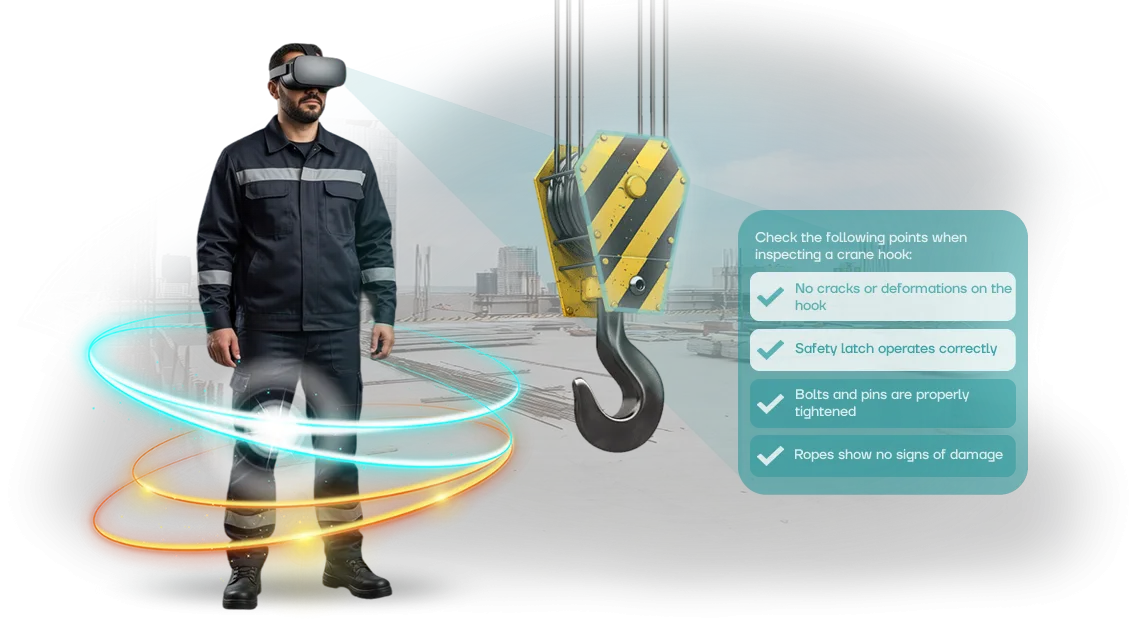
VR safety training simulators place employees in a realistic warehouse environment — with the same equipment, routes, and hazardous zones. They operate a forklift, move cargo, respond to emergencies, and the system records every action and shows mistakes. Training becomes practice that builds a lasting habit of safe behavior.
For logistics, this means lower risks, fewer violations, and fewer insurance claims. Our team develop VR simulators tailored to your warehouse: we model the equipment, layout, and regulations so that training is as close as possible to working conditions. Implementation is fast, without stopping operations, and easily fits into shift schedules.
What VR Safety Training Gives Employees
Employees at logistics centers work every day near moving equipment, tall racks, and heavy loads. Even a brief lapse of attention can lead to a serious injury — with downtime, payouts, and investigations.
Regular briefings and posters do not let a person truly feel the danger: they listen, but do not remember.
VR training changes the approach: an employee enters a realistic situation where they must make a decision themselves. In just a few minutes, they experience a scenario that in real life could have ended in tragedy — and they do it without health risks. This is how lasting safe behavior skills are formed, not just formal knowledge of rules.
For business, the main result is reduced injuries and related costs: fewer downtime events, insurance payouts, and staff turnover. Training takes place without interrupting production or in a short session, so it does not slow down warehouse operations.
A single simulator can run through the entire shift staff, and the program automatically records who passed and who needs to repeat.
In addition, VR helps identify employees prone to risky behavior and correct their actions before a real incident occurs. This is no longer just knowledge assessment but managing the safety culture at the enterprise.
Engagement also grows: people approach this training with interest rather than as a mandatory formality, so the effectiveness of each session is noticeably higher.
We create simulators on professional equipment and adapt scenarios to your real processes — equipment types, facility layouts, and regulations. As a result, you get employees who know not only the theory but also act correctly in stressful situations.
That is the return on investment: fewer incidents, stable operations, and peace of mind for management.
VR Simulator Formats for Logistics Training
Logistics has different areas — receiving, storage, picking, shipping — and each has its own risks. Training everyone with the same scenario is ineffective: a warehouse operator needs one algorithm, a forklift driver another, and a shift supervisor a third.
That is why we prepare VR simulators for specific enterprise tasks: you choose the format that covers your weak points, not just one that “introduces employees to virtual reality.”
Below are typical options most often used by logistics companies. They combine easily and scale across different staff groups.
| Format | For whom | What it gives the client |
|---|---|---|
| Interactive scenario for new employees | Onboarding of warehouse operators, storekeepers, pickers | Reduced time to full productivity and fewer mistakes caused by not knowing instructions |
| Equipment operation simulator | Forklift, stacker, and electric tugger drivers | Practicing safe techniques without risk to people or equipment |
| Evacuation and emergency response practice | All warehouse staff | Employees act automatically rather than waiting for instructions in a real situation |
| Hazardous zone simulation | Shipping and rack storage area employees | Understanding why regulations must not be violated — through a lived scenario |
| Skill assessment before work authorization | Candidates and employees after training | Objective confirmation that a person is ready to work in a specific area |
Each format fits into regular training and requires no special knowledge from staff. An employee puts on a headset, goes through the scenario, and the system shows you the result: where they stopped, what they missed, and which actions had to be repeated.
You get not just a training record but a clear picture of team readiness — and can see in advance who needs additional preparation.
How We Create a VR Simulator for Your Process
Developing a VR simulator is not a “black box” but a controlled process with clear stages. We support you from the first brief to launch and maintenance so that the result precisely matches your tasks and occupational safety standards.
- Brief and audit of your processes. We study regulations, instructions, and typical employee errors. We record which actions and scenarios need to be practiced specifically at your warehouse or production facility.
- Scenario and approval. We create a detailed training scenario: situations, employee actions, and possible consequences of mistakes. You make edits before development starts — this saves time and money.
- VR environment development. We model a virtual space that replicates your facility: rack placement, forklift traffic zones, and dangerous areas. Training takes place in conditions as close to real as possible.
- Pilot testing. We conduct training with a group of your employees, collect feedback, and adjust details — from hint logic to session length. You see the result before full launch.
- Launch and implementation. We install the simulator, configure it for your equipment, and train instructors. Employees can start sessions immediately, without a long adaptation period.
- Support and updates. We update scenarios to new occupational safety requirements, monitor correct operation, and remain available after launch. The simulator does not become outdated after a month.
In the end, you get a tool that is embedded in your training system and works to reduce injuries and staff errors.
What Is Included in a VR Occupational Safety Simulator Delivery
Every VR occupational safety simulator is not just a program but a ready-made solution for employee training. Everything needed to start is already included in the delivery: from scenarios to analytics.
You receive a complete package and can conduct briefings from day one without purchasing anything extra.
What is included in the delivery:
- Ready-made scenarios for your tasks. We build situations from real warehouse, loading, and cargo movement work — the employee practices actions in a safe virtual environment.
- Interactive occupational safety instructions. Instead of reading regulations, workers go through dangerous situations and remember correct actions through practice.
- Configured equipment. Professional VR headsets with software, tested and ready to use. Just turn it on — and training can begin.
- Instructor dashboard with analytics. You see who completed the training, how long the course took, and where employees most often make mistakes. This allows you to quickly find weak points and adjust the program.
- Methodological materials for the instructor. A step-by-step guide on how to conduct a session, what to say before starting, and how to review mistakes afterward.
- Support and scenario updates. If requirements change or new tasks appear, we supplement the simulator without purchasing new equipment.
This package covers the full cycle: preparation, conducting briefings, knowledge control, and reporting. This is especially important for logistics because warehouse safety is critical and staff turnover is high.
Every new employee completes training in minimal time, and you are always confident they have learned the rules.
We already supply such solutions to transport and logistics companies. Clients note that after VR training, the number of violations in the workplace noticeably decreases, and all materials and scenarios are adapted to your internal regulations.
Case Study: Reducing Warehouse Injuries with VR
Warehouse injuries hit not only employee health but also company economics: downtime, payouts, and lost goods. Regular briefings and posters do not create the required level of engagement — rules remain a formality until a real incident occurs.
What we did
A large logistics operator faced a rise in micro-injuries and rack damage. We developed a VR simulator for them that places employees into real work situations: forklift movement, working at height, and actions during cargo spills.
In a safe environment, a person learns to notice danger and make the right decisions — without risk to health or property.
The simulator was used not as entertainment but as a mandatory stage of the safety briefing. Every employee repeated scenarios until they completed them without errors. As a result, safety rules stopped being an abstraction and became a practiced skill.
Business result
After six months, the company saw measurable changes: the number of warehouse accidents dropped by 40%, and the share of employees who successfully passed the occupational safety test grew from 72% to 96%.
At the same time, training time for one newcomer decreased by almost a third — previously they had to be taken away from work for several days.
A separate effect was lower equipment repair costs. Damage to forklifts and racks became a quarter less frequent, which meant fewer unplanned expenses and downtime.
Site managers noticed that employees began reminding each other about the rules — this qualitatively changes the safety culture.
After implementation, the client scaled the solution to all its warehouses in the region and has been using the VR simulator as a training standard for the second year.
For us, this is the main confirmation of the result — when a client returns and expands the project because they see a direct link between training and reduced injuries.
How to Choose the Right VR Simulator for Your Business Task
Choosing a VR simulator starts not with a scenario catalog but with answering the question: which business task are you solving? In logistics, typical goals are reducing warehouse injuries, speeding up newcomer onboarding, and eliminating violations in equipment operation.
Determine where mistakes most often happen and how many employees need training — this immediately narrows down the solution format.
If you need mass training on basic rules, short VR scenarios for onboarding are suitable: an employee goes through typical situations in 15–20 minutes, sees the consequences of mistakes, and remembers the regulations.
When it comes to rare but dangerous incidents — fire, falling cargo, evacuation — you need a separate format with detailed practice of the action algorithm. It costs more, but these scenarios are what build correct behavior in stressful situations.
For personnel assessment, choose a VR simulator with action tracking and a final report for the manager. This is convenient for certification, after incidents, or during high staff turnover: you see who has mastered the program and who requires additional training.
The technical implementation is secondary — what matters is that the scenario reflects your internal instructions and the actual warehouse layout.
There is no universal answer: one business only needs a basic scenario for 5 workstations, another needs a comprehensive solution with individual scenarios for each area.
We help you choose a format after an audit: we look at regulations, typical violations, and the number of shifts, then propose a specific scenario and scope.
This approach prevents overpaying for unnecessary modules and guarantees that the simulator will integrate into your current training system.
The main guideline is a measurable result: fewer violations, faster employee preparation, and reduced downtime from injuries. Start with a pilot group — see in practice whether the chosen format works, then scale it to the entire staff.
And to avoid any doubt about the choice, send us a description of your task — within one day we will suggest a suitable option for your budget and timeline.
Frequently Asked Questions About Implementing VR Training
Before implementing VR simulators in logistics, most managers have the same questions. The doubts are not about the technology but about practice: how it will affect current processes, how long launch will take, and what happens if something goes wrong. Below we address typical concerns — briefly and to the point.
Is the simulator compatible with our training system?
Yes. The VR module integrates into the existing program as an independent element. It does not require replacing all materials or restructuring the schedule — you just need to allocate 20–30 minutes for each employee. Instructors receive a simple launch scenario, and results are automatically saved in a report form.
Is VR training difficult to launch? Will we need a dedicated specialist?
No, you do not need a technical employee on staff. The equipment is connected in one day, and learning to operate it takes no more than a couple of hours. We provide a short procedure: put on the headset, select the scenario, and the instructor sees progress on the screen. Any regular occupational safety instructor can handle this task.
What if the simulator is not suitable — who is responsible for the result?
We launch a pilot format before full deployment: we test the scenario and usability with several employees. If something is unsatisfactory, we adjust the materials or scenario until the result matches your expectations. After launch, we stay in touch: we answer questions and help with content updates.
Questions are normal: the cost of a mistake in logistics is high, and a new tool must work without failures. That is why we structure the process so that you see results before fully purchasing equipment, and the launch itself takes days, not months.Leave a Request for VR Occupational Safety Simulator Development
Leave a request — we will take care of the routine from there. Tell us about your logistics tasks, and we will advise where a VR simulator can have the greatest effect: reduce warehouse injuries, speed up new employee training, and cut downtime.
You get a consultation, a cost estimate, and a demo — without obligations or long approval processes.
How we will structure the work
- Request and consultation — we discuss your scenarios, risks, and safety requirements.
- Process audit — we look at which operations most often lead to errors and violations.
- Cost calculation and timeline — we give you a clear estimate for your scale, with no hidden payments.
- Demo version — we show a prototype on professional equipment so you can assess the effect before launch.
- Development and approval — we create scenarios based on your instructions and regulations.
- Implementation and training — we install the simulator, prepare instructors, and launch.
- Support — we update content and provide technical assistance.
What you get immediately after your request
- A personal consultation tailored to your warehouse or transport department tasks.
- A preliminary budget and timeline estimate — within 1–2 business days.
- Demo access to a standard module so you can understand the training logic.
- Example scenarios for logistics: loading and unloading, equipment operation, working at height.
- Recommendations for integration with your training and certification system.
- A clear implementation plan with responsible parties and control points.
- An estimate with options: from a basic package to a comprehensive solution.
Call or write to us — we will answer your questions and prepare a cost estimate within two business days.