

Maritime Transport: Why Old Safety Briefings Don't Save
Accidents on ships occur not because of a lack of instructions, but because of the human factor: fatigue, autopilot habits, confusion in an emergency.
In maritime shipping, the cost of such a mistake is the crew's health, vessel downtime, company reputation, and enormous financial losses.
Meanwhile, standard occupational safety briefings are conducted just for formality: sailors and mechanics listen, nod, and a week later forget how to act in a fire or decompression.
The problem is that classical training transfers information rather than builds skill. A person may know the rules, but in a stressful situation acts on habit, not memory.
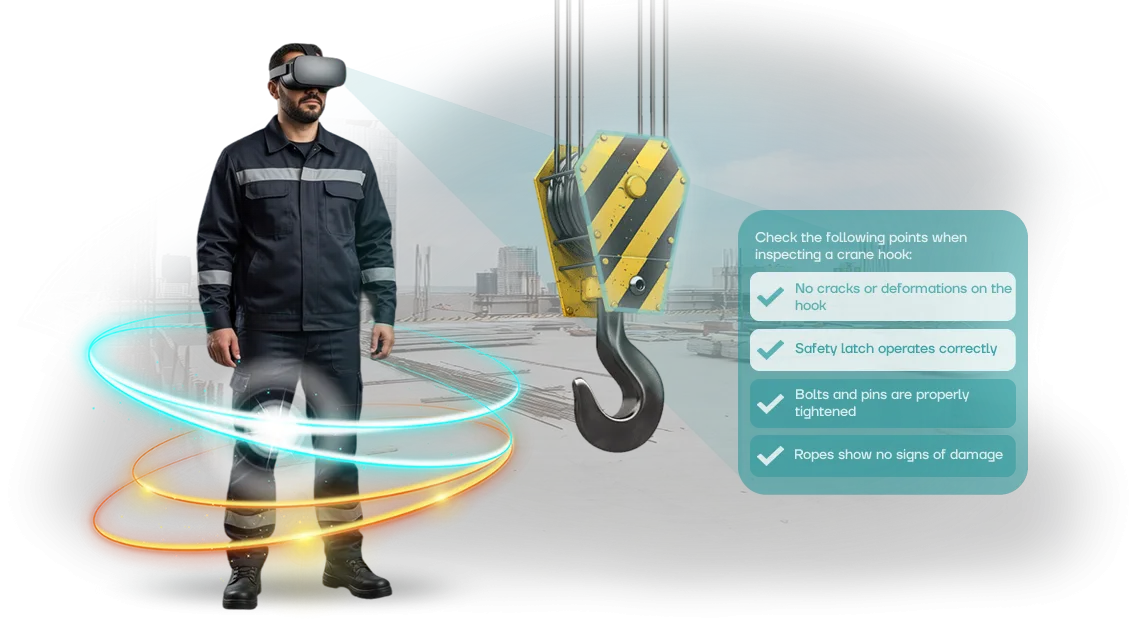
VR simulators solve exactly this problem: they immerse the employee in a realistic emergency environment where decisions must be made in seconds.
The crew practices actions to the point of automation — from fire containment to vessel evacuation — without risking lives and without disrupting the work schedule.
This training format has long been used in aviation and the oil and gas industry, and is now coming to maritime shipping.
The captain and chief engineer see the crew's real level of readiness, and the company gets a measurable result: fewer incidents, faster response, higher discipline.
We help shipping companies implement VR simulators for occupational safety — from scenarios tailored to your fleet to installing equipment on shore or directly on board.
This is not a replacement for briefing, but an enhancement: theory remains, but is now reinforced by practice that is remembered forever.
Benefits of VR Training for Crew Safety
Crew safety is the main asset of the maritime business. Mistakes on a ship are costly: downtime, fines, reputational damage, and above all, people's health.
Traditional lectures and briefings provide superficial learning: within a week, sailors remember only a small fraction of the rules.
VR training moves preparation into a practical dimension: the crew practices actions in an environment as close to reality as possible, and therefore the retention of material reaches a qualitatively different level.
The simulator allows experiencing rare and critical scenarios — engine room fire, decompression, man overboard — without risk to people or the vessel. In normal life such situations cannot be practiced, and when they do occur, action must be quick and precise.
Virtual practice builds muscle memory and confidence that then carry over into real work. This is why advanced training on VR simulators is becoming the standard for maritime specialties where the cost of error is highest.
An additional plus is reduced training costs. There is no expense for vessel time, fuel, or equipment wear; no need to divert the ship from its voyage or pay for instructors' travel.
One system replaces dozens of classroom hours, and the crew can train in port, on shore, or in a training center — without compromising quality.
We have already helped shipping companies reduce the number of incidents after implementing VR training. Managers note that crews respond faster in emergency situations and work more confidently with checklists.
This format integrates easily into the training system and delivers a measurable result — a higher safety level and smooth voyages.
VR Simulator Formats for Maritime Transport
On shore and at sea requirements differ: a bulk carrier crew needs one set of scenarios, while a gas carrier or ferry crew needs another.
Universal training does not provide the required level of readiness, so we select the VR format based on vessel type, staff responsibilities, and the conditions in which training takes place.
Below is a comparison of the main VR training formats we use for maritime transport.
| Format | Who It Is For | What It Gives the Client |
|---|---|---|
| VR classroom for group briefings | Basic crew training, scheduled drills | Practice of fire response, alarm, and evacuation for the entire group at once. Reduces briefing time and improves retention. |
| Mobile VR kit | Training on board during a voyage or in port | Can be set up in any space, no permanent classroom required. Saves on logistics and vessel downtime. |
| Individual VR simulator | Practice of rare and hazardous operations | Each crew member goes through the scenario at their own pace (working with cargo systems, actions during decompression). The system records errors — you see the real level of preparation. |
| Shared VR scenario | Team coordination practice during emergencies | The crew learns to coordinate actions in a shared virtual environment during emergencies. This reduces the risk of human error in critical situations. |
We will select a format for your vessel type and tasks — from bulk carriers to tankers and passenger ferries. We adapt each scenario to your company's regulations and standards and conduct training with minimal disruption to work.
How an Occupational Safety VR Simulator Is Developed
Every simulator for maritime transport is not an off-the-shelf solution but a project tailored to your specifics. We structure the process so that you understand what you are getting at each stage and can influence the outcome. Deadlines are agreed at the start and fixed before work begins.
-
Brief and audit. We review your occupational safety documentation, analyze incidents and typical crew errors. We determine which skills need to be practiced first: fire response, exiting a smoke-filled compartment, and deck work procedures.
-
Scenario design. Together with you, we approve the scenario: initial situation, employee actions, error variants, and hints. We agree on evaluation criteria — this is the basis for future knowledge control.
-
Virtual environment creation. We build a realistic ship environment: deck, engine room, emergency exits, and life-saving appliances. The employee trains in an environment as close to reality as possible, but without risk to life.
-
Logic and interactivity development. We configure the action sequence, error-tracking system, and feedback. At this stage, you receive an intermediate version and see what the training will look like.
-
Pilot testing. Your specialists are the first to complete the training. We collect feedback and make adjustments: scenario difficulty, session length, and clarity of instructions.
-
Launch and deployment. We install equipment, set up instructor workstations, and provide materials for tracking completions. Your employees can start training on launch day.
-
Support and development. We support the simulator after launch, update scenarios when regulations change, and add new situations upon request. Refresher training runs without downtime.
This approach reduces approval time and mitigates risks associated with VR deployment in advance. You receive a working tool rather than just a virtual demonstration.
What Is Included in the VR Simulator Delivery
You receive a complete package for launching training — nothing extra to buy or refine. The delivery includes software, simulator equipment, training materials, and a usage license.
All of this is packaged into a single solution that can be deployed on vessels, in shore-based training centers, and in port facilities.
- Software with occupational safety courses — simulators built on real maritime scenarios: loading and unloading operations, deck work, enclosed spaces, and emergency situations.
- Professional VR equipment — virtual reality headsets and controllers, calibrated and configured for your specifics. No fuss — everything powers on and works according to the manual.
- Instructor training materials — ready-made lesson scenarios, checklists for evaluating actions, and analysis of typical mistakes. The instructor does not need to build a program from scratch; it is enough to conduct the session according to the suggested plan.
- Instructions for staff — simple guides: how to put on the headset, how to select a scenario, how to behave if dizzy or uncomfortable. This addresses employees' questions before training even begins.
- Software usage license — the legal right to conduct training at your number of workstations without restrictions on the number of sessions. If you need to expand the number of simulators, you get an additional license without reworking the entire system.
- Training for your specialists — our engineers provide remote setup and a short demonstration for your team so that those responsible for training feel confident.
- Technical support — assistance throughout the entire period of use: scenario updates, consultations, and troubleshooting within agreed timeframes.
The entire package is delivered turnkey — you get not scattered components but a working system. This means that just a few days after delivery, you can launch the first sessions and meet occupational safety requirements without hiring external contractors.
Case Study: Ship Crew Training with a VR Simulator
Traditional occupational safety briefing on a ship means hours of theory that is quickly forgotten. The crew listens to regulations, but in a real emergency acts on autopilot — and often incorrectly. For shipping companies, this leads to more downtime, fines, and risks to people's lives.
We built a VR simulator for the shipping company North Sea Shipping that replaces part of the mandatory briefings. Instead of slides and lectures, sailors practice actions in a realistic environment: engine room fire, evacuation, and emergency grounding.
The simulator records every action and highlights errors — the crew sees exactly what they did wrong and immediately replays the scene.
Implementation Results
Briefing for an entire crew was reduced by 40% — it previously took a full working day; now a single shift is enough. Most importantly, the number of safety violations on the company's vessels dropped by half.
The captain notes that the crew responds faster to alerts and does not get lost in off-nominal situations.
The shipping company has already ordered a second module — for working with cargo cranes. The first case showed that VR training pays off through reduced accident rates and crew time savings.
For us, this is confirmation: the simulator works not as a 'toy', but as a tool that changes employee behavior in the workplace.
How to Choose a VR Simulator for Your Vessel's Needs?
The right choice of a VR simulator begins not with equipment but with answers to three questions: what risks are specific to your vessel type, who will undergo training, and what result you want to achieve.
For a tanker, the scenarios are one set; for a passenger ferry or tugboat, another. So a universal solution does not exist, and that is normal.
Fleet type directly determines the set of emergency situations to practice.
For a tanker crew, actions during a cargo compartment fire or vapor leak are critical; for a bulk carrier crew, falling cargo on deck and crane operations; for a ferry, passenger evacuation and actions during heel.
We select VR scenarios to match the real regular situations on your vessel so that training is relevant rather than abstract.
Audience level is no less important. New sailors need basic algorithms: put on equipment, walk through a smoke-filled corridor, find lifeboat gear. Officers need team coordination, decision-making under time constraints, and task distribution among people.
Therefore, when selecting a simulator, we clarify who exactly will be training: cadets, current crew, or a mixed group, and adjust session complexity and duration accordingly.
We help you decide on the format — from a compact solution for a single vessel to a fleet-wide solution where one package is used on several vessels with different training programs.
We conduct a short audit: meet with you, review vessel types, occupational safety regulations, and crew composition, and then propose a specific set of scenarios and terms rather than just a list of specifications.
If you are unsure where to begin, contact us: we will advise which minimum set of VR scenarios will deliver maximum effect for your specific fleet, and help you implement training without stopping onboard work processes.
Frequently Asked Questions About VR Simulator Implementation
Implementing VR simulators in the maritime industry raises questions: how to fit training into voyage schedules, whether it will require reworking shore-based processes, and whether crews will handle the new technology. Below we address typical customer concerns — briefly and to the point.
Employees are unfamiliar with VR — will there be problems training staff?
The simulator is designed so that the first session takes 10–15 minutes. The crew works with hints, and the briefing for the occupational safety specialist takes one day. We support the launch and stay in touch until training becomes part of the regular schedule.
How flexible is the simulator to our scenarios and regulations?
We adapt scenarios to your instructions, vessel types, and real situations from your fleet. We make edits after pilot launch and refine modules to meet new requirements — without rebuilding the entire program.
What about support if something goes wrong?
We work under a contract with fixed response times. We resolve most issues remotely within a business day, and if necessary, we visit the site. The equipment is tested in maritime conditions and comes with a warranty.
Will we have to stop working processes for training?
The VR simulator can be launched on shore during crew shift changes or on the vessel in the home port. Sessions take 20–30 minutes and fit into the existing briefing schedule — no separate time slot is needed.
Will training results be measurable?
The system records each trainee's actions: number of errors, time per operation, and critical violations. You receive a report for every session — a basis for personnel control and for demonstrating compliance to inspecting authorities.
Submit a Request for VR Simulator Development
Submit a request — and we will prepare a cost estimate for a VR simulator tailored to your company's maritime tasks. All we need from you is a brief: how many employees to train, which scenarios are critical, and on which vessels you plan to hold sessions. Then we take it from there. This places you under no obligation.
After your inquiry, you receive:
- Implementation consultation: we review your current occupational safety programs and identify scenarios where VR training will deliver maximum impact.
- Cost estimate tailored to your request: we account for the number of trainees, vessel types, and scenario complexity, with no hidden surcharges or fine print.
- Proposal with an implementation plan: development stages, timelines, team composition, and what will be needed from your side for launch.
- Access to demo materials: we show our maritime-related work so you can see the format and quality before the project starts.
- A personal manager: one contact for the entire project — answers questions, monitors deadlines, and approves each stage.
Submitting a request takes two minutes. Within one business day, we will get in touch, clarify details, and come back with a cost estimate and recommendations — with no obligations or prepayments.
You will receive a solid basis for making a decision: what to implement, how long it will take, and when results will appear.