

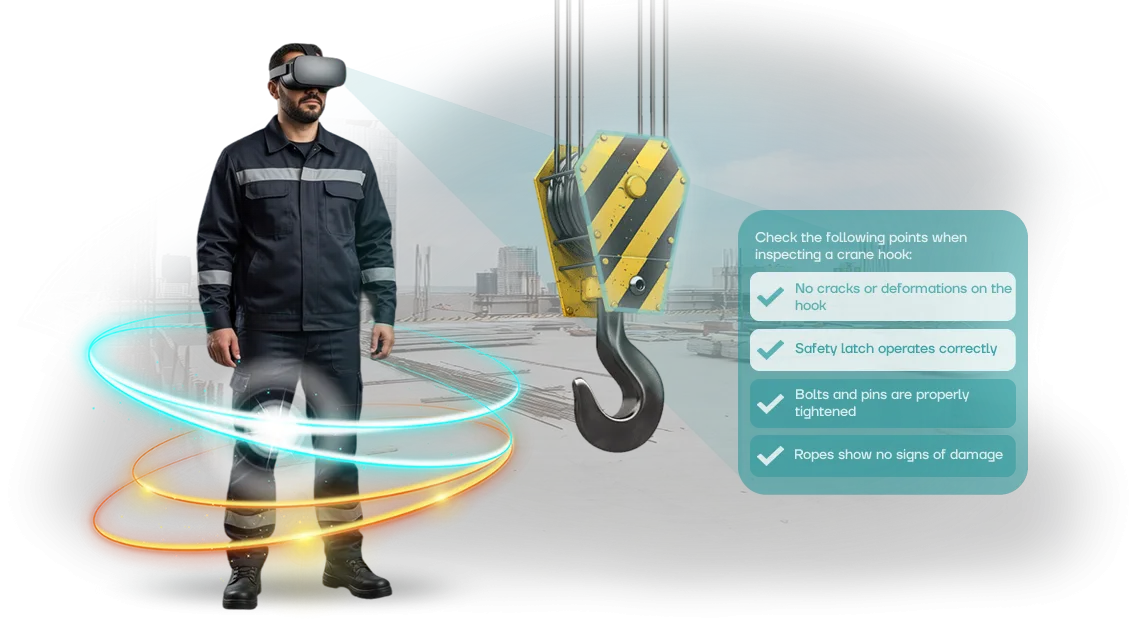
Occupational Safety in Underwater Operations: Why a VR Simulator Is Needed
Underwater operations are one of the most dangerous fields of activity. Pressure changes, limited visibility, responsibility for the lives of colleagues: here the price of a mistake is the health and lives of people.
Occupational safety in underwater operations requires a special approach, because standard briefings do not prepare workers for emergency situations in a real environment.
Traditional training methods — lectures, posters, videos — provide only theory. Practicing actions in an emergency situation on dry land is impossible, while training in a real body of water is expensive, time-consuming, and risky in itself, especially for beginners.
A VR simulator solves this problem. It immerses the employee in a realistic environment with a watery setting, limited time, and stressful factors.
The trainee practices actions until they become automatic, learns to make decisions under uncertainty, and takes no risks in the process. The scenario can be repeated dozens of times until the skill is cemented.
For a manager, this means a predictable result: prepared employees and fewer incidents. Training takes place without interrupting production, and the program matches current occupational safety requirements.
We develop turnkey VR simulators tailored to the specifics of your underwater operations — from diving descents to working with equipment. Tell us about your task, and we will show how virtual training improves the safety and confidence of your team.
Three Benefits of VR Training for Safety and Business
Underwater operations are one of the riskiest areas: pressure, zero visibility, tight deadlines. An employee's mistake results not only in injury, but also in downtime, fines, and a hit to the company's reputation.
Ordinary briefings and posters do not give a person a sense of real danger, which is why knowledge is quickly forgotten and actions in an emergency remain unpracticed.
The first benefit is a reduction in injuries and accidents. A VR simulator immerses the worker in a realistic underwater site environment: they see, hear, and act under conditions close to real-life.
This kind of practice builds a lasting skill of safe behavior, not just memorized rules. An employee who has already "been" in an emergency situation in the simulator reacts more calmly and quickly in reality — which directly reduces the number of accidents.
The second benefit is practicing rare and dangerous scenarios without risking life. In reality, no one will deliberately create depressurization or a hose rupture for a training drill.
VR allows the most complex scenarios to be replayed over and over: equipment failure, emergency ascent, losing orientation in murky water. Every worker receives equally high-quality practice — regardless of experience and natural reaction speed. As a result, the team meets a real emergency situation prepared, not confused.
The third benefit is a measurable result for the business. We track every employee's progress: how many attempts were needed for the correct algorithm, what mistakes they made, and how quickly they corrected them.
You get objective data for certification and see the actual level of staff readiness — not just a formal completion mark.
Training on a VR simulator takes less time than classic practical sessions, does not require renting training grounds, and makes it possible to train entire shifts remotely or directly on site. This reduces training costs and the cost of downtime.
This approach pays off after the first prevented incident. The company not only protects people, but also strengthens its reputation as a reliable contractor, and clients are more willing to work with those who take safety seriously.
We design simulators for your organization's real workflows and emergency regulations — from brief to launch usually takes four to six weeks.
VR Simulator Formats for Different Enterprise Objectives
One and the same simulator does not solve all tasks equally well. If you need to quickly train a large number of personnel, one format is effective; if you need to practice rare underwater emergency situations, quite another.
We select the format based on your task: by the number of employees, by the training location, and by the level of scenario danger.
| Simulator format | For whom | What it gives the client |
|---|---|---|
| Individual immersion | Divers, underwater operations specialists who need to practice emergency scenarios | Full simulation of an emergency situation without risk to life. The employee acts at a real pace, while the instructor sees every decision and immediately reviews mistakes |
| Mobile VR classroom | Groups of up to 10–15 people, training directly on site | No need to bring people to a training center. The simulator is set up in any room within an hour, and several crews can be trained per shift |
| Blended format "theory + VR" | Mass training, initial briefing, scheduled knowledge checks | Employees first study the rules on screen, then reinforce them in the virtual environment. The material is absorbed more deeply, and results are automatically collected into a log for certification |
For each format, we prepare a scenario based on your regulations and actual working conditions. For underwater operations, this includes decompression control, working with equipment, actions in the event of lost visibility, or equipment failure.
After training, the employee acts more calmly and quickly, and you have objective data on the readiness of every team member. Simply describe the task — we take care of the rest and offer a suitable format with a calculation of timelines and coverage.
How We Create a VR Simulator: Stages of Work
Developing a VR simulator is not buying a ready-made application; it is a joint project with clear milestones. For underwater operations, dozens of nuances must be considered: from equipment features to actions in emergency situations.
We structured the process so that at every step you see the result and can influence intermediate versions. This way, there are no "surprises" at the final handover, and you know exactly that the simulator solves your tasks.
- Brief and audit. We dive into the specifics of underwater operations, study your regulations, analyze real incidents, and typical mistakes. Together with you, we define training goals and success criteria.
- Scenario and methodology. Our specialists, together with your occupational safety colleagues, turn instructions into a living interactive storyline: from an ordinary shift to an emergency situation. You approve the logic and content.
- Creation of VR content. We model the working environment: equipment, visibility conditions, characteristic risks. We show intermediate versions so you can see what the future simulator looks like and make adjustments.
- Integration into the training process. We install and configure the simulator for your equipment, connect progress tracking and integration with the training program. You get a working tool, not "hardware in a box."
- Pilot launch. We conduct test training with a group of employees, collect feedback, and refine details: from scenario to interface. Only then does the simulator go into full operation.
- Support and development. We stay with you after the launch: we update scenarios when regulations change, add new situations, and help with technical support.
As a result, you get a working training tool that addresses exactly your risks and fits into the daily work of the occupational safety department.
We are responsible for timelines and results — each stage is recorded in the contract, and you always know what stage the VR creation process is at and what you will receive next.
What Is Included in a VR Simulator for Underwater Operations: The Complete Package
You receive not just a program, but a complete employee training system for underwater operations. The simulator includes several scenarios that cover typical and dangerous situations, as well as everything needed to use them: from setup to results evaluation.
The delivery package includes:
-
Training VR modules for the main types of underwater operations: structure inspection, welding work, damage repair, and actions in emergency situations. Each module simulates real conditions — limited visibility, depth, and working in gear.
-
Scenarios with checkpoints — the employee must make the right decision at the right moment. The system records every action, allowing the instructor to spot mistakes and prevent them on a real site.
-
Methodological instructions for the instructor: how to structure a lesson, which tasks to assign, and how to interpret results. Everything is prepared — you only need to schedule the time.
-
Administrative panel — management of the employee list, progress review, and generation of training completion reports for internal control and inspections.
-
Simulator updates — we add scenarios when regulations change or upon your request; you are never left with outdated content.
-
Technical support and warranty — we help with setup, answer questions, and promptly resolve issues so that training never stops.
Thus, you have the complete tool for fast and visual employee training, reducing the time spent on briefings and lowering the risk of mistakes in real underwater operations. The only thing left is deployment — and we also help with that.
Case Study: How a Simulator Reduced Injuries at a Production Site
Water does not forgive mistakes: in underwater operations, every wrong action leads to an accident, downtime, and injury. Ordinary briefings do not produce the necessary reaction — an employee cannot "feel" an emergency situation before encountering it in person.
That is what a VR simulator closes. We built one for Baltic Dredging Company, whose divers service underwater pipelines at depths of up to 30 meters.
The client came to us with a specific pain: four accidents in a year, one victim with a fracture, and long downtime for each incident.
Before the simulator was launched, 4 accidents and 11 micro-injuries were recorded over the previous year. Six months after deployment, the numbers changed: accidents — zero, micro-injuries — three. Injuries dropped by almost 75%, and the number of errors during real descents fell by a third.
What the Metrics Showed
- Situation assessment speed increased — the average diver reaction time to depressurization fell from 14 to 9 seconds.
- Downtime due to incidents decreased 4 times — the company saved on equipment repair and compensation payments.
- Repeat order: a year later, the client expanded the program to all 12 crews, and also added scenarios for deep-water work and rescuing a colleague.
The simulator does not replace a briefing; it turns theory into skill: the employee experiences a dangerous situation in a safe environment and remembers the right actions on a physical level.
A manager receives objective statistics on each diver — who is ready for work and who needs additional training.
If you want to predict the effect for your production, let's start with a short audit of scenarios. Tell us which operations are the riskiest for you — and we will show how a VR simulator can address them.
What if I Have Specific Training Requirements?
Yes, for us this is a standard task. Specific requirements do not hinder the launch of training; they become the starting point for development.
This is especially important for underwater operations, where every detail — from the condition of the equipment to the action algorithm in an emergency — affects safety.
An individual approach begins with a short audit of your situation. We study the regulations in force at your enterprise, typical crew scenarios, equipment features, and supervisory authority requirements.
Based on this, we adjust the simulator program so that it reflects not abstract rules, but your actual conditions.
Next, we test scenarios together with your specialists, make corrections, and approve the final version. As a result, you get a simulator that takes into account your instructions, equipment models, and employee skill levels.
If necessary, we make changes even after launch — training does not stand still, and the program evolves along with your processes.
If requirements change or new input emerges, simply contact us — adaptation will not take long. You are never left alone with the task: a personal manager is in touch and responsible for the result.
Ultimately, you get a tool that speaks the language of your employees and solves the specific tasks of your production.
Frequently Asked Questions About Implementing VR Simulators
Before launching any occupational safety training, the person responsible for safety has practical questions: how to integrate the simulator into existing regulations, how long setup will take, and how to evaluate employee progress.
For underwater operations, this is especially important — a mistake at a real site costs a lot, and testing skills in water is risky.
We have compiled answers to the most common pre-order questions. They cover implementation, lesson format, results monitoring, and guarantees — in other words, everything that determines the ease of start-up and the usefulness of the simulator for your business.
How long does it take to implement the simulator?
The standard cycle: brief — two days, scenario preparation based on your regulations — up to one week, installation and equipment setup — one day. Then we conduct a pilot session and adjust the scenario based on your instructors' feedback. In total, from contract signing to the first full lesson takes 10–14 days.
How does a VR simulator fit into the existing occupational safety training program?
The simulator does not replace theory — it strengthens it with a practical component. You include it as a mandatory preparation stage before allowing access to underwater operations, or as a regular skills check once a quarter.
The scenario is adapted to your instructions and typical emergency situations, making it a natural extension of your regulations rather than a separate system.
How can I check that an employee has actually absorbed the material?
The system records every action in the scenario: the correct order of equipment checks, reaction time to an emergency situation, and correct decisions during depressurization. At the end of the session, a report is generated and exported to Excel or your training system.
The instructor sees which specific mistakes are repeated by the team and can adjust the program with precision.
What if employees do not know how to use VR equipment?
The controls are built around simple actions — picking up a tool, inspecting a valve, pressing a button. Training takes 5–7 minutes, and for underwater scenarios we use controllers with intuitive grips.
Even older employees with no diving experience master the interface within one session; our specialist provides the instruction at the launch site.
Who is responsible for the equipment after implementation?
We support the simulator: we update scenarios, monitor headset condition, and carry out preventive maintenance twice a year. We respond to your requests within one business day, and in the event of a breakdown, we replace the equipment with a backup within 48 hours. For your team, this means training never stops due to technical issues.
Order the Development of a VR Simulator for Your Enterprise
For underwater operations, the price of a mistake is especially high — there is no "second chance." A VR simulator makes it possible to practice emergency scenarios, equipment handling, and rescue algorithms before the employee is in a real environment.
Order the development of a simulator tailored to your regulations and get a ready-made tool that integrates into the training system from the very start.
After your request, we will:
- conduct a review of your tasks and advise which scenarios should be modeled first;
- prepare a commercial proposal with a clear scope of work and timelines — no hidden stages or "surprises";
- develop the simulator based on your instructions, regulatory requirements, and typical emergency situations;
- show intermediate versions and make changes before you accept the result;
- provide instructions for instructors and employees so that the launch requires no additional staff;
- take on updates and support after the release.
You get not just a program, but a working knowledge-control tool: the system records the employee's actions, shows mistakes, and generates a report for certification. This eliminates paper checks and subjective assessments.
Leave a request. We will explain which tasks are best served by VR, give you an idea of the timelines, and help you choose a format — from renting a ready-made solution to fully custom development.