

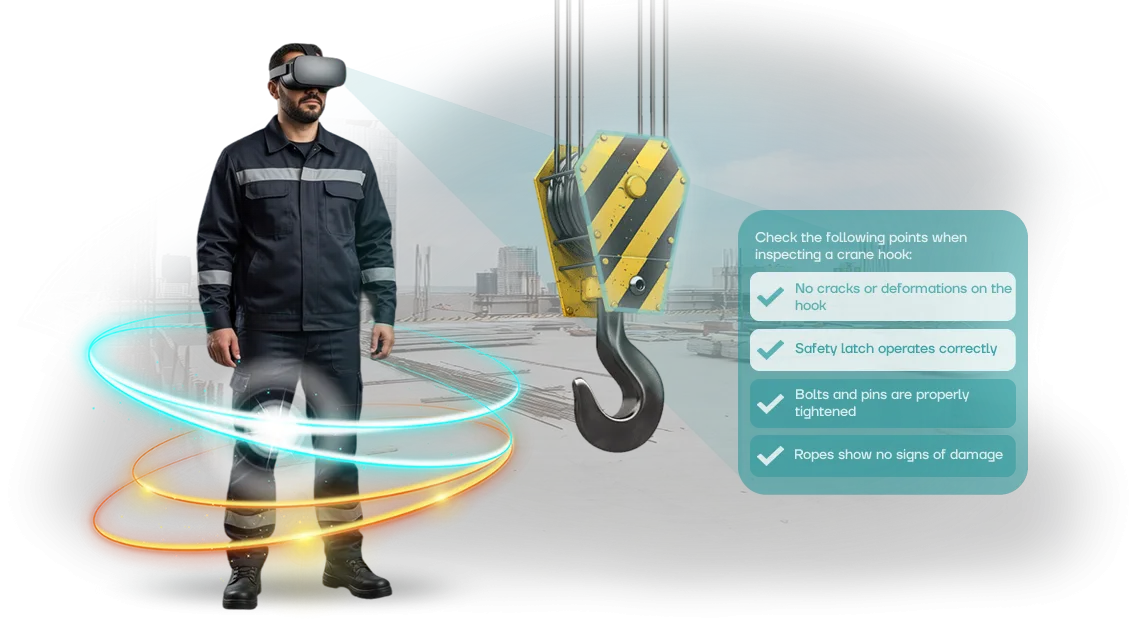
VR Trainers for Fire Service: Training Without Risk
Firefighter training is always associated with risk. Real flames, acrid smoke, collapsing structures, and the need to make decisions in seconds — any mistake during a drill can cost health, and in combat conditions, a life.
Classical exercises require complex organization, involve equipment and personnel, and most importantly, do not allow for safely simulating truly dangerous scenarios.
A VR trainer for fire safety removes this contradiction. The trainee enters a virtual environment where the fire's source, dense smoke, limited visibility, and panic among people are realistically recreated.
At the same time, they are fully protected: there is no fire, no toxic combustion products, no physical threat. A mistake here is not an injury but valuable experience that is remembered better than an instruction briefing.
Such virtual safety training makes it possible to practice actions in situations that cannot be replicated at a real training ground. A firefighter can run through a scenario ten times in a row, changing tactics and seeing the consequences of each decision.
The team trains cohesively, and the supervisor gets an objective picture: who acts decisively, who hesitates, and who gets lost under stress.
For the client, this means a reduction in injuries during drills, resource savings, and a predictable training outcome. An employee arrives at a real call with a ready-made action algorithm, not with confusion.
We develop VR trainers tailored to your unit's tasks: practicing evacuation, suppression, rescue of people, and team coordination. A safe environment leads to fast and confident actions when every second counts.
Why VR Training Is Better Than Classical Drills
Classical fire safety drills often boil down to lectures, posters, and rare exercises. In a real emergency, an employee faces smoke, limited visibility, and a severe time deficit — and loses composure because they have never been in such conditions.
VR trainers place a person in a realistic environment where they learn to act correctly without waiting for a real fire.
Here is what a fire service gets by choosing virtual trainers instead of classical exercises:
- Rapid response. Practicing scenarios with unexpected developments — from a fire in an electrical panel room to smoke in a corridor. The employee trains decision-making speed while it is critical and brings actions to automaticity.
- Personnel engagement. The VR format holds attention completely: the person does not get distracted but lives through the situation. Training stops being a formality — employees engage in the process themselves and remember the algorithms better.
- Recognizable environments. The trainer models not an abstract facility but your premises: passages, floors, locations of fire extinguishers and exits. When a person has already seen the route in a headset, they move more confidently in real danger.
- Safe mistakes. In VR, a mistake can be made with zero consequences: a wrong step will not lead to injury or damage. However, the error review shows the employee exactly what needs to be changed and reinforces the correct behavior model.
The effectiveness of personnel training is built on repetition and feedback.
The system records every action: reaction time, route, equipment used — and provides an objective assessment rather than a "pass/fail." The supervisor sees who is ready for real work and who needs an additional training cycle.
At our team we design VR scenarios for the tasks of a specific service: from short introductory exercises to comprehensive drills with multiple participants. This is a proven way to increase personnel readiness without risk to life or property.
The fire service gets not entertainment but a working tool that pays off through employees' confident actions at a critical moment.
VR Trainer Formats for Occupational Safety and Health
Fire service training is not only theory of regulations but also practicing actions in conditions close to reality. Conducting drills on a real fire is expensive and dangerous, and a training ground does not reproduce every scenario.
Virtual reality closes this gap: it simulates any emergency and allows training personnel to automaticity without risk to people or equipment.
At our team we select the VR trainer format for a specific task — from a quick individual skill drill to coordinated group exercises. Below are the main types used in occupational safety programs.
Main Formats
| Format | Who It's For | What It Gives the Client |
|---|---|---|
| Single Scenario | An employee who needs to consolidate a specific skill: using a fire extinguisher, forcing a door, assessing the situation | Quick repeatability, error recording, and objective assessment of actions without an instructor present |
| VR Group Drills | A firefighting team of up to 6 people, duty officer, captain | Coordination in smoke, role distribution, practicing commands and mutual assistance in a shared virtual environment |
| Fire Suppression Scenario | A crew or shift responding to a call | Full algorithm: detecting the fire source, extinguishing, evacuation, interaction with adjacent services |
| Comprehensive Training | Occupational safety manager | A ready-made program: theory → VR drill → results review → improvement plan |
Formats are easy to combine: a new employee first completes a single scenario, then joins group drills. This builds training from basic skills to working as part of a crew, rather than disconnected exercises.
For a fire service, scenarios are detailed for typical calls: limited visibility, high temperature, urgent evacuation of people. We adapt the trainers to your organization's regulations so that employees gain exactly the experience required at a real facility.
How VR Trainer Development Works: 6 Steps
The development of a VR trainer for the fire service takes place in six clear stages. The trainer creation process is transparent: you see intermediate results, approve key decisions, and launch training without delays. Below are the stages of VR trainer development from brief to launch.
-
Brief and task analysis. We study your scenarios and employee errors. We define training goals and evaluation criteria.
-
Project approval. We present the concept: scenarios, actions, evaluation algorithms. You make edits before development starts.
-
Prototype development. We build a working version and test the mechanics and usability of the scenario.
-
Trainer creation. We fill in the scenario: environment, equipment, instructions. We refine every step with your instructors.
-
Testing. We run through the scenarios with instructors, checking the reliability and clarity of prompts.
-
Training launch and support. We train the personnel and help integrate the trainer into the program. After launch, we stay in touch and refine the scenarios.
This process allows you to order turnkey VR development without surprises: you know in advance what you will get and influence decisions at all key points. Project approval is conducted in a convenient format, and training launch takes minimal time after the final version.
What's Included in VR Trainer Delivery: Complete Package
You receive not just a program but a ready-made turnkey solution — from scenarios to training for your instructors. Nothing needs to be purchased or configured separately: we bring the package, deploy it at your site, and show you how to use it.
The standard VR trainer delivery includes:
- Ready-made VR scenarios for fire safety. Real situations are practiced: evacuation, extinguishing a fire, actions in a smoke-filled room. Employees train in safe conditions but with full immersion in the environment.
- Professional VR equipment. Headsets and controllers are tested and configured for your tasks. No complicated manipulations — put on the headset and start the drill.
- Instructions and procedures for personnel. Clear guides on how to prepare the area, launch a scenario, and conduct a session. They are written so that any employee can figure it out within one day.
- Training for your specialists. We provide instruction for those who will work with the trainer: how to lead a session, how to track results, how to avoid common mistakes.
- Technical support and updates. We are in touch from the day of launch: we help resolve any issues and update scenarios and software so that drills remain relevant.
- Assessment methodology materials. Ready-made forms and criteria so that you can see employee progress and report to management.
The entire package works as a single system: software, hardware, instructions, and support are all coordinated. You don't need to understand the implementation details — just turn on the trainer and conduct sessions, and we ensure it works reliably and delivers results.
Case Study: VR Training for Fire Service — Results
Examining a real deployment helps show what VR training delivers in practice. We worked with a fire service where employees are required to regularly practice actions in dangerous situations.
Previously, training took days: training grounds, equipment, instructors, and time were needed to organize each field exercise.
Together with the team, we developed a VR trainer that simulates extinguishing a fire in a residential building and evacuating people.
The fire service gained the ability to conduct drills without traveling to a training ground — directly at the fire station, in any space, and at any convenient time.
The deployment results speak for themselves:
- Training time was reduced by 40% — instead of several days per course, less time is required thanks to automatic scenario switching and fast session preparation.
- Training effectiveness increased: employees practice rare and emergency situations that are difficult to recreate safely in real life.
- Coverage expanded — twice as many employees completed training in one training cycle than before.
Supervisors noted that the VR format enables objective assessment of each participant's actions: the system records reaction time, movement route, and correctness of decisions. This helps identify weak points and precisely adjust the training program.
After the first stage, the service ordered additional modules — scenarios for handling chemical threats and rescuing people from smoke-filled rooms.
The repeat request confirmed that the results met expectations, and investments in VR training pay off through time savings and increased personnel readiness.
This experience shows that VR trainers are in demand not only in industry but also in emergency services. If you are looking for a way to speed up training and improve its effectiveness — let's discuss your scenario and calculate the potential impact for your organization.
How to Choose a VR Trainer Format for Your Task?
Choosing a VR trainer format starts not with technology but with three questions: the number of trainees, scenario complexity, and the scale of investment.
These parameters determine whether to choose a compact solution for practicing one skill or a full-fledged system with multiple scenarios.
Headcount is the first criterion. If a small number of employees go through training, a single universal scenario is sufficient. For a large fire service with dozens of units, a system is needed where inputs change: building layout, fire source, number of casualties. This directly affects the speed and coverage of training.
Scenario complexity is the second criterion. For basic orientation, standard situations are enough: evacuation, fire extinguisher use.
A professional fire service needs rare and dangerous situations that are difficult to rehearse in real life: a domestic gas explosion, a basement fire, rescue from a smoke-filled room. The closer the scenario is to real work, the more valuable the drill.
The third criterion is the scale of investment. It is important to understand what you are getting: a one-time scenario recording or a platform where scenarios are added as regulations change.
We select the format for the task, not the most expensive solution — this avoids overpaying for unnecessary features.
There is no universal answer to "which trainer is best." We start with a brief: headcount, specific requirements, regulations, and the desired outcome. Based on this, we propose a format for your task, with clear implementation timelines and no unnecessary costs.
An individual approach ensures that training works for employee safety, not just "for show."
Common Concerns When Implementing VR Training
When it comes to implementing VR trainers in a fire service, the first questions are about reliability. What happens if the equipment fails right before a session? Will the personnel cope with unfamiliar technology?
Will new devices need to be purchased to launch the training program? These concerns are understandable: people's safety, working time, and the unit's budget are at stake.
We mitigate these risks at the service level. Trainers are delivered with a warranty and maintenance — an engineer helps with setup, trains instructors, and in the event of a breakdown promptly resolves replacement issues so that drills are not interrupted.
Operation is designed for people without technical training, so the first exercises can be conducted on the day of installation.
What if the VR equipment breaks down at the most critical moment?
Breakdowns are rare, but we are prepared for them. The package includes a spare set of key components, and engineers remain in touch — most issues are resolved within one business day.
The equipment is serviced throughout its entire service life, so unplanned costs will not fall on the unit.
Is it difficult for firefighters to master a VR trainer?
The trainer launches with a single touch, and the actions mirror familiar work: opening a door, laying a hose line, removing a cylinder. The orientation takes about 20 minutes — after that, a firefighter is ready to complete scenarios independently. No special skills are required.
Will the trainer work with our existing equipment, or do we need to buy new hardware?
We select a solution based on the tasks and existing technology. If the current equipment is not suitable, we will offer rental or a flexible delivery option — taking into account budget capabilities and timelines. We help launch the program without unnecessary approvals.
Submit a Request to Implement a VR Trainer
Submit a request — and we will prepare a solution for your fire service's tasks. We will explain how VR trainers fit into the existing training system, help calculate the budget, and provide demo access so you can evaluate the result before purchasing. This is non-binding — only value for your process.
After submitting a request, you receive:
- Consultation on VR trainers for the fire service: we will advise which scenarios will deliver the greatest impact for your employees.
- Cost calculation for training at your scale: we will account for the number of specialists, session frequency, and required equipment.
- Demo access to the trainer: you and your colleagues can try the scenario live and feel the difference from a regular briefing.
- Proposals for virtual reality implementation: integration into the drill schedule, orientations, and planned exercises.
- Launch plan: what needs to be prepared, how long setup will take, and when training can begin.
- Support at all stages: from the first consultation to handing the trainer over for daily operation.
After your request, we will contact you within one business day, clarify the tasks, and send materials. No obligations — only specifics: timelines, trainer composition, and budget.
Ordering VR training for the fire service now means having a ready-made tool within a few weeks that makes drills safe, realistic, and measurable.
Submit a request to receive a consultation, cost calculation, and demo access — and take the first step toward implementing virtual reality in your training program.