

Shipbuilding and Occupational Safety: How VR Simulators Reduce Risks
Shipbuilding is one of the most safety-demanding industries: work at height, confined spaces, heavy equipment, and welding processes. The cost of a mistake here is employee injury, production downtime, fines, and reputational damage.
At the same time, classic safety briefings and lectures do not give workers the most important thing — the skill to act in a real dangerous situation.
VR simulators solve exactly this problem: the employee enters a realistic shipyard environment where they practice scenarios that cannot be safely simulated in real life.
They learn to notice risks, make decisions in seconds, and respond correctly to emergencies — without any threat to health and without stopping production.
An employee who has completed VR training acts more confidently at a real site: they have already "seen" these hazards and know how to respond to them.
The manager receives not just a formal record of course completion, but a confirmed result: which skills were practiced, where the employee made mistakes, and what needs to be repeated.
For shipbuilding enterprises, this means fewer incidents, faster onboarding of new employees, and a clear safety control system.
Training is conducted on professional equipment and adapted to specific workplaces — from the workshop to the deck — so employees train on exactly the risks they face every day.
Benefits for the Enterprise: From Reduced Injuries to Improved Qualifications
Shipbuilding is an industry with elevated risks: work at height, confined spaces, heavy machinery. Every accident is not only about employee health but also workshop downtime, fines, and loss of reputation.
VR training allows dangerous scenarios to be practiced without real threat, and our team creates simulators that change staff attitudes toward safety.
Implementation gives the enterprise measurable benefits that are easy to verify based on training results:
- Reduced injury rate. Employees learn to respond to emergencies in a safe virtual environment and then act more confidently at a real site.
- Improved qualifications. Complex operations — rigging, work at height, fire response — are practiced to the point of automation without stopping production.
- Resource savings. No consumables, training grounds, or business trips are needed: training takes place right at the workplace, at a time convenient for the shift.
- A unified standard. All workshops receive the same scenarios, so occupational safety requirements do not depend on the "human factor."
- Transparent analytics. The manager sees what mistakes each employee makes and can specifically repeat difficult topics.
An example from practice: a shipyard implemented a VR simulator for work at height. Within a year, the number of minor injuries nearly halved, and new workers began being allowed to work two days faster.
"Employees stopped treating occupational safety as a formality," notes the enterprise's chief engineer. "The simulator shows real risks, and people start thinking with their heads."
As a result, VR training pays off not only through reduced injuries but also through increased productivity.
The occupational safety department gets a tool for continuous control, and the enterprise gets qualified employees ready for the demanding conditions of shipbuilding production.
VR Simulator Formats for Shipbuilding: From Training to Certification
In shipbuilding, the cost of an occupational safety mistake is especially high — welding, heavy loads, work at height. Ordinary lectures and briefings do not give personnel real experience in responding to emergencies.
VR simulators recreate the production environment, allowing the employee to safely go through scenarios that in real life could cost them their health.
We have developed a line of formats that covers the entire cycle — from initial training of new employees to planned certification of experienced specialists. Each format is adapted to a specific area of your enterprise: the slipway, workshop, crane, or warehouse.
How to Choose the Right Format
| Format | Target Audience | What It Gives the Client |
|---|---|---|
| Introductory training | New employees and trainees | Quick familiarization with safety standards, fewer mistakes from the first days on the job |
| Emergency scenario practice | Workshop and slipway workers | Readiness for fire, spills, or rigging failure without risk to life |
| Certification for managers | Supervisors and area managers | Objective assessment of occupational safety knowledge, readiness for inspections |
| Periodic knowledge refresh | All enterprise personnel | Keeping skills up to date, reducing occupational injuries |
Each format includes result tracking — you see who completed the training and with what result, not just a mark in a log. This makes it possible to build a transparent control system from the individual employee to the entire enterprise.
Scenarios are modeled based on the real workplaces and regulations of your enterprise, so the training reflects exactly your risks. Implementation does not require any technical preparation from the client — we handle launch and support.
Stages of Creating a VR Simulator for the Client's Needs
Developing a VR simulator for shipbuilding production is a process where it is important for the client to see every step and understand that the result will arrive exactly on time.
We have structured the stages so that you control the progress of the work and receive a ready-made training tool that integrates into your occupational safety system without disruptions.
-
Brief and needs audit. We collect the input: which operations and risks need to be practiced, who will be trained, and which regulatory requirements we are addressing. At this stage, we define the goals — from reducing injuries to preparing new employees.
-
Scenario and plan design. Together with your occupational safety specialists, we develop the simulator's storyline: emergency situations, sequences of actions, and critical errors.
We agree on the structure so that the training matches the real regulations of a shipbuilding workshop.
-
Layout and logic approval. We show what the scenario will look like, what actions we expect from the employee, and how we evaluate the result. You make corrections before production begins — this eliminates rework and extra costs.
-
Simulator development and content creation. We create virtual workplaces, equipment, and situations close to real shipyard conditions. Already at this stage, individual modules can be tested to ensure everything works as intended.
-
Testing with your audience. We run a pilot launch with a group of employees, collect feedback, and adjust the difficulty and interface. It is important that the training is clear and effective for people with different levels of experience.
-
Launch and commissioning. We install the simulator, connect the necessary equipment, and train administrators. You receive a ready-made solution with instructions and a usage procedure.
-
Support and development. We accompany the simulator after launch: we update scenarios to match new regulations, add situations, and help with technical issues. Training remains relevant, and your employees remain protected.
What Is Included in the VR Simulator Delivery: The Complete Package
When we talk about VR simulator delivery, the client receives not just a program but a complete solution for employee occupational safety training.
We put the package together so that training can be launched immediately after handover — without lengthy refinements or searching for additional contractors.
The delivery package includes:
- Software — the simulator's working platform with a usage license, already configured for your enterprise's tasks.
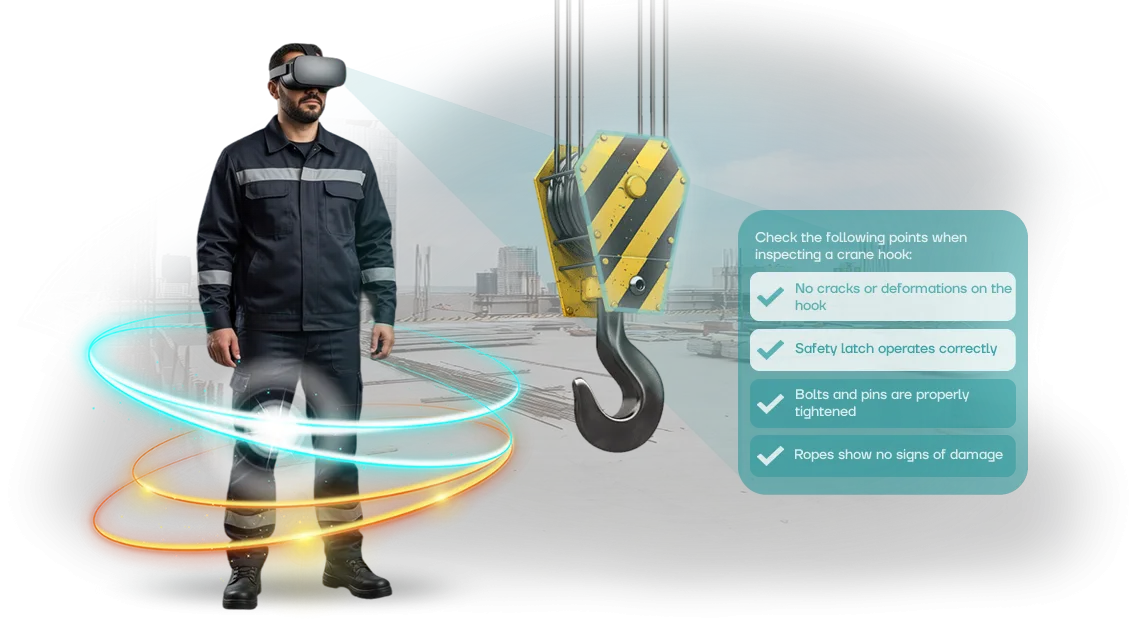
- VR content — a set of scenarios reflecting typical shipbuilding production risks: work in confined spaces, work at height, emergency evacuation, and operations with lifting mechanisms.
- Professional VR equipment — headsets and controllers tested for compatibility with our software and ensuring stable operation in a training room environment.
- Methodological materials — instructor guidelines for conducting sessions, an analysis of common mistakes, and employee knowledge assessment scenarios.
- Documentation for the occupational safety department — implementation schemes, training program templates, and training completion logs.
- Staff training — instruction for your employees who will administer the simulator and support sessions.
- Support and updates — technical support, content updates, and scenario refinement as safety regulations change.
Thus, the entire training process — from preparing the workplace to reporting on each employee — is handled by a single supplier. The client does not need to buy equipment, write manuals, or look for developers themselves: everything is already included. This saves time on approvals and allows you to quickly reach planned training targets.
Case Study: How VR Reduced Injuries in Shipbuilding
At shipyards, injuries occur when working in confined spaces, at height, and when moving heavy structures.
Ordinary briefings do not create the habit of acting safely under pressure — the employee encounters an emergency situation for the first time in reality, when the cost of a mistake is too high. Virtual training allows these situations to be experienced without risk to life and health.
Result Numbers
For one shipyard, we developed a series of VR simulators in four areas: work at height, load rigging, moving around the workshop, and actions during a fuel spill. Over three months of the pilot project, 120 employees completed the training.
Minor injuries in the area dropped by 40%, and the time to prepare a new worker decreased from 4 hours to 2 — the instructor no longer spends time repeating the rules; everything happens within the scenario.
Client's Words
"Employees stopped treating safety as a formality. Mistakes are now made on the simulator, not at the shipyard — that was the main thing we wanted to achieve," comments the head of the client's occupational safety department.
After the pilot, the program was expanded to all production workshops, and that was the client's own initiative, not our proposal.
It is also telling that six months later, the client ordered an additional module for training line managers. For us, this is the best indicator that VR training works in shipbuilding and delivers measurable results.
Frequently Asked Questions About Implementing VR Simulators for Occupational Safety
Implementing VR simulators into an occupational safety system at a shipbuilding enterprise raises similar questions among many managers: how quickly will it pay off, how difficult is it to integrate training into current processes, and will the entire training program need to be changed. Below are answers to the most common concerns that clients face before launch.
What specific skills do workers practice in VR simulators?
The scenarios model real emergency situations: fire in a compartment, spill of hazardous substances, work at height, and evacuation from a confined space. The employee acts as they would in real life: making decisions, using protective equipment, and pressing emergency buttons. This allows correct actions to become automatic without putting people at risk.
How long does implementation take, and will production have to be stopped?
VR simulators are integrated into the existing training schedule — instead of lectures and posters. Preparation takes a few days: we agree on scenarios, adapt them to your production, and conduct instruction for trainers.
The production process does not stop, and training takes place at the regular workplace or in a training room.
Will we need to buy expensive equipment and build a special facility?
It is enough to set aside a space of 2×2 meters with free room and a laptop with a mid-range graphics card — we provide the rest of the equipment. If needed, we bring a ready-made kit and set it up within a day.
You do not invest in expensive infrastructure; you pay for the result: trained employees and reduced injuries.
How can we verify that employees actually understood the material?
The system keeps a log of each session: it records reaction time, errors, the number of correct actions, and the final score. The manager sees an objective picture for each employee — who is ready to work and who needs to repeat the scenario. This replaces subjective exams and provides documented confirmation of completed training.
Who will maintain the simulators and update the scenarios?
We handle technical support and regular updates ourselves. When regulations change or new types of work appear, we adapt the scenarios to your tasks. You do not need to hire specialists — we support the project at all stages, from launch to daily operation.
If you have any remaining questions, ask your personal consultant — they will help calculate the impact for your production and select scenarios for the specific risks of your shipbuilding enterprise.How to Choose VR Simulators for Shipbuilding?
Choosing a VR simulator for shipbuilding should start not with equipment but with objectives: what should change in the occupational safety system at your shipyard.
Whether it is reducing injuries during welding operations, practicing actions in case of smoke, or teaching personnel to work safely in confined spaces — the scenario depends on this goal, not the other way around.
Consider the specifics of shipbuilding production: large hulls, real noise, restricted movement in holds, and the need for protective clothing.
The simulator must reproduce exactly your environment — then the worker will transfer the skill to the workshop without a "greenhouse training effect." Ask the contractor whether the scenarios are adapted to dock and slipway conditions rather than an abstract office.
Evaluate the practicality of implementation: how many people need to be trained, how often do regulations change, and can the solution be moved between areas.
For shipbuilding, a format is convenient that can be launched during a shift without stopping production and does not require taking a team away for a long course. The easier it is to fit training into the work schedule, the faster you will see results.
Choose a partner who does not just sell scenarios but supports them according to your regulations: updates content, trains instructors, and helps integrate VR training into your existing occupational safety system.
A team with shipbuilding experience does this more precisely — they speak your workshop's language, not only the language of technology.
Do not try to cover everything at once: start with one or two critical scenarios, such as emergency response in a hold or safe crane operation. Run a pilot with a few teams, measure the dynamics of errors and the number of minor injuries, and then scale to other areas. This approach gives you a choice based on performance numbers, not on promises in a presentation.
Calculate the Cost of a VR Simulator for Your Enterprise
The cost of a VR simulator depends on the number of scenarios, the number of workstations, and the complexity of modeling your production processes.
This is especially important for shipbuilding enterprises: each workshop, slipway, and area has its own specific risks, so a universal solution is not always effective.
To give you an accurate figure rather than a "market average," we conduct a short analysis of your tasks. Then we prepare a calculation and show what makes up the price. Below is what you will receive after contacting us.
- Cost calculation for your training scenarios: number of modules, types of simulators, and number of users.
- Expert consultation: we will help identify priority areas for VR training — from work at height to fire response.
- Demo access to ready-made VR simulators: you will see what the training looks like and can assess its realism.
- Implementation recommendations: how to integrate simulators into your existing occupational safety and certification system.
- A commercial proposal with a fixed price and launch timeline.
- Post-purchase support: scenario updates, technical support, and refinement to meet new regulations.
Leave a request through the form on the website or call us — it will take a couple of minutes. We will only ask for the necessary data: workshop area, number of employees, and current instructions. We usually respond within one business day and send the calculation within two.
Provide your preferred contact method — and we will prepare a personal proposal for your shipbuilding enterprise.