

VR Simulators for Occupational Safety: Why the Armed Forces Can't Do Without Them
Standard occupational safety briefings have long ceased to be sufficient — especially where a mistake can cost health, time, and reputation.
In the armed forces, the price of a miscalculation is many times higher: personnel must act precisely in conditions close to combat, not just know the rules on paper. This is precisely where traditional training formats show their main weakness.
Lectures, posters, and tests check memory, not readiness for a real emergency. An employee may answer questions brilliantly, but in a stressful situation lose their composure, miss a critical signal, or perform an action in the wrong sequence. For the armed forces, this is not just a risk — it is a threat to lives and mission accomplishment.
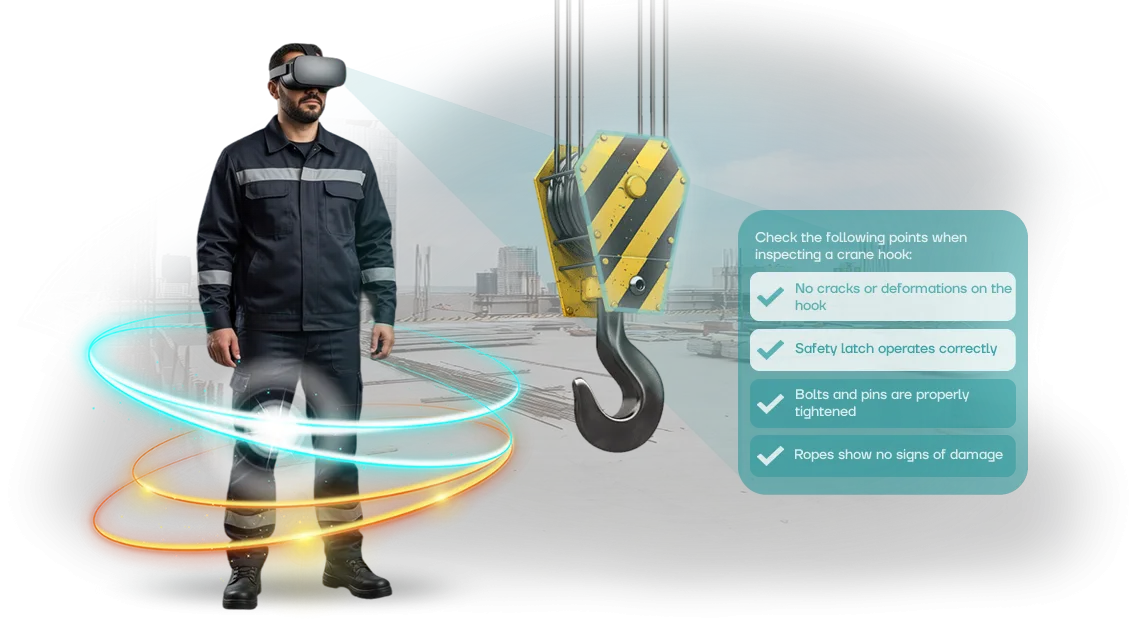
A virtual simulator bridges that gap. It immerses the trainee in a realistic scenario where decisions must be made here and now: from containing a fire to evacuating during a hazardous substance leak.
Mistakes do not lead to real consequences, but they provide invaluable experience that cannot be gained in an ordinary class. VR training for the armed forces is a way to bring actions to automaticity without exposing personnel and equipment to risk.
This kind of practice builds lasting skills faster than any classic briefing. The trainee goes through the scenario as many times as needed to act confidently and calmly.
For a commander, this means a predictable level of preparedness for each service member and peace of mind about safety at the facility. We help implement exactly this approach — without a long warm-up and with measurable results.
What Does VR Safety Training Give Military Specialists?
Military service inherently involves risk, and safety training in real conditions often requires the involvement of people, equipment, and hazardous environments. Traditional briefings and posters provide a foundation, but they do not develop durable skills.
VR simulators allow military specialists to practice actions in an environment as close to real as possible, without any threat to life or health.
The team at our team has been developing occupational safety VR simulators for more than 10 years. Our experience shows that this training format delivers measurable efficiency gains. Here are the key benefits for units and training centers.
- High personnel engagement. In a VR environment, each trainee acts personally rather than watching an instructor. This engages active attention and responsibility for the outcome, which is impossible with passive slide viewing.
- Memorization at the level of muscle memory. Actions performed in a virtual environment are remembered 3–4 times better than textual material. Even months after training, a service member will respond correctly to an emergency situation.
- Practice without risk. Emergency scenarios — explosion, leak, fire, equipment failure — can be played out an unlimited number of times. A mistake in the simulator does not lead to injury or equipment damage, but becomes experience for analysis.
- Measurable results for each specialist. The system records reaction time, correctness of the algorithm, and mistakes made. The supervisor receives an objective assessment of a service member's readiness, not a subjective "pass/fail."
- Compliance with occupational safety standards. The simulators are built on current regulations, so training is guaranteed to meet the requirements of departmental instructions — this reduces risks for the unit and satisfies inspections.
Implementing VR training takes little time: all you need is a dedicated training room. Simulators are already integrated into the training of specialists in various branches of the military and show consistent growth in training quality.
You get not just a course, but a tool for controlling and developing skills that easily scales to any number of trainees.
VR Simulator Formats for Armed Forces Tasks
Combat training and occupational safety in the armed forces have their own specifics: training takes place in barracks, at firing ranges, and during relocation.
Stationary classrooms are not always convenient in such conditions, and "paper" briefings do not provide the necessary engagement. Therefore, we offer three VR simulator formats — tailored to a specific task and training location.
Below is a comparison of formats to help you choose the optimal option.
| Training Format | Best suited for | What it gives the customer |
|---|---|---|
| Stationary VR class | Units with a permanent training base | Skill practice without risk to equipment and people, quick start of scheduled sessions |
| Mobile complex | Field exercises, off-site training, multiple units | Same functionality as a stationary class, but in a transport configuration — training where the personnel are located |
| Distance learning | Remote units, gatherings, reserve | Access to simulators from any device, a unified training standard, option to repeat sessions |
Thanks to mobile VR, we can deploy a full-fledged training classroom at a firing range in a short time — personnel go through scenarios on site, without leaving their deployment location. The remote format connects those who cannot physically attend the session.
At the same time, all scenarios — from fire response to weapons handling — remain identical for every format, so training quality does not depend on where the training takes place.
We don't just supply equipment; we assemble a solution for your infrastructure: we help you choose a format, adapt scenarios to regulations, and combine options if necessary.
One customer can receive a stationary classroom, a mobile kit, and access to a remote platform — closing all training scenarios without unnecessary costs.
How the Development of an Occupational Safety VR Simulator Works
We start with a brief introduction to how the process is structured — why it is simple and predictable for the client. Then there are 7 stages, each with a benefit for the customer.
How the Development of an Occupational Safety VR Simulator Works
Developing a VR simulator is not like pressing a "magic button" — it is a transparent process with clear stages and checkpoints.
We don't disappear into development for months without getting back to you: every step is coordinated, and the result is a simulator that integrates into your training system and delivers results immediately.
The key principle — you manage the process, and we are responsible for implementation. No improvisation: from the brief to launch, you know what is happening and influence every stage. Here is what it looks like in practice.
-
Brief and task definition. You tell us which specialists need training, what risks they face, and what outcome matters to your unit.
We ask clarifying questions and study regulations and standards — so that the simulator solves your problem rather than being "just a virtual scene."
-
Risk and target situation analysis. Together we define the list of hazardous factors and critical scenarios — from fire response to equipment operation and evacuation. At this stage, the educational value is established: which errors should be eliminated in real work.
-
Training scenario development. We write a step-by-step scenario: what the employee sees in the virtual environment, what actions they must perform, and how the simulator reacts to mistakes. You receive a document for review — no surprises at the final stage.
-
Scenario review and approval. You make edits, add details, and approve the final version. This stage prevents the situation where "we wanted one thing and got another." All requirements are recorded in the technical specification — this is the basis for further work.
-
Simulator implementation. Our specialists build the virtual space, configure interactivity, and set up the action assessment system. We work with professional equipment and proven tools — so you get a stable picture and fast response without technical glitches.
-
Testing and quality control. We test all scenarios "to the limit": correctness of reactions, clarity of instructions, resistance to user errors. We conduct test sessions and refine details before the simulator reaches your employees.
-
Launch and support. We install the simulator, train your specialists to work with it, and hand over instructions and regulations. We stay in contact after launch: answer questions, monitor stability, and refine functionality as needed.
This procedure helps you predictably meet deadlines and budget — because each stage has clear readiness criteria. Your employees get a simulator that truly prepares them for real incidents, and you get a tool with clear logic and measurable results.
What Is Included in the Delivery of the Personnel Safety Simulator
Ordering a VR simulator, you receive not a "raw" program, but a ready-made solution that can be used immediately after installation.
We assemble the kit so that your specialists do not have to figure out technical details — everything is already configured, tested, and documented.
The standard delivery includes:
- Ready-made VR program — a configured simulator based on your scenarios: emergency actions, hazardous factors, evacuation.
- Methodological materials — lesson plan, scenario, assessment criteria, and analysis of typical mistakes.
- User instructions — guides for service members and personnel: how to prepare for the lesson and work with the equipment.
- Control panel — session launch, progress tracking, report for each trainee.
- Installation and setup package — specialist visit or remote setup, integration with your classroom.
- Training for your employees — instruction for instructors and technical specialists so they can work with the system independently.
- Support throughout the entire term — updates, consultations, scenario improvements, assistance with failures.
Such a kit covers all implementation stages — from delivery to daily use. You don't need to figure anything out or look for outside contractors.
We document the delivery scope in the contract and hand it over with an acceptance certificate. If questions arise after implementation, you can always contact our support and receive a solution within one business day.
Case Study: Implementing VR Training in a Ministry of Defense Unit
A Ministry of Defense unit had a task: to teach personnel to act flawlessly in emergency situations without taking people away from duty for long courses. Traditional briefings provided theory but not experience — mistakes recurred in real work.
The command sought a format that would reduce occupational safety violations and improve unit safety.
We proposed implementing VR training and, together with military specialists, analyzed key scenarios: equipment operation, emergency response, and evacuation procedures.
our team created a training environment in which each service member repeatedly practiced dangerous situations without risk to life or equipment. VR allowed them to see the consequences of an error and immediately correct it, reinforcing the correct skill.
As a result, personnel gained practical experience that was missing in ordinary training classrooms.
Training results
Both the command and the service members themselves appreciated the effect. Within two months, the number of errors during procedure compliance dropped by 40%.
Soldiers memorized action sequences faster, emergencies occurred less often, and the level of training became more stable. Training hours were used more efficiently: real skills were practiced without interruption to service.
The unit leadership highly praised the program and decided to scale it to other units. For us, this confirms that VR simulators work not in a laboratory, but in real army practice.
Implementing VR took less time than the standard training cycle and paid off through reduced risks for personnel.
How to Choose the Right VR Simulator Format for Your Task?
Choosing a VR simulator format starts not with technology, but with a question: what skill needs to be practiced and under what conditions will it be used.
For the armed forces, this is especially important — the cost of an error in a real environment is incomparable to training expenses. Therefore, we first determine the list of critical actions that personnel must perform without delays or hesitation.
If the task is to practice individual action algorithms during an accident, fire, or hazardous substance leak, a compact scenario simulator is sufficient.
It allows a trainee to go through the same situation repeatedly, bringing the reaction to automaticity, and the instructor to see at which stage a stumbling block occurs.
If the task is unit coordination, synchronization of several soldiers or operators during emergency response — a multiplayer format with a shared scenario is required.
The second benchmark is training requirements: regulations, standards, time windows. A VR simulator pays for itself when it replaces expensive exercises involving equipment and consumables, or provides training in conditions that cannot be reproduced in the field.
Calculate how many real drills are needed to develop a skill to the required level and compare this with the number of virtual sessions — the difference in time and costs will speak for itself.
And the third point — scalability. If hundreds of people need to be trained annually, choose a solution that can be deployed across multiple workstations without losing scenario quality.
We help you choose a format based on your actual task, not by offering the most expensive equipment.
During a consultation, we record your training requirements, look at which skills are critical, and propose an option that solves the task without overpayment — with a guarantee of results and technical support at all stages.
Frequently Asked Questions About Occupational Safety VR Simulators
Questions and answers are the best way to remove doubts before launch. Our team have accumulated experience implementing VR simulators in various organizations, including the armed forces, and we know what customers ask most often.
We answer briefly and to the point: how implementation goes, what guarantees we provide, whether virtual reality training is safe, and why the simulators do not become a burden on the budget.
Is it difficult to implement VR simulators into an existing training system?
No, we take charge of the launch: we help adapt the program, train instructors, and deliver a ready-made "turnkey" solution. A typical project takes from two weeks — the first sessions already take place within the first month.
Do the simulators meet occupational safety regulation requirements?
Yes. We design scenarios based on current norms and industry instructions, and if necessary, adapt them to your internal documents. You receive training protocols that can be easily demonstrated during inspections.
How much does simulator ownership cost and what affects the price?
The cost consists of scenario creation, equipment, and support. We provide a transparent estimate with no hidden payments, and repeat sessions do not require consumables — this reduces the training budget in the long run.
Is VR training safe for military personnel?
Absolutely. We use proven headsets and monitor the load to prevent fatigue and disorientation. Every session can be stopped at any moment, and the instructor sees the trainee's condition.
Order a Turnkey VR Simulator Today
Submit a request for the development of an occupational safety VR simulator — and within one business day you will receive a consultation, a preliminary cost and timeline estimate.
You don't need to understand the technology: we handle all technical matters, and you get a working turnkey simulator adapted to your unit's tasks.
We have been creating simulators for the armed forces and organizations with high safety requirements for many years. We know the norms and regulations, so your scenario will immediately comply with industry standards and internal instructions. All work is carried out remotely, which is convenient for customers from any region.
After your inquiry, the process is completely transparent: you always know who is working with you and what stage the project is at. A personal manager will contact you within an hour, clarify your tasks, and transfer the project to the project team.
What you get immediately after your request:
- cost and timeline estimate — returned within 1 business day;
- a prototype of the training scenario that you can approve before development begins;
- an implementation plan: how the simulator will fit into your training program and class schedule;
- a list of recommended equipment and room requirements — no hidden surprises;
- a personal manager who supports the project from task definition to launch;
- training for your instructors and methodological materials;
- a warranty on the simulator and technical support during the first year of operation.
No impersonal inquiries and endless approvals. Just write to us — and by tomorrow you will know the exact cost and work plan. We work with both one-off orders and long-term training programs.
Ordering development is easy: submit your request right now — it is non-binding and will help you make a decision.