

Health & Safety: How to Reduce Workplace Injuries
Every workplace incident is not just a line in a report — it's missed deadlines, fines, lost employees, and a blow to the company's reputation.
Yet most injuries happen not because instructions are missing, but because the employee is not prepared to act in an unexpected situation. Safety briefings are conducted formally, theory is quickly forgotten, and learning from real mistakes is too expensive.
Traditional occupational safety training does not let a person experience a dangerous moment. Instructions and posters describe the rules but do not build the habit of acting correctly under pressure.
In a stressful situation, an employee acts on autopilot — and if that automatic response is not trained, the consequences can be fatal.
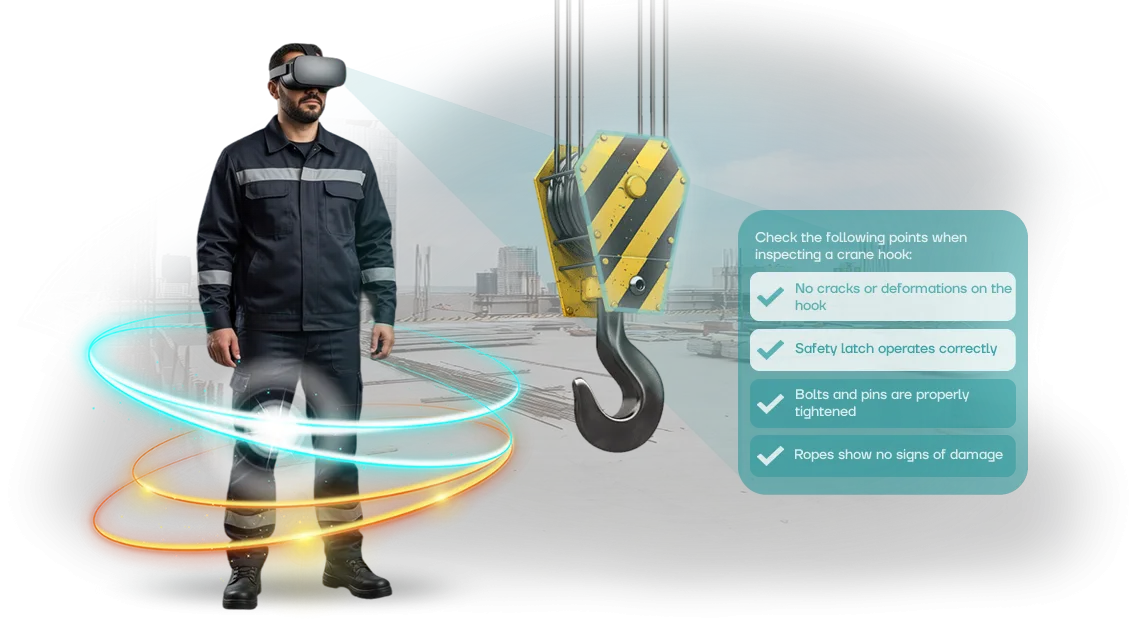
VR simulators change the approach to workplace safety. The employee enters a realistic environment where they can practice responding to an accident, a fire, working at height, or an evacuation — with zero risk to health.
This kind of training engages muscle memory and emotional involvement, so in a real situation the person reacts faster and more accurately. In essence, you give people experience that previously could only be gained through serious incidents.
We help companies reduce injuries with VR training bundles adapted to their specific production environment: your scenarios, your risks, your procedures. Our engineers use professional equipment and methodologies that have already proven effective at dozens of enterprises.
You get not "entertainment" but a working tool that protects employees' health and reduces occupational safety and insurance costs.
What a VR Simulator Delivers: Employee Response and Safety Growth
Engagement Instead of Formality
Employees go through safety briefings "just for the record" and forget the rules a week later. A VR simulator immerses the person in a real work situation — they act, not listen.
The SafeVR bundle includes scenarios for various industries, so training is engaging and remembered for a long time.
Fewer Injuries and Mistakes
Practicing dangerous scenarios in a safe environment builds correct responses. An employee who has "lived through" an accident in virtual reality acts faster and without panic in reality. The business sees fewer injuries, less downtime, and lower insurance payouts.
Measurable Effectiveness
The VR system records each employee's errors and reaction time. The manager sees the team's actual skill level and knows who needs additional training.
Formats for Your Tasks
We will match a scenario to your specific goal:
| Format | For whom | What it gives the business |
|---|---|---|
| Introductory briefing | New employees | Fast onboarding without risk |
| Knowledge check | All staff | Objective assessment of preparedness |
| Emergency training | High-risk areas | Readiness for emergency situations |
VR Training Bundle: Formats and Configurations for Your Task
VR occupational safety training is not a single product but a set of formats for different tasks — from initial briefing to actions in an emergency.
We put together a bundle for your industry, headcount, and regulatory requirements — you get exactly the scenarios that deliver measurable results, not "training for the sake of it."
The basic bundle includes scenarios covering the main risks: working at height, electrical installations, and loading/unloading operations. For higher-risk facilities we add evacuation, fire response, and emergency response procedures.
The scenarios are combined into a portal where the manager can see each employee's progress and ready-made reports for certification.
How to Choose a Bundle for Your Task
| VR Training Format | For whom | What it gives the client |
|---|---|---|
| Basic bundle of 3-5 scenarios | Companies implementing VR for the first time | Quick start without unnecessary costs, staff familiarization with the format |
| Industry-specific bundle for key risks | Facilities with hazardous areas | Reduced injuries in specific operations, confident passing of inspections |
| Full VR training portal | Large enterprises and multi-site networks | Training control for all staff from a single window, ready-made reports for management |
We help you choose the configuration before launch: we analyze risks and recommend which scenarios will deliver the maximum effect. New simulators can be added after implementation — the bundle grows along with your needs.
How to Create a VR Simulator: 7 Steps from Brief to Launch
We have broken the process into seven clear stages — from the first meeting to training your employees. You always know what stage the project is at and what comes next.
- Brief and analysis. We gather information about your procedures, typical errors, and hazard zones. We determine which actions need to be practiced first.
- Scenario and methodology. We turn your instructions into interactive tasks. We specify how the employee should act in each emergency situation.
- Mockup and approval. We show what the simulator will look like and how the logic works. You make corrections before the main development begins.
- Graphics and assembly. We create a realistic workshop environment, tools, and animations. We work on professional HTC Vive equipment so the image is clear and does not cause discomfort.
- Testing and debugging. We test the simulator on real users — your employees or trainees. We fix errors and adapt the difficulty.
- Launch and training. We install the system, configure the equipment, and conduct a briefing for your team.
- Support and development. We maintain the simulator and update scenarios when procedures change or new risks appear.
The full cycle typically takes 6-10 weeks depending on the number of scenarios. The exact timeline and cost are fixed in the contract after the brief — you will not encounter unexpected costs.
What's Included in the VR Training Delivery Package
A complete VR occupational safety training package is not just a program but a ready-to-run system that can be launched in a company immediately after implementation.
We deliver not a "raw" product but a packaged solution: equipment, scenarios, instructor documentation, and technical support. Here is what exactly you get in the package.
- VR occupational safety training scenarios — practicing responses to accidents, working at height, working with electrical installations, and other hazardous situations. The scenarios simulate a realistic environment so the employee remembers the correct procedure at the reflex level.
- VR equipment with replacement stock — headsets and controllers calibrated to your tasks. We match the devices to your employee count and training format — from a single workstation to a corporate classroom.
- Methodology materials for the instructor — launch guide, knowledge checklists, evaluation forms, and recommendations on integrating VR sessions into your existing training schedule. The instructor does not need to understand the technology — everything is spelled out step by step.
- Software licenses and updates — official rights to use the VR simulators and to receive new versions of scenarios. No "gray" keys: you work legally and without risk of blocks.
- Training for your specialists — we train the staff who will run VR sessions: how to organize a session, track results, and change settings if needed. We pass on practical knowledge, not a presentation.
- Technical support and maintenance — for the duration of the contract we support the package: we update the software, help with failures, and quickly replace equipment when needed. Training will not stop because of a technical issue.
- Adaptation to your procedures — if your company has internal instructions that must be reflected, we supplement the scenarios before delivery. You get a simulator that matches your exact requirements.
All components of the package are agreed in a single document — you know the composition, timeline, and terms in advance. After delivery we do not just leave the equipment; we stay in touch to ensure the first launch goes smoothly. If you need to expand the package, we add workstations or new scenarios within the same approach.
Case Study: How a VR Simulator Cut Factory Injuries by 40%
When the number of accidents grew at the PromStanko factory, management realized that traditional briefings no longer worked. Employees listened to lectures formally and forgot safety rules a month later.
Every incident led to production line shutdowns, investigations, and payouts — hitting deadlines and reputation.
We proposed a different approach: instead of slides and posters — full immersion in dangerous situations through a VR simulator. Workers practiced responding to fires, working with equipment, and emergency scenarios in a safe virtual environment.
The body remembers the muscle response and the correct procedure, so in real life the decision is made automatically.
Results after Six Months
The key metric — a 40% reduction in injuries over six months. The number of safety violations dropped threefold, and employee reaction time to emergency situations improved noticeably.
The factory reduced downtime and compensation costs significantly — the exact savings are calculated after an audit.
The factory's occupational safety director assessed the results this way: "VR training proved more effective than all previous training formats.
We expected improvements, but we got not just fewer injuries but a change in the safety culture on the shop floor." After the pilot project, PromStanko included the VR simulator in the mandatory program for all new employees.
This case confirms: a well-designed VR simulator pays for itself in the first months and keeps working for years. Our engineers adapt scenarios to the specific production environment and safety procedures, so results are achieved faster than with standard approaches. You get not just training but a risk-reduction tool with a measurable economic impact.
How to Choose the Optimal VR Training Format for Your Industry?
Choosing a VR training format starts not with technology but with the needs of your production. It is one thing to familiarize all employees with general rules, and another to practice response to an accident or working at height.
For the former, short interactive modules are enough; for the latter — fully immersive scenarios with action assessment.
To avoid overpaying and overcomplicating the process, we answer several questions together with you: what risks are most common at your sites, how many people need to be trained per year, and what results you want — knowledge checks, skill development, or fewer incidents. The answers to these questions determine the optimal format.
It is also important to consider industry requirements: every sector has its own safety standards and training procedures.
Our engineers understand the specifics of different types of production and integrate VR scenarios into your existing training system so that it satisfies regulatory requirements while remaining convenient for employees.
We do not offer a "box" with a single solution. We analyze your situation, select the format, and at the start produce a pilot module that you test on a small group. If it works — we scale it.
This way you get a training package that precisely matches your industry and goals, without wasting money on experiments.
FAQ about Implementing VR Occupational Safety Simulators
We address the main concerns managers bring to us: from budget to how VR fits into existing processes. We answer the questions most often asked at the decision-making stage.
How much does a VR occupational safety training package cost?
The cost depends on the number of scenarios and their complexity. The price of a turnkey bundle of 4-6 simulators is calculated after an audit; this includes development, methodology materials, support, and updates.
For comparison: a single workplace accident with payouts and production downtime costs many times more.
How difficult is it to integrate VR simulators into current processes?
Implementation takes 2-3 weeks: we set up the equipment, load the scenarios into your learning management system, or launch a separate training room. Employees complete a short briefing in a few minutes, and then everything works automatically. Our team supports the launch and stays in touch.
How do employees adapt to VR training? Is there resistance?
Experience shows that even those who see a VR headset for the first time get comfortable within 5-10 minutes. The game-like format removes the barrier — people perceive the training as skill practice rather than a boring test. To boost engagement, we include points, leaderboards, and team scenarios.
Can VR simulators be integrated with an existing training system?
Yes. We export results to your system: who completed the training, what mistakes were made, how many attempts were needed. The manager sees statistics for each employee and department and can generate a report for regulatory authorities when required.
What about warranty and support after launch?
After launch, a warranty applies: we fix errors, update scenarios for new regulations, and add refinements. The average response time to a request is one business day. You are never left alone with just the equipment and a manual.
Order Your VR Simulator — What You Get in Just 30 Days
In 30 days you will have not "a set of equipment" but a working training system built into daily safety briefings.
Employees will practice emergency scenarios in a safe virtual environment, internalize procedures, and get used to acting correctly — without risk to life or health.
We start with a brief and an analysis of your specifics: workshop, offices, construction site, or warehouse. Our engineers will prepare a scenario for your procedures, run a test launch with a group of employees, and hand over the finished package.
All edits are approved at every stage, so the outcome is predictable and the price is fixed in the contract.
What you get in 30 days:
- A bundle of 2-4 VR simulators covering your typical hazardous situations — from working at height to fire response.
- A ready-made training program: the employee puts on the headset, completes the scenario, and receives an assessment of their actions.
- Configuration to your internal standards and occupational safety instructions — training not "in general" but about your actual processes.
- A report for each employee: where the mistakes were, what to review, who has mastered the material — control results, not attendance.
- An instruction manual for your occupational safety specialist and a short training video for self-launch.
- Support for the first two weeks of operation and a warranty on equipment and software.
The timeline guarantee is written into the contract: if we are late delivering the package, we refund the prepayment. And if you have questions after implementation, we stay in touch for a month and fine-tune scenarios free of charge.
Order your VR simulator today — we will reserve the next available slot in the development schedule. Leave a request, and within one business day we will send you examples of our scenarios and a cost estimate for your tasks.