

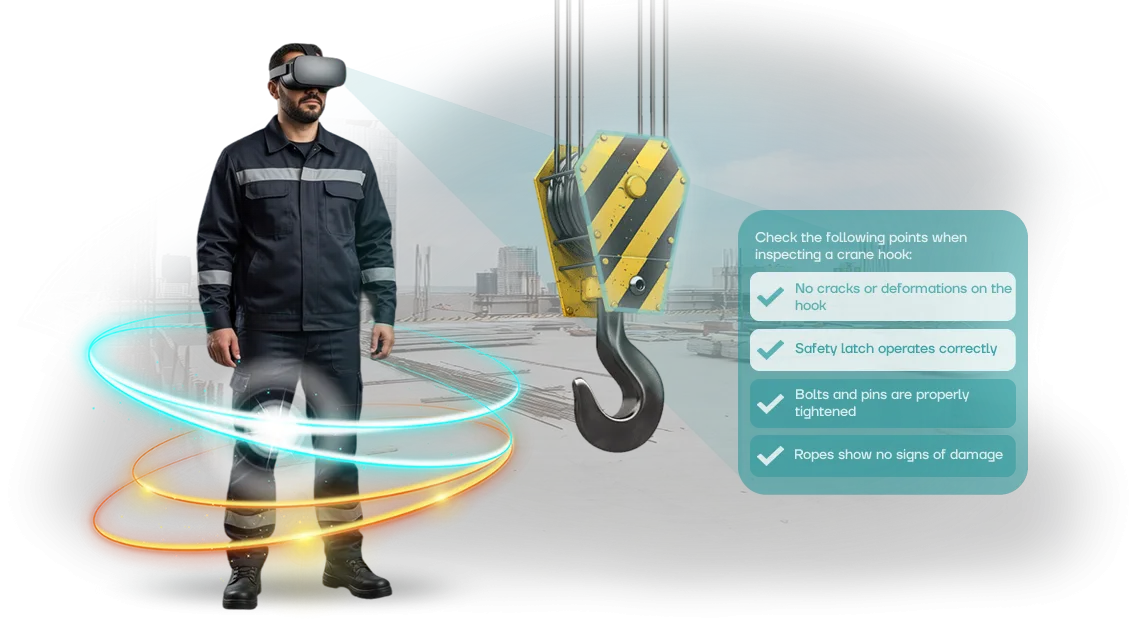
Workplace Safety VR: How to Reduce Injuries and Fines
Injuries in the workplace cost businesses dearly: they mean human losses, fines, downtime, and growing insurance premiums. Every accident forces a review of processes, triggers unscheduled inspections, and distracts management from growth.
At the same time, classic safety briefings often remain a formality—an employee signs the logbook but never practices real actions in an emergency.
This is why companies are switching to VR training for occupational safety: it makes it possible to safely model dangerous scenarios and train correct reactions without risking lives.
In a virtual environment, the worker sees the consequences of an error, memorizes the sequence of actions, and develops automatic responses.
This kind of injury prevention delivers measurable results—fewer incidents and confidence that every employee is truly prepared for an emergency.
Workplace Safety VR is not a replacement for safety briefings, but an enhancement: employees gain hands-on experience that a lecture cannot provide. Immersion in a realistic environment activates muscle memory and emotional engagement—knowledge sticks more effectively.
For the company, this means lower compensation costs, fewer inspections, and a higher overall safety level on the shop floor.
We design and implement VR simulators for the specific needs of each enterprise: from risk assessment to a ready-made training scenario. Our engineers handle the entire development process—from idea to launch—and we support the project after implementation.
As a result, you get a working injury-prevention tool that pays for itself through fewer fines and healthier employees.
What Implementing VR Simulators for Occupational Safety Delivers
Standard occupational safety briefings often become a formality: an employee listens to a lecture and forgets it within a week. The result is repeated mistakes, injuries, regulatory orders, and fines.
VR simulators change the approach: instead of theory, workers are immersed in a dangerous situation without real risk. According to a PwC study, VR training accelerates material comprehension by 4 times and improves retention by 30–40%.
This is not just "another training format"—it is a tool that directly reduces business costs. Let's look at the main benefits.
Reducing Injuries
An employee is placed in near-real conditions and learns to act in critical situations: fire, falling loads, gas leaks. They can make hundreds of mistakes on the simulator—but not on the production floor. As a result, accidents decline, and personnel gain lasting safe-behavior skills.
Saving on Fines and Downtime
Every workplace accident is not only pain and health damage, but also fines, halted production lines, and lost working time. VR simulators help prevent these risks.
Companies save on compensation, legal fees, and downtime—total savings can be significant, with the exact figure calculated after an audit.
Company Reputation
A responsible approach to employees and care for their safety strengthen the employer's image. This attracts skilled specialists, increases team loyalty, and builds customer trust. A company that invests in modern training methods is perceived as a reliable partner.
Engagement Instead of Formality
People absorb knowledge better through action and emotion than through lectures. VR training holds attention and builds the right habits. This reduces staff turnover and makes the safety briefing genuinely valuable for the employee.
VR Training Formats for Your Task
VR training is not a single format, but a set of scenarios for different tasks. Some companies only need a short introductory course for new employees; others require a full program with emergency response practice and result tracking.
We tailor the scope and complexity to your process so that training fits into your work schedule and delivers measurable outcomes.
Unlike classic lectures and video materials, VR simulators immerse the employee in a situation and force them to make decisions. This increases engagement and retention: knowledge is reinforced through practice, not through reading instructions. This approach reduces the risk of injuries and mistakes in real work.
| Format | For Whom | What It Gives the Client |
|---|---|---|
| Short VR course for new employees | Initial safety briefing | Quick introduction to the rules, full coverage without stopping production |
| Emergency response simulator | Duty teams, maintenance personnel | Practicing response skills without risk to life |
| Custom scenario for your facility | Sites with unique risks | Training on a realistic model of your workshop |
| Series of modules for regular training | All personnel | Knowledge retention, scenario updates |
| Full support and development | Companies with high safety requirements | Turnkey development, technical support, updates |
Formats can be combined: for example, a short course for initial onboarding and a custom simulator for key employees. We will help you build a training system tailored to your specifics—from the first scenario to full ongoing support.
How Implementation Works: From Brief to Support
We have structured the process so you always understand what is happening at every step and what results you get. The stages of VR implementation are documented in a plan, project approval follows that plan, and you can see the status at any time. We work in stages: from brief to VR training support.
Work Stages
-
Brief and immersion. We discuss your goals: where violations occur most often, who needs training, and which regulations matter. We define requirements, prepare a cost estimate and timeline, and provide a preliminary plan.
-
Project approval. We present the simulator scenario, the list of situations, and the evaluation criteria. You make edits before development begins—this eliminates unnecessary costs for rework.
-
VR simulator development. We create interactive scenarios, a realistic environment, and an action evaluation system. Employees train in safe conditions, and you see objective results of their performance.
-
Testing and refinement. We give your employees a trial version. We collect feedback and adjust the difficulty and content to match your processes.
-
Launch and staff training. We help prepare the space and equipment and conduct a briefing for responsible staff. Employees start working with the simulator from day one.
-
VR training support. We stay in touch: update scenarios, add new situations, and resolve technical issues. You are never left alone with the product.
What's Included in Delivery: Complete Package for Launch
Here is everything you get in the package—everything needed to launch training without hunting for contractors piece by piece.
We handle not only scenario development, but also full preparation for work: equipment, a management system, and even materials for your instructor. You receive a turnkey solution, not a set of disconnected files.
The delivery package includes:
- VR scenarios tailored to your tasks. Modules for different professions and risks: work at height, electrical installations, loading equipment, chemical production. Scenarios mirror your procedures and typical violations.
- Equipment and workstation. We select headsets for your budget and tasks: from a single station to an entire classroom. Everything is set up, connected, and ready to use—you don't need to understand the hardware.
- Learning management system. Track employee progress, attempt results, and mistakes. Connect your corporate system or use ours—without modifications or extra costs.
- Instructional materials for briefings. Checklists, a lesson plan, and an error analysis guide for the instructor: how to run a VR session and reinforce the results.
- Launch and training for your team. We conduct a briefing for your occupational safety specialists—they launch and supervise sessions independently.
- Updates and support. We refine scenarios to match regulation changes and help with equipment replacement.
All components are connected: scenarios load into the system automatically, and reports gather into a single dashboard. All you have to do is assign employees and start training.
Real Case: How We Reduced Injuries in Manufacturing
A machine-building plant called UralStalProm came to us: at their welding site, 14 injuries were recorded in a year, some requiring lengthy treatment. Managers had tried standard briefings, but workers kept violating safety rules—formal training did not change habits.
Instead of posters and lectures, we proposed immersing employees in VR scenarios that reproduced the real emergency situations of that workshop. The welders, in a virtual copy of the site, encountered the consequences of dangerous actions: flashes, fires, falling loads. A mistake did not cause an injury, but the emotions and memory worked as in a real incident.
The results over the year exceeded expectations. Injuries at the site fell by 37%, and the number of minor injuries was cut in half. Training time dropped from two days to four hours—while workers now score 95% better on safety instruction tests.
The percentage of correct actions during inspections rose by 40, and new hires got up to speed twice as fast.
The economic effect was measurable: the plant reduced sick-leave payments and decreased equipment downtime in the hazardous area.
Six months later, management extended the contract and ordered VR simulators for the welding and assembly workshops—a case where results speak louder than any presentation.
How to Choose the Right VR Safety Format for Your Task
Every client comes to us with the question "which VR simulator do we need?"—the right answer starts with the task, not the format.
For mass familiarization with safety rules, a short 10–15 minute scenario works well: it reaches hundreds of people without stopping production.
If you need to practice a rare emergency where a mistake is costly, we choose an in-depth training with multiple scenarios and detailed debriefing.
The choice of VR training depends on what you measure. An introductory format increases awareness of the rules and reaches more employees. A training simulator builds lasting skills and lets you test reactions in a safe environment.
An exam format records each employee's readiness level and gives HR and the safety department clear results.
In practice, we help choose VR for your task based on three criteria: audience size, error criticality, and scenario repetition frequency. For a large group with low criticality, a single pass is enough.
For employees in hazardous areas, regular full-cycle training is better: briefing, practice, assessment. Such a solution quickly pays off through reduced risks and downtime.
We don't lock you into one format: at the brief stage, we discuss goals, audience, and metrics, and select a scenario that fits your regulations. If the task changes, we expand the program with new modules.
You pay for a solved problem, not for technology—so the format remains a tool, not an end in itself.
Common Doubts: Addressing Concerns Before You Start
Implementing VR training for occupational safety raises questions—and that's normal. Managers worry about how employees will receive the new format, whether the project will be too expensive, and whether technical difficulties will disrupt work. Let's address the main concerns based on dozens of implementations.
Will employees treat the simulator as a game?
The scenarios reproduce real work situations: typical mistakes, emergency alarms, and their consequences. The system records every employee's actions and produces a score that can be used for work authorization. Most people treat it as an exam, not entertainment.
How expensive is it, and when will it pay off?
The cost depends on the number of scenarios and audience size—we find a solution to fit your budget. One prevented accident or major fine often outweighs the investment in a simulator.
Reduced injuries, lower sick-leave expenses, and less downtime pay back the project within the first months.
Is it hard to implement, and will we need to change processes?
We handle preparation, setup, and training of your specialists. The briefing takes one day, the equipment runs on professional hardware, and it doesn't require constant IT involvement. Implementation happens without stopping current processes.
What guarantees do you provide?
Before we start, we set measurable goals: employee coverage, fewer violations, higher scores after inspections. After launch, we support the project, update scenarios, and help with operations. If something goes wrong, we stay close—we don't disappear after handover.
Didn't find your question? Write to us—we'll explain how a VR simulator fits into your occupational safety system and calculate a project tailored to your tasks.Order VR Simulators for Occupational Safety: What You'll Get
Workplace injuries are not only pain and lost days, but also fines, downtime, and reputational damage. VR simulators for occupational safety let employees safely practice dangerous scenarios—from falls from height to fire response. Training becomes visual, memorable, and doesn't require stopping production.
To get such a turnkey solution, start with a VR consultation. Our engineers will assess your situation, propose scenarios for your industry, and calculate the cost of VR training within your budget. After your inquiry, you'll receive:
- a cost and timeline estimate for development within two business days;
- a selection of scenarios tailored to your specifics—from work at height to emergency evacuation;
- demo materials so you can see what the future simulator will look like;
- an implementation plan that accounts for your schedule and occupational safety requirements;
- methodological support and assistance during training launch;
- a guarantee of scenario updates and technical help after project handover.
If you're ready to order a VR simulator for occupational safety, leave a request—our manager will contact you within one business day.
We'll explain how to adapt the solution to your procedures, help you prepare arguments for management, and answer questions about the cost of VR training. The consultation comes with no obligation.