

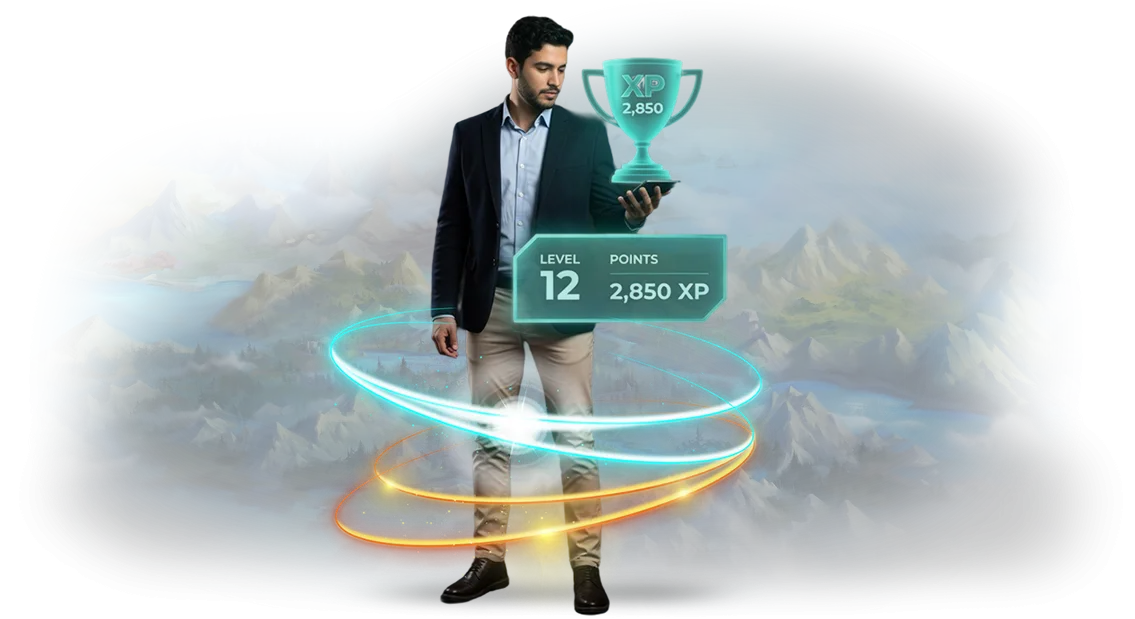
Employees work without engagement — gamification of business processes solves this
Employee engagement declines imperceptibly: first, proactive ideas disappear, then deadlines stretch, and by the end of the quarter tasks are closed "for the sake of a checkmark." Routine processes — approvals, reporting, handling requests — stall, even though people are formally in place and bonuses are paid on schedule.
Staff motivation rests only on money, and money stops working as soon as it becomes a habitual part of the salary.
Gamification of business processes closes this gap differently: an employee sees their progress, compares results with colleagues, and receives recognition for specific actions, not for tenure.
Labor productivity grows not from pressure from above, but from internal competition and clear feedback — a person returns to the task on their own so as not to lose their position in the ranking or to complete a personal challenge.
For a manager, this also means controllability: you see exactly where discipline sags, which stages slow down the process, and who is pulling the team along.
We embed game mechanics directly into work scenarios — so that they reinforce existing regulations rather than live as a separate app that gets abandoned a month later.
We have been building such systems for more than ten years and we know the main thing: a mechanic works only if it relies on real data about an employee's work.
That is why we connect gamification to the company's accounting system — points, levels, and rewards are awarded automatically based on facts, without manually maintained spreadsheets and without "negotiated" results.
What a business gains from gamification at work
Gamification at work is not "we played a bit and that's enough" — it is a management tool. When an employee sees progress, points, levels, and clear rewards for results, routine tasks stop being a gray obligation.
Engagement grows not from one-off campaigns, but from a daily sense of moving forward — and this directly affects how the team feels about its work.
KPI transparency stops being a headache for a manager. Metrics are visible in real time: who is driving the direction, where the dynamics are sagging, which departments work for results and which work for reporting.
Instead of monthly summaries that are outdated by the time they are published, you get a live picture for every employee and department.
Employee loyalty and reduced staff turnover are directly connected. A person leaves not because of salary, but because of the feeling that no one notices their efforts.
Gamification makes the contribution visible: achievements are recorded, the best get recognition, and a newcomer quickly understands the rules of the game and sees a path for growth. This retains people more effectively than one-off bonuses.
Internal communications come alive. Instead of "for your information" mailings, there are team goals, friendly rivalry between departments, and shared challenges. People start discussing work not only at planning meetings — and this changes the atmosphere in the team.
We handle this task turnkey: we analyze your processes, select mechanics for the real goals of the business, and configure the system so that it works for results, not just for a pretty picture.
Gamification formats for your business objectives
The gamification format is chosen not by how elegant the mechanics look, but by the objective you are addressing: tightening up discipline, speeding up training, breathing life into routine processes, or retaining people during peak periods.
Below are the working formats we most often implement, and what each of them delivers to the department head.
| Format | Who it suits | What it delivers to the client |
|---|---|---|
| Competition between teams | Sales departments, warehouses, service teams | Higher work pace and healthy competition, visible dynamics for each unit |
| Personal achievements and levels | Frontline staff, newcomers on probation | Faster ramp-up to target metrics, lower turnover at the start |
| Corporate game with an overarching storyline | Companies with distributed teams | A shared field of meaning, awareness of internal initiatives, engagement beyond direct responsibilities |
| Quests and learning through play | Departments where regulations must be mastered quickly | Material is absorbed in practice, the burden on mentors is reduced |
| Seasonal campaigns and challenges | Retail, logistics, seasonal peaks | Managed growth in activity precisely during the weeks that matter |
What matters at the start
Implementing game mechanics begins with your metrics: what counts as success — request processing speed, the share of plans met, the number of active participants. We select the format and rules to fit these metrics, not the other way around.
A motivation system works when progress is visible to the individual every day, and to the manager in a summary. That is why we build in transparent indicators and clear logic for awarding points from the outset, so the game does not turn into a dispute about fairness.
If you already have accounting systems, gamification integrates into your current processes: the employee fills in nothing extra, and the data for the game is pulled in automatically.
Let's discuss your objective — we will come back with an estimate and a plan tailored to your scale.
How a project works: from brief to launch
We structure the project so that at every step you understand what is happening and when you will see results. No "black boxes": first we lock down the task and metrics, then we show the plan, and only after approval do we start development.
This order saves time for both sides and removes the risk that the finished solution turns out to be "not about that."
How the stages are structured
- Brief and goals. We discuss the task: which processes you want to bring to life, whom we involve — employees, partners, or clients, and by which metrics you will know it worked. The output is a short summary with the goals and boundaries of the project.
- Plan and scenarios. We propose the mechanics, the structure of levels, and the rules for awarding points and rewards. You see the logic before development starts and make edits on paper, not in the finished product.
- Approval and estimate. We lock down the scope, timeline, and team composition. You receive a clear work plan with stages and the points where your feedback is needed.
- Implementation. We build the interfaces and set up integration with your accounting system so that performance data is pulled in automatically. We show intermediate versions — you see progress rather than waiting for the finale.
- Testing on real data. We run the scenarios with your employees or a pilot group, check accruals and reports, and smooth out rough edges before the broad launch.
- Launching the gamification. We open the system to all participants, train the people responsible, and help with the first communications inside the company.
- System support. After launch we stay in touch: we monitor stability, refine the mechanics for new tasks, and add levels and rewards as engagement grows.
This sequence makes it possible to launch gamification without halting current processes and without a "big bang" at the end. You get a working tool and a team that knows your specifics and is ready to develop it further.
What is included in the delivery
The delivery is assembled so that after launch the system lives without us: your team is left with clear materials, instructions, and an owner for further development. Below is the package as seen by the customer, not a list of technical artifacts.
- A gamification concept tailored to your processes. Which roles and departments are involved, which performance indicators we turn into game goals, and how this connects to your current regulations and motivation system.
- Scenarios and mechanics. A set of game scenarios for specific tasks: engaging people in routine operations, reducing turnover, speeding up onboarding of newcomers, improving data quality in your record-keeping systems.
- Integration with your record-keeping environment. We set up data exchange with your HR management system so that progress, points, and achievements are calculated automatically from actual data, with no manual entry and no duplicate work.
- Personal dashboards for employees and managers. An employee sees their goals, points, and achievements; a manager sees team dynamics and the points where help is needed.
- Employee training. We deliver role-based training: separately for employees, separately for managers and system administrators. The format is hands-on sessions using your own data, plus short quick-reference guides for fast onboarding of new people.
- Regulations and documentation. We hand over a description of the mechanics, the rules for awarding points, roles and access rights, and administrator instructions. The documentation is written so that a manager can read it, not just an engineer.
- Post-launch support. We support the first cycles of operation, help tune the mechanics based on employee feedback, and hand the system over to your team to manage.
The package addresses the main risk of such projects: the mechanics get launched, and a month later everyone forgets about them. The concept, training, and regulations keep gamification in your work processes, not in a presentation.
Case Study: How Gamification Mechanics Boosted Engagement in a Retail Chain
Client's Challenge
A retail chain with several dozen stores faced a classic problem: sales associates were meeting targets "at the bare minimum," turnover among frontline staff was rising, and internal processes — from receiving goods to reporting — were stalling.
Management didn't want "yet another motivational newsletter," but a mechanic that engages employees daily and makes results visible.
What We Did
We didn't invent a separate system, but instead embedded a gamification layer directly into familiar work tools. A sales associate sees progress on their tasks, points for completion, and their position in the shift ranking — without extra windows or transitions. A store manager gets a summary of team engagement instead of manually collecting data from chats.
Implementation Results
- Engagement in daily tasks grew by roughly a third in the first two months.
- Turnover among sales associates decreased: people began to see returns on their efforts.
- The speed of closing internal tasks — from inventory to onboarding new hires — noticeably accelerated.
- Ratings and rewards became clear to everyone: each employee can see for themselves what needs to be done to move up.
A repeat order to expand the mechanics to other branches is the best indicator that the system took hold. We applied a similar approach in a project for a coffee shop chain, where gamification mechanics helped retain staff during the high-load season.
How to choose the right format for the task?
The format of gamification is not chosen "by eye" — it is derived from the business goal.
That is why we start not with mechanics, but with an audit of processes: we look at exactly where the result is being lost — employee engagement is falling, regulations are stalling, customer service quality is suffering, or sales plans are not being met. Until the pain point is clear, any game-based add-on will remain attractive but useless.
Next, we select mechanics for the task, not the other way around. If routine operations need to be accelerated — a system of points and levels with a clear reward for speed works. If quality needs to be raised — competition between teams and transparent metrics.
If the goal is to retain newcomers — scenarios with gradual complication and mentoring. The same tool in different hands produces different effects, so we check every mechanic against a measurable indicator: what exactly should grow and how we will see it.
The key selection criterion is integration with the accounting system where data about employee performance already lives.
We integrate gamification with 1C:ZUP so that progress, points, and ratings are calculated automatically based on real results rather than filled in manually.
This takes the load off managers and eliminates disputes about the fairness of the calculations — the numbers are taken from a source they trust.
As a result, the client receives a format that solves a specific task: increased engagement, accelerated processes, or reduced turnover.
We do not offer a universal template — first we analyze your goals and processes, then we show which scenario will deliver results and how we will measure it.
Common customer doubts before starting
Doubts before launch are a normal part of the decision. Below are the questions leaders ask most often, and how we address each risk in practice.
What happens if the system breaks down in the middle of the month?
We design gamification so that it is not a single point of failure: employee performance data remains in the accounting system, and the game layer only displays it and awards points.
If the game module is unavailable, work and payments do not stop — accounting continues as usual, and points are recalculated after recovery.
At launch, we establish a support policy and response time so that you have a clear point of contact, rather than "write to the chat and wait."
What if employees perceive this as surveillance or a "kindergarten"?
Resistance arises where rules are handed down from above without explaining the benefit to the person themselves. That is why we start with a pilot on one team, show transparent scoring rules, and let people see their points and progress.
Experience shows: when an employee understands what they receive recognition for and how it affects their bonus or career, engagement grows in the first weeks rather than declines.
Are modifications to the accounting system needed, and who makes them?
Integration with 1C:ZUP is built through standard exchange mechanisms, so intervention in your database is minimal and does not break updates. Typical scenarios — awarding points for metrics, exporting ratings, linking to the bonus component — we cover out of the box.
If you have non-standard rules or several legal entities, modifications are possible: we assess them separately and state in advance what will be included in the first stage and what can be added later.
How long will the launch take, and what if there is no result?
We usually show the first working contour with real employees within a few weeks, not months. We do not abandon the project after delivery: we monitor engagement metrics, adjust the rules, and suggest which mechanics to strengthen.
If the pilot does not deliver the expected effect, you will see it in the numbers before scaling to the entire company — and you can make a decision without large investments.
We discuss these questions at the start, before signing — so that you have no surprises regarding either reliability or the budget for modifications.
Let's discuss your task and come back with a plan
When you order gamification of business processes, you get not a set of mechanics, but a working system built into your processes. We start by analyzing the task: which metrics are underperforming, who needs to be engaged, what prevents employees from meeting the plan.
Based on this, we prepare a concept and an implementation plan with clear timelines and checkpoints.
The project estimate is based on your reality: team size, current systems, data volume. We don't offer a template — we build a solution for your process and show how it will affect key metrics before work begins.
What turnkey launch includes:
- Task analysis and setting measurable goals — what exactly should change and how we will see it.
- Gamification concept for your processes: scenarios, levels, rewards, rules.
- Integration with your accounting system so progress is calculated automatically, without manual entry.
- Setting up personal dashboards and ratings for employees and managers.
- A pilot on one team with result measurement before scaling.
- Training your team and handing over instructions for managing the system.
- Post-launch support: refinements, adjustment of mechanics, answering questions.
After launch, you see engagement, metric dynamics, and understand which mechanics work and which should be strengthened. The system remains manageable: you change the rules and rewards yourself, without depending on the contractor for every edit.
Describe your task — we'll come back with an estimate and an implementation plan.