

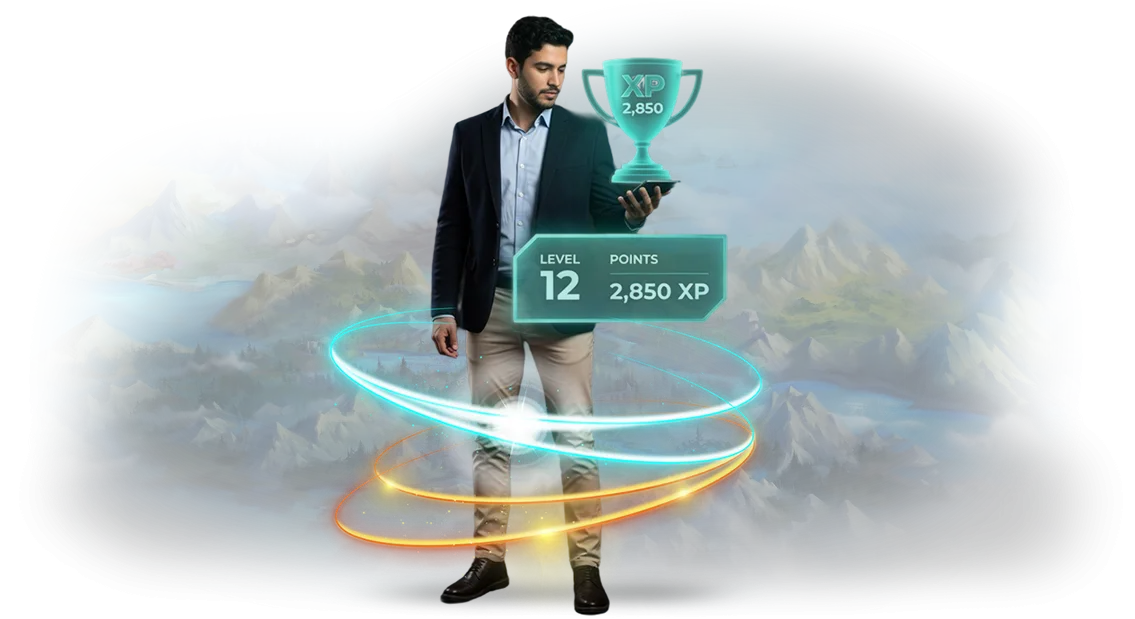
Gamified Applications: How to Retain Employees and Customers
Employees lose interest in routine tasks when they can't see how their actions connect to company results. KPIs remain a formality, and team motivation rests solely on salary — leading to turnover and reduced productivity. The problem isn't people; it's that business processes provide no feedback and show no progress.
The situation is similar with customers: they need more than just products or services — they need engagement in the process. Without clear interaction mechanics, customers quickly switch to competitors, and retaining them demands ever-increasing advertising spend.
Meanwhile, internal business resources — loyalty, ambassadorship, repeat engagement — remain untapped.
Gamification of business processes turns routine into a system with clear goals, levels, and rewards. Employees see their contribution and compete in a healthy format, while customers get a scenario they want to go through again.
This approach boosts employee engagement and customer retention without one-off promotions or discounts. We've spent over 10 years designing and implementing gamified applications for business needs — from team motivation to growth in key metrics.
What Gamification Delivers: Higher Engagement and Measurable Results
Increased Engagement
Ordinary interfaces get boring fast — users leave without completing the desired action. Gamification adds levels, rewards, and visible progress: people engage on their own.
The result — more frequent logins, more completed scenarios, longer time in the system. These metrics directly affect conversion, which means more leads and sales.
Customer Loyalty
Points, statuses, and personalized challenges make brand interaction emotional. Customers return to reach the next level, not just because of price. Our team sees how this mechanic increases repeat engagement and reduces churn.
Loyal customers are more willing to try new products and bring friends — sustainable growth without extra ad spend.
Increased Productivity
When employees see the goal and their progress, they work more willingly. Game mechanics set clear tasks, intermediate achievements, and recognition — without rigid control.
Onboarding is faster, quality is higher, and turnover is lower. Motivation becomes intrinsic, so the team works consistently.
Measurable Results and Return on Investment
We configure metrics around your goals: conversion, repeat orders, plan fulfillment. You see the effect of each mechanic in numbers and understand what works and what needs refinement.
The investment pays off through growth in key indicators. We adjust scenarios after launch and provide clear reports — no magic, only measurable results.
Gamified Application Formats: From Portal to Telegram
The gamification format determines how easily your audience will engage with the mechanics and how quickly you'll see results. Some prefer desktop access, others smartphones, and still others live in messengers.
We select the right format for your business task so the game drives specific metrics rather than serving as mere entertainment.
All formats share one thing: clear mechanics, a low entry barrier, and the ability to track performance in real time. Below are typical scenarios our clients choose most often.
| Format | Who It's For | What It Gives the Client |
|---|---|---|
| Gamification web portal | Broad audiences, partners, distributors | Higher engagement and repeat visits without app installation, easy access from any device |
| Mobile app | Regular customers, loyalty programs | One-click mechanics, personalized push notifications, higher purchase frequency |
| Telegram Mini Apps | Active messenger audiences | Fast launch without downloads, viral reach through forwarding, low entry barrier for participants |
| Corporate portal | Employees, internal teams | Better productivity, game-based training, reduced turnover, and higher engagement |
| Gamification for retail | Retail chains, online stores | Higher average order value, repeat purchases, collection of customer preference data |
We'll help you choose the right format or combine several to cover your business needs. Every option integrates with current processes and requires no special skills from customers or employees.
How We Develop Gamification: 6 Steps from Brief to Launch
The development process matters as much as the outcome, because it's during this stage that we lay the foundation for how employees and customers will perceive the mechanics.
We've built a transparent six-step process: you always know which development stage you're at and what comes next. No "black boxes" — just clear approvals, timelines, and checkpoints.
-
Gamification brief and immersion into the business task. Within two to three business days, we interview your team, study the audience, and gather requirements — from goals to constraints.
You receive a document with the agreed outcome so all stakeholders understand the task the same way.
-
Concept and game mechanics. We propose a scenario: which actions are rewarded, how progress works, and which motivational elements suit your audience. You see how the application will fit into the process and can adjust direction at this stage.
-
Project approval. We lock in timelines, scope of deliverables, and acceptance criteria. The estimate and plan contain no hidden items — after your confirmation, we move to implementation without surprises.
-
Development and testing. We build the interface, configure the logic, and test against real scenarios from your company. We show intermediate versions along the way, so by final launch you already understand how everything works.
-
Application launch. We support the rollout: onboarding users, configuring access, and helping with communication within the team or customer base. The process runs without downtime or unnecessary instructions for participants.
-
Post-launch support. We analyze activity, gather feedback, and adjust mechanics as needed. You can count on us not just in the first weeks but beyond — we adapt the game to evolving needs on request.
Thanks to this workflow, you get a predictable timeline, a manageable budget, and a product that actually works. Each stage ends with a concrete deliverable: from brief and plan to the launched application and a report on initial user activity.
What's Included in the Package: Everything for Launch and Support
The package includes everything needed to launch and run a gamified application on a daily basis — from the first prototype to team training and ongoing analytics.
You get more than just a software product; you get a working tool that delivers measurable results for your business.
- Interface prototype — a visual sample of the future application, approved before development begins. You see the process in advance and make changes without unnecessary costs.
- Ready-made system for employees — an interface with clear scenarios: tasks, levels, rewards, feedback. No complex training required — everything is intuitive.
- Adaptation to your processes — we tailor the application logic to specific business goals: sales, training, KPI achievement, customer service.
- Instructions and staff training — we run short sessions for administrators and users so the team gets up to speed quickly. Materials stay with you.
- Administration and support — you get access to manage content and game rules, plus technical support throughout the entire lifecycle.
- Engagement analytics — a dashboard with metrics: employee activity, progress, achievement levels, and areas where participation drops off. Easy data-driven motivation adjustments.
- Updates and evolution — based on analytics, we propose mechanic improvements and fix issues to keep the application effective.
- Security and reliability — the system runs on a proven server architecture, data is protected, and application access works reliably.
Case Study: How Gamification Boosted Activity at a Clinic Network by 2.3x
The MedLife clinic network approached us with a request familiar to many executives: doctors and administrators were losing interest in internal standards, and training plus medical-record compliance were seen as formalities.
Meanwhile, service quality depends directly on how quickly staff spot errors, help patients, and follow procedures.
Instead of another punitive system, we proposed a gamified application where employees competed in teams and earned points for real actions — accurate records, fast responses to inquiries, completing training modules.
No changes to the medical system were required: the application integrates into the workflow and runs on tablets in every department.
Within three months, staff activity rose 2.3x: completed training courses increased by 78%, and complaints about front-desk waiting times nearly halved. The atmosphere changed noticeably too — employees themselves asked for new competition categories between branches. Management linked the rise in patient satisfaction scores partly to this mechanic's launch.
Crucially, the system didn't become a "tick-box game." Over six months, we ran four seasonal campaigns, each supporting a specific business goal: reducing documentation errors, speeding up initial consultations, booking preventive check-ups.
As a result, the network ordered an expansion of gamification to new areas and keeps coming back for scenario refinements.
"We used to think gamification was just fun badges. It turned out to be a working tool that changes the numbers in reports and how staff relate to their tasks," commented the MedLife network's development director.
How to Choose a Gamification Format for Your Business?
The main challenge in choosing a format isn't technology — it's the tendency to build gamification "for everyone at once." Banks and retailers have different goals: the former need to build regular financial habits, the latter need to increase purchase frequency.
That's why a one-size-fits-all application doesn't work: you should start from the business task and audience behavior.
Gamification for banks typically revolves around personal financial goals — savings jars, saving quests, rewards for regular transactions. Gamification for retail focuses on repeat purchases: bonus levels, personalized tasks, and exclusive perks for regular customers.
Gamification for B2B shifts the emphasis to employees and partners — leaderboards, team missions, transparent recognition of achievements.
And gamification for distributed teams helps maintain connections between people in different cities: shared challenges and virtual rewards sustain team spirit and reduce turnover.
There's no universal "best" format — there's a format that matches your task. If the goal is to improve online conversion, short in-app game scenarios work well. If you need to motivate managers to hit targets, a gamified KPI tracker is more effective.
For distributed teams, gamification becomes a unifying thread: it provides a common language and a reason to stay connected even without in-person meetings.
We help you choose a format based on a short audit: we examine the business model, customer or employee behavior, and determine which mechanics will deliver quick results and which will drive stable, long-term engagement.
This way you avoid spending budget on "trendy" features and instead get measurable metric growth right away — whether it's repeat orders in retail, active users in banking, or engagement in B2B.
Frequently Asked Questions About Implementing Gamification in Companies
We've gathered answers to the questions most often asked before a project starts. Below — about budget, timelines, compatibility with existing systems, and staff reactions. If your question isn't listed, write to us — we'll respond within one business day.
How much does it cost to develop a gamified application?
The cost depends on the project's scope: the number of roles, scenarios, and depth of integration with your systems. At the brief stage, we prepare a transparent estimate where every stage is itemized separately.
You get a fixed cost in the contract — no hidden fees or "add-ons along the way." For a pilot launch, we select a minimal set of mechanics that already delivers results.
How long does implementation take?
A typical project takes from three weeks to three months. The timeline depends on logic complexity, number of participants, and whether corporate systems need to be connected.
We break the work into stages with clear deadlines and show results after the first sprint. You see intermediate versions, not a "black box" at the end.
Will gamification work with our CRM and internal services?
Yes, in most cases. We use standard data exchange protocols, so the application connects easily to your CRM, corporate portal, or messenger.
You don't need to change current systems or "migrate" to new ones. We configure synchronization so data on employees and achievements automatically flows into the right reports.
How is employee data confidentiality ensured?
We sign a non-disclosure agreement (NDA) and work exclusively within your security perimeter. Data on employee actions never leaves your infrastructure without separate agreement.
You control which metrics are visible to participants and which remain visible only to management. No information is shared with third parties — this is contractually guaranteed.
How will employees react to gamification? Won't it feel forced?
Gamification works through voluntary participation and intrinsic motivation, not coercion. People receive recognition, visible progress, and clear rewards for real results.
To ease concerns, we launch a pilot with one team or department. The results show how activity changes, and only then do we scale the solution across the company.
We understand that doubts always exist before implementation. That's why we offer a short call: we'll discuss your task, give you a sense of timeline and budget, and suggest the best place to start.Launch Gamification and Get First Results Within a Month
Gamification stops being a "someday toy" when you have a clear launch plan and a partner who handles the implementation.
We've deliberately designed the process so you see initial results within a month of starting — without lengthy approvals or diving into technical details.
It all begins with a consultation: you tell us about your task, we suggest a suitable format and estimate timelines. Then we launch a pilot project — a small but functional gamification segment that shows real numbers: engagement, activity, repeat actions.
What you get by working with us:
- Fast start: first meeting and work plan — within days of your inquiry.
- A pilot project instead of a "six-month project": we test mechanics on one process and see the effect before scaling.
- Clear gamification launch timelines: first results in a month, not after endless refinements.
- Domain expertise: we've already delivered projects for events, training, and loyalty — we bring proven solutions.
- Post-launch support: we adjust mechanics based on data so results grow rather than fade.
- Fixed pricing and transparent scope of work: no hidden costs during development.
Submit your development request right now — we'll call you back within one business day, answer your questions, and prepare a proposal. We'll start with a consultation and together identify where gamification can deliver quick, measurable results in your business.