

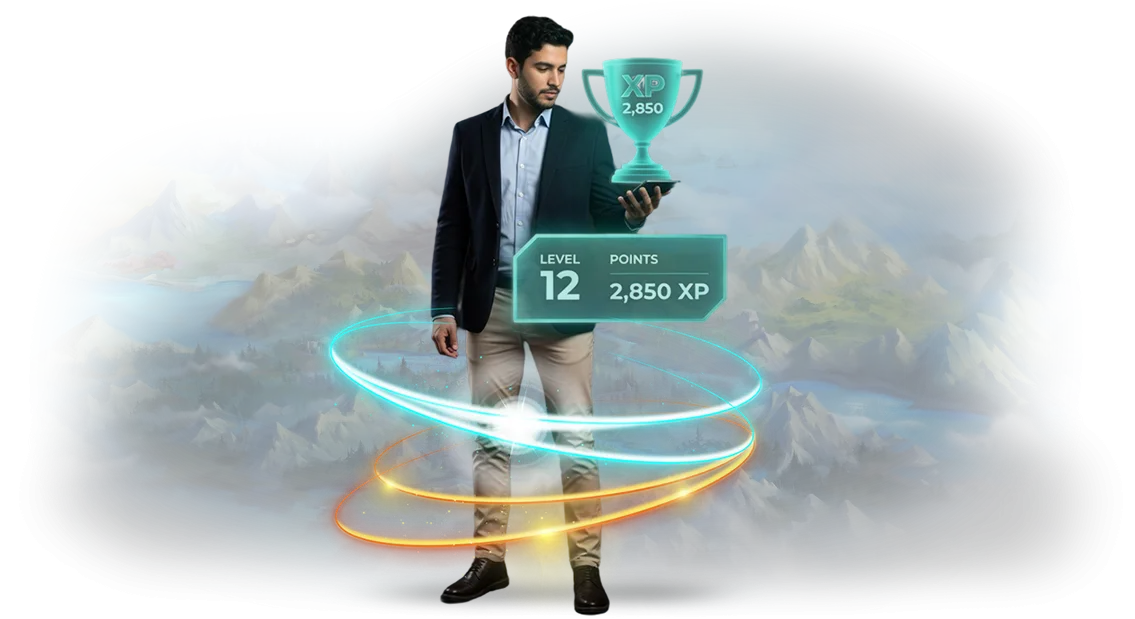
Gamification for Marketing and Advertising Agencies: Where to Start
Classic promotion methods—targeted advertising, email campaigns, banners—work worse every year. Audience attention is overloaded, banner blindness is growing, and standard mechanics no longer generate the same response.
Marketing and advertising agencies face the challenge of client retention: campaigns are launched, but engagement drops, and measuring real results becomes increasingly difficult.
Gamification of business processes is an approach that turns audience interaction into an engaging scenario. This is not a game for the sake of a game, but a well-thought-out marketing mechanic based on natural human desires: competition, achievement, status, curiosity.
With it, an agency does not just attract attention—it holds it. Clients and users return again and more readily complete targeted actions.
Even at the stage of a portal or interactive page, you can launch a points and rewards system, quests, or competitions among participants. Such audience engagement delivers measurable results: increased activity, repeat visits, willingness to share content and invite friends.
For an agency, this is a way to show the client concrete numbers, increase the share of repeat orders, and stand out from competitors.
Wehave been developing such solutions for more than 10 years. We help you start small: we analyze your audience, select suitable mechanics, and launch them quickly. We handle the full cycle—from idea to implementation and support.
As a result, you get a working tool that strengthens campaigns and turns one-off promotions into a system of long-term retention.
What Business Results Gamification Delivers
For marketing and advertising agencies, gamification is no longer just entertainment—it is a tool that directly affects key business metrics. Game mechanics engage participants and turn everyday actions into an engaging process that can be measured in sales and loyalty figures.
The first measurable result is increased conversion. When a portal visitor receives points, statuses, and rewards for every action, they are more willing to travel the path from registration to the target step.
Agencies report an increase in applications and completed forms of 20–40% within the first months of the system running.
The second result is repeat visits and loyalty. Gamification creates a habit of coming back: the user sees their progress, wants to complete a series of tasks, and overtake colleagues in the ranking.
This kind of engagement works better than reminders and push notifications, and clients stay with the brand longer.
The third result is an increase in average order value. Bonuses for additional services, accumulation levels, and special tasks motivate larger purchase amounts.
Marketing and advertising agencies achieve revenue growth without expanding their advertising budget, by leveraging an already engaged audience.
Finally, gamification strengthens brand awareness. Participants share achievements on social media, invite friends, and create natural buzz.
The result is stable loyalty: clients return on their own and bring new ones—this lowers the cost of acquisition and makes sales forecasts more accurate.
Gamified Solution Formats for Your Task
Choosing a gamification format is not a matter of fashion, but a matter of what result you want to achieve. Marketing and advertising agencies work with different audiences: clients, employees, partners.
Each needs its own mechanics: accumulation programs hold attention, competitive ones fuel excitement, and game processes inside sales increase conversion. We help you choose a format for your task so that it works for your business, not just a 'game for the sake of a game'.
Here are the main formats that we adapt to your processes and brand.
| Format | For whom | What it gives the client |
|---|---|---|
| Accumulation program | Regular clients, loyal audience | Growth of repeat requests, predictable purchase cycle |
| Competitive mechanics | Active users, sales departments | Surge of engagement, healthy competition, viral effect |
| Sales gamification | Managers, distributors | Transparent motivation, higher plan fulfillment |
| Quests and levels | New audience, leads | Quick introduction to the product, progress accumulation |
This is not a rigid classification, but a starting point. Often the best result comes from a combination: first an accumulation base, then a competitive tournament among leaders. This is how we build a long interaction history—from the first touch to retaining a regular client.
That is why we start with a short analysis of your situation. We look at who your audience is, which process needs to be strengthened, and what resources are available.
As a result, you get a clear scheme: which format is launched first, what is included in the second stage, and how this will affect key metrics. You receive a solution that can be implemented gradually, without interrupting your core work.
How We Work on a Project: 5 Steps
For marketing and advertising agencies, gamification is a way to hold clients' attention, increase engagement, and collect data for new campaigns. For the mechanics to work, a structured process is needed: from brief to launch and development. We have organized exactly such a process—transparent and manageable.
- Brief and audit. We analyze your goals, audience, and current channels. We choose the game mechanic: points, levels, quest, or competition—to fit your tasks.
- Concept and prototype. We create the portal scenario and its visual style. You see the future product before development starts and adjust details in advance.
- Development and integration. We build the portal on a professional platform and connect it to CRM and email campaigns. We test all mechanics under load to avoid failures during launch.
- Launch and support. We roll out the solution, train your team, and help announce the portal to clients and partners. We accompany you during the first weeks of operation.
- Analytics and development. We monitor engagement and conversion and give recommendations for improvement. We refine the mechanics to match changes in your campaigns.
A transparent process means you know where the project stands and can influence the outcome. We are responsible for organization; you make key decisions. This is how gamification becomes a working tool, not just entertainment.
What Is Included in a Turnkey Gamification Delivery
Turnkey gamification is a ready-made solution that can be introduced into an agency's operations without additional subcontractors or lengthy approvals.
We handle the entire cycle: from idea to training your team, so you get a working tool for increasing engagement among employees and clients.
What is included in the delivery package:
- Gamification scenario for your business processes. Thought-out mechanics that motivate employees to meet KPIs, and clear rules for participants.
- Mechanics design. Visual design of the portal, game elements, rewards, and levels—all in your brand style so employees immediately feel a familiar atmosphere.
- Portal setup. Deployment on your server or in the cloud, integration with internal accounting systems, and access rights configuration.
- Administrator guides. Step-by-step instructions for managing the portal, adding users, and changing tasks and rewards.
- Staff training. Webinars or on-site training for your team so managers and supervisors confidently work with the new system from day one.
- Technical support during launch. Assistance in the first weeks of operation, when the team is getting accustomed and questions arise.
Thanks to this package, you get not just a 'box' with software, but a full-fledged tool that immediately brings results. Your employees master new processes faster, and you save time and resources that would otherwise be spent searching for solutions and training on your own.
Case Study: How Gamification Tripled Repeat Orders
Task
A marketing agency consistently attracted clients with one-off promotions, but fewer than a third returned. Advertisers saw no value in the partnership: after the final report, communication stopped, and within a month the client went to a competitor with a better offer.
Solution and result
We designed a private web portal for the agency, where each client received a 'map of shared achievements': launched campaigns, actual reach, and growth in inquiries. Showing this to clients was a pleasure for managers.
In addition, for each completed campaign, the agency awarded points that unlocked access to exclusive media formats and priority placement.
The effect was stronger than forecasts. Within six months, the share of repeat orders grew from 30% to 90%, and the sales cycle shortened by two weeks—clients returned on their own to avoid losing their accumulated status.
The core principle of gamification worked: the client was no longer an 'outside observer' but became a participant in shared growth.
This approach works well for both agencies and their clients—that is why we use it in our projects. our team builds such portals turnkey: from prototype to launch and team training.
How to Choose the Right Gamification Format?
Choosing a gamification format starts not with a trendy mechanic, but with a business task. For an agency, this is usually one of three things: generate new leads, activate the existing base, or increase loyalty over the long term.
If the goal is a quick surge in social media reach, giveaways and contests with a 'refer a friend' mechanic work well. If you need to keep clients for several weeks, accumulation points and levels work better. The same format can be successful or useless depending on what exactly you measure.
The second criterion is your audience and its habits. B2B clients value benefit and time savings, so they prefer simple scenarios with instant results: a quiz with a personal discount or a benefit calculator.
Mass audiences are more willing to participate in emotional stories and challenges. Consider where your audience lives: in social media feeds, on the website, or in email campaigns.
This affects not only the mechanics, but also the format—from an interactive banner to a full-fledged portal with a personal account.
The third criterion is resources and deadlines. If the campaign is needed by a specific date, choose proven template mechanics that can be quickly adapted to the brand. If there is time for thorough development, you can create a multi-level program with a non-standard storyline.
We always honestly assess what can realistically be launched within your deadlines and propose gradual complication: first a simple version, then we add elements as engagement grows. This reduces risks and allows us to adjust mechanics based on data.
Finally, the most important thing is a predictable result. The right mechanic always answers the question: 'What will the participant get and what will the agency get?' If the motivation is clear and the reward matches the action, gamification works.
If not, even the most beautiful idea will go unnoticed. Therefore, we start with a brief and, together with you, set the target metrics—registrations, repeat orders, or the share of completed actions. Then we select and adapt the format to those metrics.
You can formulate the ideal option in one short meeting. Tell us what task you are solving, and we will offer 2–3 formats with a forecast for engagement and launch timelines. You will receive not an abstract concept, but a concrete mechanics plan for your campaign and audience.
Frequently Asked Questions About Gamification of Business Processes
Agencies often postpone gamification due to doubts: will clients understand it, will it break in the middle of a campaign, will it eat the budget. This is normal—behind every question is a risk that can be eliminated at the start. We address pre-sale objections so that the decision is made on numbers, not guesswork.
Will gamification suit our clients and audience?
Yes, if the mechanics are tied to the brand's goals. We tailor the scenario to the advertising agency's niche: from short promo campaigns for leads to long-term loyalty programs.
Over 10+ years, we have done projects for different markets—we found formats that strengthen campaigns.
How safe and stable is it in operation?
The portal runs on professional equipment and server architecture—it withstands peak loads. We run tests before launch, and after launch we provide support and quickly resolve failures. Participant data is protected, and only you have access.
How much does development cost and when will we see results?
The cost depends on the scale and integrations. After the brief, we give the exact price and timeline—usually from two weeks to several months. We calculate payback through metrics important to the agency: reach, leads, repeat inquiries, conversion. Gamification becomes a revenue item, not an expense.
Still have questions? Let's discuss your scenario during a consultation—we'll show examples and calculate the preliminary effect for your campaign.Let's Discuss Gamification for Your Business Tasks
We understand how difficult it is to hold clients' attention in a stream of similar offers. For marketing and advertising agencies, gamification is a way to stand out, increase loyalty, and boost campaign response.
Instead of boring surveys and static promotions, you get an interactive portal that engages the user and turns one-time participation into a lasting habit.
Wehave been developing game mechanics for business for more than ten years.
We approach the task not as technical contractors, but as partners who first understand your goals: sales growth, database collection, increased social media activity, or employee training. The result is a clear tool that solves exactly your task, not just a 'game for the sake of a game'.
We work on professional equipment and modern servers—this guarantees stable portal operation even under peak loads, for example, during an advertising campaign. You won't have to think about the technical side: we handle development, testing, and launch. You get a ready-made product with clear analytics and the ability to refine it for new tasks.
Leave a request, and in response you will receive:
- a consultation: we will analyze your task and advise which game mechanics will work specifically in your case;
- a commercial proposal with transparent timelines and scope of work—no hidden payments or unexpected extra charges;
- a preliminary budget estimate: you know in advance how much the project will cost and when it will pay off;
- a prototype of the key scenario before full development starts—you see what the mechanics will look like before the final version;
- technical support after launch: we are available, respond quickly to questions, and help with portal development.
No 'call us later' and no lengthy approvals. Send a request through the form on the website—within one working day, we will prepare a commercial proposal and answer your questions.
We'll start with a consultation, during which you will understand how gamification fits into your processes and what results it will bring in the first season.